Sociology
In Conversation with Maghsoud Farasatkhah: The Function of Elites Standing at the Boundary of State and Society
In Border Agents, Maghsoud Farasatkhah argues that, due to the instability of structures in Iran, the intelligence and initiative of actors play a compensatory role; an analysis of the function of elites standing at the boundary between state and society from the Qajar era to the early Pahlavi period.
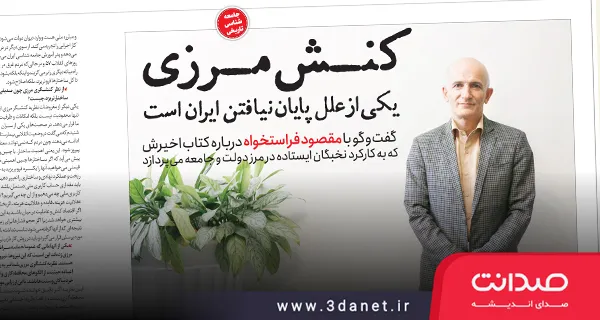
With this insistence on turning society upside down once again; has a cost-benefit analysis been done for the nation?
Dr. Farzad Nemati's Conversation with Maghsoud Farasatkhah
On the Newly Published Book, Boundary Actors
Ham-Mihan, Issue 182, February 25, 2023, Culture Page
A conversation with Maghsoud Farasatkhah about his recent book, which addresses the function of elites standing at the boundary of state and society.
Farzad Nemati (Culture Desk Reporter): Maghsoud Farasatkhah is one of the most prominent and creative researchers in the humanities, and the publication of any work or the raising of a discussion by him creates a wave of reflections in the field of knowledge in Iran. He, who for decades has patiently and with rare precision been striving to describe and analyze Iranian society, now, 15 years after first proposing the subject of the "Boundary Actor" in 2007, has presented the first volume of this work to readers, dedicated to the period from the Qajar era to the beginning of the Pahlavi period (from Abd al-Latif Shushtari to Mohammad Ali Foroughi). On the occasion of the publication of this valuable work, we sat down for a conversation with him on a snowy day about the main themes of this book and other questions in this field.
What does the idea of boundary actors signify, and when we speak of the boundary, what is meant by the boundary, and how do these actors behave in relation to these boundaries?
"Boundary activism" has been developed inductively based on detailed evidence of the various agencies of social agents throughout Iranian history, especially the recent 200 years of contemporary history. In sociology, the dualism of structure and agency is widely known, and there has been much debate in this dispute over the primacy of each. Figures like Anthony Giddens and Pierre Bourdieu have combined the two. However, depending on each society, if this combination is to be used, more concrete points must be considered. For example, in societies that lack developed and established structures, whose transition has not been successfully completed, where institutional differentiation and specialization have not yet fully run their course, and which, in short, can be considered unsuccessful in development, I have come to the conclusion that the intelligence and initiatives of agents are more decisive. The first time I explained the concept of the boundary actor in the public sphere of the scientific community was at a session held in 2007 about Dr. Gholam Hossein Sedighi, the father of Iranian sociology, at Allameh Tabataba'i University, and the title I used there was: "Gholam Hossein Sedighi, a Boundary Person." This conceptualization was, of course, based on certain assumptions. One assumption was that the general theory of integrating structure and agency is insufficient for a more precise explanation of the Iranian problem.
What change must be made to that theory so that it can be applied to Iranian society?
In Iran, developed, established, invulnerable, and durable institutional structures are few, and a kind of instability, volatility, discontinuity, and starting anew has been abundantly repeated in our history. Of course, in the book I have explained in detail that an institutional framework in Iran endures in a dotted-line fashion, and I ask researchers to read the book carefully for the full story, but we still witness that in this society, social, civic, and local structures, as well as democratic and development-oriented structures at the economic, social, political, and cultural levels, have rarely existed in a self-governing and autonomous manner. Accordingly, one of my assumptions is that due to the weakness of structures in Iran, individual and group agency is of fundamental importance. There is systematic intelligence in structures. Structure is full of intelligence and regulates behaviors. When intelligence is not institutionalized within structures, we arrive at the importance of wise, intelligent people and the individual intelligences of persons. What initiatives they had and how powerful their initiatives were. In a society where structures are developed, we may not need energetic, intelligent people so much because the structure does its work and ordinary people suffice, but the history of societies like ours is determined by the agency of humans with high emotional abilities and high epistemic abilities. Of course, one must not slide into voluntarism in this regard. No, structures are important, but the situational initiatives of agents also become decisive. The limitation, blockage, and rigidity of structures, the suppression of activists, the lack of freedom, and the existence of dominant powers cause Iranian agents to resort to their situational intelligence, creative initiatives, and pragmatism, and to initiate diverse forms of social action, civic action, cultural action, and action oriented toward change. Alongside this, in Iranian society, civilizational memory is of great importance because, apart from “tell me your memories and I will tell you who you are,” in analyzing the ancient Iranian nation, civilizational memories are a reality that, without wanting to give it an exaggerated dimension, is of great significance.
What are some of the advantages of this ancientness?
We had figures like Razi, Khayyam, Ibn al-Haytham, and Biruni. This civilizational capacity and cultural memory became a source of vibrant imagination, excitement, and imagery across generations, and caused Iranian society not to lose its breath, so that life continued to flow beneath its skin. This society wants to endure and live. There is evidence for each of these, and this evidence is derived from the field research described in the book. Based on objective evidence, I say that life flows in Iranian society, and alongside cultural and civilizational capabilities, and despite structural limitations, social agents strive, using those civilizational capacities and their own intelligence, and utilizing modern possibilities such as communications, globalization, the rise in education, the increase in the power of initiative, and the expansion of ICT processes, to cast a new design. Iran is in a special position in terms of global communications and is the crossroads of the world, and these factors, along with that memory, plus cultural capabilities, initiatives, and the agency of individuals, cause diversity in agencies to form in order to compensate for that structural backwardness. I therefore call the points of the theory of boundary actors a theory of compensation, and it is because of these matters that Iran, despite a turbulent history, despotism, and various invasions, etc., instead of not being, is. This society has probably had capabilities that have enabled it to preserve itself in the most difficult conditions, even when its culture was under the domination of invaders. In the face of the domination of the Caliphate, Iranian emirates and states such as the Samanids emerge, and from within this process, someone like Ferdowsi appears who, with “much suffering in these thirty years,” preserved the Persian language and Iranian identity. Many nations that were defeated by the Arabs had their language become Arabic, but Iranians preserved their language. Ferdowsi preserved the locus of language for the life of Iranian society through boundary activism.
This civilizational memory and recollection you speak of as a factor in Iran's resilience—why did it not transform into structure and tradition?
That is precisely the point. These memories have not transformed into durable structures. There are multiple reasons; for example, insecurity and rupture. I have elaborated on this discussion in other books and articles: that we have had more scholars than enduring institutions of knowledge. In the book The Occasional University in Iran, it is stated that we had scholars and scientific stars recognized throughout the world. Yet we were not quite able to create schools and academies in their enduring sense. The Nizamiyya, the Rab'-e Rashidi, and the rest harbored various institutional weaknesses within themselves and were dominated by dogmatic religion. Returning to boundary activism, this theory posits that the Iranian person's forms of imagination are vast. The vastness of Iranian imaginative forms and the power of Iranian social imagination has meant that when unable to proceed via one path, they have chosen other paths.
What are those other paths?
One of those other paths is an intermediate, grey situation. In developed societies, civil society was formed through immense hardship and, as Habermas has explained, through multifaceted activities in salons and assemblies. In Iran, however, this faced extensive limitations, was suppressed, and emerged weak. In this situation, the power of Iranian creativity and imagination has led to the invention of other forms of action and the discovery of other zones and modes of operation. Thus, different breeds of human agents have formed, whom I have named boundary activists, and their central issue is that they belong to Another assumption of the boundary-actor theory is that structure is not merely a constraint but also provides us with possibilities and capacities. In the remarks of one of the current opposition leaders, I heard him say that in a revolutionary situation, hospitals continue to function because people cannot wait around for the revolution to triumph. This signifies the importance of structure. Given such a situation, the question arises: if structures are so important, why do you want to completely dismantle them at any cost, instead of changing and improving the institutional and structural makeup, form, and function? We must have some regard for the national ledger and see what we contribute to it and what we take from it. A kind of cost-benefit rationality and cost-effectiveness rationality must be at play here. If the economy of action and agency is involved, greater attention will be paid to these rationalities, because if the volume of pressures to overturn society is not proportionate to the results obtained from them, those activities will be called into question, and the method of work must be reviewed. One of the accusations generally leveled by epic-chanters against boundary actors is that these forces are conservative forces. In a sense, your theory of boundary activism could also be a rehabilitation of conservative models and the necessity of using ancestral wisdom and traditions. Do you agree with this assessment? If this theory is read carefully, it is certainly not a conservative political theory; on the contrary, it is a social theory of change and provides causal explanations for changes in the complex and specific Iranian situations. However, with the reasonable interpretation of conservatism that you mentioned, yes, I agree that important points can be seen in authentic conservatism as a model of political action. One cannot evade change, because without change, corruption occurs, and change is a requisite for growth and progress. Not changing means human captivity in systems, the absence of innovation, and the trampling of human rights. Transformation, however, must be rational, calculated in terms of profit and loss, and comprehensive. Here, conservatism in its profound sense shows its importance. Some imagine that conservatism means prioritizing personal and group interests or preserving the status quo. But there is also an elevated reading of conservatism, which means proposing more reasonable ways for the productive management of change. Boundary activism is not equivalent to conservatism, but it shares some similarities with it. Elevated and reasonable national conservatism does not pursue individual and class interests but rather the realization of national interests, the work and lives of the people, and it has the courage to remain aloof from populist excitements and bandwagoning, harboring concerns for the general state of society so that it does not descend from a bad situation into a worse one. Part of the importance of conservative thought also lies in telling us that not everything can be done at any time, even at any cost. The boundary actor does not possess the staff of Moses, the shining hand, or a magic box to miraculously solve all problems through shortcuts. Moreover, alongside the capacities they have, the boundary actor themselves also has limitations, which I have detailed in the book with historical evidence. For example, one of these limitations is adhesion to power. The boundary actor operates between the court and the divan, and for this reason, a vulgar middle-game sometimes takes shape, and the boundary actor, due to the temptation of the benefits within the apparatus, develops an adhesion to power. In Iran, power is a scarce commodity, and for this reason, a kind of adhesion to power emerges in those who gain access to this scarce commodity, and they forget their role and purpose, lose their boundary-acting property, and turn into defenders and justifiers of the status quo. Therefore, I do not necessarily consider boundary actors as promised saviors and those who introduce the final path to salvation to us, and I believe their success is also entirely conditional. I have pointed to this in the discussion of bio-power. So you are not prescribing the boundary actor? I am a teacher, student, and researcher, and I have analyzed and explained the boundary actor using scientific language. I have stated what causes and factors in Iranian history have led to the emergence of strategies for boundary social action. Boundary action is a form of political, social, and technical action that takes shape in Iranian history due to the factors that exist for it. The more these factors and contexts increase, the more boundary action increases. If these factors and contexts disappear, boundary action is also negated. I have described these with scientific precision, of course to the extent of my modest means, and this is what theory is. An important part of this theory is that, in addition to causal and contextual variables, intervening variables have also been examined. These variables are intensifying and moderating. For example, the intellectual capabilities of the agents and their intelligence lead to better and more effective initiatives. In this way, one can weigh and compare the methods of Mirza Hossein Moshir al-Dowleh Sepahsalar and Mirza Yusef Mostashar al-Dowleh, and measure their degree of effectiveness. Overall, the set of causes, contexts, and those intervening variables I mentioned create behavioral strategies that are based on tactics. Finally, the results of the action are explained. Thus, you see that, based on inductive and empirical evidence, the process of the boundary agents' action has been described and explained, and this is precisely the theory. Your view of certain individuals is also more empathetic, isn't it? Yes, there are many examples. Consider, for instance, Lady Astarabadi, who emerges on the margins of the harem. For the first time in Iranian history, she writes "The Vices of Men" and becomes one of the pioneers of Iranian feminism and the critique of patriarchy. Yahya Dowlatabadi launches a school-building movement from within the system. Sediqeh Dowlatabadi is a boundary activist and launches the "Zaban-e Zan" (Woman's Tongue) journal. Mirza Hassan Roshdieh, in his movement between the porch of society and the divan of the state, and with the initiatives he employs, and considering the intervening variable of his emotional intelligence and resilience, builds schools time and again. The schools are closed and destroyed, and he continues his work again. A number of individuals gather and form the "Anjoman-e Ma'aref" (Society of Knowledge). The Anjoman-e Ma'aref possesses a boundary nature and function. It is important to know how the first community of graduates from Tehran's teacher training colleges came into being in a civic manner, whose announcement was published in the "Sokhan" magazine. It is important to know who these people were and why and how they emerged. None of them were heroes, martyrs, or epic figures, but they created capacities for society and advanced change in Iran. One of my goals in this book is also to provide a thick description of these individuals. One of the important points mentioned in the book's introduction is the discussion of the "history of compensation." In this discussion, you have cast doubt on some well-known views, such as the short-term nature of Iranian society, and pointed out that this concept of the history of compensation must be considered within the "paradigm of possibility," which stands in opposition to the "paradigm of lack". When we speak of despotism and blockage, we are often caught in the paradigm of backwardness and the rentier, patrimonial state with its oil economy. In Fardidian literature, it is also assumed that the beginning of our history is subordinate to Western history. From these, one might conclude that despotism is Iran's fabrication or that Iran has reached its end. This is a reductionist view. The theory of the short-term society by Dr. Katouzian has good capacities, but its social and popular interpretation in Iran sometimes yields the conclusion that Iran is finished, that Iran is a concluded, failed project, a repetition and continuation of decline. The popular interpretation of grand theories is very important, and I have this fear regarding the theory of boundary actors as well, that a kind of misunderstanding and social misinterpretation might be derived from it, diminishing the depth of the theory and its theoretical complexities. Returning to your point, yes, the history of lack, the accursed history, is based on learned Iranian helplessness, from which ultimately despair, deprivation, and taking refuge in external savior powers and the dominant world system, or messianism, or seductive ideologies emerge. But when we free ourselves from that history of lack and turn to the history of possibility, we realize that society possesses capacities for life within itself. Why should we not pay attention to these capacities for life? Why should we only look pathologically and see only society's illnesses? Why not ask how this society strives to live and has mechanisms for living? The important thing is to explain scientifically what these mechanisms are. For example, Ms. Vanessa Martin has done scientific work on Iranian society and said that in the Qajar era, there was a kind of bargaining. I have brought the details in the book. This view of history is particularistic, meaning the history of possibility moves beyond the generalities of the history of lack. According to the history of lack, Iran comes to an end, but with the history of compensation, one can explain the continuity of life in Iran. It seems the history of lack pays little attention to society, its internal dynamics, and the logic of its reproduction in diverse social spheres, and from this perspective, it mostly focuses on the history of the rise and fall of dynasties and grand events. From this viewpoint, isn't the history of possibility a revival of social history and history from below? Yes, the history of compensation and the history of the middle seek to overcome the weakness of social historiography in Iran. The history of possibility is a social history, a history of the middle, and a descriptive, detail-oriented history. In this history, thick description and minute details are of great importance because events have occurred in our history that have preserved society, and through them, society has endured. Allow me to give an example from the realm of science. Abu Rayhan Biruni has a work called "Kitab fi Tahqiq ma li'l-Hind" (The Book of Research on India). On a 10-year journey to India, the cost of which was paid by the Ghaznavid government, Biruni wrote a research-based, field study about the culture and society of that land, which is a kind of prehistory of anthropology. He collaborated with the government, but the result of his scientific activity elevated the intellectual life of Iran. He is not an epic or political hero, but he is a guardian of a part of our civilizational capacities. Politicized negative views, however, largely hide this important function from sight and emphasize the collaboration with the government, even sometimes in the encounter with Ferdowsi's Shahnameh. That is exactly the case. Even a great figure like Ahmad Shamlou has been exposed to such situations. In this book, I have identified and categorized various types of these actors. For example, E'tizad al-Saltaneh assisted with the “Nameh-ye Daneshvaran” (Book of Scholars), or it was through the opportunities provided by him and E'temad al-Saltaneh that figures like Mohammad-Hossein Foroughi established the Dar al-Ta'lif (House of Compilation). We recognize the reign of Naser al-Din Shah as the fifty-year period of “enlightened despotism.” In this era, despotism exists, but a large part of the foundations of constitutionalism were also formed during this pre-constitutional period. Some of these boundary actors are even more in pursuit of their own interests, but the importance of the discussion is that, even if it was for pursuing those very interests, they perhaps inadvertently created opportunities for society and generated added values. Therefore, one must not be absolutist in analyzing them and interpret all their efforts within the framework of self-sacrifice for society. This statement of yours indicates the importance of the discussion of “unintended consequences” and what Bernard Mandeville points to in “The Fable of the Bees,” saying that private vices yield public benefits. Yes, that is exactly right. Collective virtues sometimes arise from individual vices. At times, people pursue their personal interests, but through this, benefits emerge for society. From this perspective, another presupposition behind boundary activism is realism, which pays attention not to divs and fairies but to ordinary people of flesh, skin, and bone who are also pursuing their personal interests, and whose ambitions are also effective in their actions. We need this kind of understanding of the logic of individual and collective action, and a detailed description and careful investigation into the middle layers and the grey stratum, in order to properly explain our society and to work for it instead of composing slogans. This itself also cultivates scientific humility in us, regarding what minute details have been neglected and how our mental laziness has caused us to round off society with general concepts. Boundary actors are neither angels of salvation who will one day come, nor demons who will depart; they are people who actualize a part of our historical continuity, sometimes even inadvertently. What is important for you is understanding the logic of their opportunity-creating action amidst possibilities and limitations, and what opportunity-destroying acts also occurred alongside these opportunity-creations. Yes. This perspective sheds light on our history and even on our present moment, and causes us to pursue social changes with higher national productivity and to adopt more efficient and effective strategies for change. Moreover, boundary activism does not mean the negation of other forms of action, and it should not be reduced to an ideological prescription. In an important part of the book, the limitations of this type of action are, in fact, described; for example, that boundary actors often created behavior rather than space. They would do something and achieve results, but it would end and not persist, and they less often created institutions and sustained capacity. Therefore, I have also enumerated the shortcomings of boundary activism and have simultaneously seen their strengths and weaknesses. The dominant Iranian historiography sometimes even looks at boundary actors in a black-and-white manner. For example, it considers Amir Kabir as a hero and Sepahsalar as a traitor. The question I have is, in the study you conducted, for instance, how did the early histories view the role of Iranian viziers within the Caliphate's apparatus? From what point did the discourse governing the narrative of boundary activism in Iran, based on the presuppositions of that history of absence, place these individuals into the duality of heroes and subservient figures? This idea has deep roots in Iran, and part of it can be explained by the dualism of the Iranian mind and the battle between Ahura Mazda and Ahriman. There has been a tendency in us to explain the world based on the battle between good and evil, and for this reason we constantly ask people where they stand in history. Today, too, you see populists asking, “Where do you stand in history?!” They use broad metaphors of truth and falsehood, and in the contemporary era, this is intensified by leftist and nationalist ideological understandings, overshadowing descriptive and analytical historiography with epic history. Tabari is one of our important historians; one of the characteristics of Tabari’s history is its detailed and relatively particularistic nature. How good it would be if we turned from a purely heroic narrative of history to microhistory, the history of details, and evidence-based history. The discussion of the decline of political thought and the decline of politics in Iranian history is of great importance and means that politics, in the sense of a field of free action by citizens and the logic governing it based on the common good arising from expediency, agreement, and coalition, has not been much recognized, and politics has mostly been described through the lens of myth, religion, philosophy, and science. From this perspective, the theory of boundary activism is a restoration of politics, and the logic governing it in explaining the interactions of the state, society, and individuals is political. Plato says: either rulers must become philosophers or philosophers must become rulers. This understanding of politics is idealistic. With Aristotle, however, the discussion of interests, costs and benefits, the comparison of different degrees, and empirical details is raised to some extent. Aristotelian politics is more empirical than Plato’s and is not dominated by transcendent ideals. In this context, Max Weber’s discussion of “Realpolitik” is very illuminating. In boundary activism, too, a kind of Realpolitik can be seen; an understanding of politics as it is on the ground of life. Look at Khalil Maleki. One of the members of the Group of 53 and a militant companion of the late Dr. Mosaddegh. Yet, at some point, he also comes to the conclusion that he should negotiate with the Shah. There is no need to immediately resort to a moral and transcendental judgment here. One can stand in real history and still pursue Maleki’s story with greater precision. In fact, the boundary activist is, as circumstances require, a pragmatist and moves beyond essentialist debates. We still have an essentialist view of historical figures and have failed to produce a rich, particularistic description; a description that sees all aspects of individuals and events. Boundary action explains the details of changes in the field of Iranian politics, society, culture, economy, and life more precisely, and in a sense, it can also be said to be a kind of theory of social hope. . . . .
Download the PDF file of this interview


Discussion1 comments
صرف جلوگیری از درگیریها و خونریزی ها در تقابل بین دو قطب متخاصم همیشه مفید نیست....همینطور ایجاد و وسوسه نظریات خنثی کننده و آرام کننده... نظریه بر حق را در مبارزه تنها گذاشتن ، از رشد و نمو آن در حیات آینده جامعه جلوگیری کردن است...زمانی خواهد رسید که جامعه در برابر کجی ها و ستم های خانه برانداز فلج است ... مانند جلوگیری از خونریزی موقت یا خون گرفتن از تن بیمار یا دچار فشار خون و ...است. اصلا بعضی بیماریها با خونریزی درمان میشوند...مسئله تشخیص بیماری و لزوم خون گیری است... افراد فاسد وقدرت طلب و زیاده خواه که خود را پشت نظریات خوش ظاهر و فرببنده و مقدس نما پنهان میکنند همان خون کثیفی هستند که باید از بدن جامعه بیمار بیرون کشید....هر چه دیرتر مخرب تر و خرابی های بیشتر... فَهَزَمُوهُمْ بِإِذْنِ اللَّهِ وَقَتَلَ دَاوُودُ جَالُوتَ وَآتَاهُ اللَّهُ الْمُلْكَ وَالْحِكْمَةَ وَعَلَّمَهُ مِمَّا يَشَاءُ وَلَوْلَا دَفْعُ اللَّهِ النَّاسَ بَعْضَهُمْ بِبَعْضٍ لَفَسَدَتِ الْأَرْضُ وَلَكِنَّ اللَّهَ ذُو فَضْلٍ عَلَى الْعَالَمِينَ ﴿۲۵۱﴾ بقره الَّذِينَ أُخْرِجُوا مِنْ دِيَارِهِمْ بِغَيْرِ حَقٍّ إِلَّا أَنْ يَقُولُوا رَبُّنَا اللَّهُ وَلَوْلَا دَفْعُ اللَّهِ النَّاسَ بَعْضَهُمْ بِبَعْضٍ لَهُدِّمَتْ صَوَامِعُ وَبِيَعٌ وَصَلَوَاتٌ وَمَسَاجِدُ يُذْكَرُ فِيهَا اسْمُ اللَّهِ كَثِيرًا وَلَيَنْصُرَنَّ اللَّهُ مَنْ يَنْصُرُهُ إِنَّ اللَّهَ لَقَوِيٌّ عَزِيزٌ ﴿۴۰﴾ حج quranmizan[.]com