Sociology
Why Elites Leave and Don't Return, Instead of Coming and Going
Iranian society does not nurture elites; it is hostile to them. As a result, elites either emigrate or retreat into isolation. Yet the blame should not be placed solely on structures, for the elite must also transform conditions through active adaptation and agency.

To make our discussion more comprehensible to the audience, let us begin with a common utopia—common among both the public and the elites—namely, a fascination grounded in a centuries-old belief that certain countries are producers of elites and are elite-oriented, while others have never been and are not cultivators of elites. For instance, one can mention the fascination of our elites with France and Germany, which stands in contrast to our enduring and historical disillusionment with Iran. What differences exist between countries that become cultivators of elites and those in which this characteristic is neither evident nor tangible?
Our society is not only not a cultivator of elites, but it is also hostile to elites. Of course, it is necessary to distinguish between elitism and elite cultivation. In our society, elite cultivation is absent, yet elitism prevails over it. The grounds for traditional elitism and elite rule have long existed in Iran, and in the contemporary era, we have fallen prey to populist elitism. We are among those nations that, unfortunately, still need heroes, and most of the time, it is these pseudo-heroes who ride the waves and stir up populism. But we have never been cultivators of elites.
There is an empirical historical reason for this claim: Al-Biruni was put in chains in our society, Khayyam sighed and lamented, Avicenna was excommunicated, Ibn al-Muqaffa' was killed, Rumi migrated, and so on. All of this shows that we have not been a society that cultivates elites, although forms of traditional or mass elitism have existed among us. Hafez, who was himself a serious elite, describes the state of our society with such regret: "The heavens place the reins of desire in the hands of the ignorant; you possess knowledge and virtue—that alone is your sin."
This is the tale of our condition from the past. Today, we are facing the third wave of "brain drain" and the migration of elites. Hostility toward elites is strong in our society. This is why they either migrate outward or inward. In another couplet from the same ghazal, Hafez says: "Do not journey further from the beloved's abode, O dervish; for spiritual wayfaring and the corner of the monastery suffice you." Our elites either migrate and journey through the horizons, or they retreat into seclusion and spiritual wayfaring.
Of course, in examining this issue, we must not fall into the fallacy of external attribution—meaning that we attribute everything to factors outside the elites themselves, see it solely within anti-elite structures, and hold society responsible for this matter. Rather, the responsibility of the elites themselves must also be placed within the horizon of our discussion. If one is an elite, it is expected that they engage with these anti-elite structures, swim against the current, devise a plan and bring about change...
Impose themselves...
Yes, impose themselves upon systems that have a tendency toward homogenization, mediocrity, and even baseness. One of the characteristics of elites is active adaptation to the environment, meaning that if the external environment is unfavorable, the elite can persevere and not be brought down. If they are brought down, it means there are weaknesses within the elite themselves that must be carefully considered.
Here, I would like to draw on Alain Touraine's book, The Return of the Actor. Touraine says that structural and contextual factors can limit the realm of individual and group choices, but they cannot eliminate all human thought and action. If there are structures, there are also human agencies. Social agents and actors can, by using even the limited possibilities they find within structures, improve and change them. It is expected that a person at the level of an intellectual elite would also be a powerful actor, capable of transforming conditions and the environment with abundant intellectual, spiritual, and practical energy.
Could you clarify this definition of the elite? Who is an elite?
The elite has been defined in psychology and education departments and associations, in the philosophy of mind, and in various other fields. I will offer my own understanding of the elite. An elite is someone who possesses abundant mental capacities, a particular endowment of various types of intelligence. Their ability to learn and gain experience is high; they are creative, possessing analytical power, intuition, or aesthetic perception. Other components of an elite include speed of transmission, meaning-making, cultural understanding, and critical thinking.
A major part of these components you mentioned are non-acquired, such as an abundant mind. I want to take this definition of yours as a basis, because it provided a complete and tangible definition of the elite. Does an elite inherently possess heroic or quasi-heroic traits, or do they acquire these quasi-heroic traits over time and through acquired aids such as academic education, reading, writing, and thinking in the sense of the "deep thought" that the Germans have named?
A combination of biological and genetic backgrounds, life history during the embryonic period and early development, causes elites to emerge with individual differences, but this is only one side of the story. The other side is the process of social learning and the acquired aspect. As the famous saying goes, a large part of genius is also in perseverance. In my view, if we want to explain the emergence of elites, we need to pay attention to both non-acquired backgrounds and acquired factors. We must see both the innate characteristics of individuals and the characteristics of the environments in which these elites were nurtured, as well as the effort and perseverance they themselves employed.
At the individual level, we have examples of famous elites whose intelligence quotients (IQ) have been discussed by researchers; for example, Leonardo da Vinci (220), Goethe (210), Pascal (195), Newton (190), Laplace (190), Voltaire (190), Copernicus (160), Descartes (185), Galileo (185), Kant (175), Darwin (165), Mozart (165), Einstein (160), and Bill Gates (160). The biographies of these individuals are available to us, and we can see how favorable their backgrounds were and how much they themselves strived.
At the demographic level, there is usually a "normal distribution"; one-fifth of the normal distribution curve of a society is highly intelligent, with an average above 115, while on the other side of the normal curve, one-fifth is of low intelligence, with an average below 85. This figure, of course, varies in different societies. In developed or advanced countries such as the United States and England, to Japan, South Korea, Taiwan, and Hong Kong, the average IQ is between 100 and 105; in developing countries like Turkey and the like, it is said to be around 80 to 90; and in deprived and troubled countries, for example in Africa, the IQ is lower than 75. You can see that there are tangible differences both at the individual level and at the level of societies and among countries.
Has any work been done on Iran's average intelligence and the country's ranking in this regard?
As far as I have followed, Iran's average IQ is estimated to be around 84. This is, of course, at the level of a conjecture that needs to be examined and scrutinized, but according to some data, Iran's rank among 185 countries of the world was 97. It is clear that I do not subscribe to a specific ethnic genome in that essentialist sense, nor do I consider a racist viewpoint justified—that we should come and say, for example, the "Germanic" race or another race has a higher and superior IQ.
From this chart you have kindly drawn for us and the characteristics of the elite that were discussed, one can arrive at a conclusion that completes your belief. Contrary to the racist view of these discussions—whose outcome was previously revealed in fascist movements and has sometimes been prevalent among Iranians as a crude belief—even a cursory review shows us that a large portion of the countries that have secured top positions in IQ ratings are advanced and powerful nations. In fact, while it is true that certain non-acquired parameters are important in the process of elite formation, these ratings show that the social context is far more significant. These “intelligent” countries are those that possess the educational infrastructure, the atmosphere of free thought, the tools for research and inquiry, and all the necessary means for enriching thought, and for this reason we have witnessed their intellectual leaps. In this sense, countries that are more advantaged economically and socially are also more advantaged in terms of intelligence.
Yes, and there is a great deal of research showing that structural and functional factors, such as nutritional poverty and weak educational institutions, lower the average intelligence of the people, and this itself can indicate the impact of economic and cultural structures on elite cultivation. Based on some scientific studies, the average intelligence of Iranians has clearly declined in recent years! Of course, none of these constitute an “a priori matter” but are rather considered “a posteriori matters” and must be empirically examined, researched, and explained.
For empirical research, we can focus on the population of Iran. When we say “elite,” we can track demographic samples of them. For instance, Olympiad students or students who demonstrate genius and innovation, discovery, and critical thinking, or faculty members and those engaged in specialized intellectual professions and knowledge workers who have left behind a record of high performance. Of course, with these existing selection systems, it is clear that a large portion of our elites remain shut out of universities and even go beyond the borders, and their seats are filled by those who have little merit for being elite.
Well, one reason for this decline you mentioned is undoubtedly the migration of elites. What is happening? Why are our elites’ suitcases always ready for departure?
According to published statistics, we have 4 to 5 million Iranian immigrants in 32 countries around the world, with the United States having the largest share, where one million Iranians have migrated. More than a quarter of Iranian-Americans hold master’s and doctoral degrees, which is the highest educational index among the 67 racial groups in America. Iranians residing abroad possess capital amounting to at least 800 billion dollars...
Equivalent to more than a decade of the country’s oil revenue...
Yes, exactly. Now, this 800 billion dollars aside. Our intellectual capital and human capital, in addition to this economic capital, are also circulating abroad, and their benefit accrues to transnational systems. Today, there are more than 500 Iranian professors in the United States who are influential at MIT or Stanford or other scientific and academic centers in America, and this figure is equal to one-fifth of all our professors inside the country.
The total number of professors inside the country in the 2010-2011 academic year was 2,560, but currently, only 500 Iranian professors are working at high global standards in America. Can you imagine the depth of the matter? In America alone, and not in all the countries of the world, we have one-fifth as many Iranian professors as we do inside the country!
Furthermore, Iranian specialists in OECD member countries equal one-quarter of all our specialists inside the country. According to the statistics of the officials themselves, only half to two percent of these Iranians who have migrated abroad are politically active and considered active political opponents of the regime. You see that our problem is not just that we have been unable to keep the opposition inside the country and engage with it constructively so that the country can move on the path of progress, because opposition in the free world is a cause for the advancement of societies. Not only have we not utilized this capacity, but we are also losing all of our elites. When they themselves say that half to two percent of these are opposition forces, this means that at least 98 percent of these elites who have left, are leaving because of the situation and the inefficiency of the structure, and they cannot stay here. This is truly a catastrophe; we can neither satisfactorily retain our opponents for the productivity of our land, nor can we honor and keep all of our elites, whom we ourselves admit are not even active political opponents.
We have had three waves of migration; one was during the Pahlavi era, when migration began due to the authoritarianism of that period and other existing factors. The second wave of migration resumed with the Revolution and subsequently peaked with the war and other issues. Now, since the early 2000s, we have entered the third wave, which is no longer a wave; it is called a "migration tsunami." The difference between this migration tsunami and the two previous waves is that the two earlier waves subsided after a few years, but this tsunami is still increasing, and that is why it has been called a tsunami. Because it has been ongoing for 10 years and not only has it not subsided, but it has also accelerated in the last two years.
Some time ago, the United Nations Development Programme published a report revealing that Iran holds the record for the migration of skilled professionals, with 150,000 to 180,000 leaving annually. According to economic equations, the annual departure of this number of skilled professionals is equivalent to the outflow of 50 billion dollars in capital each year. If you consider this over several years, it equals those several hundred billion dollars we spoke about a little while ago.
In 2009, the International Monetary Fund reported that Iran ranks first among 91 countries in the world for "elite migration," and these 91 countries were all developing or underdeveloped nations. According to the parliament's own reports, 60,000 of the migrants in 2010 were elites. There is another staggering statistic; 25% of all educated Iranians live outside of Iran! Official statistics declare the migration rate among all our graduates to be 15 percent, but two weeks ago, I was in a doctoral defense session where a student defended their dissertation and received their PhD. They had conducted their research as a survey in the Faculty of Social Sciences at the University of Tehran; according to the field studies of this doctoral student, who has now received their doctorate, more than 70 percent of the university's doctoral students were thinking of migrating.
According to some statistics, probably three-quarters of Iran's Olympiad medalists who have achieved world rankings are studying in the United States alone. To put it simply, out of every 10 Iranians who have won medals in international science Olympiads, about 7 are now studying only in America, and it is unclear in which other corner of the world the other three are. Allow me to present a statistic from the International Organization for Migration (IOM), according to which the migration index in Iran is only 2.8 percent. This means that out of Iran's total population of over seventy million, a negligible 2.8 percent migrate. But when we see that sometimes more than 70 percent of doctoral students state they want to leave, or according to some statistics, 75 percent of Olympiad medalists and 25 percent of all educated Iranians are outside Iran, we realize the depth of the catastrophe. This shows that a significant portion of our elite, intellectual, creative, and specialist forces have problems with the current state of our institutions, structures, and functions and cannot live with them.
The obvious consequences of elite migration are clear from your words. There are also more impactful hidden consequences, to which you earlier made a brief reference regarding the decline in average intelligence. It is time for you to elaborate fully for us.
A respected professor at Shahid Beheshti University of Medical Sciences conducted research and concluded that in the last three decades, according to some estimates, our average intelligence has decreased by about 3 points due to migration. That is, the IQ we said averaged 84 has, based on their studies, decreased by another three units. Their thesis is the "dilution" of the average intelligence of Iranians, and they say the reason for the decline in the average intelligence of Iranians is the reduction of the highly intelligent segment of society. The continuous reduction of our society's highly intelligent segment results in a decrease in the genetic reservoir. It has a simple meaning: you, who are an elite, leave and take with you the elite gene, your daughter, your son, and your family. As a result of this phenomenon becoming epidemic among the highly intelligent segment of society, a gradual decrease in the genetic reservoir occurs in society, which they interpret as "Intellectual Dilution" (Intellectual Dilution), meaning our intelligence quotient is being diluted and watered down. This has also been experienced in the world. It happened in Scotland in the first half of the twentieth century when Scottish elites were moving to England, and subsequent studies revealed that the average IQ in Scotland had decreased.
Can the perspective of official structures towards elites reinforce this tendency to leave?
Certainly, a main factor in migration is these very official approaches. I mentioned all these statistics so that we could first see how great the catastrophe is, and then we can discuss its causes. One of these is the form of official perspectives. Two different approaches towards elites are comparable: one is a humanistic approach, and the other is an instrumental and pragmatic approach. You see, the humanistic approach fundamentally pays attention to the emergence of human talents and human perfection and excellence, but the instrumental approach is based on the premise that if we do not have these elites, we cannot progress, so let us retain them in order to develop.
In the first wave of emigration, a line of thinking took shape within the government of the time that we cannot develop without our elites, so we must create incentives for them to stay. A policy that was pursued and yielded some results. Unfortunately, in the early years of the revolution, even this instrumentalist view disappeared, and the second wave of emigration took shape. During the 1990s, in the so-called Reconstruction era, the gentlemen once again realized that we cannot grow without elites, and some of the rational figures on the margins of the government tried to create conditions for the elites to return. Of course, it did not come to much, but creating these conditions did manage to slow the wave of emigration somewhat. The same trend was more or less followed during the Reform era.
But on the whole, in these three decades, we have never had an institutionalized, humanistic approach to elites; this belief has not been formalized or institutionalized in our country that a human being has the "right" to manifest and express themselves with all their talents, and that the government is responsible for providing the ground for the flourishing of the Iranian person. In this humanistic view, which we have unfortunately not recognized in practice nor institutionalized, despite all verbal claims, Iranian elites are not our property or even tools for the country's development, but rather part of the authentic human resources and endowments of this planet.
As you said, the primary principle should be a humanistic view of elites, not an instrumental one. Do other countries in the world, especially developed countries, give primacy to the humanistic view? Have you found an example of a humanistic view of elites in some corner of this world?
You have raised an interesting point. I must say that, unfortunately, everywhere in the world, the developmental approach prevails over the humanistic one. In other words, even in successful countries, what was abundant was the developmental view, not the humanistic view. Of course, in fairness, it must also be added that in the shadow of the civil development of institutions, a degree of rationality has formed in their social systems and institutions, within which the humanistic view is also beginning to sprout. But overall, in my opinion, in the world too, unfortunately, the humanistic view of elites and the growth of human talents has not yet been able to become a dominant paradigm, and instrumental rationality prevails, which is a matter of regret.
Beyond this view, elites certainly have more powerful reasons for leaving their homeland. What exactly are the factors behind emigration?
In this limited time, I will try to briefly answer your good question. One theory is the economic theory, which says the problem lies in the labor market and the wage system; why does an elite leave? Because they have no job opportunity, no job security, the transaction cost here is high, the risk cost is high, and your rational choice tells you to go. This is one theory, but later other theories emerged that took a multifaceted view and considered economic, political, social, and cultural factors together. They saw the impact of the environmental factor.
For example, a society in which social conflicts are not resolved satisfactorily will have a high percentage of elite emigration. In my opinion, our Iranian society is one such example. We cannot resolve the conflicts among our various social groups in a desirable or even semi-desirable manner. Here, we explain the topic of conflict management to our students in 2 course credits; with these two credits, they learn what conflict means, but many of the society's administrators do not know what conflict resolution entails, what art it requires, and what the prerequisites for a satisfactory resolution of conflict in society are! Another example of factors is the disruption of social support and the inefficiency of the educational system. I cannot offer acceptable quality to my student at the university, so they leave this land and pursue their education at a university in another country.
But after these, other theories emerged, one example of which is the push-pull model (Push-pull model) of Ravenstein or Everett Lee. I have explained these in detail elsewhere. In these theories, various factors have been examined. Psychological theories have paid attention to levels of needs, and one of the most famous among the public is Abraham Maslow's hierarchy of needs. He says; at one level, humans have physiological needs, at another level social needs, then friendship needs, then safety needs, and so on, he proposes different levels of needs and says; when humans' lower-level needs are met, other needs immediately arise. Maslow says; the human being is a perpetually wanting creature with substitutable but endless needs. The fundamental cause of migrations, based on these theories, is that we cannot meet the various levels of human needs, and as a result, elites, who undoubtedly have more needs and meta-motivations, have no reason to stay here. Because we do not understand at all a part of their other needs that have arisen.
Another theory is the theory of globalization. This perspective looks radically at the confronting issues of the contemporary world, for example, it sees unequal structures with a critical eye, sees hegemonic positions and the media empire reliant on large cartels and companies. For example, America has a hegemonic position, there are various media promoting the American lifestyle in the world, so it is natural that attractions are created for elites to migrate to America. On the other hand, the inequalities in facilities that exist in third-world countries compared to America are important for a young person and an elite. It is natural that, based on these inequalities that exist in the world's structure, they migrate to a place where they can enjoy more life chances.
What you enumerated are a series of structural and internal factors that cause us not to be an elite-nurturing country, but rather more of an elite-repelling one. Let us focus on the bottlenecks of this structure that causes such an approach to elitism? Can we point to cultural and economic backwardness or civilizational regression? I also believe that due to the three major attacks on Iran in less than a millennium, we have experienced a civilizational decline. Here, however, I want to emphasize the contemporary structure, this very existing structure, what does it fail to provide for elite nurturing?
You see, one could say that we lack elite-nurturing structures, because neither our educational institutions, nor our cultural institutions, nor our social and political institutions, not only lack the necessary capacities for nurturing elites, but they also set in motion forms of anti-elitism as a matter of routine, law, and regulation. For example, let me say that in ancient Greece, there was "Paideia." I don't know what word we could use to translate Paideia, but if we wanted to explain it, it would be that they wanted young people to become cultivated through mathematics, art, learning, dialogue, discussion, and symposium in a free public space. This is Paideia.
Something like a genuine free-thinking forum...
We in Iran lack "Paideia" because we lack an effective public sphere. If "Paideia" existed in Greece, it was because they had a public sphere, they had a somewhat fragmented democracy, and in this public sphere, the possibility of dialogue was provided. It is these dialogues and conversations that provide the possibility for creativity and the flourishing of talents, but look at our classrooms. Most classes are one-sided, formal lectures, and moreover, our education at the formal system level is ideological and political. Our classrooms are the transmission of one-way, packaged messages, and in such classrooms, many discussions cannot be opened up. Children cannot participate in discussions. This is just at the micro level, and the classroom is a representation of our entire education and higher education system. With this state of our institutions, it seems as if humans are not meant to be raised as lovers of wisdom at all. Look, in the world, the highest formal degree of the educational system is PhD, meaning someone who reaches a level of cultivation and becomes a lover of wisdom. But we often suppress the love of "wisdom and creativity" in our children. We do not help them become enamored with wisdom and develop a passion for knowing. From the perspective of our formal institutions, extensive awareness not only brings no reward but is punishable. Deeper knowing brings punishment because it is accompanied by questioning and critical thinking. Our educational systems are not creativity-nurturing; the root of this must be sought, in one respect, in the construction of our educational institutions and the legal systems governing education, and especially the heavy shadow of ideology-centrism and the dominance of state politics over the educational system.
There are other reasons for the brain drain as well, such as the "gap between the state and the nation." Where is the elite? Elites are typically in the lifeworld; when formal systems lack the necessary interaction with this "lifeworld," and a vast gap opens up between formal systems and the lifeworld, the result is that alienation towards the system arises in the lifeworld, and this alienation can be one of the causes of migration. In fact, many of our young and new elites have a language that is perhaps different from the official language. Their horizon is different. Consequently, the issue is not merely one of livelihood and material conditions; perhaps they could even have job opportunities right here, but the gaps, alienations, and the non-coexistence and non-synchronicity of formal systems with them cause their repulsion.
One of the very important factors is the lack of merit-orientation; of course, I mean merit-orientation, not meritocracy. I mentioned earlier that elite-nurturing is a desirable thing, but elitism and elite rule—no. Because in the background of elite rule, the suppression of the other lies in wait. Also, in elite rule, there is a monopoly of opportunities and injustice. All humans must be provided with the opportunity for growth and flourishing, and this is precisely elite-nurturing. Merit-orientation also means that tasks are in the hands of those with the scientific and specialized qualifications. If tasks are in the hands of dwarfs, the elites leave. We fundamentally do not witness scientific authority in the country. In truth, conduct is not based on science and professional merits.
Another factor is "good governance," which has indicators such as transparency and the like, and in this regard, our situation is also not favorable. Another factor is the tension-creating policies pursued in the country, which cause instability. Instability is one of the important reasons for migration. We have seen that many of the young people who migrate suffer from a series of issues and feel fear and insecurity due to certain specific situations. Let us compare ourselves with Turkey. Their way of dealing with regional events in general, and specifically regarding Palestine, is different from ours and, to be fair, effective. The official political discourse and official approaches are such that they are incompatible with stability and create tension. Well, these in turn can cause migration.
After these, we arrive at a more important issue called the lack of social capital and distrust. If there is no trust, the possibility of social participation, connection, and empathy is also taken away, gradually causing elites to become isolated. Furthermore, restrictions on individual, social, and civil liberties, and on minorities, political restrictions, and lifestyle restrictions are also among the factors driving brain drain. Especially this last one raises the motivations for migration among the youth. A young person must be able to have their own lifestyle, to express and reveal themselves, but when there are restrictions on lifestyle and social freedoms, they cannot comfortably pursue their own thoughts and lifestyle, and naturally, they leave.
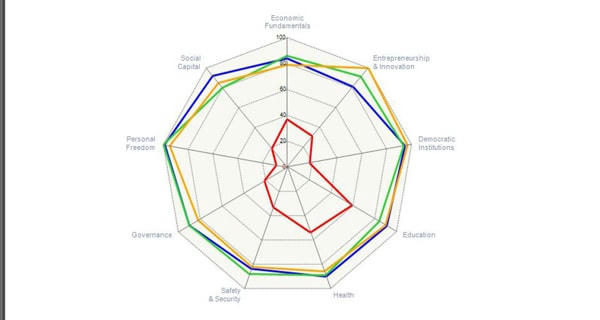
Allow me to show you a diagram, which is the "Legatum Prosperity Index" (Legatum Prosperity Index ). This index has 9 components, which are: 1. Economic Quality, 2. Business Environment, 3. Democratic Institutions, 4. Education, 5. Health, 6. Safety and Security, 7. Good Governance, 8. Personal Freedom, and 9. Social Capital. Based on these 9 components, we can compare Iran, as a migrant-sending country, with three migrant-receiving countries: Australia, Canada, and the United States. You can see that a very small and disproportionate diagram shows the state of the index in Iran. How low the level of our 9 components is. In this same diagram, it is clear how little social capital there is, how problematic the institution of government is. Again, the only thing that has progressed a little is education, and to some extent, health. Compare this with Canada or with the United States, and then with Australia, where the prosperity index is a large diagram. These three are almost in a similarly high situation, and we have a stark difference with them. The result is that we become a major migrant-sending country, and they become major migrant-receiving ones. In this diagram, Iran is shown with a red line; the United States, brown; Australia, blue; and Canada, green.
Well, there is another characteristic in Iran's structure that causes elite elimination. We are faced with a structure that likes people to be average. There is never a visible desire for people to rise above a certain level. In fact, the bureaucratic institution constantly promotes mediocrity in the country. How much does this desire for people to be average affect the thinning of the country's elite stream?
You made a very important point. The insistence on uniformity and the inclination toward mediocrity have become institutionalized in our country and are the worst obstacle to flourishing. We detect its signs both in public culture and in everyday talk in the streets and bazaars. Especially in official institutions, there is a tendency to distribute and divide things among everyone like coupons, as if a votive spread has been laid out from which everyone is given an equal portion. This dividing and inclination toward mediocrity means that when someone wants to soar, they are suppressed and "rejected" by the system. Why? Because when they want to soar, they want different rules for the game, they speak a different language, they develop critical thinking, they think inversely, but within the power structure, there is no institutional capacity to tolerate them. Official structures want precisely this mediocrity you mentioned; we see this in our educational systems as well. We see that the variance in our grades has become very small. For years at universities, I have observed up close a clear tendency for everyone to have a mediocre level. This is why our universities are turning into diploma shops.
In addition to mediocrity, or as you put it, the inclination toward the middling, another belief has become prevalent among the elites themselves in Iran, especially in the last two decades. We see abroad that there is a utopia that promotes and reinforces elitism accompanied by heroism and the elements of being elite and distinctive. But here, among Iranian elites themselves, we have long been discussing the anti-hero. There is constant talk that one should not be a hero. There are serious disillusionments in this area and cultural backgrounds, and there is also an effort for social progress—all of which may be valid—but doesn't the dogmatic and formulaic way elites confront the phenomenon of the hero become yet another reason among reasons for the influence of elites to be lost, for a sense of futility to prevail, and for it to draw them toward the city gates?
That's an interesting point. Our situation in this regard is contradictory. On the one hand, it seems we still, even now, need heroes, and on the other hand, we don't have a very good feeling about heroes either. One reason might be that bandwagoning has increased in our society. There are dwarfs who play the role of heroes; counterfeit masks of the hero. These people ride the wave and sit on the shoulders of the masses.
Socrates in Greece is a hero, but he does not ride the wave. He critiques from the bottom up, even criticizing Athenian democracy. He goes into the streets and bazaars, converses with the youth, and tries to show them the complex process of knowledge. He tries to demonstrate ambiguity and to hold up compound ignorance to himself and his audience, calls the youth to discovery and questioning, and subjects his own and their assumptions and beliefs to interrogation. Socrates is an elite who challenges the assumptions and certainties of the people, not someone who wants to ride the wave of the masses. It is a very important matter for an elite to engage in social critique, critique of power, and even critique of the people, and to show a new horizon.
An example in our literature is Hafez, who is an elite with sharply critical views. He comes and criticizes afflictions like hypocrisy, pretense, asceticism, and sheikh-worship that have penetrated the culture of society, and he hammers the sharpest language of his rendi upon the mind of a mediocre society. Any of us who reads Hafez sees and measures ourselves, our neighbor, and social institutions in the mirror of his critique, as it were. Hafez has become a mirror for our social scrutiny, meticulous examination, self-reflection, and self-criticism. Fortunately, he has also attained a high status. We see that, with all his rendi and sharp language toward people's beliefs, he has found a fitting place from the seclusions of mystics to thinkers, and to our evening gatherings and public culture. This is a real hero who does not play the role of a bandwagoner.
Doctor, considering all these discussions we've had, these statistics that were presented, the terrifying root causes that were mentioned, and some of these incurable pains, why have you yourself, despite all this, remained inside the country?
At the beginning of the conversation, I recited a poem by Hafez; those who remain in the Beloved's abode (Iran) seem to choose a kind of dervishhood, due to spiritual gratifications and an attachment to the soil and water of this land. It is clear that I am not at that level, but I think there is a phoenix in Iranian culture. The phoenix rises from all the burnt ashes and tribulations. I do not think this is a romantic interpretation, considering the capacities that exist in Iranian society.
.
.
Edited text of the conversation between Sasan Aghaei and Maghsoud Farasatkhah
Published in the special issue of Etemad, No. 2285; 15 Mehr 1390, pp. 8-9
.
.

Discussion2 comments
تو ایران موندن مرگ خاموشه هر کی می تونه تامل نمی کنه
دقیقا درسته فقط رفتن از این مرداب مرگ هم ساده نیست به خصوص اگه همه عمرت و اجدادت از همون طبقه متوسط باشند اگر هم بخوای بری در جامعه جدید باز باید همون متوسط مهاجر مزاحم باشی