Sociology
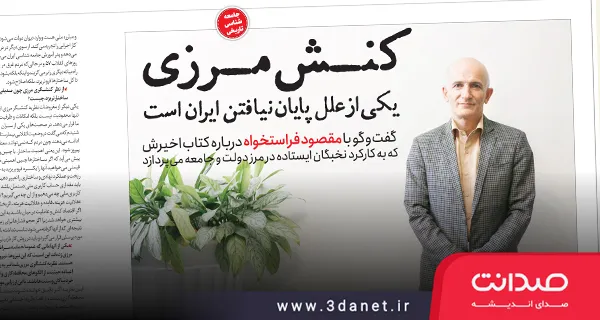
A Conversation with Maghsoud Farasatkhah: Protests and the Structural Difficulties of Dialogue
Maghsoud Farasatkhah sees structural blockages and systematic deafness as the cause of the eruption of pent-up anger. To move beyond this situation, he considers free media, the circulation of power, and genuine dialogue essential.
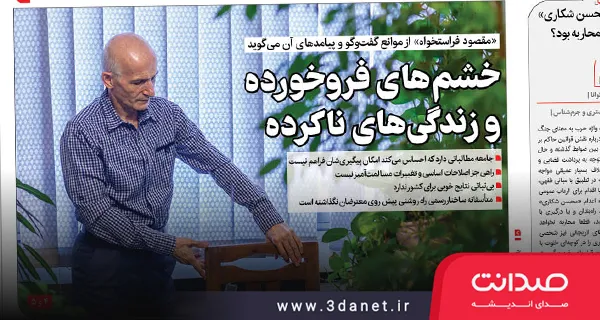
Protests and the Structural Difficulties of Dialogue
A Conversation between Hesam Eslamlou and Maghsoud Farasatkhah
Payam-e Ma Newspaper, 10 December 2022, pages 1, 4, and 5
These are not good days for Iran and Iranians. Bad and unfortunate news is being fired at our ears like a machine gun. Violence that flows, capital that is wasted from this country, and lives that have been and are being ruined. What exactly happened that Iranian society reached this point? It is as if an anger born of despair has erupted after the last hope was dashed. It is as if society has encountered the high wall of a great "no" to reform. Since 2017, at various times and under different pretexts, a wave has risen from the turbulent sea of society. Each time, this wave has been pushed back and then returned with redoubled force. Sociologists had previously warned, citing the results of national surveys, about the shortening time between the outbreaks of social protests and their multiplicity, but it seems this warning was not taken seriously. For some time now, a faint voice has been heard among officials and political activists speaking of the necessity of "dialogue." But dialogue about what and under what conditions? In this regard, we went to Maghsoud Farasatkhah, a sociologist and faculty member at the Institute for Research and Planning in Higher Education. In his conversation with "Payam-e Ma," he speaks of the worsening of conditions and the loss of opportunities for peaceful and conciliatory solutions to problems. Farasatkhah's compassionate warnings are among the voices that must be heard in this turbulent atmosphere, perhaps to serve as a beacon for navigating this critical situation.
*You recently spoke in a lecture about the difficult path of peace and tolerance. Why have we fallen onto this difficult path?
It seems we are situated in a structure where tolerance is impossible, and there is no way but fundamental reforms and peaceful changes. The level of reforms must be raised significantly and, instead of being unilateral and top-down, become multilateral and dialogical.
*If not the entire society, at least a part of the social body has become angry and is erupting because it has lost hope in the formal structures of dialogue and its possibility. That is, it has become disbelieving in the effectiveness of a two-way conversation and having its voice heard at high levels.
We are facing a collection of suppressed angers and unlived lives. Society has demands that it feels cannot be pursued institutionally and systematically. Citizens' expectations for effective participation in their own destiny, improving the quality of life, and attaining their civil rights and entitlements are not being met, and their collection of demands and wishes is not being fulfilled.
*What is the reason for these social demands going unanswered?
There are structural blockages. There are limitations in the structure that systematically prevent the voice of popular demands from being heard through non-governmental organizations and the ballot box. Anger, discontent, grievances, and protests exist in every society, but to prevent them from being suppressed and accumulating all at once, they must overflow in the form of demands into civic spheres, the press, various parties, and free elections. They must overflow into a ballot box that provides the possibility for a real circulation of power. We destroyed trust in the ballot box and in the circulation of power through free elections. When demands, protests, complaints, and so on are not brought to legal spheres in a timely manner, are not pursued through official and peaceful channels, are not heard, and receive no response, the result is nothing but the current situation.
Now that we have reached this point, how can both sides be brought to the negotiating table—a table from which one side has walked away and the other, citing this very fact, refuses to return? And who exactly are these sides, and how many facets do they have?
Let me first say that these demands are legitimate. However, if they are not pursued through dialogue, by meeting in the middle and considering the country's public interest in a balanced way by both sides, we will not have a good future. Instability does not yield good results for the country. But unfortunately, the official structure has not laid out a clear path for the protesters. Dialogue has conditions that have not been systematically provided.
From the beginning of this affair, a series of debates were broadcast on television, or the government spokesperson appeared at some universities. Can these be categorized as effective dialogues?
Such formalistic, theatrical, and fantastical dialogues are of no use. We need serious bargaining. We need elites to put forward their discussions in the public sphere. The media must be free to reflect these discussions. We should also have television channels other than the state television, so that only the government's voice is not heard. Unfortunately, all these paths are closed. If the space existed, dialogue would happen, and in this way, anger would not accumulate. The existence of such mechanisms helps societal stability and political stability, and in such a case, society would feel that the system has a sense of hearing. But now we are facing a systematic deafness that causes the sudden eruption of pent-up angers.
Our political structure ostensibly has the modern mechanism for forming a relationship between the state and the nation. So why don't these work in practice?
When we speak of sustainable development, one indicator of this sustainability is the development of social foundations, which leads to the resilience of the social system and the distribution of powers, and will contribute to Iran's endurance. One facet of dialogue is the bargaining of political elites who alternate in the circulation of power. Not that these elites are heroes or self-sacrificing, but they are compelled to pay attention to these demands in order to win votes in the next round and try to fulfill at least part of them. Because they need people's votes, they pay attention to public opinion. The circulation of power helps pluralism, and without the system needing to collapse and costly revolutions becoming necessary for society, change can be created through general amnesty, the declaration of national reconciliation, and continuous, timely, society-oriented reforms via civic and democratic capacities, achieving the stability of a land.
What are the requirements and preconditions for the formation of a genuine dialogue between the state and the nation?
Dialogue does not happen in a vacuum. For dialogue, social structures must exist, such as free media, pluralism, a democratic party system, a strong civil society, elections without vetting, accountability of officials, and the circulation of power. Merely recognizing dialogue in words is not enough. Telling citizens that it is okay to protest but not responding to their protests is not called dialogue. Dialogue requires the guarantee of freedom of expression and the acceptance of fundamental changes. The individuals participating in a dialogue must not worry about their freedom after expressing themselves, and they should express themselves comfortably and voice their dissenting thoughts without concern. Otherwise, if the dialogue is artificial, a portion of the angers will again be suppressed.
The various interventions in people's private lives and the non-recognition of lifestyles in the name of social morality patrols were unnecessary. These interventions have brought things to a point where a different lifestyle has today become a form of resistance. In the Mahsa moment, this resistance suddenly detonates a volcano of anger.
What model can be adopted to overcome this situation?
The creation of pluralistic spaces, civil spaces for dialogue between the state and society, must be taken seriously. The gap between the nation and the state should be transformed into a dialogue between the nation and the state in the form of changing discriminatory laws. Government authorities at every level must be made accountable to society. But unfortunately, politics in Iran has become a matter of prestige. Whereas politics is not a matter of prestige. Politics is accompanied by rationality, give-and-take, negotiation, reaching intermediate solutions, interaction, and middle-ground agreement. But in Iran, politics as a public sphere has turned into the private backyard and sanctuary of the rulers. Whereas governance is a social contract. Rulers are the stewards of society.
These protests have a history of incompetence and excessive demands behind them. They have a history of not listening in a timely manner behind them. It is the story of refusing dialogue and failing to reach interaction. Governance is no one's private domain. It is the public sphere. It must be made accountable. Not that all kinds of restrictions should be created for society, parties, and the press over these years. Controversial restrictions that delegitimize the state in Iran and deepen the gap between the nation and the state.
It seems that neither the authorities believe in dialogue, nor do the people believe in the theatrical mechanisms of dialogue anymore, and in this situation, anyone who speaks of dialogue gets labeled.
Now, to preserve Iran and the rights of the nation, we must all pay a price. The one who is speaking of realistic, free dialogue in such circumstances is like a mother who even relinquishes her maternal rights for the sake of saving her child's life. So that everything is not lost, all sides must take a step towards the other and see the truth among one another, not in their own absolute and exclusive ownership. Now our land has reached this dangerous position. On one hand, some within the political structure do not want to hear the voice of dialogue and continue to create otherness. They suffer from personality narcissism and epistemic dogmatism. They imagine that truth is in their possession and that the one-sided dissemination of this truth will turn the world into paradise, but the world becomes hell. Not seeing and not hearing the voice of cultural plurality and the diversity of people's worldviews creates this hell. The slogans show that people themselves want to choose their lifestyle. Rulers are not the custodians of truth. These very things disrupt sustainability and stability. The ruler's job is to protect borders, prepare infrastructure for the people, create social welfare, and provide rights so that people can live comfortably. The ruler has not come to say what the truth is. Truth is something scientists, thinkers, and all citizens should discuss. Ideology, however, with political totalitarianism and creating blockages in dialogue, wants to introduce itself as the only path to truth, and this is false knowledge.
The precondition for dialogue is listening to the other's opinion. Rulers should grant citizens the right to express opinions and protest. Not that they consider the expression of opinion a conspiracy and define the dissenting opinion-holder as an enemy. Let us give those who have emigrated a real sense of security so they can come and go. Let society speak its mind. Let the people's demands be understood by the government, and the government's limitations be understood by society.
We must formally recognize civic protest within serious social organizations, be accountable, and submit to peaceful changes. A referendum is a reasonable mechanism for social dialogue and for reforming laws and structures. Dialogue means that a worker can pursue their demands in the workplace and the union. An academic can freely express their opinion in the university and research environment. Ethnicities and minorities can make decisions about their local issues within the framework of a single, great land and pursue their rightful demands and basic citizenship rights. Parties can participate in the circulation of power through free elections. Kurds, Baluchis, and other diverse, dear ethnic groups are among the most authentic parts of the history and identity of this land; they are the principal owners of this land, and Iranian identity is precisely this beautiful rainbow of linguistic and religious diversity. They should not suffer from a sense of discrimination, powerlessness, and "otherness." Non-governmental organizations should be able to pursue issues and problems.
You speak of creating opportunities for social institutions, while in these years, even non-governmental organizations have faced restrictive policies.
When we have suppressed and eliminated reference groups, it is natural that today celebrities fill the role of reference groups, thinkers, and scientific and political elites. Celebrities are also among the country's assets, but their work is something else; however, because parties and reference groups have been weakened, celebrities are forced to fill their role. The pressure of civil institutions, without the need for violence, leads to the change and reform of laws for the benefit of society, and this contributes to stability.
But we prevent these things and accumulate suppressed rages so that at a critical moment, these various social rages form a coalition against the established situation. They create a fragile coalition and resistance. In Iran, a separate, autocratic system always seizes ownership of resources without accountability, blocks the path of dialogue, and divides society into insiders and outsiders. In opposition, a negative coalition of the "others" is formed against the established situation, leading to collapse at great cost. Then a new situation replaces the previous established one, and before long, the coalitions fall apart again, disputes begin, and a defective cycle is constantly repeated. The country is deprived of growth, development, and stability and falls behind the successfully developing world in the region. In these four decades, we have made women the "other." We have made ethnic groups the "other." We have made religions and sects the "other." Whereas the late Taleghani believed that the rights of ethnic groups should only be secured through dialogue and that we should resolve any discontent.
After events like the Kermanshah earthquake and the manifestation of public distrust in state aid institutions, with people channeling donations to athletes and celebrities, our structure saw this rift but did nothing to improve the lost capital.
We lost all previous opportunities, and everything accumulated for a single moment. December 2017, November 2019—these were the moments when they should have realized and listened to society's voice so that things would not pile up like this and we would not reach this point. But we securitized the voices. It was late, but it was still possible to return the spilled water to the stream. Before that, the system had lost opportunities one by one. The interim government and experienced national figures like Engineer Bazargan. Then we did not allow serious, society-oriented reforms to proceed lawfully. We eliminated and set aside all of these. We left their experiences unused. Even within the government, we do not create an opportunity for dialogue.
It seems that the political structure interprets any possibility of hearing the voice of these protests as a retreat, and with historical analogies—such as the notion that the Shah also listened to the protesters and granted concessions, which led to his fall—they do not welcome it.
When the Shah became psychologically ready for dialogue, it was already too late. For several decades, all the boundary actors who served as the intermediary link between the people and the government had made efforts. During Reza Shah’s time, when so many plans and designs were implemented for education, for industry, for the railway, and so on, they were the result of the initiatives of these very boundary actors—these did not all spring from Reza Shah’s mind alone. They were all ideas of elites who, a decade before the Constitutional Revolution, had attained higher education from within the body of society. They were literate and expert. Moreover, they had ties with both the state and the nation. They moved between society and the state. Although they worked in the government, they were also part of society. People like Ali-Akbar Siasi, who, even if they became ministers, did not merely obey the system’s orders. They believed in the independence of the university. Even now, among the mass of Iran’s educated society, on the margins of state systems and in their middle layers, we have no shortage of such people whom we do not use and whose knowledge and expertise we have left idle. Like an enlightened ring, they surround the government, and even within the structures and margins of state apparatuses and the middle and lower layers of administrative forces within this very structure, there are those who understand the problems and their solutions. They are specialists in their own fields. They know that this voice must be heard and that something must be done for society. They are a national asset. They are an opportunity. If the system would only give these boundary actors some room, they might be able to save us from the midst of a great national loss. A boundary actor must be able to engage in dialogue with the upper levels of the government. To engage in dialogue with society and with the government so that many issues can be resolved. So that the causes of protests can be removed and public satisfaction can be created. So that the water problem can be solved. We have good environmental experts who have even worked within the system, but we did not hear their voice. There must also be the possibility of dialogue between scientific experts with their technical language and politicians within the policymaking system. If they are given more opportunity, they will convey some of the outstanding affairs, such as foreign diplomacy, national sovereignty rights, citizenship rights, and society’s demands, to the government and will fulfill some of the expectations. They will also convey some of the government’s limitations to society. But closed circles, monopolistic and rentier organizations, and extremists unfortunately do not allow the initiative to fall into the hands of these boundary actors. Considering every other person an enemy does not permit dialogue. Before the revolution, there was something similar to this, albeit to degrees not to this extent; the economy had 16 percent growth, but they ‘othered’ the national forces, authoritarians, conservatives, sycophants, and proponents of violence held sway and blocked the possibility of interaction and dialogue, and the result was collapse, with all those costs.
That famous statement by Engineer Bazargan in the Shah’s regime court—that we are the last generation to speak to you in the language of the law—is also a sign of this same blockage.
Yes. In the 1950s, the possibility for dialogue and for society’s voice to be heard was not provided, and the result was that from the 1960s and 1970s, guerrilla and partisan struggle and political radicalism became the model for the youth of that period.
It seems that in the tradition of Iran’s monologic culture, there was not much news of disputation and dialogue in its Socratic method in Greece.
Our society has been one of admonition. It has been so from ancient times in Iran until today. Iran is one of the most admonition-giving countries. Instead of admonition, we need effective dialogic structures. There is no lawful structure for hearing the voice of the youth, their dreams and aspirations. At the international level, why do we have so much tension and sanctions, and what costs the nation has paid and is still paying for this. Because we lack diplomacy. Diplomacy means dialogue. One must engage in dialogue even with the enemy. We do not engage in dialogue, and instead, we unilaterally assert our justification with bulging neck veins, and worse than that, the justification stems from a position of power.

Discussion2 comments
تمام صحبت ها که سرشار از عمق نگرش جناب فراستخواه هستند، مربوط به گذشته ای هستند که امروزه رخ نداده اند. از تمامی این نگرش ها بایستی برای آینده مان بهره ببریم، اما در حال حاضر مردم قادر به گفتگو با حکومت نیستند، چرا که حکومت شرط گفتگو را رعایت نمی کند. حکومت مردم را دشمن می پندارد و چون بر پایه ایدئولوژی است، تنها صحبت هایی که با ایدئولوژی خودش همراه است را به رسمیت می شناسد. هرگز امکان شکل گیری گفتگویی با این حکومت وجود ندارد و راه حل مردم عبور از آن است نه گفتگو.
چه کسانی باید بیان کنند که در جامعه ما اعتقاد به معصومیت اشتباه است...از خود روحانیون یا از بین روشنفکران؟... اعتقادی که ریشه مشکلات است...بنا بر این اعتقاد ، حاکمان جانشین معصومین هستند چرا که احادیث و روایات آنها را میشناسند...هر جند آن روایات تخته بند زمان و مکان خاص باشند....و این جانشین ، بی خطا یا کم خطا زمانمند نیست اختلاف و انتخاب و تنازع را بر نمی تابد... چرا با ایشان به محکمه قرآن نمیرویم تا با دقت امروزی و این عصری ، مورد سوال و جواب قرار گیرند؟ آیا محکمه دیگری وجود دارد؟