Sociology
Maghsoud Farasatkhah in Conversation with Mehr: The Debate on Iranian National Character Lacks Scientific Basis
Maghsoud Farasatkhah argues that the discourse on Iranian national character lacks a scientific, essentialist foundation, viewing behaviours instead as products of social conditions and dysfunctional structures. He identifies institutional reform and social capital as the path to changing conduct.
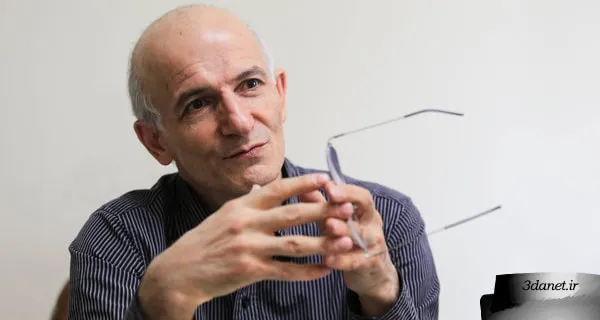
Perhaps all of us, in various social situations, have often found ourselves pointing the arrow of our problems at our being Iranian. When did we Iranians truly become Iranian, and since when have we attributed the causes of our wrong social behaviors to our Iranianness? Do the character traits of us Iranians have weaknesses? In response to these questions, 96 percent of a statistical population consisting of faculty members and a group of the country's elites answered positively. They identified the problem as weakness in the culture of teamwork, openness to criticism, social inhibition, lack of transparency, self-centeredness, the dominance of emotions over rationality, the prevalence of lying, and unpredictable behaviors. They considered epistemic factors, the decline of social capital, the structure of the state, the relationship between religion and state, the type of religious teachings, the eventfulness of history, relations of production and economic structure, and elite conflict as influencing Iranian character traits, and to solve this problem they have proposed continuous education, cultural and social development programs, enacting good laws, strengthening local communities and public institutions, creating welfare and eradicating poverty, political development, and reforming the institution of the state.
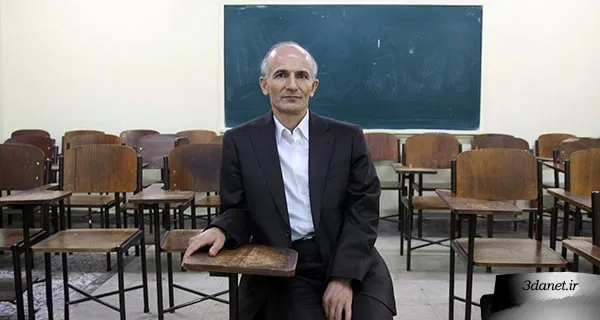
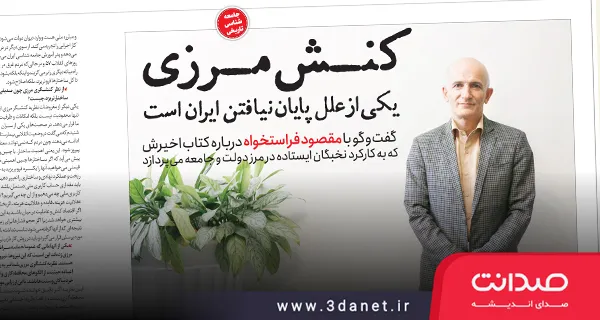
"Maghsoud Farasatkhah," professor of sociology and director of the higher education planning and development group, in his book "We Iranians," which has recently reached its twenty-first printing, has analyzed and studied the weaknesses and solutions for remedying these Iranian character traits with a scientific perspective. To examine these character traits and trace the roots of their causes and formative factors, we sat down for a conversation with this prominent and prolific sociologist and researcher of our country, which follows;
*When and by whom was the discussion of Iranian character traits first raised in society?
In the first chapter of this book, I have explained ten entries, noting that both Iranians and non-Iranians, whether Orientalists or those who have traveled through Iran for various reasons, naturally reflected these issues in their travelogues. However, specifically from the 1960s, Jamalzadeh started this discussion in his book "The Character Traits of Us Iranians," and afterward, other individuals, including Engineer Bazargan, wrote another book on this subject. I think the reason people pay attention to this issue is that they see it as a serious problem, and when they examine their difficulties, they arrive at something deep within themselves. Of course, in this book, I have examined the point that one cannot conceive of something called the innate character traits of Iranians. There are two perspectives on this matter: one is the character-trait-centered view, which imagines that character traits do not change and looks at them in an essentialist way, and the other perspective is situational theories. This group believes that behaviors are shaped in situations. In "We Iranians," I mostly tried to explain that our history and social conditions have been such that certain behaviors have become more prevalent; that is, it has been a kind of social learning, and due to instability, people have tried to save their own skin. People are not self-centered; rather, the dominant social conditions have provided the ground for the emergence of certain behaviors. If social conditions change and other factors like education and social situations develop, naturally, situations will be provided for people in which their behaviors will also change.
*Do you believe in the essentialist view on this matter or the situation-centered one?
On this matter, I have specifically explained in the book "We Iranians" that I do not hold an essentialist view, but in any case, an essentialist view exists on this subject. Even recently, surveys have been conducted in this regard, in which we also see certain issues. Suppose there are surveys on this matter by people like "Hofstede" at the international level and people like "Blue," which is an important international survey, and one of its indicators is uncertainty avoidance. Their argument is about how many people in any given society avoid uncertainty, meaning they do not want to take risks. This indicator shows that the higher the uncertainty avoidance index, the more people do not want to take risks and seek stability, because they have seen instability and do not want to take risks.
Another indicator is long-term orientation, meaning to what extent people orient themselves toward the long term. This indicator is also low in Iran and shows that people think more about their tomorrow and think more in terms of livelihood, the reason being conditions of instability, mismanagement, and inefficient structures. The more efficient the structures, the more one can entrust affairs to social systems and think long-term. But if structures are not trustworthy and social capital erodes, one cannot trust institutions.
A significant part of social capital is trust in institutions; when you do not trust institutions, you are forced to solve your problems on a day-to-day basis. This shows that individuals are not inherently problematic; when the playing field improves, the player can play better. The best players on rough and unsuitable fields naturally cannot play a good game. In the book We Iranians, I tried to analyze these issues more, and how the state of our institutions is such that it causes a series of behaviors of this kind, such as collective work in Iran, not to be very successful, even partnership work, and Iranians even have proverbs about this.
These issues exist because our social capital is weak, there is territorial dispersion, and in this regard, I have paid a great deal of attention to institutions. That is, I have seen a relationship between structure and behavior. If the structure improves, behavior also improves. For example, take the use of bank counters; ever since number dispensers were installed for people, people's behavior in banks changed. The cameras that exist on the streets have also eliminated many behaviors such as violations and bribery altogether. In this book, I tried to address this issue from a sociological perspective, that if we develop our institutions and systems, many of people's behaviors will improve overall, and many of people's behaviors will be enhanced, and this enhancement of behaviors creates further improvement, and this is a cycle that has a reciprocal effect on each other, and I think development in the world has happened for this reason.
*Have Orientalists played a role in the emergence of this debate among Iranians?
Yes, there is an Orientalist discourse in this regard. This discourse considers the East as an object and the West as the knowing subject. The West is a subject that examines the East and imagines the East as its own historical past, and says Easterners as a group are such and such. There are untested assumptions in Orientalism, and non-Western countries and nations, and the natives of other regions, have typically been approached with certain assumptions.
These assumptions have entered anthropology books and influenced anthropology texts. This issue dates back to previous decades, and people like Edward Said have worked on this. In this book, it is also explained that the theory of backwardness is not an efficient theory for explaining the nations of the world, because it bases its assumption on the backwardness of non-European nations, whereas such an assumption is incorrect, and this is because, in this regard, it has relied on field evidence and not the assumptions raised in the backwardness debate.
*To what extent do you consider the role of geography effective in this matter?
Geography can also be a variable, but it is not a fixed and absolute variable. For example, it has even been studied that human height changes based on nutrition. Good management, good social conditions, or poverty, or stability, or social connections, or urbanization can influence people's behavior, and peoples who have gone from Asia to European countries and have lived in North America have been successful individuals in their scientific and economic communities. The Orientalist assumption should not cast such a shadow that we forget the change of nations and the diversities of nations. I think there has been a degree of exaggeration in this area, and in any case, I have also criticized the theory of backwardness in the book We Iranians.
*It seems that the focus on the discussion of Iranian character is undertaken to compensate for backwardness and achieve development. To what extent do you agree with the theory of backwardness in this regard and the posing of the question, "Why are we backward?"
If we assume that we are backward and ask why we are backward, this is itself presupposing the theory of backwardness. As a researcher, I do not accept this, but to erase the problem altogether and say we have no problem and that we are perfectly fine—these, in my view, are nationalist and racist reactions to the issue. “Art is only among the Iranians” is not correct, but we must also not erase our problems; we must examine and analyze our problems and report that we are a nation with a long background, and there are very authentic civilizational values in Iran.
I think perhaps there are few nations in whose myths there exists a myth named “Chista”; Chista means “inquisitiveness,” which is part of our myths. Consequently, my impression is that we must adopt a scientific perspective, conduct fieldwork with empirical evidence, and longitudinally examine large datasets across different times. For example, changes such as the quiet revolution of women can be studied. Women have truly advanced and changed in these years. We must see what this is due to—education, connections with the world, or… Naturally, women have entered social participation, although their economic participation rate is still low, the reason being the existence of unsuitable structures.
In general, I believe the lifeworld of Iranians is dynamic and inclined toward progress, and it still flows in this land; people do not want to give up on living. But unfortunately, our systems are not intelligent. Our systems are not suitable for progress or conducive to flourishing, and this is why survival values have now come to dominate our society. This means everyone wants to preserve themselves and stay on their feet. Survival values stand in opposition to self-actualization values. Conditions have unfortunately become such that people are more concerned with preserving themselves than with revealing and flourishing themselves. Consequently, it seems that the foundation must be placed on improving institutions, developing governance institutions, the fair distribution of social fortunes, and meritocracy. In that case, imagine how much people could change.
In one organization, it has been observed that with a change in the organization’s management style, the same people’s behaviors changed. Consequently, people can acquire a new personality and flourish with this personality, which requires providing suitable social, institutional, and managerial conditions for them. Overall, in this book, I have concluded that institutional development has two meanings: one is social learning, meaning that people can learn to act better. Take this learning from formal education to informal training, universities, and so on—all of which can be effective in improving people and bringing about changes. The other is social action and the development of institutions. That is why I see the transformation of the Iranian character as occurring through civic and voluntary activities. The more opportunities for such participation, local and social participation, neighborhood management, and city management are entrusted to the people, the more people’s character develops in the arena of social action. If tasks are entrusted to the people and opportunities for social initiatives are provided for them—which requires accepting diversity and plurality and having a creative outlook on various issues—the situation will improve. Lifestyles in Iran are diverse; until we accept this, people will not participate. People feel that minimal participation is demanded of them; if they realize full participation and the delegation of authority even to lower social levels is possible, then they will actively participate themselves. People do not learn to ride a bicycle without pedaling, but unfortunately, we have not been able to provide this opportunity for people very much.
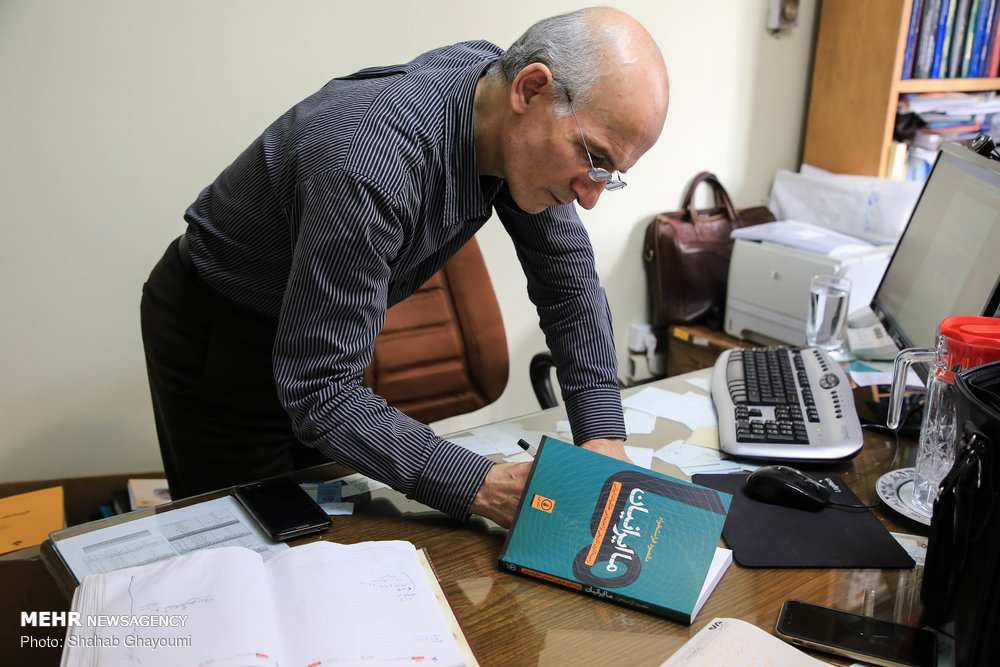
*What is the role of elites and statesmen in this regard; shouldn’t they lead these behaviors?
As a matter of fact, I believe the problem lies more with our elites and managers. There are defective cycles in this regard. When you ask the elites why they do not enter the arena and engage the people in participation, they in turn say that there are political restrictions placed upon them, that they are not trusted or sufficiently supported, or that there are anti-support laws in this regard. We have institutions and laws that are anti-participation, and we hold a set of beliefs that are such that they prevent participation. Some elites also complain about higher-level structures that are centralist and where governmental policies are of greater importance; consequently, they too complain more about participations that have led to punishment.
If you could access the black box of the minds of some elites, you would understand that they have reached the conclusion that those who have participated have paid heavy costs, and have sometimes even been punished and repressed, or had all sorts of social restrictions imposed upon them, and as a result, they too become discouraged. In my view, if our political structures develop and the structures for economic development are also provided, a possibility arises whereby, through the reform of laws, non-governmental sectors and civil and professional sectors are strengthened. Also, if professions are strengthened and their norms are specified, a part of the Iranian character will be reformed through work and professional participation, that is, by providing the grounds for growth. Experience has also shown that everywhere in the world, people have developed new personalities through development, and when they have developed, their personalities have also changed.
Poverty, lack of participation, and other restrictions prevent the flourishing of humanity's transcendent talents. Consequently, I agree that the elites in society are responsible; the governmental elites, the intellectual elites, and the social elites all bear responsibility in this regard. In my book We Iranians, I have mostly criticized fatalism. I believe in change and transformation. Even the people of Europe did not behave this way from the beginning; rather, they have changed throughout different periods of history. On the whole, the discussions concerning the Iranian character are lightweight and lack a scientific basis and real evidence.
*Can we generalize every incorrect behavior in society to our being Iranian?
Firstly, we cannot generalize. Our national character is defined when a behavior is consistently observed in individuals aged 15 and above across different periods. Whereas we see something in society and, without analysis or examination, generalize it to the entire society. We also usually have an imaginary perception of Europeans in this regard. I myself have experienced that in that very Western society, if the power goes out for a moment at a metro station, the behavior of those same people changes completely. That is, with a change in one situation, the behavior of those same people changes. Consequently, I believe the claims and assertions made about the Iranian people are untested. Likewise, our immediate feelings and reactions must be examined precisely, and we must believe in change in this regard, and that many of people's behaviors are changeable.
*How can change be created in this character?
The first 2 years of human life are very important. If educational institutions in Iran become rationalized, our education system can play a very significant role in this regard. Our education system is not school-centered, and schools cannot exercise creativity. In school, students do not find opportunities for participation. In Turkey, children save money at school; in Japan, children tidy up their classroom before going home, and the school is fundamentally an institution for their upbringing, and they are nurtured there. Has it ever been realized that in our schools, grades are given to the group? Grades are always given to the individual. That is, from the very beginning of school, we teach them individual relationships and a kind of self-centeredness. Giving collective grades, the possibility of children's participation in school, and not discriminating based on language among different ethnicities are very important in this regard.
As a result, by strengthening the teaching profession and viewing teaching not as a job but as a profession, educational methods can be creatively changed and replaced with methods of discussion and dialogue. In this way, these same children become participatory citizens who are critical, possess critical thinking, and are dialogue-oriented. The very fact that a student learns dialogue and learns to first listen when someone speaks, not to impose some of their own assumptions, and to accept to discuss the matter patiently, is very important, and all of these can be taught to children.
Conditions must be created in neighborhoods where neighbors gather and manage the neighborhood themselves, so that they are effective in their neighborhood and convey their problems to the councils through their representatives. That is, if we can provide opportunities for participation and the collective critique and examination of issues, people can develop greatly in the course of social action. As this plan has also been very successful in other countries. The neighborhood can be a very good sphere for participation in the city and, subsequently, participation at the national level for citizens. Social hope plays an important role in this regard. A large part of the transformation in social character requires that people be hopeful; people must feel that they can pursue their goals, and this is, in essence, the definition of hope. When small goals can be pursued in communities, at home, at school, in the neighborhood, and in work organizations in a guild-based and specialized manner—which requires that changes be made in our institutions—that is, we must think a great deal about political and social development in this regard, and if these are provided, cultural development also becomes possible within their context.
*Has the arrival of modernity and the process of modernization in Iran had no effect on the formation and direction of these Iranian character traits?
Becoming modern and modernity must be an endogenous, lived social experience. Modernization began in the first and second Pahlavi periods, and the Iranian nation has been seeking change for 200 years; it can be said that the Iranian nation has been starting a renaissance for 200 years. As you know, from the time of Abbas Mirza, that is, since the year 1200 [1821 CE], this renaissance emerged with the establishment of Dar ul-Fununs, teacher training colleges, the press, and so on, all of which are part of that same Iranian modernity. But unfortunately, before the revolution, the Pahlavi government mostly tried to reduce this modernity to modernization, which is a state project that seeks to change and modernize society from above in an administrative manner. Of course, the government can help this process through very modern administrative organizations and support for modernism, but if the internalization of modernity, modernism, and new thinking does not proceed endogenously, and we want to advance society from above, this is what happens: the program is disrupted because we deprive it of its endogenous nature. Of course, the government can also intervene in this matter, but it must support it with the participation of the people and in an endogenous way, not just impose it from above.
Unfortunately, after the revolution, the entirety of modernity was called into question, and this time, from above, we also wanted to Islamize society; that is, instead of modernization, we moved towards Islamization this time. In any case, Iranian modernity was not realized and was damaged because state-led modernization cannot be very sustainable, just as state-led Islamization cannot be sustainable. I believe that part of the behavioral changes in people can be improved through modernization; through this, people learn to participate, connect with the world, think rationally, and have critical thinking. Modernity is the attainment of these very things, which can also affect social character traits, but this cannot be considered as a universal matter. I believe a kind of modernity exists in Iran, although Iranian modernity is crooked and has become rigid, meaning it is superficial and shallow, and many non-modern behaviors still exist among the people. This matter can be realized in a long process and cannot be achieved all at once. I believe we must think more about slow and continuous changes. A nation cannot change overnight, and a long-term plan must be envisioned for Iran; all these issues cannot be changed in one night, and people's spirits and character traits can be changed gradually.
When people participate in their own affairs, their actions and behavioral patterns change as well. Solving Iran's problem is a long-term process and proceeds through the method of reform. The foundations and structures must be reformed and made transparent. People must be informed about everything, and social justice is a very important issue in this regard—that people enjoy life's fortunes equally. As long as this possibility does not exist, social alienation will persist. Now, if you examine many behavioral traits, part of them have arisen due to social inequalities, which have caused people to distrust the system and one another. Participation for people in these kinds of structures is a form of deception, because they feel inequality. In sociology, there is a discussion that says inequality is bad, but the feeling of inequality is worse than inequality itself; that is, even if inequality does not exist, but people feel they are unequal, it greatly affects their behavior. We must work to eliminate this feeling of inequality, the feeling of corruption, the feeling of relative deprivation among the people, and this will not be eliminated through admonition; rather, the grounds for systematic corruption must be eradicated. As long as corruption exists, Iranian character traits will not be rectified. Corruption is also systematic, meaning conditions exist that generate corruption. Corruption cannot be eliminated through directives, arrests, and backroom deals; it must be dealt with systematically. The laws that create corruption in society and the conditions that are the source of corruption must be traced to their roots, such as the lack of transparency, rents, and so on. The fact that privileges and opportunities are provided for certain individuals in society causes public institutions to weaken.
If small issues are discussed and criticized through the media and raised and evaluated on social networks and the like, naturally, large-scale corruption will not take shape and will be seen and criticized in its initial stages. If children at home feel they are not being paid attention to, they become violent, whereas violence is not inherent to us. When there is no kindness in society, there is violence and hatred, and the cause of that is the very corruptions and inequalities. It is the very lack of possibility for participation and kind communication, which is provided to people through the possibility of participation. As a result, I still believe that we must think about reforming structures and institutions, and this does not happen all at once; rather, it is provided through small opportunities for participation, gradually accumulates, and yields fruitful results for society.
*To what extent can education play a role in shaping the character traits of Iranians? Have you had any research in this regard?
I am currently working on studies that involve conducting national surveys on this matter, the results of which will, God willing, be published. I am also working in the field of cultural change. I believe the people of Iran are changing, and it is the systems that have lagged behind Iranian society; there is an asynchrony between the people and the systems. The systems themselves have emerged from our beliefs and mentalities and are far behind the social changes in society, which have been shaped by extensive global communications. I am currently studying what changes exist in society that the systems are not keeping pace with. Some of my work is also in the field of higher education and the university, and in the changes occurring in this domain, where unfortunately, due to those same systems, neither schools nor universities can provide adequate quality education for the country's 4 million students. One of the important characteristics of the Iranian nation is its educability. Our parents are willing to spend a great deal so that their children can study; there is a famous example that says someone would sell the rug under their feet for their child's education. This shows that the Iranian family has a desire for human investment. In Iranian society, the interest in education is very high, and people are generally receptive to learning, but the education provided by the university lacks the necessary quality; that is, the university is not focused on the real problems of life and has not developed its academic programs based on the real needs of life. The same is true of schools; there is no real connection between the school and the neighborhood, the school and the home, and the people's issues. Things are said in books that children cannot emulate in life, and there is a gap between school and real life. Part of my research is in this area; because I consider education a major criterion for changing the Iranian character. One of my hypotheses, which I have arrived at through my studies, is that I have great confidence in education, education, education. I believe that if we provide effective education and instruction related to social hardships and people's problems, the Iranian nation will change. That is why one of my central research areas is in the field of university studies, analysis of education, issues of education, teaching and instructional methods, school management, etc., and I have published books in this field.
*Given that you were honored as the winner of the "Interdisciplinary Studies" award at the 10th Farabi International Festival, could you briefly explain how you moved towards interdisciplinarity?
One of the characteristics of my work is its interdisciplinarity. The world has now moved beyond disciplines towards interdisciplinarity. There was a time, the era of specialization in science, when everyone had a specialty and worked within that specialty, but for two or three decades, society and the world have been moving towards trans-specialization and the interdisciplinarity of science. I am also among those who have been making interdisciplinary shifts for years, and as a result, my work has moved in this direction.
.
.
Discussion1 comments
سلام. استفاده کردم. بسیار ممنونم از بازنشر این مصاحبهی ارزنده. اشارههای کلیدی به سرنخهای: - مشارکت عامه - شرکت در پروژههای کوچکِ مشارکت موثر بر آموزشِ نهادینه ( و نه الزاما شرکتِ گذرا در سیرکهای بزرگ انتخاباتی) - آموزش، آموزش، آموزش - خودگردانی محلهای - درونزا نبودن الگوهای شکوفاییِِ برگرفته از جهان غربی- شمالی، و لذا ضرورتِ درونزا کردن شکوفایی - فقدان اعتماد و اطمینان به عنوان شاخصهی اصلیِ ترمزکنندهی رشد - اشاره به خانواده و جامعهی بقا در برابر خانواده و جامعهی خودشکوفا (خود بیانگر) و .... بعضی از نکاتی اند که در نظرات جناب آقای فراستخواه پر رنگ و در عینِ حال مشکلگشا هستند. در سایتِ عدم خشونت، در دو نوشته به بسیاری از همین نکات مهم به شکل مفصل و نیز مختصر پرداخته شده است: نمایی از توسعهی انسانی: https://bit.ly/2WAX428 - کتاب سارودایا: https://bit.ly/2ECgfOR