Political Science
Why Did the Revolution Happen? A History for Thinking
An analysis of the causes of the Iranian Revolution using a four-stage model of societal development shows how economic growth and the rise of the middle class in pre-revolutionary Iran paved the way for political demands and regime change.
One. Introduction and Analytical Model
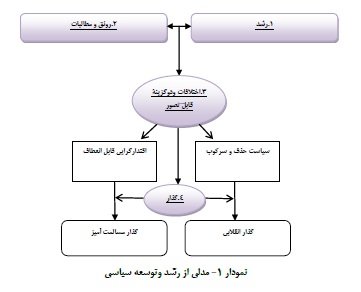
The premise of this article is based on the “conventional path of a society’s development.” A simple model of this path can be described in four periods (Persson,2000&Tabellini):
First period (Growth[i]): Economic growth programs in the undeveloped world are usually initiated by and under the supervision of the state. The new educated elites are also typically compelled to advance these programs through the state.
Second period (Prosperity and Demands): During economic growth, urbanization and education increase. New middle classes emerge. A relative cultural and social flourishing comes about. As a result, political and civil society is invigorated, and political demands upon the state become relevant.
Third period (Disputes and then Two Conceivable Options): In such societies, where modern culture and structures are not yet consolidated, the state has a tendency toward authoritarianism. Therefore, it usually resists political demands. The political demands themselves are also often radical in nature. This causes a confrontation between the state and its opponents. Here, two options may arise: 1. The state consents to a flexible authoritarianism, and among the opponents, the initiative mainly falls to groups that are inclined toward bargaining and compromise. 2. The state exhibits coercion and rigidity and adopts a policy of elimination and suppression. The opponents also persist and radicalize, raising the level of demands to the point of regime overthrow.
Fourth period (Peaceful Transition[ii] or Revolutionary Change): Usually, from the first option described in the third period, it is expected that the process of political development[iii] will proceed peacefully through interaction and bargaining between the state and political and civil society, conditions will become relatively competitive and electoral, and will tend toward the random rotation of power[iv] and democracy. The second option often leads to revolution, the state collapses, political power falls into the hands of opposing political groups, and the issue of regime change arises. Using the aforementioned source, the author has formulated a simple model as described in Diagram 1:
Two. Discussion Based on the Model
We now turn to pre-revolution Iranian society to see how it can be explained with the above model. We will conduct a brief period-by-period review.
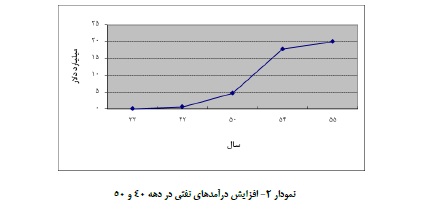
First period: Did the first period of our model occur in pre-revolution Iran? This article’s answer is a confident yes. Annual oil revenue rose from $0.022 billion in 1954 to $20 billion in 1976 (Foran, 1998, 461) (Diagram 2)
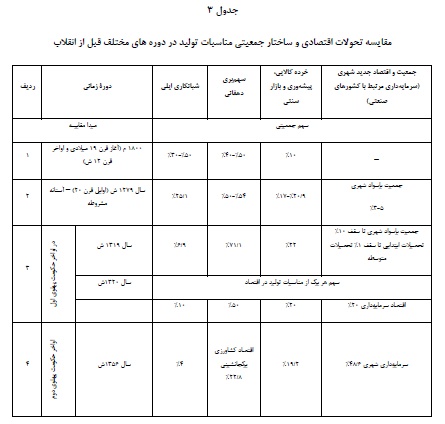
Iran's economy was transformed. Pastoralism, sedentary agriculture, and even petty-commodity production, artisanal work, and the traditional bazaar declined, and in their place, urban capitalism reached its highest level up to that period. In 1977, pastoralism accounted for only 4%, petty-commodity production, artisanal work, and the traditional bazaar for 19.2%, and sedentary agriculture for 28.2% of the economy, while urban capitalism had achieved a share amounting to 48.6%. This amount of urban capitalist growth has been compared with previous periods. The author, using the collection of information and data contained in two sources, “Katouzian, 1989: 117-364” and “Foran, 1998: 325-517”, has extracted, calculated, and compiled Table 3 (for details, see: Farasatkhah, 2009).
Thus, the 1970s marked the peak of Pahlavi-era modernization and a tangible shift in Iranian society towards urban growth, where extensive infrastructural investment and accelerated development based on oil revenues took place in the country's assembly industry and new economy, becoming a source of income for many strata and leading to increased wealth and the growth of the middle class. Per capita income rose from $166 in 1953 to $1,541 in 1977, a 9.12-fold increase over two decades. Gross national product growth during part of this period reached a ceiling of 30%, which was one of the highest growth rates in the Third World. Overall, from 1965 to 1975, Iran's economy had enjoyed 15% growth, which again placed it in the upper ranks of developing countries. In terms of gross domestic fixed capital formation, society witnessed a growth of 18.4% during the years 1963 to 1977 (Foran, 1998).
Experts have had differing assessments of the economic growth and development of this period. For example, Abrahamian (1998: 162) has noted the high level of this growth and even considered it tantamount to a small industrial revolution in the Third World of that day; Ahmad Ashraf (1979) and Homa Katouzian (1989) have pointed to this growth's excessive reliance on oil and its inability to foster capitalist growth; and Nikki Keddie (1990) has addressed the rentier characteristic of the economy of that period. In any case, a kind of consensus emerged around state-led modernization and a significant spectrum of new elites, the result of which was the aforementioned growth (Huntington, 1991). During this “growth,” it can be boldly stated that Iran underwent a process of progress and modernization in its economic, social, cultural, and even political institutions (Foran, 1998: 329-518), the result of which was our country's exit from a peripheral position in the world to a semi-peripheral and prominent position in the region and the world. The author has elaborated on this subject in the book mentioned above (Farasatkhah, 2009). In short, the first side of the model in pre-revolutionary Iran came to pass. We now arrive at the second side of the model.
The Second Period: According to our assumed model, during economic growth, a relative cultural and social flourishing should have occurred, political and civil society should have been invigorated, and political demands from the state should have become relevant. As far as the author's limited studies allow, this largely happened. As follows:
The middle classes grew, and new intellectual professions (teachers, students, professors and writers, artists, specialists, and technologists) emerged on the scene. In 1956, this group constituted only 1.6% of the population, whereas in 1972, their proportion of the total population had reached 3.5%. In 1977, there were 208,241 teachers, 6,726 faculty members, 61,066 engineers and managers (white-collar workers), and 21,500 medical professionals in the country (Foran, 1998: 490). This led to the growth of an active and influential intellectual subculture and so on, which, of course, brought with it demands and requests. Especially since both the growth of the first period and this flourishing of the second period in the Pahlavi era were afflicted with strange and peculiar internal contradictions. Below, I will point to an example of these contradictions, and I have provided its details elsewhere as mentioned (Farasatkhah, 2009).
1. Oil-Based Growth
In 1971, a high proportion of over 50% of the country’s budget revenues was supplied by oil, a figure that reached 82.6% in 1975 and 84.3% in 1976, whereas in the 1940s (1948) oil revenues covered only 11% of government expenditures. This is why, with the fluctuation of prices and the decline in oil revenue, a severe shock was inflicted on Iran’s vulnerable economy, and as a result, Iran’s economic growth of fourteen to fifteen percent suddenly dropped to 9.4% in 1977–78. (Katouzian, 1989: 258–321; Foran, 1998: 459–517).
2. State-Oriented Growth
In the mid-1960s, 40% of industrial investment was in the hands of the state. In 1973–74, alongside the rise in oil prices, the government’s total investment in the country peaked at 89% (Foran, 1998: 487). On the one hand, this situation prevented national capitalism from growing and the economy from being dynamic. On the other hand, it increased the rentier character of the state. A rentier state[1], relying on easy revenues, feels no need for people’s taxes and their participation, becomes indifferent to their demands, rights, and votes, and develops a propensity for autocracy, totalitarianism, and monopolism. This situation also leads to the formation of a rentier economy and increases financial and economic corruption within the governmental pyramid of the state bureaucracy. Ultimately, in such a situation, the country’s economy becomes a function of political variables and loses its stability.
3. Unbalanced Growth
In 1971, 48% of physicians and 59.1% of dentists served only in Tehran. The ratio of physicians in Tehran was 1:885, while for the entire country it was 1:3408, and for Ilam it was 1:14529. The ratio of dentists in Tehran was 1:5403, in the whole country 1:23905, and in Ilam 1:247000. 41.7% of diploma-holding nurses and 45% of diploma-holding midwives in 1971 resided in Tehran. In the same year, the number of hospital beds per one hundred thousand population was 121 beds in Tehran, while this indicator showed a single-digit figure of 8 for Ilam (Institute for Scientific and Educational Research and Planning, 1972).
Apparently, 93% of sharecropping peasants had become landowners, and this was successful compared to land relations in countries like Egypt, Syria, and Iraq. However, these peasants continued to live in poverty. In 1972, about 60% of the country’s population lived in nearly 66,000 scattered villages lacking minimum communication routes and adequate services. A defective bureaucracy allowed landowners to continue exploiting them by resorting to various loopholes. On the other hand, corrupt bureaucracy and cultural and social factors caused agro-industrial ventures in joint-stock agricultural companies to have less economic success. Land reform, especially after Amini’s dismissal by the Shah and during the period of “Asadollah Alam,” took on a political and propagandistic aspect for the regime. Such that after all the excessive fanfare launched as the Shah and People’s White Revolution in the 1960s, previous rural institutions and norms had become dysfunctional, and no new efficient institutions had been created for rural and agricultural development. Migration from villages and urban marginalization was one of the symptoms of this situation, which in the 1970s reached a figure of 3 million people, 76% of whom were unemployed and, living in slums and shantytowns, led a miserable life in terms of nutrition, housing, health, education, and other services, and were good subjects for extreme political radicalism.
The problems of the agricultural sector fueled a horrific disproportion between Iran’s imports and exports. In the mid-1970s, Iran’s imports increased to 80% and non-oil exports decreased by 8%. Iran’s non-oil industrial exports also fell to 2% or 3% in 1975, while at the same time, similar countries like Mexico had 33%, India 50%, and Singapore 60% non-oil industrial exports (Foran, 1998: 459–517).
4. Corruption-Ridden Growth
برخی از ابعاد فساد عبارت بود از : سوء مدیریت، حیف و میل، سوء استفاده، عدم تناسب پروژهها با شرایط بومی، بازده پایین اقتصادی در طرحها و تأخیری که در اجرای پروژهها روی میداد، تخریب منابع طبیعی و محیطزیستی، صرف بیرویه منابع . مراکز قدرت سیاسی وامنیتی وانتظامی، آلوده به انواع رانتها وفسادها شده بودند.
5. رشد نابرابر
توزیع اقتصادی درآمدها در جامعه بیش از اندازه نابرابر بود. در سال 52 نزدیک به یک سوم جامعه تنها در 7% هزینهها سهم داشتند. 20% از خانوادههای سطح بالا، تا سهمی بالغ بر 56% از هزینهها برخوردار بودند. در سال 1353 نیز 73% کارگران کمتر از حداقل دستمزد قانونی عرفی در آن روز، دریافت میکردند. (رهنما، 1357) .
خصوصاً که بر اثر توسعه و با راههای ارتباطی و حمل و نقل آسان و رسانههای تصویری، امکان این فراهم آمده بود که خواه ناخواه، بسیاری از انبوهمحرومین از رشد نامتوازن در رفت و آمدهای درون شهری و یا مسافرتهایی که به شهرها میکردند، ویلاها و ساختمانهای باشکوه، اتومبیلهای گرانقیمت، فروشگاهها و پاساژها و کالاهای متنوع آنها اعم از انواع وسایل جدید خانگی، مواد غذایی رنگارنگ، لباسها و اسباب تجملی و لوازم تفریحی گرانبها و ... را میدیدند یا در تلویزیون تماشا میکردند و در نتیجه، احساس فقر و محرومیت و نگونبختی و رنج بردن از بیعدالتی و نابرابری در آنها دامن زده میشد.
خیابانها و کوی و بازار مملو از متکدیان بود.کسانی دیگر که پروای آبرو اجازه گدایی به آنان نمیداد به سیگار فروشی، روزنامهفروشی، شیشه پاککنی، روغنکاری کرکرة مغازهها، فروش بلیت بختآزمایی، عملگی در کارهای شاقّ و مشاغل سخت پناه میبردند. بسیاری از جوانترهای این گروه در معرض انواع مفاسد مانند اعتیاد، چاقوکشی، آزار جسمی و بزهکاریهای متعدد بودند.
6. رشد ولی نه درونزا
دولتی بودن واز بالا به پایین بودن نوسازی، چون بربسط تجربه مدرنیته در متن جامعه وبا ابتکار جامعه مدنی مبتنی نبود، نمی توانست از عهدۀ حل تعارضهای سنت و تجدد در سطح جامعه بربیاید. بخش قابل توجهی از مردم در شهرها وروستاها، بهرههای بانکی و معاملات آن را به لحاظ شرعی مجاز نمیشمردند و از آن احتراز میجستند. به سینماها و تئاترها و تابلوهای رنگارنگ آنها، کابارهها و مشروبفروشیها همچنان با دیدة نفرت مینگریستند. به باشگاهها و کاخ جوانان و اردوها و دیگر برنامههای اجتماعی و فرهنگی حکومت سوءظن شدید داشتند. کسانی حتی درآمد حقوق بگیران دولتی را حلال نمیدانستند. به پارکهایی که در زمینهای گورستان ساخته شده بود، قدم نمیگذاشتند، کراوات و کلاه شاپو را مظاهر فرنگی میدانستند. بیشتر خانوادهها از بابت اعتیاد فرزندان خود به مواد مخدر، مشروبات الکلی و مفاسد و منکرات اجتماعی که شایع بود، بیم شدید داشتند. دختران و حتی پسران در بیشتر مناطق شهر، از نگاهها و رفتارهای آلودهای که هر لحظه ممکن بود، از ناحیه این یا آن رهگذر بدنیت و بدچشم متوجه آنان بشود، دلهره و نگرانی داشتند.
نتیجه : هر رشد اقتصادی به تحرک طبقات متوسط جدید ورونق جامعۀ سیاسی و مدنی می انجامد و مطالبات سیاسی و مشارکت خواهی گروه های جدید را دامن می زند. این امر در ایران هم اتفاق افتاد. بویژه آنکه مشکلات فوق الذکری که در رشد آن دورۀ ایران بود، ابعاد نارضایتی ها و مطالبات را افزایش می داد. نخبگان وگروه های مخالف، طالب عدالت و برابری وهویت و استقلال سیاسی کشور و رفع فساد و مانند آن بودند. همانطور که ملاحظه می شود تا اینجای کار را نیز مدل توضیح می دهد چون در مرحلۀ سوم مدل، اختلافات جامعه سیاسی و دولت در دورۀ رشد پیش بینی شده است.
Third period: The question now is, following the disagreements between political/civil society and the state, which of the two conceivable options in the model occurred in pre-revolutionary Iran. The answer, according to the author's understanding of the historical evidence, is that we were stuck with the first option. Neither was the state's authoritarianism flexible, nor did the initiative lie with opponents who were willing to negotiate and compromise.
The state's programs led to the growth of the middle class, yet this same state could not accommodate the demands and political participation-seeking of individuals and groups from this class, nor adopt the rules of the game with them. This was truly a contradiction of purpose. The state expanded universities but showed incompatibility with academics and students who naturally held critical views, stationed disciplinary and security forces over their heads, and imprisoned them for a measure of political demands. The growth of specialists and educated people necessitated the expansion of civic institutions, labor unions, and guild activities. But the political structure and behavior of the ruling state remained alien to the requirements and consequences of the rapid growth it had itself caused. It had a pathological stubbornness that the labor syndicate, in a centralized form, be a unit of the regime's security organization and, in fact, subordinate to its "labor department," and that even its guild and welfare demands be controlled and intervened in on a case-by-case basis. It dealt with demands through repressive and political-security confrontations.
A state arrogant with windfall oil revenues even disregarded the advice of non-political intellectuals such as Dariush Shayegan, Ehsan Naraghi, Jamshid Behnam, Reza Ghotbi, and Majid Rahnama. These intellectuals, on the margins of the political system of the day, offered an internal critique of the state's hasty modernization and were aware that alongside the country's quantitative growth in economic, social, and cultural development, attention must also be paid to the issue of quality, such as family, environment, ethics, spirituality, emotions, and the heritage of indigenous culture (Naraghi et al., 1357, 33-56).
Furthermore, the state did not know how to behave towards the institution of religion. According to Abrahamian's calculation (1377), the annual income of the clerical guild, as a result of growth, reached 30 million dollars in 1351. The customers for their goods and services increased; roads, means of transportation, income, and opportunities for visiting holy places became more plentiful. The market for religious gatherings and ceremonies boomed in the urban economy. Communication networks and the field of interaction and message exchange were expanding. But the Shah remained with the same disregard towards the clergy that he had at the beginning of the 1340s, and was oblivious to the newly emerging social and political role of the clergy and their communicative, message-bearing, and influential function in a technological and relatively developed economy. Alvin Toffler (1370) explains how the cassette tape, tape recorder, and new facilities for the mass reproduction of lecture tapes and their dispatch here and there were a manifestation of the third wave of knowledge, which the clergy opposing the Shah, within the traditional and popular networks of mosques and shrines, ceremonies, and natural communication platforms, had unintentionally benefited from and could overcome the Shah's state radio and television, which was a relic of the second wave of technology.
Fourth period: With the above description, it was predictable that the fourth link of the model, instead of proceeding peacefully through interaction and negotiation between the state and political/civil society, would be driven towards revolution. Neither of the two sides, the state and the modernist opponents, could agree on civil interaction and negotiation. Except for a few independent elites like Seddiqi, who were also unable to make any headway (for details, see Farasatkhah, 1390).
There were four major political forces: 1. Secular nationalism 2. Religious nationalism 3. The Marxist left 4. Islamism. The first current was, in fact, the great and principal force of Iran's political society. This current was represented by the National Front and the authentic leadership of Dr. Mosaddegh. Secular nationalism, unlike the communist left, was also not subject to the pessimism of the traditional religious society. Why? Because our secular national thought typically believed in "separation of religion" and not "eradication of religion." Had it not been for the state's policy of elimination and suppression, this thought and this national force would not have been weakened, but due to political suppression it was weakened and, at best, religious nationalism grew alongside it and gained a reputation for itself within the religious society. This was while "political Islamism," due to its traditional and ideological influence over a society with weak civil infrastructures and political culture, could even, in due course, seize the initiative from the religious freedom-loving nationalists, and it did. Thus, Iran's modernist political society (the first three forces) could not, on the one hand, resolve its differences with the authoritarian state-led growth and modernization peacefully, and on the other hand, was caught off guard and overwhelmed by the fourth force.
.
.
References
- Abrahamian, Ervand (1998) Iran Between Two Revolutions, translated by Ahmad Golmohammadi and Mohammad Ebrahim Fattahi. Tehran: Ney Publishing.
- Ashraf, Ahmad (1979) Historical Obstacles to the Growth of Capitalism in Iran, Tehran: Zamineh.
- Toffler, Alvin (1991) Powershift: Knowledge, Wealth, and Violence at the Edge of the 21st Century. Translated by Shahindokht Kharazmi, Tehran.
- Rahnama, Giti (1978) Quality of Life. In a collection of articles by Ehsan Naraghi and others, pp. 33-56, Tehran: Amirkabir.
- Farasatkhah, Maghsoud (2009) The History and Vicissitudes of the University in Iran. Tehran: Agah.
- Farasatkhah, Maghsoud (2011) Gholamhossein Sedighi, Sociology and Strange Awarenesses. Mehrnameh, Azar 2011, No. 17, pp. 154-155.
- Foran, John (1998) Fragile Resistance: The History of Social Transformations in Iran from the Safavid Era to the Years After the Islamic Revolution. Translated by Ahmad Tadayyon, Tehran: Rasa.
- Katouzian, Mohammad Ali/Homayoun (1989) The Political Economy of Iran from Constitutionalism to the End of the Pahlavi Dynasty. Translated by Mohammad Reza Nafisi and Kambiz Azizi. Tehran: Markaz Publishing.
- Huntington, Samuel (2001) The Third Wave of Democracy. Translated by Ahmad Shahsa, Tehran: Rowzaneh Publications.
- Keddie, Nikki R. (1990) Roots of the Iranian Revolution. Tehran: Ghalam.
- Institute for Scientific and Educational Research and Planning (1972) Report to the Fifth Conference on the Evaluation of the Educational Revolution. Tehran: Institute for Scientific and Educational Research and Planning.
- Naraghi, Ehsan and others (1978) Quality of Life. Tehran: Amirkabir.
.
.
Persson, T. and G. Tabellini (2000) Political Economics:Explaining Economic Policy, MIT Press.
[1] . renter government
[i] Growth
[ii] Transmission
[iii] Political Development
[iv] Randomization
.
.
Why Did the Revolution Happen? A History for Thinking
Author: Maghsoud Farasatkhah
.
.

Discussion2 comments
با وجود صدق " می نی مال " توصیف نحوه تبلیغ روحانیت مبنی بر بهره گیری از ضبط صوت و غیره متن بالا سعی نموده محتوای انقلابی و جذب ملت ها به عدالت، منطق، انسانیت، و توانایی عظیم اسلام در mobilizeکردن ملل و پیروزی بر نگاه های دانشگاهی نظری و غیر کاربردی را کوچک نمایی کند. منطق ارائه شده علیه کاریکاتور administrationشاه ، سادات، و خاندان سعودی نه تنها مصرف گرایی و کاپیتولاسیون و تحقیر ایران را افشا و ساقط نمود در حال حاضر همین کار را در چند کشور منطقه با لیبرالیسم کرده است. لیبرالیسم دیگر قادر به گیج کردن جوامع نیست و حتی در جامعه مادر در رقابت با socialism شکست خورده است.
یکی از pathogen های نسخه مقلد غرب دانشگاه استفاده از detail جزییات بیشمار و جاسازی نظریه های آکادمیک است که به علت تعداد بیشمار و esoterckبودن مخاطب را در مورد تکیه آن به تجربه و یا علم گیج کرده و نهایتا مجاب می کند. confuse people with scienceگیج کردن مخاطب با لحن، محتوی، اصطلاحات نظری که مانند صدها هزار نظریه شکست خورده به تاریخ خواهند پیوست. در کنار نسخه دانشگاه و علم در چارچوب شغل، پرستیز، جلب توجه، ego trip، کسب شهرت، اتلاف نیروها و سرمایه های ملی مشاهده، مطالعه، تجربه، آزمون ، نظریه پردازی خالی از از تقلید صرف آن چیزی است که روحیه علم آموزی و تحقیق به یک جامعه اهدا می کند. مطالعه اقبال، جلال آل احمد، دکتر شریعتی،مکتب فرنکفورت در نیمه نخست عمر خود می تواند روشنگری فراوانی در این زمینه صورت دهد.