Philosophy
A Critique of the “Religious Science” Project and the State Islamisation of the Sciences and Universities in Iran
The project of 'religious science' is an unreasonable and unethical claim that, by generating contradictions, distorts humanity's shared heritage. By shutting down criticism and imposing ideological constraints, this project has inflicted serious damage on the institution of science and Iranian universities.
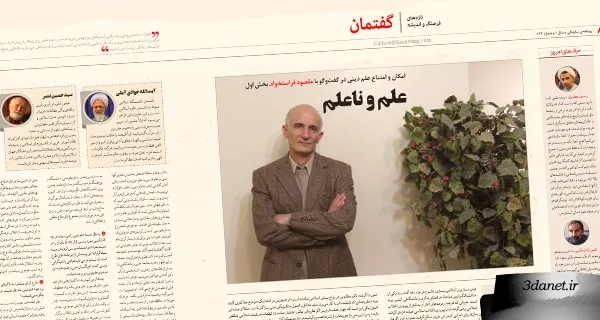
At the outset of the discussion, please explain the possibility and impossibility of the term “religious science.”
Let me begin by saying that I do not find the term “religious science” acceptable. In my view, “religious science” is neither reasonable, nor useful, nor is the insistence on religious science an ethical matter. The “religious science” project has no ethical dimension; it is not good or worthy, but rather harmful and unethical. Moreover, the claim of “religious science” is fundamentally illogical; when we claim a science that is religious, it is like saying we have a science that is “non-science.” That is, it contains a contradiction. The “religious science” project is also not useful, because through it we are driven away from science and left bereft of religion as well. It is not ethical because, with religious science, the proponents—however unconsciously—damage an independent domain of human knowledge. In human history, there is a domain of knowledge that is now called science everywhere in the world and is used to reduce suffering. This domain did not come to us easily; it is the result of centuries of effort and a shared human heritage, and what has emerged in the modern era under the name of science is a common human heritage, and in the name of “religious science” we are distorting this heritage. We damage the process of learning and practicing science, we harm the rights of scientists and researchers, the institution of science, and the act of scientific practice, and we deprive thinkers, critics, and scientists of their freedom, especially in the human, social, and cultural sciences. Furthermore, we obstruct a public good that is supposed to reach people through science. Another main reason that the “religious science” project is contrary to ethics is that “religious science” is a deception.
What is your definition of science, and what characteristic does this science possess that religious science cannot have?
According to my understanding, science is systematic knowledge aimed at understanding the natural, human, and social world. Science is methodical, transparent, and capable of “intersubjective” verification. When I practice science, this practice of mine can be examined and verified by you and everyone else; everyone, anywhere in the world, using universally acceptable methods, can examine how I have practiced science and show where it is correct and where it is incorrect. This science is open to intersubjective and public criticism, and the door to criticism in scientific practice is always open. Scientific theories are always open to critique regarding their methods, data, arguments, and analyses, and they are subject to commentary, are testable or falsifiable, and have public rational justification. When you work on a doctoral dissertation, I can fully critique it. The same applies to theorizing. In addition, when we practice science, we must provide public, intersubjective justification for it that can be re-examined.
How does the process of scientific work begin and how does it proceed?
Science begins with a problem. When you encounter a problem, you have two main scientific paths for research ahead of you. On the first path, to engage with your problem, you first go and select a scientific theory, and based on that, you construct hypotheses, collect data, and test those hypotheses methodically. Here, the method is clear, the theory is known, and everything is intersubjectively verifiable. Then you analyze them, and I can critique this entire path of data collection, the methods and tools, the manner of data processing, and the correctness of your analyses and arguments. The second main path of the scientific process is that, after the problem, you go directly to society, culture, and the real field of life; you go toward data and evidence in society, and in an orderly, methodical, systematic, and regular way, you conceptualize the data, and through this, you arrive at a new theoretical horizon, a path which is mainly traversed with qualitative methods. Here too, we can see your research process and find fault with it or criticize it, for example, showing that the data is incomplete, flawed, or insufficient, or that you have not been able to conceptualize it properly, and so on. The working method here is also intersubjectively verifiable. In any case, science, on whichever path you take, is open to criticism, testable, and sensitive to observations. This means that if one observation, just one observation, is found that contradicts your claims, you must be accountable again and cannot evade or justify it, and for this reason, in science, you are sensitive to every subsequent critical argument. You must respond. Therefore, with the definition of science I have presented, when we say "religious science," we suddenly disrupt all these paths, and with the qualifier "religious," we domesticate and limit science, which is unruly, and close the door to criticism and free dialogue upon science. Even if we ourselves do not know it or bring justifications. But the truth is that the "religious science" project distorts the entire process of learning science and is therefore neither useful nor reasonable. That is, it is not rationally comprehensible at all, like saying a square circle, which is fundamentally unreasonable and contains a contradiction. On the other hand, the religious science project is also not useful; it harms people, ensnares a society for a long time, and deceives it.
So you believe that the methodology of religious science is different from science in its general sense, and since those methods cannot be employed in this interpretation, this interpretation contains a contradiction?
As I said, I fundamentally consider the claim of "religious science" to be unreasonable, harmful, and unethical, and accordingly, I honestly know of no methodology in it, except that it is a lack of understanding of science and methodology, or it is fallacious and misleading.
With these explanations, what is your opinion on the representatives of religious science within the country, such as Dr. Golshani?
The objections I have raised apply to all these gentlemen. Dr. Golshani, Dr. Seyyed Hossein Nasr, or Ayatollah Javadi Amoli all, in one way or another, lay claim to religious or sacred science and the like. I hold all these individuals in respect; they are people of considered opinion and are respected in their fields, but unfortunately and logically, serious criticisms apply to their claims regarding sacred science or religious science. When Mr. Golshani writes the book “Religious Science and Secular Science,” all the criticisms I have mentioned apply to his work. “Secular” is an insult they have hurled at universal science. “Religious” is also an affected, ideological, state-imposed qualifier that these gentlemen have attached to science, and then, with billion-dollar projects in the name of Islamisation, they set upon the humanities. The illegitimate entity called religious science, which these ideological tendencies created, did not become science, but it cost Iran dearly. The state project of religious science in the post-revolution era, for which these gentlemen, consciously or unconsciously, willingly or unwillingly, provided the logistics and theoretical provisions, has truly inflicted great harm upon our scientific and academic community and upon Iran over these four decades. Of course, we now see that some of Dr. Golshani’s views have changed, and recently he has made criticisms and discussions and no longer defends religious science with the same former intensity. But there is a saying: forgive, but do not forget. People cannot lose their memory and not know what mistakes, errors, policies, and incorrect practices this religious science has fostered and justified in the last four decades. Of course, I emphasize again that these are respected individuals. Especially Mr. Seyyed Hossein Nasr, who in my opinion is an erudite and respected scholar, although all the objections I raised definitely apply to his theory of sacred science as well. But the rest of the individuals in the country who beat the drum for religious science and, in the name of religious science, have created universities, research institutes, and apparatuses, and receive and spend several times the budgets of the country’s hapless top-tier universities from the public treasury, openly and covertly, are, in my opinion, shops selling counterfeit goods, causing national loss and damage, and are, on the whole, not logically or morally defensible.
In your view, in what context can religious science be examined? Should it be considered within the context of modernist religious thought or within a fundamentalist one?
I think that behind discourses such as religious science, sacred science, and indigenous science lies a will to power. This desire for power is cloaked in discursive and ideological garb, whether in Pakistan and the views of Abul A'la Maududi, or at the conference held in Mecca at the beginning of the revolution. These interpretations directly and indirectly belonged, and still belong, to fundamentalists, specific political factions, and wills to power in the Islamic world. However, religious modernists, even though in some of their earlier books and views they illogically conflated the realms of science and religion and became the source of major errors, never defended the project of “religious science” and the “religionisation of science”; rather, they opposed it and generally sided with science and the independence of scientific institutions. It was Salafi and fundamentalist views in Pakistan, Saudi Arabia, or European circles that resorted to the discourse of religious science. The Pakistani government supported these ideas for specific reasons, or currents seeking to gain power exploited these issues. In Iran, too, after the Cultural Revolution, these discussions were more political and ideological claims, and they also drew upon the philosophical and scientific discussions of these gentlemen. Behind these epistemological discussions lay a kind of vested interest, power issues, interference and intervention in the work of the institution of science, and damage to the independence of the university and its academic freedom. It was the hegemony of politics and ideology over science and the university.
Setting that aside, it is mostly their arguments for the existence of religious science that we have in mind.
I have presented my critical view of the main contents of these arguments. Allow me to add here that a particular trend has also become fashionable in recent years, and those who are proponents of religious science sometimes greedily consume and utilize postmodern discourses as well. They use Feyerabend, they consume Foucault without knowing him from head to toe, in order to somehow establish the claim of religious science! It is truly astonishing and, of course, painful to me how someone who does not accept the modern has now become postmodern, and someone who defends a pre-modern thought resorts to postmodern thinking and cites Foucault and Thomas Kuhn as evidence. For instance, they use the concept of the Kuhnian paradigm, Foucault's theory of "knowledge and power," to say that we have religious science! These gentlemen apparently never ask themselves what becomes of the very foundation of religious knowledge with these concepts and theories, and what they intend to do about religious discussions themselves with the logical consequences of these theories, after proving religious science! With such fascination and to justify religious science, they come and extravagantly consume postmodern literature, but they do not realize that when they say science is not pure knowledge and is historical and so on and so forth, are they willing to accept that religion is also not pure knowledge and is historical and the rest of the consequences? Do these individuals accept this view of religion, and do they accept that in the same manner that religious science is justified in a postmodern context, religion can also be deconstructed in the same context? I am not saying this method of work and these discourses are insincere, but they are ambiguous and contain contradictions within themselves. Unfortunately, what such currents in our country pursue is to make science the handmaiden of theology; they strip it of its independence and integrity and make scientific knowledge subordinate to religious knowledge, and indeed have made it subordinate and captive to a factional governmental ideology in the name of religion, an ideology that belongs to a segment of influence groups and is oriented toward specific power and interests.
In your view, what relationship exists between science and religion? Can any exchange be established between the two at all?
When science is reduced to religion, culture, or politics, when it is reduced to a specific ideology, it becomes "non-science." It becomes anti-science or even "pseudo-science." But allow me, in response to your question and so that perhaps some of the bitterness of my words may be lessened and the pain of awareness may become somewhat more bearable, to state that there is, in fact, no iron wall between science and religion on which is written: Entry Forbidden! No, it is not like that. Religion and science can indeed have beneficial relations. I will briefly mention a few instances: First, religion can create enthusiasm and motivation for scientists to engage in scientific work. We are religious, and this religion tells us to go and serve the people for the sake of truth. So, religion has entered the realm of science and supports scientific work and aids scientific work.
Thus, we do not have religious or Islamic science, but we do have Muslim and believing scientists; we do not have indigenous science, but we do have indigenous, local, patriotic, culture-loving scientists with identity. We have indigenous knowledge. Let me return to the point that there is not necessarily an iron wall between science and religion, and one of these instances I mentioned was the motivation to enter science. The second instance is the choice of problem. Religion can tell us which problem to choose for scientific research. Religious beliefs and inclinations assist the scientist in choosing a problem, which is no small matter. The choice of problems can transform the history of science; depending on which specific problems you choose, science proceeds along a different path. The third instance is the choice of subject: which subjects should we choose for scientific research? We can draw inspiration from our religion and creed and conduct scientific research on specific subjects inspired by authentic religious teachings. The true religion tells us to scientifically examine injustices, the sufferings and hardships of the people, incurable diseases, and the destruction of nature; to undertake scientific research and scientific creation to alleviate poverty, disease, water and air pollution, soil erosion, and the warming of this earth, which is a divine trust in our hands. The fourth instance of religion entering the domain of science is the choice of theory. We prefer some scientific theories over others. For example, because you are religious or even patriotic, you might pay more attention to Wallerstein's world-system theory or Homi Bhabha's postcolonial theories, and there is nothing wrong with this if your scientific research proceeds with logical discipline, methodical rigor, transparency, and sound reasoning and evidence. Here, you have not done anything unscientific, nor have you harmed science; you have not made science religious or Iranian, but you are an Iranian and Muslim or Third-World scientist, and your being Iranian, Muslim, and from the South influences your preference for certain scientific theories in your research programs, while you also, of course, follow the necessary scientific methodology. The fifth instance of the healthy entry of religion into the independent realm of science is in the choice of method. Perhaps religion gives me the insight to pursue qualitative methods, because part of people's states and the inner qualities and modes of people, and many anthropological, ethnographic, and cultural characteristics of different, indeed unique, nations are singular, unique, and cannot be examined with quantitative methods. For instance, they require phenomenology. For example, years ago, during the first ten days of Muharram, I went and qualitatively studied the mourning rituals. Why did I do this? Had I not grown up from early childhood with religious education and upbringing and religious sentiments, I might not have had the patience for this painstaking task.
The sixth instance of justified cooperation between religion and science is the choice of fields and the choice of types of observations. Religiosity influences you toward which social groups you are drawn; I might, due to a sense of justice-seeking arising from my religion, be drawn toward the deprived groups of society, the urban poor, the marginalized, the socially excluded, and the absentees of society, and conduct scientific research about them.
The seventh point is that at the end of the work, when you compare the results of your findings with other views, these views can be those of sages, mystics, theologians, or religious exegetes. You can compare the results of your methodical scientific findings with religious teachings, ancient wisdom, verses, and hadiths, without harming the integrity of your scientific work. For example, after a methodical, logical, scientific course, compare the result with the subtleties of Illuminationist wisdom. For instance, compare it with the views of Shaykh al-Ishraq, Sadr al-Muta'allihin, Nazzam the Mu'tazilite, or Jabir ibn Hayyan, without damaging the independence of the realm and method of science. In this sense, all domains of human knowledge are one large family, and while each is independent and distinct, they possess unity amidst plurality. Religion, science, literature, art, mysticism, etc., are all different and distinct realms, each with its own specific language, method, grammar, and epistemological protocols, but ultimately they all proceed toward a single truth, and one can systematically move, circulate, and journey between these domains and compare them in an orderly fashion. I have given a talk somewhere entitled “The Strange Familiarities of the Sciences and Mysticism,” in which I explained how sciences such as physics, sociology, psychology, and even economics have strange familiarities with mysticism. That is, while they are separate, they are strange familiars. In short, you can compare the results of your scientific work with religious and spiritual wisdoms and sacred metaphors.
Fundamentally, we Iranians have it in our historical wisdoms that they do not much recommend a possessive knowledge of the world and humanity, nor a greedy scientific and technical possession of nature. From this perspective, knowledge is not of the type of affirmation; rather, it is also about wanting not to be an overlooker of existence but to be graced by it. More than being an entirely mental and technical possession, knowledge is also an approach to the truth of the world, an unveiling of the hidden, a drawing back of the veil from a profoundly concealed truth that manifests, captivates the heart, and then hides away; it is far too exalted to be caught in the snare of affirmation and negation. Our Iranian knowledge has been largely poetic. These heritages can be used in developing a particular style of scientific creation without destroying the independence of scientific knowledge as a common human achievement in the contemporary world, without disrupting its methodical nature, and especially without closing the door to critique and deconstruction in the name of religion and religious truth.
Doesn’t the contradiction of scientific results with religious teachings create a problem at this stage?
If a scientific investigation reaches a conclusion that contradicts our religious beliefs, it must be respected and preserved as a scientific finding and expressed freely, and of course, it can be critiqued scientifically. We might even reach a conclusion from our own research that contradicts some of our accepted religious notions. We should pause; perhaps it is logically necessary for our beliefs to be revised and corrected. Scientific discoveries help us edit and correct our religious interpretations. Or, at least for the time being, we should keep the two domains of science and religion separate and preserved, advancing each independently. Scientific results are not absolute and eternal; they may later be critiqued and examined in a scientific manner, especially since there are usually various competing views in science. Just as religious views are usually the product of the opinions of religious scholars and are open to critique, and should not assume a halo of sanctity in the name of religion. In any case, the two realms of religion and science need peaceful coexistence with mutual respect. The relations between science and religion must be liberal, patient, and mutually respectful. Whatever the case, the solution is not to launch a religious science project and destroy science. This discussion requires a separate, detailed conversation.
Let me return to the ways in which religion assists science. I have so far mentioned seven. The eighth is that religion and faith tell us: do not conceal truths, and if you reach a conclusion that does not suit your own beliefs, or those of the public, or that the powerful and the eminent dislike, stand by it nonetheless and express it. For an authentic religious wisdom tells us: do not conceal the truth. You are a researcher and have arrived at a conclusion that conflicts with the accepted and popular notions of the people, and with the official discourse and official power. If you are a sincere believer, you will say: my faith tells me I must not conceal the truth, and as a result, with complete courage and bravery, you will stand by the disclosure of truths and express scientific truths contrary to the ruling and influential groups or the popular beliefs and accepted notions of the people, and this is very important. Consider Galileo: he was an orthodox Catholic, but he said that faith is distinct from the official interpretations of the Bible, and what his cosmological theory contradicted was not the essence of Christ's message, but these official interpretations and readings of the Holy Book. Indeed, the very principle of faith demanded that he say, even if I recant, the earth does not cease to move. Or figures like Kepler, who shaped the era of the great scientific revolution, were people of faith, and part of their work was influenced by their religious faith. Of course, the Inquisition that Galileo suffered was carried out in a part of Europe, and we again make the mistake of thinking that this Inquisition prevailed throughout all of Europe, whereas it existed only in a part of Europe. We do not even write the history of science correctly. We do not know the history of Europe correctly either. For instance, Galileo had a teaching post at the University of Padua and was doing scientific work, but by ill fortune he took a trip to Florence, where he was caught and put on trial; had he not taken this trip, perhaps Galileo's story would have unfolded differently.
Something has just occurred to me here. The scientific movement that began and grew from the fourteenth and fifteenth centuries, although its roots lay in humanism and economic development, was also influenced in its own way by Hermetic myths in this process of scientific advancement. Hermetic myths held sway among Europeans. These myths are full of magic, sorcery, and mystery, and scientists under their influence sought to uncover the secret of existence. We see this in Giordano Bruno. So, can we conclude that European science is a Hermetic science? No, but myths, in their own way, have influenced the work of the scientist and the formation of science, and many have undertaken scientific work under the influence of these myths. Yet at the same time, the scientific method, the system of scientific knowledge, and scientific examination and testing have their own order, independence, and specific criteria. It is like a funnel: one end is very wide, and a myth can also have an effect and play a role in scientific discovery, but from the narrow end of science, it must emerge after methodical and systematic examination, testing, reasoning, and orderly, intersubjective, and public justifications.
So you believe we do not have Islamic science, but we do have the knowledge of Muslims?
Yes, that is exactly right. When more Iranian and Muslim scientists engage in scientific work in this world, it is through this that our Iranian and Islamic culture can have a greater share in human knowledge and increase the diversity of scientific work styles. So we do not have Islamic science, but we do have the knowledge of Muslims. I cannot forget when I was a student, I read a book by Professor Mohammad Reza Hakimi called The Knowledge of Muslims. In that book, he narrated all the sciences of Islamic civilization, from Khwarizmi and Abu Rayhan to Zakariya, Ibn Sina, Suhrawardi, Ibn al-Haytham, Khayyam, and others. All fields, from history to astronomy and physics. Or the late, dear Dr. Zarrinkoub, had a book titled The Record of Islam. We read it many years ago, before the revolution. In this book, you see Iranian and Muslim scientists in a flourishing period, during the European Middle Ages, when modern Europe had not yet formed and the Renaissance had not occurred. They carried out scientific work in that era because the government did not dominate them, translation was possible, free scientific exchanges took place on a global scale, and scientists had dignity and status—and there was no Islamisation project. Now, Mr. Zarrinkoub named his book The Record of Islam, but without believing in religious science. He never pursued Islamic science; he considered science to be science and Islam to be Islam. In any case, if you had searched for a concept twenty years ago, you would have seen fewer Islamic names like Qasim, Ahmad, Arash, and Gozal. But now this situation has changed, and Iranian, Turkish, Arabic, and other names appear in scientific articles, showing that the more scientists do scientific work, the more the Islamic world can share in global science. And in the same way, it is natural that the role of Iranian and Islamic culture is imprinted on the realm of global science, and science also comes closer to our local and national issues, and the pains of Iranians and Muslims are healed through this. Perhaps through this, a new scientific style may even emerge within the great global family of science, for scientific style is not limited to a single form. Just as research methods are numerous, the style of knowledge production also differs, and you can create new scientific styles through this movement, without harming the global realm of science. The global identity of science, which is recognized everywhere by specific characteristics, has complete independence from theology, religious teachings, and scripture. Scientific work never dictates what is written in scripture, or what the Prophet and the Imams have said. Scientific work never comes to limit scientific research with a religious decree or a religious text; the realm of knowledge, method, and scientific language has its own specific independence.
With these interpretations, how do you evaluate the measures taken to establish indigenous humanities?
This project was certainly harmful to society and still is. The indigenisation of science, like its religionisation and Islamisation, is neither reasonable, nor useful, nor ethical. But when we do scientific work according to the universal standards of science, naturally, as I have explained before, our indigenous knowledge, our Iranian knowledge, and our national knowledge archive will develop and serve national development and the alleviation of the sufferings of this land. The indigenisation of science is a very misplaced and unjustifiable claim. However, the becoming-indigenous of knowledge, in the sense that Muslim scientists do scientific work endogenously with religious motivation, is fruitful, because it spontaneously directs science toward our everyday, indigenous, and national problems. Science connects with our real pains and issues, and indigenous knowledge that is both local and global accumulates spontaneously and endogenously. We have a local and a global. In science, we have neither the purely local nor the purely global. Every global science has a locality. Europeans and Americans advanced science by focusing on the problems of their own societies. So why shouldn't we do the same? We do not do scientific work, scientific creativity, or scientific innovation, and we mostly feed off the science of others—while, of course, also cursing them. We must be local and indigenous while also being global. But this cannot be achieved through state-led indigenisation from above. Before the revolution, the dominant ideology was modernisation, and after the revolution, its inverse, Islamisation, became prevalent. Both of these ideologies are state-driven, and it makes no difference; both are also mistaken. Islamisation, religionisation, and indigenisation are all three neither reasonable, nor useful, nor ethical. But the becoming-indigenous of knowledge can happen naturally and endogenously when accompanied by the motivations, efforts, and free actions of scientists. On the whole, I believe in a multi-dimensional human being and a multi-dimensional society. In the sense that there is not just one language. To use Wittgenstein's expression, we have the language of science, the language of religion, the language of philosophy, ethics, literature, and art. Each is a separate sphere, and the human being must live in different spheres. When you practice science, you are in one sphere with specific goals and methods, and when you practice religion, you are in a distinct sphere with distinct goals and methods. These are separate and are two different, not contradictory, languages that can engage in dialogue and collaboration with one another.
In your opinion, what is the future horizon of science in the country amidst all this?
Our behavior toward science is hypocritical. We exploit science greedily and rapaciously, yet we also curse it. For four decades, the government has been tirelessly pursuing technology. We seek the most modern technical equipment in the world, and we even insist on culturally and socially engineering society and culture through a superficial recourse to certain new discussions, while at the same time, under the banner of religion, we continue to vilify science and technology. We boast about churning out ISI articles and the quantitative growth in the number of papers, which mostly serve promotion dossiers, doctoral defense sessions, and credentialism, yet we simultaneously speak ill of science and technology, and we obstruct the path of critical and original thinking in the humanities and social sciences with all sorts of ambiguities and restrictions in the name of religious science. I should also add that in our history, there are traces of a flight from reason. Although the dominant aspect of our civilization was not a flight from reason, grounds for it existed, and these have been exacerbated over these four decades. The flight from the foreign is the same. Again, I emphasize that neither the tendency toward a flight from reason nor "xenophobia" was ever in the essence of Iranian civilization, but they existed here and there. Over the past years, these two have been redeployed with the logistics of official ideology and have become the covering fire for "religious science." Creating dichotomies such as religious science and secular science has become severely deceptive and misleading for us. We muddle words. Language is the house of being, and we are destroying it. Muddled words indicate a muddled mind and also create turmoil in the cultural life of our society. Words like religious science and atheistic science, or sacred science and secular science, wittingly or unwittingly, raise dust, and as a result, the path to change, progress, and development for this wretched society in a fast-paced, competitive world becomes obscured, and we fall behind. In the opinion of this humble student of science, over these four decades, because of this dust, both authentic religious truths have been lost and genuine scientific work, original articles, independent scientific institutions, and free and dynamic scientific agency have been damaged. A damage that must be compensated for as soon as possible, and perhaps we will not be able to compensate for it.
.
.
PDF file of this interview in Sazandegi newspaper
.
.
A Critique of the “Religious Science” Project and the State Islamisation of the Sciences and Universities in Iran
Pardis Siasi’s Conversation with Maghsoud Farasatkhah
On “Religious Science” and the Islamisation of Science and the University
Published in: Sazandegi, 2018, Issues 123 and 124, July 24 and 25, 2018
.
.


Discussion0 comments
No comments yet; let yours be the first voice.