Religion
Four Religious Scenarios for Iran's Future
The future of religion and religiosity in Iran is being shaped by five key drivers—society, economy, knowledge, globalization, and governance—alongside an analysis of major religious trends over the past three decades.
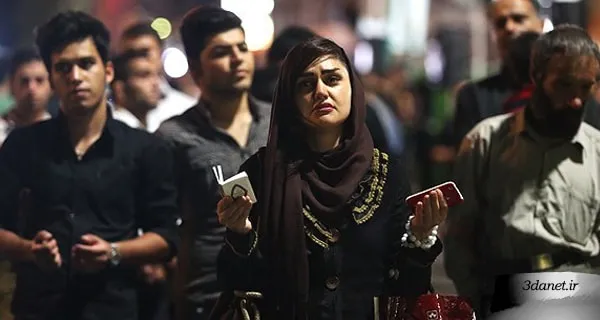
In the last three decades, considering the totality of social, cultural, and political developments, what major changes has the state of religion and religiosity in Iranian society faced? (In terms of variables such as styles of religiosity, current religious thought in society, the official institution of religion, etc.)
This is actually two questions. One concerns the economic, social, cultural, political, and technological driving forces. The second concerns the macro-trends related to religious belief and practice. So I will first address the driving forces and then the trends.
A. Driving Forces and Factors Shaping the Future
Based on previous studies, developments and factors are divided into five categories: 1. Society and Culture, 2. Economy, 3. Knowledge and Technology, 4. Global Society, and 5. Territory, Politics, and Governance, which have influenced the trends of religion and religiosity in Iranian society and will also shape its futures:
1_ Society and Culture
- The growth of new social groups in cities, such as the youth, women, and the educated
- The quiet revolution of women towards equal enjoyment of life chances and social participation, and the element of a feminine (feminist) perspective
- The growing importance of the element of efficiency and practical values
- The intensity and compression of competitive spaces for access to opportunities, resources, and capital
- Demographic trends such as the rise in average age, etc.
- Increasing diversity in social, gender, age, and identity stratification
- The networking of society
- The ever-increasing trends of utilitarianism, pragmatism, instrumental rationality, and cost-benefit calculations in the choices of various social actors
- The speed of urbanization and the growing importance of citizenship, the increase of popular power in cities, and the dynamics of urban life
- The emergence of diverse forms of consumption and lifestyles in streets, alleys, arcades, and parks; public culture, everyday life, increased attention to the body, etc.
- The increasing trend of plurality in most domains, the multiplicity of actors on most stages, and the proliferation of hands
- The growth of contingent patterns
- The intensifying distribution and fragmentation of society
- The breaking of traditional service chains in most domains and the emergence of various, competing, and rival actors and providers
- Environmental movements, the growth and flourishing of the sustainable development discourse in opposition to conventional development views
- The growth of various grounds for conflict in different polarized situations, such as rich and poor, capital and cities, center and periphery, etc.
- The plurality of expectations in the social lifeworld
- The expansion of commodification in most areas: the culture industry, the education industry, etc.
- The growth of individualism, often in an uninstitutionalized and self-centered form
- Profound transformations in family structure and its values, the decline of patriarchy, generational gaps
- Multiplicity and diversity in intellectual horizons and the growing importance of epistemology, critical reason, etc.
- The growth of a culture of diversion, personalization, pleasure, entertainment, and the theatrical element in society
- The expansion of plurality and differentiation in various realms
- Postmodernist ruptures and confusions in which identities become fragmented and various elements of tradition and modernity insist on coexisting in society and culture
- Weakness in social capital
- Weakness in the normative system of society, public morality, etc.
2_ Economy
- The increasing prominence of economic factors and financial variables
- The dominance of market ideology, the rapidly growing importance of market rules, the private sector, economic freedoms, and the reign of money over relations
- The transition from a model of job tenure to entrepreneurship
- The trend of commercialization to the point of the commodification of knowledge, the linking of science with wealth, and GATS tariffs
- Difficulties in solving problems such as unemployment
- Contentious trends of monetization in most affairs
3_ Knowledge and Technology
- The medialization of the world, the diversity of media, multimedia environments, the ever-increasing rise in media literacy
- Information and communication technology in a world that is increasingly becoming borderless or at least transborder (the Internet, satellite, virtual social networks, etc.)
- The development of the personal computer and mobile phone industry and their subsequent evolution into new generations of novel, super-smart communication tools (the call key, and interaction with the outside world as vast as the globe in everyone's pocket and bag)
- The massification of public and higher education, the transition from elite to universal and widespread universities, the quantitative increase in student populations and the educated populace
- The abundance and explosion of information, and alongside it, the growing importance of attention
- Newly emerging phenomena of information and mass communication technologies in the world
- The remarkable and novel growth of new generations of converging NBIC technologies (Bio, Nano, Info, Cogno)
- The increasing permeation of knowledge-based life and the knowledge-based economy
- Interdisciplinarity, transdisciplinarity, and the expansion of knowledge
4_ Global Society
- The transition from a bipolar world to the multipolarity of global powers (such as the twenty-first century being dubbed the Chinese century compared to the American twentieth, the plurality of powers like the European Union, Russia, China, etc.), the difficulties of unilaterally ordering the world
- The transition from the traditional North-South binary and newly emerging economic and technical phenomena like Brazil, India, or even in Africa...
- Political, ideological, identity-based, and religious tensions in the world and the region, population displacements in the country's border areas, and new economic, cultural, and political maps in the region
- The shift from purely national and domestic political and economic functions to international protocols
- Globalization alongside localization, multiculturalism, and multinationalization (the trend of dialogue among cultures alongside severe misunderstandings and clashes of civilizations)
- Brain circulation, the increase in cross-border and planetary travel, the international movement of people, information, money, genes, etc.
- Growing trends of internationalization
- The growing trend of the increasing importance of diplomacy and international negotiations to confront the escalating tensions of a conflict-ridden world
5_ Territory, Politics, and Governance
- The depletion of resources and the move toward minimal government, the devaluation of state enterprise, and the ever-increasing importance of the efficiencies of good governance
- The shortfall and contraction of government budgets and its constantly increasing inability in coupon and subsidy mechanisms
- The saturation or devaluation of the traditional system of employment and fixed salaried work in government bureaucracy and the emergence of new models of work and organization, project commissioning, and outsourcing
- The ever-increasing multiplicity of political currents not only outside the government but also within it, and the difficulties of adapting to political pluralism and the new national division of labor
- The prevalence of liberal-democratic tendencies, democratization, and the discourse of civil rights
- Growing centrifugal trends and the inefficacy of centralized, autocratic models
- The diversity of Iranian ethnicities and religions and the increase in mobility due to power shifts in the region and border proximities
- The government's use of oil revenues to capture markets by mass-supplying desired cultural, intellectual, and religious goods in education, radio and television, government organizations, and public spaces, and reproducing the desired culture
B. Trends in Religion and Religiosity over Three Decades
According to research, the following trends in religious matters are observable, more or less influenced by the above factors:
1. Religious belief and religiosity remain a dominant and stable characteristic in the country's population, with differences in gender and age
A large majority believe in God and the afterlife. They turn to God in life's difficulties and think about ultimate salvation. Of course, religiosity in the dimension of belief and religious experiences exceeds the practice of rituals. Women's religious belief and religiosity have been meaningfully several percentage points higher than men's, and this also causes some mothers to willy-nilly play a supportive role in the reproduction of religious belief in their children through state schools and media. On the other hand, according to some research, as these children age, their religiosity weakens, they show less inclination to perform religious rites and rituals, and their presence in religious institutions decreases. "Intergenerational" gaps are observed. Young people from religious families tend toward different models of religious belief and practice than their fathers and mothers.
2. The quantity and quality of religiosity differ according to social stratification, with transformation especially in the religious model of the new urban middle class
University students' participation in collective religious rituals is meaningfully less than that of non-students. Young people with lower and middle social status were more religious than those with high social status. Performing religious duties among less educated groups has a meaningfully higher frequency compared to more educated groups. The new urban middle class in Iran has a greater tendency toward the individualization of religiosity, giving importance to spiritual essence, preferring ethics over religious rituals, pluralism, secularized and non-violent religion, and understanding the exigencies of the time.
3. Religion as part of leisure time
A spectrum of collective religious rituals has become somewhat intertwined with the element of Iranians' leisure time, have entertaining sidelines, and provide an opportunity for social connections with peers and friends and lifestyle displays. For example, during the Muharram ceremonies, group, neighborhood, ethnic, and other rivalries are underway. These rituals, considering their aesthetic elements such as chants and melodies, alam and kotal, and other artistic, cultural, and social dimensions, still attract a significant portion of the youth. While such a reception does not exist for other, more devotional collective rituals like congregational prayer.
4. Transformation and diversity in the pattern of religiosity
Paradigms of religiosity, especially among the youth, have been deeply transforming and diversifying. A significant portion believes that a pure heart, benevolence, or the experience of spirituality can replace religious acts, including obligatory ones (such as prayer and fasting). Pluralism in Iranian society in terms of religiosity is increasing day by day and encompasses a spectrum from anti-religiosity, to non-religiosity, to nominal religiosity (such as occasional participation in certain ceremonies without much commitment to religious duties), to commodified and instrumental religiosity (for example, for political and social purposes), to fragmented, piecemeal religiosity. Of course, alongside these, we still witness other varieties such as traditional Sharia-based religiosity, secularized religiosity, intellectual, civil, private, and even a new type of "formless religious practice."
5. Growing plurality and divergence in religious currents and communications
There are at least five distinct currents, as follows: 1. The official state ideology (in the IRIB, the Islamic Propagation Organization, and the headquarters of Friday prayer leaders and congregations), 2. The traditional current (religious gatherings), 3. The religious reformist current (circles, books, magazines, educational activities, gatherings, and communications, with a gradual shift from political religion to civil religion), 4. The unofficial popular current (eulogy products that we sometimes hear blaring from young people's cars in the street), 5. The unofficial newly emergent current (such as communications oriented toward spiritualism, mysticism, pseudo-religions, parapsychology, energy healing, yoga, Native American and Latin American mysticisms, and books and publications about reincarnation, etc.).
6_ Religion as a personal and inner experience, or as part of the general culture without serious commitment to duties and rulings
According to national surveys, what is predominantly seen of religiosity in society, at least among a significant portion of the population strata, is mostly in warm, subjective, and inner personal dimensions such as trust in God (tawakkul), making vows (nadhr), or giving alms (sadaqah); or it involves those religious matters, like Ramadan and iftar, that are interwoven with the rhythm of family life and warm social emotions such as parties and friendly and kinship relations; or it relates to families' mourning ceremonies and religious festivals; or the entertaining sidelines that certain rituals possess; or the visitation of holy sites, which has taken on dimensions of travel and tourism.
7_ State religion has become contentious
In surveys, a significant portion believes that dress code should be optional and that the state should not interfere in it. Many, despite participating in religious gatherings, religious associations (hey'ats), and mourning ceremonies, show little enthusiasm for those religious rituals and duties that have taken on political dimensions (such as Friday prayers). Religiosity among a part of society and social groups follows a path separate from official institutions and deviates from the course of a state ideology. The consensus and agreement that still exists in Iranian society regarding adherence to religion is not seen in political, and especially state, religion. Despite great commonality in the doctrinal and experiential foundations of religion, people differ on the relationship between religiosity and politics. Regarding the necessity of referring to the clergy on socio-political issues, noticeable shifts in attitudes are observed; on the subject of religion and the state, we witness a wide divergence of opinion. The inclination toward the optional nature of religiosity is growing.
8_ The growth of a general feeling that religiosity in Iran is on a downward trajectory
Even respondents who themselves profess adherence to religion believe that religiosity in Iran is declining and that the country's people are becoming less religious.
9_ From privatization to personalization
According to some studies, even the "privatization of religion" does not adequately describe the religiosity of some groups in contemporary Iranian society; rather, "personalized" tendencies toward religion are growing. In private religion, serious beliefs exist, except that these beliefs are not a public obligation but a matter between the individual believer and their God. In personal religion, however, each person, according to their own circumstances and exigencies, sometimes resorts to elements of religion on a case-by-case, contingent, and arbitrary basis, and sometimes distances themselves from it.
10_ Divergence of attitudes regarding public religious rulings such as hijab
According to research, not only is the tendency toward wearing a manteau and headscarf, even with hair showing outside, increasing, but many also think that inner modesty is more important than outward hijab. A significant portion in surveys have stated that at parties with non-mahram individuals, they observe covering without a headscarf, or do not observe it at all.
11_ Modernization, secularization, pluralization, contingentization, and commodification in the matter of religiosity
Religiosity based on personal, non-committal, and arbitrary needs is on the rise among the faithful. Even religious rituals are not immune to the influence of these trends.
12_ The decline of totality and integrity in the religious sphere
Both traditional and modern elements continue to persist in Iranian society, creating a “bricolage” (piecemeal) culture. Iran’s lifeworld is neither wholly traditional, nor governed by an official ideology, nor purely secular, customary, and modern. There is a desire for freedom and plurality. In today’s Iran, bricolages of religion and non-religion are emerging.
13_ Quasi-religions, quasi-mysticisms, and spirituality
As mentioned above, groups within society, based on contingent needs, show interest in practices such as meditation, symbols like Sai Baba, quasi-mysticisms, and beliefs such as reincarnation.
14_ Individualistic and hedonistic religiosity
The variables of individualism, hedonism, and purely heartfelt belief are gaining importance in religiosity. A segment of society, especially the youth, say that turning toward God does not mean traditional submission and adherence to jurisprudential rulings, nor does it mean renouncing individual identity, intellectual preferences, lifestyle, and personal pleasures. According to some research, the more enjoyable the performance of religious rituals is, the greater the inclination toward them.
- Given the trajectory so far and the current situation, what is your prediction for the most important future developments of religion and religiosity in Iran?
In futures studies, to which I am also drawn, the claim of prediction no longer holds scientific credibility today. Futures studies are, in truth, nothing but a scholarly attempt to methodically and reliably examine and understand the domains of uncertainty about the future. Perhaps through this, one can compare scenarios about the future. The most important domains of uncertainty in Iranian society regarding the future of religion might include cases such as these:
- Will we have satisfactory intergenerational dialogues, or will the gaps lead to conflict and even generational rupture?
- Will the possibility of interaction, dialogue, and understanding arise between the country’s official systems and the lifeworld of society, or will the systems insist on colonizing society’s lifeworld?
- Will the state remain the custodian of the matter of religion, the contents of religion, and the propagation and enforcement of religion, or will the religious sense and life, rooted in the anthropology of this society and the ethnography of this land, be entrusted to society itself and to independent religious spheres, local and popular communities, civic institutions, and voluntary social sectors?
- Will the national culture economy develop, or will it remain lacking in competitive possibilities against official and unofficial foreign-based media?
- Will a regular and continuous process of “efficient democratization” advance within the political system, or will matters lead to extremism and radicalism on both sides and national divergence?
- Will we have diversity and innovation in the provision of religious services, or not?
- Will the grounds for peaceful and respectful dialogue between religion and non-religion, and between the sphere of religion and the spheres of science, art, ethics, and politics be provided, or will relations be contentious and violent?
- To what extent will endogenous, spontaneous civic and NGO initiatives in the religious domain be supported?
- To what extent will our country experience political stability and durability, and a lawful and liberal rotation of power?
- Will equal international interactions become possible, or will tension dominate foreign policy?
- Which of the spaces of diversity, plurality, and flexibility, or extremism and monopolism, will we have in relation to the religious matter?
- Will we have a growing economic situation and social welfare? (Oil prices, sanctions, management of economic production and inflation control, consumption patterns, and class divides)
- To what extent will religious groups, institutions, and communities succeed in satisfactory, liberal initiatives for the appealing and authentic propagation of religious missions?
- How will civic and voluntary religious actors, including intellectuals, play their part?
- Will we have successes in environmental sustainability (climate, etc.)?
- What will be the fate of the proliferating religious extremism in the region?
- To what extent will the religious have a successful, liberal-minded presence and participation in virtual social networks?
- Will the health of the youth and their satisfaction with life be facilitated through entrepreneurship and participation, or will addiction, unemployment, and anomie persist?
- Will the possibility of institutionalized and lawful participation of regions and provinces in managing their own affairs within a unified territorial framework be arranged?
- What are the probabilities for Iran's future?
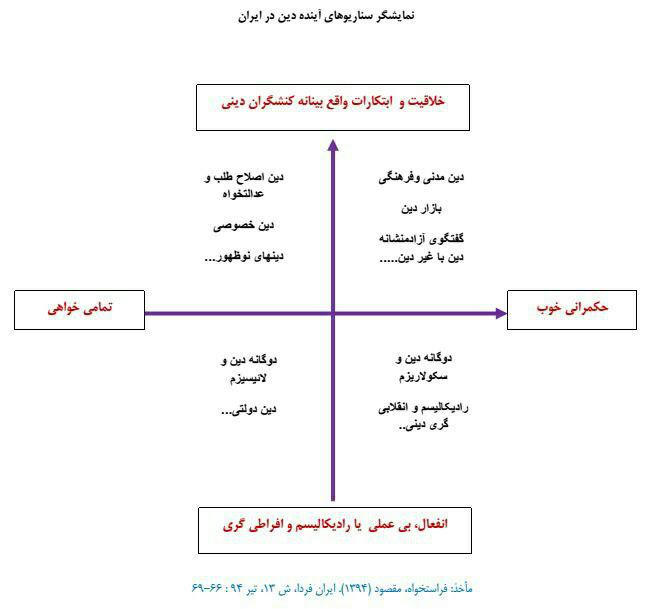
For the sake of brevity and simplicity in the discussion, from among all these uncertainties mentioned, two important uncertainties for the future of this land are selected as examples: one pertaining to the state and the other to society and the nation. In the realm of state uncertainty, the country's future will waver between the two poles of good governance and totalitarianism. In the realm of society and the nation, two states of uncertainty will be the creativity and realistic initiatives of religious actors versus passivity, inaction, or radicalism and extremism in society:
o Some characteristics of good governance are that transparent, lawful, accountable, and participatory state systems reach an understanding with the Iranian lifeworld. The government entrusts the contents of religious matters, through orderly and reasonable rules, to independent religious spheres, civic capacities, and voluntary public sectors; it supports the national productive economy in the cultural sphere; it formulates policies for development, justice, and social welfare; it pursues respectful and intelligent diplomacy with the world and the region; and instead of direct administration, it becomes a facilitator of endogenous social and cultural initiatives in the matter of religion.
o Some characteristics of creative, innovative, and realistic religious actors are that they intelligently understand the requirements of religious practice in the contemporary world, accept the reality of change and diversity, engage with the realms of science, art, politics, and ethics with mutual respect and by recognizing their independence, share their religious views and responsibilities in society peacefully and without violence, engage in production and innovation in religious services and propagation, engage in constructive and even collaborative competition with non-religious actors, and prefer lawful, peaceful coexistence.
Thus, from the intersection of these two uncertainties pertaining to the state and the nation, we can envision four scenarios for the future of religion in Iran, which are:
1_ The White Scenario; good governance on one hand, and "creativity and realistic initiatives of religious actors" on the other
The most important indicator of this scenario is cultural and civil religion. Religion as a possibility will have social adherents in free and competitive conditions. It will be coupled with rationality, ethics, democracy, tolerance, and pluralism. In the public sphere, the religious realm, knowledge, and language will engage in liberal-minded and elevating dialogue with other realms such as reasoning, science, ethics, art, and governance. In the private sphere, it will also have an influence on hearts. The Iranian model of religiosity will further discredit violent religious phenomena in the region and the world. This successful model of religion will have meaningful messages for global crises and the problems of humanity:
- Religion; a part of culture and anthropology in the history of this land
- Rational and ethical religious practice
- The flourishing of the market of religion and diversities in religious thought and life
- Tolerant, pluralistic, and peace-seeking civil religion
- Liberal-minded dialogue between religion and non-religion in the public sphere
- Respect for and influence of religion in the private sphere
- The model of religion in Iran, a successful paradigm of calm amidst the storms of the region and the world
- Religion's share in effectively confronting the crises of today's world, reducing suffering, and elevating the health and quality of life
2_ The Green Scenario: Realistic creativity and initiatives of religiously oriented actors in the face of authoritarianism and totalitarianism in the sphere of governance
The main characteristic of this scenario will be religion as a transformative, reformist, justice-seeking, and freedom-seeking discourse against the state's religious ideology, bearing the mission of social and political critique and enlightenment. Groups within society will also live with religious meanings in their private sphere. A portion of religious practices will become an expedient amalgam of traditional, modern, and postmodern elements. Against the official religious ideology of the state, we will have various types of unofficial religiosities in traditional, popular, and new forms, in addition to emerging religions, mysticisms, and spiritualities. In this scenario, religion will, in any case, be considered a determining factor in the forthcoming changes in Iranian culture and society:
- Religious reformism and libertarianism
- Religious transformationism and justice-seeking
- Religious critique and enlightenment
- Fragmented religiosities in the social lifeworld (satellite and minaret)
- Private religion
- The duality of official religion and various types of unofficial religiosities in traditional, popular, and new forms
- Emerging religions, mysticisms, and spiritualities
- The role of religion in social changes in Iran
3_ The Red Scenario (Good governance and, in opposition to it: passivity, inaction, or religious radicalism and extremism)
In this scenario, the prominent and accepted tendency in Iranian society for governance will be a secular one, and this society will grapple with the duality of religion and secularism. While the accepted discourse for the sphere of steering the country will be customary and civil law, groups in the name of Sharia will contend with this discourse. As a result, violent contexts under the banner of religion will proliferate. Some groups will exploit this religious violence, while others will use certain religious teachings according to their personal tastes and temperaments in life as circumstances dictate, and considerable groups will also incline toward irreligiosity. The state will attempt to enact laws to control religious extremism, but these laws will have inefficiencies, and religion will become a factor of instability in Iran:
- The duality of religion and secularism
- The duality of Sharia with customary and civil law
- Religious radicalism and revolutionism
- Violent religious zealotry
- Privatized religion
- Social irreligiosity
- State laws for controlling religious extremism
- Religion as a factor of instability in Iran
4_ The Black Scenario (Totalitarianism in the sphere of governance and extremism in the social scene)
This scenario is the worst possibility for the country's future, characterized by a totalitarian state religion and, in opposition to it, a growing discourse and tendency toward de-religionization in society, pushing anything bearing the name of religion to the margins of the public sphere. Groups from the weaker social strata, faced with official religious coercion, will resort to pretense, undermining their self-esteem, while more cunning groups will use religion instrumentally to access rents and benefits. In either case, religion in Iran will be discredited; its capital of influence over hearts and the ability to attract trust and empathy will diminish, and instead of being a social mortar and a factor of solidarity, it will become a source of social alienation. Another wave of ISIS-, Taliban-, and Boko Haram-type phenomena will likely grow in Iran, further fueling religiophobia in the region:
- State religion
- The religion vs. secularism binary
- The decline of religion's social and cultural capital (the prevalence of religious pretense, etc.)
- Sectarian and religious conflicts
- Instrumentalized and commodified religiosity
- Iranian-style ISIS-ization and Taliban-ization phenomena
- Religiophobia
- Social alienations
.
.
Four Religious Scenarios for Iran's Future
Maghsoud Farasatkhah
Published in: Iran-e Farda, No. 13, Tir 94: 66-69
.
.

Discussion4 comments
با تمام نیرو به سمت سناریوی سیاه پیش میریم
کاملا درسته.. ظاهرا نویسنده باید مجددا سناریویی برای بعد از سناریوی سیاه بنویسد :-)
سناریوی سرخ در حال حاضر بیشتر در رسانه و شبکه های مجازی قابل مشاهده است اما رگه هایی از سناریوی سیاه هم ظهور پیدا کرده. مسلما ما به سناریوی سفیدی که از اوایل انقلاب تا کنون قصد رسیدن به اون رو داشتیم نمیرسیم. صادقانه باید گفت عملکرد گروه های رادیکال و چپ داخلی و خارجی به مراتب بهتر از رسانه ها و گروه های محافظه کار و اصولگرا بوده.
به نظر، همین حالا در سناریوی چهارم هستیم :-/