Religion
Safir-e Hayat Interviews Maghsoud Farasatkhah on Religion and Religious Disaffiliation
Maqsoud Farasatkhah distinguishes two distinct aspects of religion: religion as a real phenomenon, which is a dimension of human life, and religion as an ideal phenomenon, which is the province of the elect and the prophets; a sociologist's discussion of religious trends in Iran.
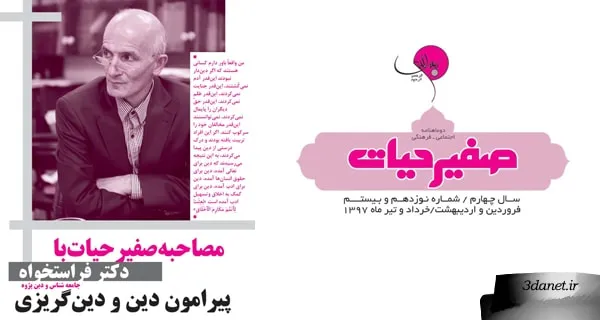
What follows is a detailed conversation between “Safir-e Hayat” and Dr. Maghsoud Farasatkhah, a sociologist and faculty member at the Institute for Research and Planning in Higher Education. His academic studies have been in the fields of philosophy, theology, and higher education development planning.
To begin with, could you give a brief definition of the two terms “religion and disaffiliation from religion”?
I think religion has two distinct aspects: one aspect of religion is religion as a real affair, and another aspect is religion as an ideal affair. [Religion as a real affair or religion as an ideal affair.] I will explain this real affair and ideal affair and how they are connected a little later; for now, let me put it this way: religion as a real affair is a dimension of human life, a dimension of the human mind, a dimension of human language.
Wittgenstein says: there are various kinds of vocabulary and various kinds of grammars; we have the grammar of science or the grammar of art, and there is also a language that is the language of religion. Religion itself has a language; this language has symbols, it has vocabulary, and it is essentially a guide for living. So, in this sense, my conception is that the human being is a multi-dimensional creature; one dimension of the human mind, one dimension of human language, and one dimension of human life can be religion. What does this mean? It is a mode of feeling; if you and I and our friends happen to have this feeling, religion becomes relevant to us. But we may not have it; many of our friends, who are also very good friends, do not have a religious feeling, for various reasons and causes. We can still live with them in a liberal manner according to the rules of custom, ethics, and law. Consequently, I conceive of religion as a dimension of the human mind, human language, and human life; it is a mode of feeling and perception. It has its own symbols; symbols and tendencies arise for humans through religion. Beliefs are formed that create a ritual system, for example, Buddhism, Christianity, Judaism, Islam, Zoroastrianism, various faiths, Shinto, shamanism, and others come into being. In every religion, there are narratives, there are sacred texts, religious authorities and religious traditions take shape. Blessed objects and places come into existence in the view of the faithful, and a sacred law is formed: “For each [community] among you We have appointed a law and a way.” [1]
People like Glock and Stark have worked from a sociological perspective. We have done a lot of work with students; over the past few decades, national questionnaires and surveys have been conducted. There is an accumulation of these surveys. A few years ago, I conducted a meta-analysis of national studies; I meta-analyzed at least 90-some studies. That is, I re-arranged and examined the results of the surveys and studies and published them on my blog [2]; I discussed and presented these several times at the Sociology Association. From the totality of research conducted on religion in past years, I summarized something: what are the results of religious trends in Iran?
Glock and Stark proposed five dimensions of religious belief, religiosity, or religious practice for religiosity: one is that religion is an experience, a lived experience. Everyone has a lived experience; for instance, someone has made a vow and their vow was fulfilled, they have an experience of trust in God, they have experiences of other religious things. A few days ago, one of my doctoral students who had returned from a sabbatical in Toronto recounted that in the lobby of his rental complex, an Iranian had brought votive shole zard; residents of various nationalities and religions were coming and participating in the ceremony. So, one dimension of religion is the experiential dimension.
The second dimension of religion is beliefs: belief in God, belief in whether God is personal or impersonal. The God of Eastern Asian religions is not a personal God; they do not have God in that personal sense at all. Whereas in Semitic religions, there is typically a personal God. In the view of many of our mystics, the transcendent God is different from the God of the jurists, and the same is true in the view of our philosophers. Therefore, each of these religions has different belief systems. Bodily resurrection, spiritual resurrection, or resurrection does not exist in some Eastern religions, and reincarnation exists in its place. You see, there are various kinds of beliefs.
The third dimension is ritual. Every religion has its own rituals. Islam has rituals such as Hajj, prayer, fasting, and so on. Jews have theirs, Christians have the Eucharist, and so forth.
The fourth dimension is knowledge, meaning what awareness does religion comprise, what knowledge does a religious person typically possess? We usually do not survey this much in Iran, because it introduces a bias and an error into the research result; all sorts of pressures are imposed on people’s minds. Unfortunately, compulsory religious instruction in schools and the media, presented as religious education, does not show the reality of religiosity. If you had wanted to survey pre-revolutionary society, religious knowledge could perhaps have represented a part of religiosity.
The final dimension is consequence. When we are religious, we feel what the result of it will be for our life, in this world and the hereafter.
So, up to this point, I have spoken of religion as a real matter, that is, a real social and human phenomenon that exists among people, whether on a micro or a macro scale.
Another view of religion is religion not as a real matter, but as an ideal matter. What I mean by ideal is that this kind of religiosity exists at the level of the elect. That is, there are those who believe in religion as an ideal matter; for them, religion is a set of deeply penetrating experiences. Usually, this kind of religiosity is accompanied by events and occurrences. For example, Muhammad (PBUH) was a human being who had such a religion, the religion of Abraham, which in the Quran is described as the creed of Abraham. The religiosity of Abraham, Muhammad, Christ, and others contains very profound experiences and is accompanied by events. For instance, Moses; according to the traditions, his wife was suffering the pains of childbirth, the weather conditions were unfavorable, they were stranded and wandering in the desert. Then, from afar, he sees a light: “He said to his family, ‘Stay here; I perceive a fire.’” [3] That is, an event. Then he reaches the point where “Indeed, I am your Lord, so remove your sandals.” [4] That is, a state where an occurrence initiates the revelation to Moses. Or, for example, what is mentioned about the Messenger of God’s meditations in the Cave of Hira, what events happened in the Cave of Hira and the effects they had on his being, and then the story of: “Recite.” [5] These are events and occurrences, something that befalls a human being and completely dispatches and arouses him, and launches him into time and history. It is a supernatural matter, accompanied by miracles, accompanied by charismatic acts. This ideal matter is usually transmitted to society in a process and, in another process, turns back into a real matter. This dialectic is very strange, meaning as soon as the Prophet undergoes transformation, as soon as he finds an audience, invites them, all kinds of human beings emerge from among them, then this ideal matter turns back into a rite and becomes real again. Then come the sentences we have all heard.
Real in the sense of actual, or according to what exists?
No, actual; the real matter, meaning a matter that exists in reality, not truth.
In terms of precedence and succession, are these not related?
These cannot be explained in a linear fashion, but it generally seems they have always had a dialectical relationship, that is, both at the broader level of the common people and at the level of the elect.
Can we not call it innate nature (fitrah)?
In a sense, yes. I do not want to attach specific theological labels to these things; let us look a bit more broadly. In my view, both the real matter and the ideal matter are coeval with humanity; they have always generally been with human beings. When we examine human history, we see that these two matters have existed among people in some form, even in the inscriptions and writings we see on cave walls. In the past, too, from ancient times, there have been human beings who, at least in their own specific language, have had these things. The real matter has also existed on a large scale, and another on a small scale.
In our traditions, they say 124,000 prophets have appeared. For each of these prophets, there was, in some way, an ideal matter. Each of them found a community, or a group, or an audience, and then during their lifetimes, or especially after their lifetimes, a real matter emerged in which all sorts of stories arose. I myself imagine that it was not the case that religion began with the prophets; rather, it exists within the human being itself, which is referred to as innate nature (fitrah). It usually succumbs to superstition and degeneration, and then the prophets would come to improve and elevate it, to reform it, to exalt it, to say it is better to have faith and practice religion in this way. I wanted to point out the distinction between religion as a real matter and as an ideal matter. With examples I will later give from the Islamic world, this issue will become clearer. Let me also say that it has been said that religion is coeval and concurrent with humanity, but the truth is that researchers, sociologists, anthropologists, philosophers of religion, historians of religion, and all kinds of theorists have come and spoken of historical processes and historical periods. For example, Auguste Comte says: In the mythical period, the human mind was very much pursuing myths in religiosity. Then came the philosophical period, where metaphysical-philosophical discussions became prevalent, and then came the empirical period and positivism. There was a period in the history of thought when empirical science entered. In this period, people no longer want to explain rainfall through God; instead of saying God sent the rain, they say water evaporated and distilled, there is a connection between phenomena, and it rains.
Auguste Comte says: The human mind, and human history in general, has passed through periods; there were periods of religion. These ideas are somewhat old, meaning they belong to the 19th century. They are somewhat linear; later, many researchers did not accept them, they saw them as positivist, they felt that human history was not so linear, that it has had all kinds of perspectives. Even while looking at things scientifically, one could simultaneously look at them faithfully, look at them religiously.
I want to refer to the intellectual atmosphere of Iran. For instance, someone like Feuerbach says: We become alienated from ourselves precisely through God; we project the perfections we should seek within ourselves onto the heavens and become alienated from ourselves. There is a famous discussion in his work, namely: Did God create man, or did man create God? He has concluded that it is man who creates God, that is, the opposite of what we have: "God created Adam in His own image," [6] he has said it exactly in reverse. You know, he is someone from whom Marx borrowed, he had a great influence on Marx. That which has come in our tradition, that God created man in His own image—and it is not only in the Islamic tradition—he says the exact opposite. He says: It is humans who, in their own image, create a god in the heavens. Of course, he says: The perfections that man desires within himself, he seeks in the heavens, whereas he should seek them within himself. As Hafez says:
You yourself are your own veil, Hafez; rise from the midst.
Or in the words of Rumi:
O people who have gone on Hajj, where are you, where are you?
The beloved is right here, come, come.
Feuerbach said it in this way, that we in reality become alienated (Alien), and we must return to ourselves, seek awareness, freedom, power, creativity, justice, kindness, and knowledge within ourselves. But we project this, we seek it in the heavens. Then he says: Religion is the source of human alienation. The same thing Marx says: it is the opium of the masses, the sigh of the oppressed, the heart of a heartless world; Marx is under the influence of these ideas and teachings.
Then we come to Weber, who is better known and one of the pillars of the sociology of religion. Max Weber proposes: day by day the emotional current retreats in favor of the rational current. He believes: day by day, with reason and science, the world undergoes demythologization and disenchantment. Consequently, he says: the new world becomes a disenchanted world. He is a prominent sociologist of religion speaking in the 19th century and says that in the new world people follow myths less; people want to follow theories, to critique and examine. Many enchantments and mysteries are demystified. Weber himself does not argue much—of course, he himself has problems with this new world and discusses the iron cage of bureaucracy—yet later sociologists of religion also criticize this very discourse of his, that history is not so linear, and that the human being is not an entirely rational creature; the human being wants to be a little irrational as well. We truly see that the human being does not want to be entirely rational all the time; they want to be a little irrational.
Let me summarize and wrap up this part of the discussion. Someone like Inglehart, who is much more recent, also proposes: in reality, religion is the result of a lack of existential security for human beings; wherever humans cannot feel existential security, they turn to religion. He says: when development occurs, this anxiety about existential security diminishes, and consequently, following this process of development, the sense of security in humans increases somewhat and the role of religion fades. But then he himself says: on the other hand, development causes the population to increase, and the birth rate of religious populations also increases, and as a result a paradox arises here.
In Inglehart's view, does the role of religion fade with development, or do religious beliefs fade?
It makes no difference, because humans feel security. We see that theoretical debates are still ongoing; those who simplify say that religion is finished—this is truly not the case; it is very complex, although we cannot ignore these discussions either. But it is difficult; we constantly want to simplify words, whereas in truth they are difficult.
Is this view not identical to Marx's view that religion is the opium of the people?
They are connected. Of course, this is far more sophisticated than Marx's discussion; it raises a much broader topic. Marx only saw it from the perspective of class conflicts; Marx says: the upper classes created these to tell the lower classes that you will see the result in the afterlife. But Inglehart sees it on a much broader level; for example, he says: it is defeated nations, failed states, and natural and social catastrophes that increase the tendency toward religion. Of course, you know that international surveys have been conducted and a great deal of evidence also shows this. Incidentally, one of these discussions can also be seen in Iran; in Iran, the Pahlavi state-led modernization failed. Failure in the sense that corruption and inequality occurred within it, conditions were created in which it could not move forward. We fairly remember (we were students at the time) that the growth of incomes and the state of transformations taking place in society were such that some researchers said a small industrial revolution was happening in Iran, in various and large dimensions; yet at the same time it failed and could not reach fruition, because it was unbalanced; for instance, the villages and their people were not attended to, and for this reason inequalities increased and villagers also came to the city. In reality, the feeling of inequality increased. On the other hand, corruption infiltrated among the statesmen—of course, with the large volume of today's corruption, that corruption does not come to mind!—but in any case, corruption existed then; we felt this. Another issue was dependency. People felt that decisions at the macro level were not very national and had connections with foreign centers. The autocracy that arose in the Shah due to the arrogance of oil revenues caused him to suppress the nationalists, suppress the intellectuals; all of these went hand in hand and the state project failed.
When state-led modernization failed in Iran, people turned to religion. Consequently, religion became the alternative to this modernization. Certain religious leaders who had become politicized were able to expropriate this desire for change among the people for their own benefit. Overall, I want to say that these are very important discussions. Of course, contemporary sociologists of religion, whose ideas we now engage with in our classes and studies—for instance, Hervieu-Léger—propose that humanity has been afflicted with a kind of collective amnesia in the modern era. People now want to forget God; that is, their lives have become such that God is absent from them, their lives are entangled with other things, and as a result, she says, a kind of collective forgetting of concepts like God and the afterlife is taking place.
I once became curious and examined this in our own society, and I saw that this phenomenon exists. People get on the metro in the morning, go to work, and so on… there are so many preoccupations in modern life that God is either absent or His presence is faint among them. People have become enclosed within technology, so that seeing thunder and lightning, seeing the sky, paying attention to certain truths, feeling fear, or even seeing any creativity in nature itself, which they encounter, has now diminished.
Is this diminishing attention to God's presence a flight from religion? Or is it an inevitability for modern humans?
It is inevitable. Processes of change have brought about this situation; Martin Buber also holds a similar view. Buber wrote a book called "Eclipse of God," in which he says: God has essentially been eclipsed from our sky; our science, our rationality, has become like the moon. The moonlight of our humanity and rationality has come and blocked the light of the divine sun. This is what is meant by: 'You yourself are the veil, Hafiz; remove yourself from the midst…' That is, a state has arisen where we ourselves have become a barrier between us and God; meaning our rationality, our science, our technique and civilization have developed so much that they have become a veil for the sense of the divine.
Martin Buber does not deny the existence of God, but says He has been eclipsed from the sky of modern life. These ideas even exist in some discussions among our own thinkers; for example, Iqbal Lahori says: there was a period of humanity's infancy, its childhood, during which prophets continually came from outside and called to them, but humanity reaches a maturity—this is Iqbal's expression in the book "The Reconstruction of Religious Thought in Islam"—in this period, humanity itself experiences God, and there is no need for a prophet to come from outside. This becomes the source for religious experience becoming a personal matter, and gradually faith replaces religion; religion is not important, it is more faith that is personal. Some even continue along this same path, saying spirituality replaces religion. In any case, these discussions exist. I remember Mr. Motahhari, before the revolution, had a dispute with Iqbal; Motahhari said: This explanation Iqbal gave for the seal of prophethood, as to why prophets no longer come?! His explanation and elucidation is the seal of religion, not the seal of prophethood. In fairness, this dispute is not without merit; in any case, these are very weighty discussions.
I myself, on the whole, as a student of these matters—I only offered these as examples—believe that the matter of religion is not linear, that it once existed and at some time will not; it is not that simple. In today's world too, religion and faith exist more or less in various forms; even if not to the extent of the past world, in some way religion still exists in this world. That is:
The fairy-faced one cannot bear concealment; if you shut the door, she will peek through the window.
Religion is not something about which one can theorize so simply and linearly. Because it mingles with a part of human existence and emerges from it. There are even figures like Peter Berger, a sociologist of religion in Boston, America, who has worked on the sociology of religion for several decades, from the 1960s to the present. He is a Weberian; Peter Berger, in terms of sociological traditions, follows the Weberian school, yet Berger's latest theory is that one cannot say religion disappears with this disenchantment and demystification; rather, new mysteries are produced again, a new enchantment that Mr. Shayegan wrote about in Iran a long time ago. This, in fact, in a way said that enchantments have gone, but a new enchantment emerges again. For example, now in America, the market for religion is robust; Berger himself has explained how there is a market called religion in America. Unlike Iran, where religious goods have become monopolized by the rulers, in America, the competitive market for religion is thriving. Now there are religious sects in America whose budgets are larger than our country's budget. There is plurality there, there is freedom, it is a market, religion is a taste. Some people have a taste for going to church on Sundays, or another day with another sect. Imagine, if you have traveled you have seen people whose life issues are met through other means, they have income, an average per capita income of 40-50 thousand dollars, there are those for whom material life issues are resolved, as well as concerns of social life including issues of freedom, democracy, and science. To some extent, there is social welfare, there is plurality of opinions, but in that same place, Rumi's Masnavi is printed in millions of copies, Buddhism also becomes important to them, and in their leisure time they pursue these things. Marginal groups like women, Blacks, and other groups who, through religious sects, pursue their civil demands and cultural and social interests, are seeking a space for self-expression.
Are these not considered beliefs?
It is the Real itself. Of course, it is quite possible that within these, conditions may arise where individuals experience some attractions and experiences of the nature of the religious Ideal, but on the whole, it is more the Real. What I want to emphasize is that religion is not entirely an independent variable; although religion influences other things, from one perspective it is also a dependent variable, a function of other things, this is very important. That is, the matter of religion is a function of the human mental state, a function of the human spiritual state, a function of the human moral state, a function of the human social and cultural state. As Hume—the famous philosopher of religion—said: it is not important what religion people have, or whether they have religion at all; what is important is what state they themselves are in. Then he explains, saying: the religiosity of decent people usually becomes polite and liberal-minded religiosity, the religiosity of indecent people becomes indecent, fanatical, and oppressive, the religiosity of foolish people becomes foolish, and the religiosity of wise people becomes wise and reasonable. Incidentally, we also have this in our own traditions.
Add location as well, rural or urban.
That is correct, geography also has an effect. A rural fatwa smells rural, an urban fatwa smells urban. In conflict-ridden and strife-filled conditions, religiosity becomes violent; in developed conditions, religiosity also develops. Incidentally, we have this in our own tradition: "النَّاسُ مَعَادِنُ کَمَعَادِنِ الذَّهَبِ وَ الْفِضَّهِ خِیَارُهُمْ فِی الْجَاهِلِیَّهِ خِیَارُهُمْ فِی الْإِسْلَامِ",[7] this hadith explicitly says: People are like mines of gold and silver; the best of them in the Age of Ignorance are the best of them in Islam. We incidentally see in Islamic history that there are very famous Muslims who were violent, and when they became Muslims, they were still violent. People who were cultured, when they became Muslims, were also cultured. This is very important.
Ten, twenty, thirty years ago, on the Nights of Qadr, when I had the patience, I would engage people with these discussions, arguing that religiosity itself is the result of other things. My objection to our society today has been that we want to resolve everything through religion, whereas before religion we must think about other things. A society with improper education, a society with an improper ethical culture, will certainly have problems with religiosity as well.
"ذلِکَ الْکِتابُ لا رَیْبَ فیهِ هُدىً لِلْمُتَّقینَ",[8] the Quran itself says at the beginning that there is no doubt in this book, but it is only a guide for the pious and the self-restrained; one who does not have self-management and governance over their desires, emotions, and relations, the Quran cannot guide them. "شِفاءٌ وَ رَحْمَهٌ لِلْمُؤْمِنینَ وَ لا یَزیدُ الظَّالِمینَ إِلاَّ خَساراً".[9] For one who is wicked, religion facilitates wickedness for them.
I truly believe there are people who, if they were not religious, would not have killed so many, would not have committed so many crimes, would not have perpetrated so much injustice, would not have trampled so many people's rights, and could not have suppressed their opponents so much. If these individuals had been properly nurtured and had gained a correct understanding of religion, they would have concluded that religion came for transcendence, religion came for human rights, religion came for courtesy, religion came to aid morality and facilitate courtesy: "بُعِثْتُ لِأُتَمِّمَ مَکَارِمَ الْأَخْلَاقِ".[10]
The important point is that it has not yet been experienced that religion is not dependent throughout history. You cannot find anywhere in history where you can say this is the authentic religion, that it is not dependent and is independent.
Yes. I said that religion is something variable and dependent on other things.
Therefore, how can I know empirically that religion can guide me? Such a religion has not been experienced throughout history!
That is exactly right. That is what rational good and evil is for; we must proceed with reason, conscience, and morality, and test religion against them. We know that certain things are good or right, or certain things are bad and wrong. Religion must also be understood based on rational good and evil.
Rational good and evil might also suffer from the same problem.
Yes. I do not want to make them absolute. It is just that since our discussion is about religion, I wanted to say that in our society we have become accustomed to looking at religion as an independent variable. We think religion solves problems, or on the other hand, some say religion ruins things. In my opinion, both groups are mistaken. Some say: only Muslims in the world are backward, all non-Muslim countries have progressed. Some hold this view, which is wrong, because from the other side one can also see that the degenerate state of religion is also a result of their backwardness. The story here is not linear, that religion is the source of all backwardness; some on this side also say that our entire salvation lies in acting upon religious rulings, this view is also wrong. Salvation lies in reason, morality, dialogue, collective thinking, logic, freedom, and proper education and upbringing; in that case, religiosity will also improve. We must improve the human being itself; until our condition changes, nothing will change.
In what framework do you want to define this selfhood? Human reason or his emotions?
At the individual level: reason, emotion, and ethics; at the social level: social upbringing and civic institutions. A society in which civic institutions exist also has freedom and democracy, dialogue exists, and naturally, religiosity also improves. For example, Mr. Bazargan is religious. Ayatollah Taleghani said: Engineer Bazargan was religious and devout. Why? Because his parents raised him properly, then he fell into the line of people like Abolhassan Foroughi, he had good teachers, he was influenced by cultured individuals, he had collaborators and companions like Yadollah Sahabi. Then he went to France, where he was influenced by very distinguished education, influenced by the Paris school that cultivates human beings, brings self-esteem to human beings, brings moral understanding to human beings. I do not want to idealize them too much, but it is a reality that we have studied; these are our studies, our research on what happens in educational systems, what possibilities exist? Then Bazargan's record of a healthy social life, his way of living and good relations, his financial relations, social relations, economic relations, cultural relations, and his studies; all together, hand in hand, made him an Engineer Mehdi Bazargan who now wants to have a noble, liberal-minded, and courteous religiosity, wants to have a rational and freedom-loving religiosity, and he tried to stand by this until the end. And so on with other examples.
This supports the point you make that religion is a dependent variable, not an independent one; we can also add that it supports the idea that the ethical norms that come in religion are not foundational but confirmatory.
Yes. This is why we see that many religious rulings are confirmatory and advisory. That is, they have endorsed good customary and social systems. I have discussed at length somewhere that if Muhammad (PBUH) were sent today, he would call for democracy, civic ethics, freedom-seeking, justice-seeking, rational civilization, sustainable development, the new custom, and today's common sense, and would criticize violence, injustice, vulgarity, inequality, poverty, environmental destruction, the hegemony of powerful states, and bigotry, hypocrisy, and rigid ritualism [11]. Returning to the ideal matter, we have concluded that the Prophet did not bring a religion but rather wanted to correct and modify the existing religion in Mecca. In Mecca, there was worship, there was Hajj; religion in Mecca was an important matter, there was a religious culture, there were rituals, there were customs. Some held positions and statuses, all were religious positions: the custodianship of the Kaaba, providing water to pilgrims. The Prophet of Islam was accused of destroying religion. Just as it was with Moses.
Just as Pharaoh said: "Indeed, I fear that he will change your religion." [12]
This is about Moses (AS). This issue also existed regarding the Prophet. They say you have come to cause division, to disrupt the unity of our religious word. While the Prophet preached the Abrahamic Hanifiyya, that primordial faith, that innate nature. He says, woe to your religion and religiosity, woe to your prayer-performing and ritualism and ceremonialism: "So woe to those who pray * [But] who are heedless of their prayer * Those who make show [of their deeds] * And withhold [simple] assistance." [13] What kind of religion is this that we have that does not restrain from violating the rights of others? This religion of yours does not "restrain from immorality and wrongdoing" [14]. A God who: "Indeed, Allah does not order immorality," [15] is the God you worship ordering you to transgress and commit evil?! Now we see it in our own society; with religion, we commit violence, trample the rights of others, cause harm, trample custom, reason, law, and ethics, destroy the country! True religion is correcting this, returning it to an ideal matter, saying God is the pinnacle of humanity, God is presence, God is accountability, God is piety.
Let us go back and explain the ideal matter and the real matter a bit more in Islam.
Look! The Prophet had a revelatory unveiling; in my view, this was the ideal matter. And it happened precisely within the Abrahamic tradition. If the Prophet had been in China, he would have unveiled in a different way; if Muhammad ibn Abdullah had been in Japan, in another historical situation or another geographical situation, he would certainly have imagined God differently: “And We did not send any messenger except in the language of his people.” [16] He understood in the language of his people, and the worldview of Mecca is present in this picture.
Even in the pillars of the Islamic worldview?!
Everything. You mentioned that some of the rulings of the Sharia are confirmatory; it is also the case with the pillars. Allah is an Arabic word; Abdullah was the name of the Prophet’s father. So this Allah existed among them; angels and jinn existed. Indeed, the Prophet understood the world based on Arab knowledge and cosmology. But that truth of gnosis, the truth of revelation, the truth of faith, and the truth of monotheism is a very transcendental matter, yet it came within the framework of the Prophet’s mind, meaning it descended.
And we would even have had a different Quran?
Even regarding the Quran, if people had asked the Prophet other questions, we would have had a different Quran. The Quran happened to be this way; the Quran is an answer to questions. We researched this in the Quran and saw that it repeatedly says: “They ask you,” [17] meaning, O Prophet, they ask you. An incident occurred, a dispute arose, they came and asked the Prophet, and revelation came in response to him. If, instead of this dispute, they had come about something else and asked other questions—if they had been a more civilized people—other answers would have been sent down from God. So the Quran was also according to the conditions of that day.
In that case, what do we do with the theory of the universality of Islam and the Quran?
There has been a unity; whether Buddha, Muhammad, or Christ, among them, despite all the differences according to circumstances, there is a truth behind this multiplicity. That truth and that zenith are universal, and that is what matters.
Universality has nothing to do with rulings, commands, and religious obligations!
What is universal is precisely: “Exalted is He and high above what they associate with Him,” [18] “Exalted is He and high above what they describe.” [19] “Exalted is He,” He is pure and transcendent, beyond our description, beyond our differences. I do not want to enter into these theological discussions. Look! Historical Islam is the real matter, meaning the Islam we have from the early Islamic period, the period of the Companions, then the Followers, and thereafter. When you say “the people apostatized” [20]—I do not want to confirm this narration—but the very fact that you say “the people apostatized” means religion is historical religion; you do not validate this religiosity. At least in the Shi’i understanding, there is somewhat of a sense that a Shi’i understands how, during the Prophet’s time, people turned away from the Prophet’s call. I do not want to judge, because I do not want to present a Shi’i perspective here; I try to discuss religion in its totality.
What did the Mu’tazila say? The Mu’tazila approach religion as an ideal matter, meaning they want to understand it rationally. Philosophers like al-Kindi, al-Farabi, Avicenna, and Averroes pursue God as a rational matter. That is, they say beings are either necessary or contingent; since the world is a world of contingents, there must be a Necessary Being. Consequently, God is a rational matter. But do the common people live with this God of the philosophers? No, the common people and the general society understand God according to their own conception: “The words you use to describe Him in their most precise meanings are created and fashioned like yourselves, rejected back upon you. Perhaps the tiny ants imagine that God has two antennae.” [21] Whatever you imagine about God is entirely a creation of your mind; the ant also thinks God has two large antennae.
On the whole, I think that mystics seek religion as an ideal matter, which is why they speak of truth (ḥaqīqat), law (sharīʿat), and the path (ṭarīqat). One of them, like Manṣūr, who soars very high and reveals truths, is seized and killed; another becomes a Ḥallāj, another a Bāyazīd Basṭāmī. You see that this issue has always existed. In our own contemporary era, many exegetes were barred from the seminary, many sages and those who wished to teach Transcendent Theosophy in the seminary were barred, they were not permitted.
Have you passed judgment and do you consider all these outlooks to be among the saved?
I do not judge at all. I want to say that religion has two levels: one is the real matter, the other the ideal matter. Not necessarily in the sense of correct.
For one person, religion is a particular experience; for another, it is the result of an incident; for one, it is an ideal matter, and for another, a real matter. For one, it is a serious matter. For one, it is a general culture; for another, it is a heritage from ancestors and respected to that extent; for one, it is the outward aspect of the law, and for another, its inward aspect, the path, and the truth. A person may combine some of these dimensions within themselves, or lean more towards one side. There must be freedom of religiosity and also freedom of irreligion, and plurality of opinions and beliefs must be recognized, and religion must not become a source of fanaticism, harming others, compulsion, despotism, domination, and autocracy. People have daily lives; they go to the park, the university, the laboratory, abroad, and for recreation; they also go to the mosque and on pilgrimage; sometimes they pray, sometimes they do not. In the studies I have conducted on religiosity in society, I realized that changes have occurred in people's religiosity. People seek an expedient religion, to the extent of their own particular understanding of God; their God is very personal rather than an officially defined God.
What is the role of the prophets in this arena?
Allow me to offer a saying of the Buddha here; the Buddha says: The prophets pointed at the moon with their finger; we have stared at the finger and failed to see the moon. It is a very eloquent statement; he says: The prophets are pointing at the moon for us with their finger; we have stared at their finger but do not see the moon. We have it that: "Indeed, your religion has a goal, so seek its goal, and indeed your religion has an ultimate end, so conclude at its ultimate end"; meaning your religion has a goal, pursue that goal; you have clung to the means and outward forms and fail to reach the principal, ethical, spiritual, rational, and civil goals within the essence of religion. That is one point.
ʿAlī (peace be upon him) says in Nahj al-Balāgha about the purpose of the prophets: "wa yuthīrū lahum dafāʾina al-ʿuqūl" (and to stir up for them the buried treasures of the intellects).
That is exactly right. You see there are all kinds of sayings and traditions, even in narrations that we all know: if someone consumes unlawfully gained wealth, seventy years of their worship is not accepted. What does that mean? It is very clear.
I have another claim to make, as a seminarian, as a student. I have studied and reached the conclusion that there is, roughly speaking, a semantic frequency—these kinds of narrations say that if someone does such-and-such a thing, seventy years of their worship will not be accepted; a moment’s reflection is better than a lifetime of worship. In my opinion, having inquired into the matter, I have concluded that there is a semantic frequency in these various narrations, which says that if your religiosity does not lead you to depth and does not help your moral actions to improve, it is of little value. Or take that hadith where someone praised a person’s religion in the presence of Imam al-Sadiq (AS), and he finally asked: “Kayfa ʿaqluhu,”[23] saying, now tell me, how is his intellect? If someone lacks intellect, their religiosity becomes ignorant. The Book of Intellect and Ignorance, which appears at the beginning of al-Kafi, also shows the importance of this matter. We also have: “Lā tanzurū ilā ṭūli rukūʿi al-rajuli wa sujūdihi fa-inna dhālika shayʾun iʿtādahu fa-law tarakahu istawḥasha li-dhālika wa lākin unzurū ilā ṣidqi ḥadīthihi wa adāʾi amānatihi.”[24] Do not look at how much he prays; that is something he may well have grown accustomed to. He does not pray based on an understanding of the transcendent truth at all; he prays according to imitative traditions. What we see, and what I, as a student of the social sciences, have truly observed, is that what matters is the spirit of ethics, civility, humanity, spirituality, transcendence, courtesy, honor, and having a lofty aspiration. If this is the case, then religiosity also becomes one dimension among human dimensions and participates in human well-being.
With this definition of religion as either a real or an ideal matter, does disaffiliation from religion even have any meaning? How, with these definitions, has the term “disaffiliation from religion” entered the sociology of religion? It seems to have no place at all, especially since you said that religion is coeval with humanity; therefore, disaffiliation from it is meaningless.
First of all, everyone has a criterion for religiosity in their own mind; when that criterion is absent, they say people have turned away from religion. One must say: Sir! They have turned away from your superficial and incorrect understanding, not from the truth and ultimate purpose of religion. They have turned away from your official, compulsory, and violent religion, which has become a cult of hypocrisy, sanctimony, and oppression—and in my opinion, they have done well. That is, we have a reading, an understanding, typically a rigid, fanatical, and one-sided one, of religion, and we judge people by it. Incidentally, we have narrations where people came to Imam al-Sadiq and said: So-and-so is like this, for instance, his religion is deviant! Then he said: You have a plumb line; you set up that plumb line, and whoever does not conform to it, you say they have no religion. Then he says: I do not accept the understanding that you have; shall I tell you that you have no religion? Then he says: The understanding that I have… He explains these one by one, saying how much understandings differ.
Consequently, this point is important: we usually have a yardstick, and our yardstick is our ideologies, our interests, our position, authority, power, and privileges. At the very least, in the most optimistic scenario, it is our own reading. We make that the criterion, and then we sift through people one by one. If our sifting continues, no one will remain in this world except ourselves; everyone else is disaffiliating from religion.
Look! Before the revolution, Mr. Motahhari came and explained the causes of the tendency toward materialism. He offered an explanation whose content, in my view, remains correct. Because he was someone who socialized with the suit-and-tie crowd, he himself was an intelligent cleric, he studied, and as a result he became a discerning mullah within the limits of his own possibilities, and he was able to provide some enlightenment. He says: when you place religion in opposition to other human needs, people conclude that the matter is a choice between religiosity and those needs, between religiosity and life! Now, in our society, the government, in the name of religion, seeks to be so present in people's lives, to intervene and dictate terms, that people's lives have practically turned into a kind of 'non-living.' Consequently, people see that they must either submit to this 'non-living' or turn away from this governmental religion. It is generally expected that human beings will pursue their needs, because even in the best case, religion is one of those needs; it itself is an ultimate need, not a primary one. When you pit people's primary needs against religion—meaning that for people to become religious, they must trample upon their primary needs—you have essentially blocked the path. He says: as soon as religion arrives, they say: do not use your reason, do not question, do not doubt, do not think, do not play, do not enjoy, do not have freedom, and so on… and we have continued in this vein. Back then, Mr. Motahhari was saying these things; if he wanted to critique them again today, what would he have to say? We later came along and, under the banner of religion, said we do not accept human rights, we do not accept human freedom, we engage in no dialogue with the world, and then we do not even allow other groups to be active and participate in managing the country according to reason and expertise. Even gradually, in practice, it is as if we are saying that God is also our representative in the universe! It is natural that your religion confronts all cognitive needs, emotional needs, and social needs, so such a religion stands against truths and reality, and against freedom of conscience, reason, and custom. You have all heard the name Abraham Maslow; physiological needs come first for everyone. Everyone first pursues their biological needs, then, once those are somewhat met, they pursue needs for friendship, social needs, safety needs. Abraham Maslow explained this hierarchy of needs, saying: the human being is a perpetually wanting animal, with substitutable and endless needs. When lower needs are suppressed, little opportunity remains for the transcendent needs of faith and spirituality. Let me add that today is different from Mr. Motahhari's time. Back then, he was critiquing the state of religious propagation by the seminary, and he said this type of propagation leads nowhere. He was right. But in the forty years since Mr. Motahhari, the dimensions of the problem have become more complex. In the name of religion and the seminary, we do not merely propagate; we seize property and lives. We govern and place all needs—reason, custom, law, diplomacy, human rights, expertise, and governance—in opposition to religion. There was a time when someone like Ayatollah Khamenei, as a scholar, writer, preacher, and researcher of religion and the seminary, would write a book or give a lecture. Just as he translated the books of Sayyid Qutb. If there was a flaw, it would not become very problematic because there was also Shariati, there was Bazargan, there was Taleghani, there was Jafari and Shabestari, and people could choose. But now the scope of the matter goes beyond propagation; he seizes, he possesses vast governmental powers such that one can neither question nor hold him accountable! The issue is not merely expression; it is a matter of social control, a matter of governance, a matter of seizing property and lives, and this has complicated the situation of our country and the future of religion in this land. In our own society, we have placed religion in opposition to other spheres of people's lives.
In other words, religion stands in opposition to human life and, instead of a horizontal role, plays a vertical one.
That is correct. Instead of religion coming and having horizontal interaction, exchange, and give-and-take with other spheres: “So remind, [O Muhammad]; you are only a reminder. * You are not over them a controller” [25], meaning this religion is horizontal; it has vertical interaction and looks upward. When it tells the Prophet not to be greedy, in the Quran it says you are very greedy, if I had wanted I would have created everyone as believers. The divine plan is that there are believers and unbelievers; you propagate and go, you are not supposed to excessively want everyone to become Muslim. The Quran even says: Do you want everyone to believe? If God had wanted, He would have done this easily Himself, He would have created human beings in such a way that everyone would believe.
So in reality, in this world, the divine plan is that not everyone thinks alike; there is always difference. “And the Messenger’s duty is only to deliver the clear message.” [26] If such a state existed, we would have a liberal-minded religion, and rational people would turn to it, which unfortunately is not the case among us, and this matter has not been institutionalized. A state has arisen where religion has become vertical, just as you said. That is, both confrontation and domination. Instead of being an institution alongside other institutions, it has become an institution above the civil, administrative, academic, and cultural institutions of society. In my opinion, the more horizontal religion becomes, the more it expands, transforms, accompanies society, and elevates society. Because it has something of its own; there are capacities in religion that do not exist in other forms of knowledge. There is this discussion that exists, saying modern societies have achieved differentiation. What does that mean? It means they have become specialized. In societies, there are various institutions that are differentiated. Religion must also become differentiated; the differentiation of religion from the state. You and I have a religion, and we draw inspiration for seeking justice from that religion. There is no problem that I draw inspiration for seeking justice from my religion and pursue justice, even calling for justice, but not in the sense of ruling over people in the name of this religion. Rather, I use my religion for seeking freedom, for seeking justice, for ethics, for civil, social, cultural, environmental, and any other matters, and I also propagate the message of religion, but in a liberal-minded way, with respect for others, non-religious people, opponents, and even those who derive a different understanding from religion. … As I mentioned in my previous remarks, in any case, a segment of social groups somehow refer to religious discussions, because there are strange needs in human beings who do not want to explain everything rationally. They seek certain things, transcendent truths; they have specific needs, they want peace, they want courage, they want their hearts to be strengthened, they want meaning. They want to transcend the feeling of emptiness that has pervaded today’s world. They want to search for meaning. If we have liberal-minded horizontal relations, it can naturally give religion the credit it deserves, in the true sense of the word.
You pointed to a view that humanity looks at religion and, on the other hand, examines its own needs, seeing whether this religion can meet its needs or not. Then it inclines toward that religion. But we have seen throughout history, and even now, humanity in the twentieth century has a set of needs and wants to satisfy these needs in any way. A very simple example is homosexuality, where one wants to discharge their lust through this means. They encounter the commands and prohibitions of religion on this matter. If we come here and say it is in confrontation—which it truly is—what do you do with this confrontation?
There is no problem. The confrontation you mentioned that should not exist is repressive confrontation.
It is forced to repress this kind of solution for fulfilling the need.
No, it doesn't have to suppress. Look, now there are a great many priests and educators, teachers, and religious missionaries in various faiths in the West, in America itself, who oppose abortion, who oppose some of these issues you mentioned as examples. They express themselves through their own channels, through their churches, through the civil institutions they have formed, and they have an audience, without branding irons, whips, and a sheriff. In a democracy, for instance, abortion is permitted, but legal permission does not mean endorsement. That priest does not endorse it, but he also does not rise up against the social law with violence and resort to force and domination. Democracy has a subtlety, a matter finer than a hair, to which one must pay great attention. When democracy and human rights say something is permissible, they do not say it is correct. You see, democracy has a structure in which many things are possible, but not in the sense that democracy necessarily endorses them. Let me give an example: right now, is backbiting permissible in Iran or not? In this very Islamic Republic, is it legally permissible or not? Can people legally engage in backbiting in the streets and bazaar?
In the Islamic Penal Code, a punishment is prescribed for the backbiter.
Years ago, Mr. Hojjati Kermani raised a discussion which, in its own right, I believe was a very important discussion. He said: Why did we turn hijab into a law and make not wearing hijab a crime? Let it be a sin; we have many sins for which we have no laws. The moment you arrest someone for not wearing hijab, you turn this sin into a political matter! Do you also arrest someone who backbites, lies, and does not pray? Is backbiting a greater sin or, say, not wearing hijab? (Setting aside all the deep jurisprudential debates about the very issue of covering and clothing, which I won't enter into) Naturally, backbiting is far more important and is not comparable at all. Why don't you arrest someone for backbiting? Allow the account of the one who sins to be with God, let them pursue and examine their own sense of guilt; you do your preaching. The point is that being permissible is different from being correct. Consequently, what you are saying, I understand this way: when you, as a religious teacher, a religious educator, a religious missionary, a religious caller, a preacher and religious scholar, an individual who feels religious responsibility, say: This abortion, this homosexuality is ugly, it has bad effects on your soul and psyche—and indeed it does—there is no problem if you present this in a horizontal and liberal-minded way, if you present invitation, guidance, propagation, and the expression of truths.
As an overpowering force without social consent, without a social contract, without collective agreement, without the people all voting on a law. That is, you do your propagation, and the social law is also enacted based on votes and the majority. If you have the power—this very thing that happens in the West as well—come and give your explanation and reason, and attract people's thoughts and opinions to this in a liberal-minded and democratic way, so that ultimately you can win the majority in a legal and just parliament.
The Quran says: "God does not burden any soul beyond its capacity," [27] we have no duty beyond this. If we go further than this, it is no longer duty; it is our selfishness, our anger, and much of our fanatical religion—it is not the true religion, it is our social anger. Our duty is to the extent that necessary communication is required, to carry that out. If the conditions of modern life necessitate satisfying democratic methods, we can only create channels, write books, publish magazines, have media, and propagate and disseminate, not compel, dictate, and seize. The divine duty is limited to this; the rest is selfishness and transgression against the rights of others.
So there is a difference between the realm of religion and democracy?
Religion has its own domain, and democracy has its own. Democracy tells us you are free to speak, but it does not say do not lie and that lying is bad. Religion says that. Democracy does not have the influence to tell people not to lie; here it is the turn of ethics, religion, spirituality, culture, and education to come forward and say: O people who are free to say anything, remain free and benefit from democracy, but conscientiously, faithfully, ethically, and for your own human dignity, exercise inner vigilance, speak rightly, tell the truth, speak the right word in the right way, and observe the rest of the virtues.
Democracy’s job only goes as far as saying everyone has rights. It is ethics that deems lying reprehensible; it is religion that deems lying reprehensible. Of course, our actually prevalent and official religion now, unfortunately, even justifies lying in practice! But the true religion—which our understanding is that Islam is this as well—considers lying the greatest sin. Democracy says everyone is free to speak, but that people be educated not to lie is a matter for religion, ethics, and education. But not by force; with force, it yields no result whatsoever.
To sum up, I have concluded that it is not the case that religion is disappearing in society. In reality, it is we who have created this discourse to frighten and control people. Rather, changes are occurring in the form of religiosity, in the quantity and quality of religiosity. For instance, religiosity has become somewhat more personal for people, somewhat less ritualistic and more a matter of inner states. Religious experience has gained more importance relative to rituals. The outward form has diminished; the inner essence has gained more importance.
Apart from ritualistic religion, our society has also collapsed morally!
That is a separate issue.
So what is left of religion? Rituals, nothing; ethics, nothing remains either.
That is exactly right. Look! Ethics is independent of religion; ethics has been utterly destroyed. Unfortunately, yes. The reason for this is our unjust, authoritarian interventions in society in the name of religion. The result, as specific studies on religion show, is not that religion as a real phenomenon is disappearing in society. Rather, the modes of religiosity, its quantity and quality, its form, and the understanding of religiosity are becoming different. For example, how much did people refer to traditional authorities in the past, and how much do they refer to them today? This referral has decreased, and we attribute this to irreligiosity. We must separate these things and see what it means. People have access to various new reference groups, media, civil society, and information, and they do not want an imitative religiosity.
We do not pay attention to these things; you are right. But the head of the judiciary said that from 1396 to 1397, theft doubled. We call this irreligiosity.
Yes. In this ethical understanding you have of religion, because you rightly consider the essence of religion to be fairness, trustworthiness, and respect for people’s rights, in that sense, yes. But that which…
So do you accept that society has distanced itself from religion?
Before he gave those statistics, we had much more precise social statistics for years, written up, but the gentlemen did not pay attention. Unfortunately, the gentlemen do not present the wrongdoing and the conditions that exist in society, and perhaps they do not even know. The state of our society is far worse than these matters. But again, this does not mean the problem lies in society; on the contrary, the problem lies in governance, in the presentation we have made of religion. The problem lies in the administration of society and control in the name of religion, which, in addition to violating people’s rights, also besmirches the religious heritage of society, and unfortunately, it will become even worse than this.
You say that the truth of religion is ethics, and you say: this is precisely irreligiosity. They (the authorities) do not call this irreligiosity; they say: for instance, if a bit of a person's hair is showing, they call them irreligious, or if their understanding of religion is different, they call them irreligious. This, in this sense, is a matter for reflection, and studies show that this is not the case. Societal trends indicate that forms of religiosity have evolved and diversified, and naturally, the new society, as required by the nature of today's world, has become pluralized; there is both religion and non-religion, both in various forms and across a wide spectrum. For example, you see many people who observe the Ramadan fast in a particular way; they fast, they also drink some water for the sake of health principles or bodily requirements or medical advice, but the iftar and that Ramadan atmosphere and those Ramadan rituals, the visits and respect and these matters, more or less exist. The iftar spread and Ramadan gatherings and this kind of religious culture exist. In any case, one cannot deal with religion in this complex world in a simplistic manner. The problem in society is something else. Our society has become anomic, our society has become normless, and its religiosity is also normless. Its irreligiosity will also become normless. That is, a society that suffers from an anomic state, normlessness, all the behaviors of that society become disordered and normless. From this side, or from that side.
Don't you feel that the flight from religion, which was the result of a thousand years of the Church's treatment, like the Inquisition courts and so on, is creating the same model here in our society as well?
Yes, it may be created with a different version, with other characteristics.
Will this state not change so that a return occurs again? That is, are you not optimistic about the future?
Every society has its own specific historical path. These discussions require a somewhat broader conversation. One cannot take one as a universal prescription and think that history always repeats itself in the same manner. These discussions need another, more extensive opportunity.
.
.
[1]. Surah Al-Ma'idah, Verse 48.
[2]. //farasatkhah.blogsky.com/1389/11/27/post-33/
[3]. Surah Ta-Ha, Verse 10.
[4]. Ibid., Verse 12.
[5]. Surah Al-'Alaq, Verse 1.
[6]. Al-Kafi, Vol. 1, p. 134.
[7]. Bihar al-Anwar (Beirut ed.), Vol. 64, p. 121.
[8]. Surah Al-Baqarah, Verse 2.
[9]. Surah Al-Isra', Verse 82.
[10]. Bihar al-Anwar, Vol. 67, p. 372.
[11]. //farasatkhah.blogsky.com/1391/03/29/post-129/
[12]. Surah Ghafir, Verse 26.
[13]. Surah Al-Ma'un, Verses 4 to 7.
[14]. Surah Al-'Ankabut, Verse 45.
[15]. Surah Al-A'raf, Verse 28.
[16]. Surah Ibrahim, Verse 4.
[17]. Surah Al-Baqarah, Verses 189, 215, 217, 219, 220, 222, etc.
[18]. Surah Yunus, Verse 18.
[19]. Surah Al-An'am, Verse 100.
[20]. Bihar al-Anwar (Beirut ed.), Vol. 22, p. 352.
[21]. Sharh Usul al-Kafi (Sadra), Vol. 3, p. 133.
[22]. Nahj al-Balaghah (Subhi Salih ed.), p. 43.
[23]. Al-Kafi (al-Islamiyyah ed.), Vol. 1, p. 12.
[24]. Ibid., Vol. 2, p. 105.
[25]. Surah Al-Ghashiyah, Verse 21.
[26]. Surah An-Nur, Verse 54; Surah Al-'Ankabut, Verse 18.
[27]. Surah Al-Baqarah, Verse 286.
.
.
PDF file of this interview
.
.
Interview with Maghsoud Farasatkhah on Religion and Religious Disaffiliation
Source: Safir-e Hayat Magazine, Issues 19 & 20, Spring & Summer 2018, pages 14-31
.
.


Discussion6 comments
سه گانه تفرج در طبیعت /صحبت با همنوعان/نیایش با خداوند در زمانه ما جای خود را به سه گانه موسیقی/عکس /سینما داده است و به تدریج در روح و خلق ما تغییرات بنیادین بوجود آورده است. در سه گانه اول کم و بیش انسان حالت اکتیو و بازیگرانه دارد و بی واسطه با جهان و هستی ارتباط برقرار می کند و در سه گانه دومی حالت پسیو و تماشاگرانه غالب است و عشق ورزی و درگیری فعالانه کمرنگ می شود. در روزگاری زندگی می کنیم که سینما جای نماز را گرفته است و تصویر ها روح هایمان را اشباع کرده اند. البته این بیان، نه صرفا ارزش گذارانه بلکه بیشتر پدیدارشناسانه است اگر چه اذعان دارد پدیدار و ارزش تفکیک صد درصدی میانشان نیست.
این قسمت هاش خیلی درس آموز بود: مارتین بوبِر هم نظری مشابه این دارد؛ بوبر کتابی به نام «کسوف خدا» (Eclipse of God) نوشته است، ایشان می گوید: اصلاً خدا از آسمان ما کسوف کرده، علم ما، عقلانیّت ما، مثل ماه شده است. نور ماه انسانیت و عقلانیت ما آمده است و جلوی نور خورشید الوهی را گرفته است. این است که می گوید: تو خود حجاب خودی حافظ از میان برخیز…، یعنی یک حالتی است که در واقع بین ما و خدا، خود ما حائل شده ایم، یعنی عقلانیّت ما، علم ما، تکنیک و تمدن ما آن قدر توسعه پیدا کرده که حجابی برای حس امر الوهی شده است. مارتین وبر وجود خدا را نفی نمی کند، ولی می گوید: از آسمان زندگی امروزی کسوف کرده است. این مطالب حتّی در بعضی مباحث متفکّران ما هم وجود دارد، مثلاً اقبال لاهوری می گوید: یک دوره ای دوره ی صغارت دوره ی کودکی بشر بوده، در نتیجه مرتّب از بیرون برای او پیامبر می آمده و دعوت می کرده، ولی بشر به یک بلوغی می رسد ـ این تعبیر اقبال در کتاب «بازسازی اندیشه ی دینی در اسلام» است ـ ، در این دوره دیگر خود بشر خدا را تجربه می کند، نیازی به این که از بیرون پیامبری بیاید نیست. این منشأ می شود که تجربه ی دینی یک امر شخصی بشود و به تدریج به جای دین، ایمان می نشیند...
و از دل آن جورج بوش پدر و پسر و دانالد ترامپ بیرون می آید. و از دل تعصب و تبختر متوهمانه بنام مدرنیته و فلسفه فاشیسم و جنگ جهانی و آ»ریکا و اروپای سفاک ظاهر می شود که لبخند می زند و به دانشجوی ایرانی از ژان پل سارتر و ژان ژاک روسو می گوید اما biological warfare و chemical warfareرا در دانشگاهش تدارک می بیند. ابراهیم کورشی عزیز تاریخ را نه از توی کتابهای رایج نه از سخنرانی های اساتید دانشگاه متظاهر و شهرت طلب متفرعن بلکه از همه منابع جستجو بفرمایید . . دانشگاه زاییده مدرنیته نابود کننده تمامی سنن فکری پیش از خود بوده است. اندیشه ، تجربه، مشاهده ، و تعمق و نگاه انتقادی توشه خوبی برای فارغ اتحصیلان زیراکسی و فتوکپی کم رنگ ایرانی دانشگاه غربی رفته بدنبال مطرح شدن به هر قیمتی ( حتی زیر پا گذاشتن وجدان خود و تحقیر فرهنگ خود)است.
مطالعه در تاریخ، علم، فلسفه علم، دین نشان می دهد که توضیحی که شما ارائه کرده اید دارای اشکال بزرگی است. توصیف ایشان از دین مانند داوری یک داور هندبال در یک مسابقه فوتبال است.انگار بخواهم زبان اسکیمو ها را مطالعه کنم و دستورزبان چینی را مبنا مطالعه قرار دهم. آقای فراستخواه دانشگاهی که از مدارس مذهبی قرون وسطی بیرون آمد و با پذیرش فلسفه ارسطو و سپس seven liberal arts شکل گرفت و دچار متامورفوسیس کامل شد وفادار به متن دین نیست. دانشگاهی که از دل رنسانس و رفورمیسم درآمده و آن مقابله ها و نفی دین ها و تنفر از دین و دین داری را در سبقه خود دارد همدلانه دین را مطالعه نمی کند و به دلیل سبقه دین ستیزانه خود نمی تواند به دین گوش فرا دهد. نسخه زیراکسی شما نیز از معجون آثار غرب خود نه وفادار به غرب و نه همدل با دین است. نه با نگاه غرب می خواند و نه با اصل دین. شما می خواهید برای دین از عینک مسیحیت ستیز اخلاف انقلابیون فرانسه بنگرید! برای شناخت ابزار مناسب برگزینید. انتلکتوالیسم قادر به شناخت همدلانه دین نیست. دین را شما افیون توده ها، خرافات، مکانیسم دفاعی فرویدی در برابر طبیعت، القائات طبقه حاکم و یا هر چیز بدتری و یا بهتری که باشد برای شناختش بایست با ذهنی پذیرا و همدلی مطالعه و مشاهده نمود. کار شما مانند این است که برای شناخت قزیستانس فرانسوی توصیف هیتلر و گوبلز را ارائه کنیم!
آیا آن چه فراستخواه ارائه نموده خود تقلید نیست حال تقلید از مرجعی دیگر؟ تقلید تقلید است چه از غرب چه از هر نوعی دیگر. که این هم قابل بحث است.
با وجود این که هر تحقیق و مباحثه ای ارزشمند و قابل تأمل است برای شناخت پولیتیکال ساینس بهتر است جورج واشینگتن یونیورسیتی را برگزینیم. آیا شناخت دین نیز از مراجع آن در کنار مباحث دانشگاهی قابل توجه نیست؟ چرا بایست آثار ما با ویتگنشتاین شروع و با یکی دانستن وضع ایران با اروپای قرون وسطی خاتمه یابد؟ چگونه است که در رساله های دکتری ذره ای لغزش از نقل قول و یا سخت گیری های شکلی و اعتبار تا حد افراط و غیر معقول جدی گرفته می شود اما در امر یک سنت فکری آلترنتیو سر تا ته متن ما اندیشه های دیگرا ن است که در جای خود و در مقیاس مناسب خود در صورت معقول بودن و تجربی بودن به گونه ای قلم می زنیم که گویی دین مرجعی جز یک فیلسوف غیر اخلاقی مانند ویتکنشتاین وراهی برای تفقه جز در چارچوب آکادمیک و نگاه مد روز ندارد؟