Philosophy
“In the End It Will Be Magic” by Masoud Zamani
Technology once seen as a guardian of privacy now redefines it, gaining access to thoughts and data—a shift from physical ownership to hyperscale ordering and algorithmic control over human choice.

Discussions on the Changes Technology Has Brought and Will Bring to Privacy
In the End It Will Be Magic
Masoud Zamani/ Futurist and Technology Trends Researcher
Published in Issue 139 of Communication Management Monthly
Privacy has always been a dynamic subject and has existed throughout all periods of history since the beginning. However, its definition and its boundaries have changed depending on the culture and value systems of different peoples. What is now recognized as privacy exists in the design of the tools we use, architecture, and all aspects of our lives. Products are also designed to preserve or reinforce the place privacy holds in our lives. From the design of houses and windows, all of which serve privacy, to an app that lets us listen to a voice message without anyone else hearing. Privacy in this sense is a new subject.
It is worth noting that in the past, most aspects of people's lives, except for rulers, such as what they ate and wore, were open and visible. Even private matters that are considered private today were not a significant issue. Old houses (though each culture differs from another) were built with a central vestibule, and the bath, toilet, and kitchen were used communally; you could not hide the affairs of your life from others unless you were wealthy enough to afford these facilities exclusively for yourself. Therefore, sensitivity to this subject was much less than it is today.
What technology brought to humanity, along with the changing concept of ownership and the recognition of property rights and the creation of laws for it, which in its most transcendent form became intellectual property law, was a transformation in the concept of privacy. You know, one of the things that spurred the growth of American society was patent law. Initially, this law was for gold mines and the like, and later it was extended to any invention made by anyone. This law suddenly meant that the president's son and a worker's son both received equal legal protection for their new thoughts and ideas. These laws, along with the recognition of ownership, caused humans to move in a direction that many believe our nature inclines toward, namely individualism.
The movement of humans has been towards individualism; of course, this may conflict with the temperaments of many, but following individualism, humans designed and produced houses and cars in such a way that no one could enter their personal space. The wealthier a person is, the more personalized all the things they deal with in life become; from the pool built at home to personal gyms, and they prefer not to share their privacy with anyone and to have access to it whenever they feel the need.
Technology and the Change in the Meaning of Privacy
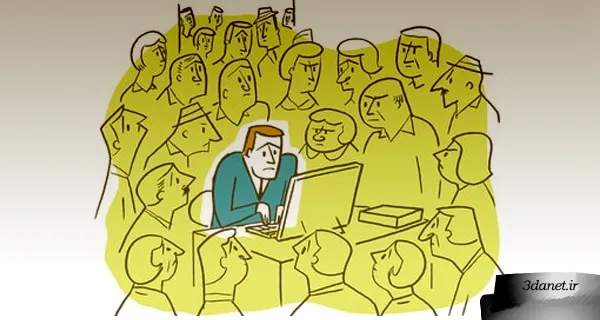
In the meantime, technology emerged as a layer that was thought to be the protector of privacy. But gradually, this aspect of technology was overshadowed. Today, through technology, we have, willingly or unwillingly, given others the possibility to access the innermost layer of privacy, namely thoughts. Companies like "Google" and "Facebook" have mastery over human thoughts. There is a common joke that Google posted a job advertisement but stated in it that a resume is not needed because they themselves know best whom to hire. Google has even crossed this boundary, and no one can say that the private act stemming from my thoughts is something that belongs to me. Social networks and the data we ourselves have provided to these networks, in combination with algorithms, data science, and artificial intelligence, have created a hybrid situation. That is, what we imagine only we know may also be available to companies and governments. In short, a change has occurred in the historical meaning of privacy, and we must arrive at a redefinition of it.
If you had spoken with an ethnographer or anthropologist about privacy twenty years ago, in answer to the question of what privacy is, they would probably have said it means not having an inquisition, that no one asks you about your thoughts, or that no one can enter your home or even your car without your permission or a judicial warrant. This view of privacy stemmed from the recognition of ownership. However, under the influence of social media data, data obtained from users' searches, the recording of conversations, video surveillance across cities, thoroughfares, and even more personal spaces, and, in general, the digitization of human counterparts in society and the digital ecosystem of the country and the world, the world now possesses knowledge about me that even my own parents do not have. There is another joke about this, which says that Facebook knows you better than your parents with two hundred clicks, and knows you better than you know yourself with five hundred clicks. These numbers are not exact, but the statement is not unfounded either. Today, if you ask someone about personal data privacy, they will likely say it is data that no one can access without your permission, such as your health data or your web browsing that is being recorded. The laws regarding data in the European Union are derived more from the privacy of individuals than from data protection rules, and companies must state what data they retain. They are even compelled to delete users' data upon their request. You can request that large companies either provide you with a copy of your data or delete it, and this obligation falls upon these companies. Compelling companies to follow specific rules in the field of privacy is the ultimate measure that has been taken.
Hyper-customization
The reality is that we have even moved past this stage where companies know us better than we know ourselves and have stepped onto a new path. For example, most sites have a recommendation engine. The strength of content platforms like "Netflix" and "YouTube" is precisely this recommendation engine, because after listening to ten songs, the platform suggests the eleventh song to you, and from a certain point onward, it places you on a path where it feels as though you have no will to choose, and instead of us choosing, we are being chosen. This means someone has crossed the boundary of my mind and interests, has settled into my mind, decides for me, chooses for me, and may even impose themselves on me and create a bias so that I do not see specific content. For example, it ensures that a particular film is never suggested in the list of recommended movies. This level of customer personalization, or the specific targeting of the audience, is very important in the discussion of privacy. In the world of economics, a phenomenon called "hyper-customization" has emerged, which represents the ultimate form of personalization. This means that, going forward, the world will move in a direction where, for example, you will hear advertisements in your mother's voice. Because with ten seconds of hearing your mother's voice and becoming emotional, you will be persuaded to buy a piece of clothing. Or two people watch an advertisement, as the most prominent manifestation; for one person, this ad is performed with the voice and image of, say, "Homayoun Shajarian," and for the other, with the voice and image of "Ibtehaj." Because the psychological decision point for purchasing is in two different places for each of them. In this situation, behavioral economics is combined with data obtained from people's minds to create a purchase point for the audience.
The Impossibility of Regulation
Another important issue is to what extent a platform or a company can exploit its users. It is like giving someone the key to your house—how far can this person enter? Are they allowed to open the refrigerator? Regulation in the realm of privacy protection cannot be entrusted to governments, because governments are very slow and developments in this field are very rapid. But can anything be achieved through increasing users' media literacy and sensitizing them to protecting their privacy? These are serious questions that sociologists must answer. As mentioned, the speed of technology is so great that governments cannot legislate for it, and whatever they do in this area is certainly slow and retrospective. Creating a law for changes may take several years, and by the time the law is passed, the meaning of privacy may have changed entirely.
At the societal level, we must come to terms with the fact that we cannot insist much on past principles. Humanity must accept that its thoughts are no longer its own. Step zero in crisis management is to accept that a crisis exists. We must also first accept that the privacy our parents told us about does not exist, and definitions must change, and we must arrive at a new definition of privacy. For example, the boundaries and limits of governments and platforms should be specified. I myself prefer a world where everything is transparent. If all humans achieve one hundred percent transparency, perhaps a better world awaits us. Transparency will cause a redefinition of our value system; for instance, an individual might have a moral deviation in their mind. If there were no privacy and you could read everyone's mind, you would realize how this person thinks and, at the same time, how they are fighting the monster within so as not to reveal it—and this is a virtue. The path ahead of us in the next ten to fifteen years will give us the power to access the human subconscious without them knowing it, but humans, by accepting these changes, must know what their equivalent is for this world.
There is an example in this regard: despite all these cameras and the new cameras that are placed as lenses in the eye and with which you can record images of people, something must happen so that if someone is on camera and their photo is taken, they have the ability to choose to delete all their photos throughout the world, or the individual can choose to have their photos completely removed from a specific platform, because a person's image is their property, so this right must be recognized. But in most cases, this right is not recognized, and the person in it is considered part of the public sphere, but no one pays attention to the fact that the public sphere produces data that can violate privacy. You can place a microphone in a university space and record the voices of all students and extract data from it, but this is a violation of individuals' privacy and people must be informed in advance. For example, in a coffee shop, if you use "Face Sterling" to understand whether customers enjoyed your coffee or not, you must definitely inform the customers. I believe that governments inherently seek to collect information, and if they enact laws, they will not be progressive laws. Even in the most transcendent democratic systems in the world, this has not been done properly. Currently, willingly or unwillingly, with all the laws that have been enacted, Facebook, Twitter, and other platforms in European countries are monitoring users. In countries like China, there is no such thing as privacy at all, and they might even delete my chat with another person. You might use words against the Communist Party in the "WeChat" app, and the government will very easily delete these words, meaning the government has this much access to your information. If you engage in political activity against the government, you will be arrested very easily. During the Corona era, those who wrote about this disease on the WeChat platform disappeared. The government's access to these matters indicates that governments are also satisfied with this access and are pleased to know whether you use your personal car or public transportation to go to work, how you spend your money, what your intention was in making a purchase, and, for example, if you bought a high-sugar drink, the reason for the purchase is clear because the tension you have in your life is evident from your walking, the phone conversation you had with a friend that was recorded, your chat, and the hard pounding of the keyboard, which determines what the reason for your purchase was. The way each person works with a keyboard is different from another person. Everyone's typing model is different, and from the sequence between clicks and typing mistakes, one can understand the person's personality type. Not only are these things clear, but your location is also clear, and as it happens, governments love control over citizens, whether in China or in Europe, governments love to know all aspects of your life. In my opinion, with the help of blockchain, networks can be created where the ownership of the market is in the hands of the individuals themselves, and their data cannot be used for advertising purposes as long as they do not want it. There are very small social network platforms where your data belongs to you, and they do not allow anyone to access your data, and even if you have public activity, you can delete all your data. There is also a special situation where companies can attract many users with these measures, and the treatment of users there would be fairer. But I don't think this will happen.
The Contradictory Sum of Publicness and Concealment
A point that is often raised is whether merely stepping onto the internet means the loss of privacy. Can one be a user on the internet with certain mechanisms and still preserve one’s privacy? It must be said that professional users can install software in this area so that their IP and their movements are not easily recorded, or they do not install programs that grant specific access to another person. But most platforms, even with the same cumbersome regulations imposed on them, still put you in a position where you confirm granting them access. They are designed in such a way that if you do not grant access to the camera or the phone book or things of that sort, you will not be able to use the platform. The reality is that we cannot fight this issue. Perhaps less than one percent of very professional individuals can only erase their footprints. The notion that people think they can preserve their privacy by activating their “Firefox Private Mode” is an illusion. In internet businesses, they say when a service is free, you are giving data to that service and you are the product, and companies will later sell your data. If Google’s search engine or other search engines were not to make money from you, you would have to pay for every search on these services. In some cases, the law ties the hands of platforms, but this issue is not enough because there are thousands of other paths for them to obtain data; they now say that even if only your hand is in a photo, artificial intelligence can extract your fingerprint, which is your unique identifier. There is no escape. Even if cumbersome regulations are placed in the way of companies by governments, nothing can be done and privacy will not be impenetrable.
The World Ahead
The outlook ahead depends entirely on how much maturity and sophistication the society in which we are discussing privacy has regarding these concepts. The media must constantly talk to audiences about this subject and say that this is a trend and nothing can be done unless you disconnect the internet. Even in that state, you cannot resist your voice and image being recorded in public spaces. There are also many software programs that, based on analyzing people’s voices, even provide information about their lying or truthfulness. If a device could determine with one hundred percent certainty who is lying and who is telling the truth, the judicial system, lawyers, and judges would also have to change. You might be able to turn off your mobile phone and not be present on social networks, but you cannot resist a technology that sees you from the outside and analyzes how trustworthy you are or not. Although I am certain that totalitarian governments will heavily exploit this issue and people in the world will suffer for at least a while, I imagine that humanity needs this, and the outlook of self-suppression and self-censorship might be eliminated, and for this reason, the path we are on is, at least for me, a happy one. Of course, for some, it is stressful or threatening. I do not consider the breaking of privacy, or even others’ awareness of each other’s dreams, to be a bad thing. A dream is also private, and perhaps individuals do not readily share it with others, but currently, technologies have been created for recording and capturing your dreams. It is said that right now in North Korea, students must recount the dreams they have to their teacher at school, and this issue may occur everywhere in the future through technology. Or in its commercial discussion, they are seeking to show you a few images during the day and play a sound from a device that brings that advertisement into your dream. Perhaps a time will come when you yourself rent out your dream and say, I am selling my dream. Like any other trade, like an athlete who sells the advertisement on their shirt. To many, it seems like 1984, but ultimately it is to our benefit. It may change our semantic system, and even our children may no longer have our stress regarding privacy.
What Will the AI Trend Do to Us?
Another important issue is the trajectory of artificial intelligence; will AI become more sensitive to privacy compared to today, or more indifferent? There are two discussions here: one, the technological aspect of this matter, and the other, its subjective aspect. There is a concept called the digital twin, meaning having so many sensors in an environment that every single object, individual, and everything that exists can be modeled. What IT does is that, with the multitude of sensors it provides, you can have a copy of a person or an environment inside a computer. Infinite scenarios can be set up for a digital twin. For example, a turbine with a hundred thousand sensors installed on it—I would check at what rotation and what stress this turbine gets damaged, or with what pattern it should be maintained; I would have to wreck a hundred turbines to understand the problem. But when I have so much information that I can build the exact same turbine in a computer, the pointless destruction of turbines to find the problem will not happen.
Before this, when we spoke of simulation, we proceeded with limited, handcrafted parameters; for instance, if in the past we wanted to do a weather simulation, we had to manually feed a million parameters into the machine, and currently there are about fifty billion sensors in the world and about thirty billion objects connected to the network, meaning a sensor is not necessarily connected to the network. There is a sensor that comments, when it gets dark, turn on the light, meaning it uses the data at that moment and does not store it. These numbers will reach ten trillion sensors and five hundred billion data objects connected to the network by 2030. That is, there will be no aspect of our lives that is not influenced by sensors. Therefore, with this data that I obtain on the internet, the digital footprint I leave behind, and the existence of these sensors, it is as if, in the literal sense of the word, they can build a twin of me. The good part is that an advertising company can see where it is able to convince me to buy a product, and the bad part is that totalitarian governments can construct some of our choices. In general, this issue causes our knowledge of ourselves to become more complete, but to the same extent, the world's knowledge of us also becomes more complete. How much transparency will occur and to what extent the world's wealthy and politicians will allow transparency is unclear, but suppose an ideal state exists; would I be ashamed of what goes on inside me, or have I been taught since childhood that I must move past this situation? A situation where everyone knows what is going on in each other's minds. How power and wealth relate to this phenomenon is also important. In my opinion, in the short term, very large and numerous abuses will certainly be formed by governance and large corporations, and something called social responsibility will fade and become a luxury issue, but ultimately, over a twenty-year period, we may all accept that this is the pattern of the world, that with so many sensors, individuals' behaviors can also be predicted with good accuracy. It can be said that if we have a machine that can predict all our behaviors, unpredictability in the world becomes zero. This prediction, of course, has its opponents and proponents. If I have all the world's data, can I predict the entire world? Will judgment then exist in this world, and what is the meaning of behaviors and actions? When everything is predictable, to what extent does this issue conflict with or align with my religious or non-religious value system that considers humans as beings with free will? These are probably issues we will grapple with more.




Discussion0 comments
No comments yet; let yours be the first voice.