Philosophy
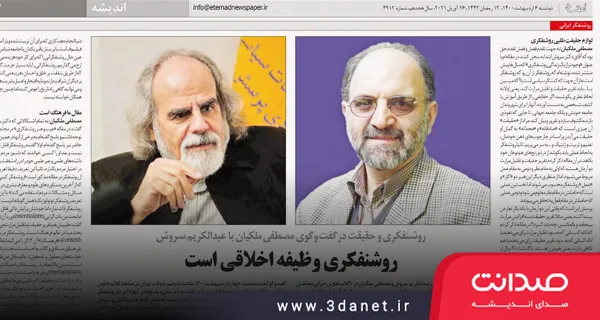
Intellectualism: Detachment and Compassion; Mostafa Malekian's Response to Fakhreddin Azimi
In response to Fakhreddin Azimi, Mostafa Malekian explains the possibility of 'free giving' and the separation of intention from outcome in ethical action. The intellectual's role, he argues, is to understand and elucidate the causes of beliefs, not to transform structures—that is the task of politicians.
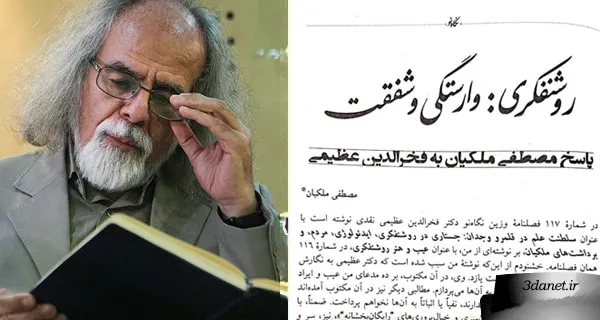
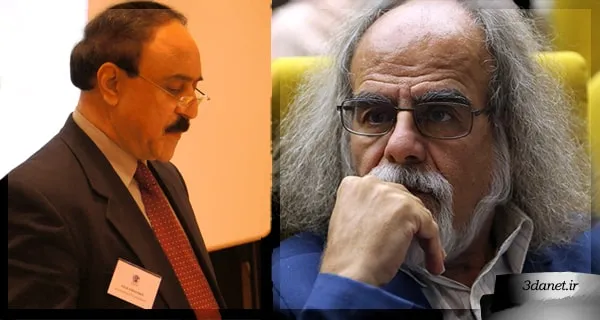
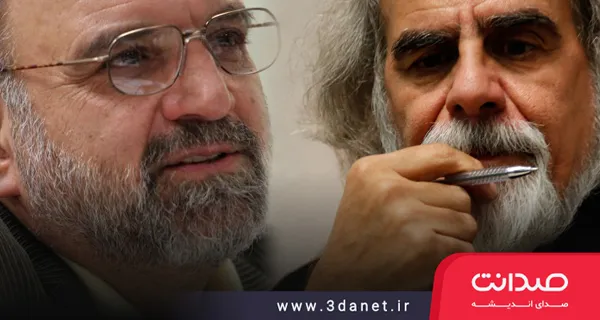
In issue 117 of the esteemed quarterly Negah-e No, Dr. Fakhreddin Azimi has written a critique entitled The Reign of Science in the Realm of Conscience: An Inquiry into Intellectualism, Ideology, the People, and Malekian's Conceptions, on a piece of mine, entitled The Vice and Virtue of Intellectualism, in issue 116 of the same quarterly. I am pleased that my writing has prompted Dr. Azimi to undertake the composition of a scholarly and useful article. In that article, he has found fault with ten of my claims, and I, in this response, will address them. Other matters also appear in that article which, as they bear no relation to my claims, I will not address, whether affirmatively or negatively. Furthermore, I will have no truck with his allusive expressions, such as "gratuitous ponderousness and high-minded fantasies." In each instance, I will first present my claim in the form of a single sentence; then, I will cite Azimi's critique, in his exact words, within quotation marks; and, thereafter, I will proceed to respond.
1) Gratuitousness is possible. (Paragraph 1-1)
Critique: "Attachment to otherworldly reward or recognition and renown in this world are among the primary motives for actions considered benevolent or gratuitous. The profit or reward of these actions is symbolic; it soothes the conscience, engenders a feeling of satisfaction. The inner contentment resulting from benevolent steps is no small reward. One can, with reason, consider the seeking of acclaim and attachment to name and fame, and the increase of disciples and readers, as important motives of intellectuals. The attention and admiration that the intellectual's work provokes is his reward. Reward is not always tangible and material. The intellectual's primary reward is often symbolic, a pleasant feeling
that he is able to make his voice heard by others and to present what he says as worthy of attention. To be counted among the renowned and 'enduring figures' and cultural leaders of society is a reward that has tangible consequences. Attaining this status is the achievement of those who imagine they have devoted themselves self-sacrificingly and gratuitously to the cultivation of culture." (pp. 100-101)
Response: Moral psychologists and moral philosophers, since very ancient times, have been divided into two groups regarding this issue: one group has held that all voluntary actions a person performs, without exception and solely, are done to satisfy their own desires and/or needs, and, therefore, all their actions are self-regarding. Another group has believed that some of a person's voluntary actions are self-regarding, that is, performed to satisfy the desires and/or needs of the agent themselves, and others are other-regarding; that is, performed to satisfy the desires and/or needs of others, not the agent themselves. The first group maintains that actions we consider 'other-regarding' are only apparently and superficially so, and inwardly, upon deep and meticulous reflection, their benefit, through one, two, or several intermediaries, accrues to the agent themselves, and, therefore, they are self-regarding. What must be noted here is that both groups disagree over the aims of human voluntary actions, not over the results of those actions. The debate is not over whether the result of an action always accrues to the agent or sometimes to others; the debate is over whether the agent's aim in performing the action is always to benefit themselves or sometimes to benefit others. It is possible—and this possibility, in many cases, materializes—that the agent's aim is other-regarding, yet the result of their action also turns out to their own benefit, for instance, in the form of a feeling of satisfaction, pleasure, delight, or tranquility. The esteemed critic belongs to the first group, who consider all human actions self-regarding; but, to prove his claim, instead of showing that every human's aims are all self-regarding, he turns to the results of human actions; and this is a confusion of aim and result.
Moreover, the critic on the one hand says: “Malekian is mostly in search of a normative model of the intellectual” (p. 99), meaning he is not describing intellectuals but rather prescribing to them; he does not say that intellectuals are like this; he says they ought to be like this. On the other hand, to refute my claim concerning gratuitous giving, that is, other-regardingness, he refers to the existing state of intellectuals and says that intellectuals reap such-and-such benefits or rewards. If he considers my statement normative or prescriptive, how does he refute it with descriptive propositions?
2) The intellectual, insofar as he is an intellectual, is concerned with reforming the inner realm of human beings. (Paragraph 5-1)
Critique: “The role he [i.e., Malekian] assigns to the intellectual is not mingled with much defiance or danger. He conflates the role of the intellectual with a prophetic role [...]. The intellectual, in Malekian’s view, ‘addresses that part of people’s disarray and distress for which they themselves are to blame and the cause and origin; that is, their beliefs, feelings and emotions, and desires.’ Are people’s beliefs, feelings, emotions, and desires synonymous with their ‘disarray and distress’? How should one evaluate the role of structural conditions, problems, and deficiencies beyond human will and agential capacity? How should one gauge the impact of those conditions on people’s culture and on their beliefs, feelings, and desires? It might be said that this is not the intellectual’s task, but if the intellectual does not correctly grasp the roots and causes, how will he devise an effective remedy? Why should attention to politics, economics, and culture, and the transformation of structures that hinder the realization of human capabilities, and striving and acting to lighten the burden on people’s shoulders, be considered incompatible with the desired intellectualism? Why should the intellectual’s role be confined to the inner transformation of people and to teaching and education?” (p. 99)
Response: Firstly, the critic believes that my desired intellectualism “is not mingled with much defiance or danger.” I am glad he lives somewhere where that is the case; but measuring others by oneself is a fallacy, and “how can the light-burdened on the shores know the state of us?” Besides, has a verse been revealed that the rightness of an act lies in its being mingled with much defiance and danger? What proof has been offered that the rightness of an act is directly proportional to its being mingled with defiance and danger?
Secondly, where in my writing have I said that the intellectual must deal only with people’s beliefs, feelings and emotions, and desires themselves and pay no attention or regard to external roots and causes? As the critic rightly says, knowing a thing also requires knowing its causes and reasons, and, therefore, knowing the causes and reasons of false beliefs, misplaced feelings and emotions, and unreasonable desires is a requisite of the intellectual’s work. But knowing the causes and reasons is one thing, and transforming them is another. My point is that knowing and making known the causes and reasons is the intellectual’s task; but transforming them is the task of politicians and political activists. The intellectual merely makes people understand that they have false beliefs, misplaced feelings and emotions, and unreasonable desires, and what the inner and outer causes and reasons of these beliefs, feelings and emotions, and desires are. Changing the outer causes and reasons, of course, is not the responsibility of the intellectual, insofar as he is an intellectual; although the intellectual can, while being an intellectual, also be a politician and political activist and undertake the task of changing the outer causes and reasons as well. (See paragraph 5-1 of my writing)
Thirdly, that the intellectual's role be confined to the inner transformation of people and to education and training is an inescapable necessity of the social division of labor and specialization, a necessity that the critic himself affirms. The critic, on the one hand, considers the task I have assigned to the intellectual to be arduous and difficult, nay, impossible and unfeasible, and, on the other hand, himself assigns other tasks to intellectuals. Listen: "How, in the age of specialization and the expansion of the scope of knowledge, does the intellectual learn all these sciences and bodies of knowledge to an effective degree and digest their achievements?" (p. 99) And also: "Our society needs reformers and teachers of virtue and ethical conduct—those who strive to transform the inner realm of the people; but it also needs those who think about transforming political, social, and cultural structures, and who see the path to collective well-being in this, and in negating the structural grounds for the persistence of oppression, injustice, and exploitation" (p. 106). Yes, society needs many things, but all its needs cannot be met by a single stratum, layer, or social group.
3) The intellectual, by virtue of being an intellectual, is not a scholar, researcher, or academic, but uses the achievements of scholars, researchers, and academics, to the necessary and sufficient degree, for the cultural change and reform of the people. (Clause 9-1)
Critique: "How much is 'that much' and 'to the necessary and sufficient degree'? What groundwork is required for this? How, in the age of specialization and the expansion of the scope of knowledge, does the intellectual learn all these sciences and bodies of knowledge to an effective degree and digest their achievements?" (p. 99)
Response: Firstly, the intellectual learns these sciences and bodies of knowledge in the same way that a physician learns biophysics, biochemistry, biology, physiology, and anatomy, in none of which they can be a specialist or an authority.
Secondly, one cannot expect me, in a piece of writing that, as a rule, cannot exceed twenty-some pages, to determine the necessary and sufficient degree, just as one cannot expect someone who insists that medical students must benefit from basic theoretical sciences to the necessary and sufficient degree, that is, to the extent necessary and sufficient for their medical art, to specify, on the spot, the necessary and sufficient degree in detail and piece by piece.
4) The intellectual is the judge and critic of the people's culture and seeks to transform this culture, not to endorse it and be its defender. (Clause 11-1)
Critique: "He [= the intellectual] is not the people's chosen judge; he has appointed himself. But if the people do not pay attention to him, how can he influence them? What should be done if his judgment is incompatible with the people's judgment of themselves?" (p. 101)
Response: One must ask, did the baker or the university professor appoint themselves to baking or to the university professorship, or did the people appoint them to this work? The reality is that the baker or the university professor themselves willed to engage in this occupation and profession; but whether the people accept them in this occupation and profession depends on the people's judgment of their knowledge and ability in the occupation and profession they have chosen. So, in one sense, they are self-appointed, and in another sense, appointed by the people. If the people do not pay attention to the intellectual, they must realize that the people have not seen them as possessing the necessary knowledge and ability. Just like a physician to whom the people have not paid attention. They, like that physician, must increase their knowledge and ability as much as they can, and if, despite this effort, they are not accepted, welcomed, and received by the people, they go their way and the people go theirs.
5) The intellectual discerns the people's needs, and if their wants conflict with their needs, sides with their needs. (Clause 21-1)
Critique: “What enables us to perceive the needs or interests of others better than they themselves can? What characteristics distinguish our claims from the paternalistic claims of others? By what pretext does an intellectual who considers himself free of ideology grant himself the right to claim he has discerned the ‘interest’ of the people, or to say that attention to ‘the needs and interests of the people’ should not be sacrificed to ‘their wants and pleasures’? Does this not mean that the people are utterly incapable of understanding their own interest, and that ‘we’ intellectuals must shoulder the burden of this task? What should be done if the people hold a different view about their own interest, and if they do not accept the judgment of the intellectual and his reformist and enlightening claims? (p. 101) ‘Furthermore, on what basis can the intellectual consider himself in every respect above the issues in which he believes “the people” are entangled?’ (p. 102)
Response: I ask: “What enables psychologists, psychotherapists, sociologists, economists, jurists and lawyers, engineers, physicians, and education specialists to suggest and recommend to their clients and patients: ‘Abandon this desire of yours, for it is incompatible with your interests,’ and, for example: ‘Do not eat this food, however much you like and want it, and take that medicine, however much you dislike and do not want it!’?” It is clear that their greater knowledge establishes this right, and sometimes duty, for them to sacrifice people’s wants and pleasures for their needs and interests. The same applies to intellectuals.
The claims of intellectuals differ from the paternalistic claims of others, as the critic puts it, in this very important respect: as I stated in my text (paragraphs 1-21), they are arrived at through an objective method and are verifiable by the same method. In other words, the claims of intellectuals are, in fact, the latest human achievements in the domain of the human sciences, unlike the paternalistic claims of others, which have no backing or documentation other than the attachment their claimants have to a school, doctrine, disposition, creed, religion, sect, or ideology.
The existence of experts and specialists in the human sciences, with whom all rational people consult in managing the affairs of their lives, of course, means that human beings are, in many cases, incapable of understanding their own need or interest and, therefore, turn to advisors. It is astonishing that someone would accept that for diagnosing the needs and interests of his body he must consult physicians, yet not accept the same for diagnosing the needs and interests of his mind, psyche, and social relations.
And as for what should be done if the people hold a view about their interest different from that of the intellectual and do not accept his judgment, it must be said that one should do the same as a physician whose patient tears up his prescription and throws it in the trash. The true physician never considers himself a patriarch, sheriff, judge, jailer, or despotic ruler. He employs all his knowledge, understanding, wisdom, and experience to diagnose the needs and interests of the patient’s body and, by writing a prescription, proposes and recommends ways to meet those needs and interests. If the patient, for whatever reason, disregards his prescription, what else can he do but feel regret?
The critic says: “By what pretext does an intellectual who considers himself free of ideology grant himself the right to claim he has discerned the ‘interest’ of the people,” as if only those attached to an ideology have the right to claim to discern the people’s interest! Whereas, quite contrary to his statement, as it happens, those attached to an ideology have absolutely no right to claim to discern the interests of human beings.
6) The intellectual must not surrender his heart and mind, his spirit and intellect, to any ideology. (Paragraphs 2-4, 2-5, and 4-5)
Critique: “Malekian’s warnings about ideology are not out of place, but ideology has a broader semantic range than what he has presented. Furthermore, the intellectual cannot, merely by opposing the ideological outlook, ignore the phenomenon of ideology and its socio-political functions. [...] The word ideology, from its coinage in the late eighteenth century to the present, has become a concept with a multifaceted semantic charge and has had descriptive, analytical, and pejorative uses.” (pp. 107-108)
Response: First: regarding words that are equivocal or homonyms—that is, they are one in terms of the word but multiple in terms of meaning, or, in other words, they are a single word but have more than one meaning, like the word "shir" in Persian, which means both a predatory animal, a drinkable liquid, and a tool from which water flows—one must know that one should not expect a speaker or writer, if they say or write something about one of the meanings of such words, to also comment on their other meanings; one should only ask them to clarify, explicitly or through context and indications, which of the meanings of such words they are speaking about. If I said about the predatory animal called "shir" that "the shir has become scarce" and proved this claim and, perhaps, explained and accounted for it, that is, why shirs have become fewer, you cannot expect me to also comment on whether the drinkable liquid or the tool from which water flows has become scarce or not. What have I to do with them? You should expect me to, in some way, certainly make clear that by the scarcity of "shir" I mean the scarcity of which of these three subjects. By the same analogy, the compound term "ideological thinking" has more than one meaning and, naturally, each of those meanings has its own presuppositions, implications, effects, and rulings.
I have spoken about one of its meanings, which I have explicitly clarified, namely the acceptance of the intellectual authority and guardianship of a single person (see 4-2) and the belief that the truth has been discovered and proclaimed by them (see 5-2) and considering their word as unquestionable (see 5-4) (incidentally, contrary to the critic's statement (p. 107), I have never taken it to mean false consciousness, which I consider a contradictory combination). Why should it be expected that I also state my position on the other meanings of the term "ideological thinking" or "ideology"?
Secondly: of course, as the critic has noted, "an intellectual cannot, merely by opposing the ideological outlook, ignore the phenomenon of ideology and its socio-political functions"; but have I ignored it or recommended that it be ignored? The very things I have said about ideology in the three sections (4-2, 5-2, and 5-4) indicate that I have not ignored it.
7) The truth regarding no subject, issue, or problem is evident and clear, and one can only approach it step by step through a very difficult, slow, and collective process, and by expending the countless hours, energies, talents, and opportunities of a vast multitude of scholars, researchers, and thinkers (the theory of the non-evidentness of truth) (Section 5-2)
Critique: "How does someone who considers truth to be non-evident measure falsehood, inappropriateness, and irrationality, and how do they know with certainty that something is false and something is true? On what basis do they enumerate the distinguishing features of the 'authentic' intellectual versus the inauthentic one, and what are their oughts and ought-nots founded upon? How have they arrived at this truth that the intellectual 'absolutely' must not do such and such? How can they say that some people have the right or do not have the right to do such and such? How do they know that some are misguided and that certain insights are illuminating? Is truth in human and social affairs, and in the realm of ethics, concealed, or is it in all realms? If truth is not evident, then why should the theory of its non-evidentness be considered an evident truth? Cannot truth be made more evident through methodical inquiries? If we do not consider many truths to be evident, will not the possibility of dialogue and mutual understanding be negligible?" (pp. 99-100)
Response: The critic's critique includes two points: first, why have I, who subscribe to the theory of the non-evidentness of truth, subscribed to a series of evident truths and expressed claims with certainty and conviction? And second, that, fundamentally, the theory of the non-evidentness of truth is an incorrect theory, because it has corrupt consequences, that is, unacceptable effects and results, some of which they have pointed to.
The critic has overlooked the fact that the philosophers and epistemologists who subscribe to the theory of the non-obviousness of truth do not mean to say that no truth has ever been discovered or that humanity has never approached any truth; rather, they mean to say that: first, contrary to the view of foundationalists, no truth has been obvious to anyone from the very first day, and second, contrary to the view of ideological thinkers, the truth claimed by ideologues is not as clear as their followers, devotees, and disciples imagine. The discovery of truth or approximation to truth is never, and will never be, the work of a single individual; it is a collective, slow, and extremely arduous and painstaking endeavor. Ideological thinkers believe that: "a) truth is so obvious that only those hostile to truth, malevolent, obstinate, and impure would deny it; and b) that entirely obvious truth has been discovered by the founder of our school, creed, path, doctrine, religion, sect, in short, our ideology." The implication of the theory of the non-obviousness of truth is the negation of both these claims, not the negation that humanity has so far discovered some truth or approximated truth.
How is it that the critic, after reading my clear, unambiguous, and unequivocal sentence that "through a very difficult, slow, and collective process, and by expending the countless hours, energies, talents, and opportunities of a vast multitude of scholars, researchers, and thinkers, one can, step by step, approach the truth," still asks me: "Can truth not be made more obvious through methodical inquiries?"?!
8) The intellectual, as much as possible, should not speak in an ambiguous, equivocal, or obscure manner. It is incumbent upon the intellectual to speak in such a way that their audience, who are the general citizens of society, understand their speech. The right path is for speech, while preserving its authenticity and to the extent that this preservation of authenticity permits, to be clear, straightforward, and accessible (Clause 9-2). The intellectual is rightly expected to speak and write in a way that people understand. (Clause 7-4)
Critique: "Malekian wants the 'true intellectual' to write simply even about complex issues and for their speech to be at the level of the 'understanding' of the people, because they have 'a great need for the trust of the people.' [...] One should not deliberately write in a complex manner, but there are discussions, and complex realities, that must be reflected with as much precision as possible. They cannot be simply rendered and made accessible. Fundamental discussions should not be vulgarized and reduced to newspaper, salon, and television debates.]....[One of the tasks of serious intellectuals is the understanding and analysis of complex social matters based on methodical depth-work relying on modern humanities and social sciences. This work should not be commercialized." (p. 103)
Response: First: The critic has conflated two processes: the process of acquiring knowledge and the process of transmitting knowledge. In the process of acquiring knowledge, a person wants to personally become aware of a reality or understand a reality. In the process of transmitting knowledge, they want to teach a reality they have become aware of to others or make a reality they have understood comprehensible to others. There is no doubt that in the process of acquiring knowledge, one must delve as deeply and scrutinize as meticulously as possible in order to avoid falling into error, mistake, and delusion as much as possible. However, my point concerns the process of transmitting knowledge, where a person wants, with the aid of speech and/or writing, to teach or make something comprehensible; and my claim is that in this context, so that the audience does not suffer unnecessary hardship, the speaker or writer must "speak in such a way that their audience, who are the general citizens of society, understand their speech" (Clause 9-2). I do not know what contradiction there is between speaking or writing simply, in the context of transmitting knowledge, and delving deeply in the context of acquiring knowledge.
Second: How does the critic prove the equation "simple speech = imprecise speech"? Does speech become imprecise merely by virtue of being simple? And did I not say myself: "Speech, while preserving its authenticity and to the extent that this preservation of authenticity permits, should be clear, straightforward, and accessible" (Clause 9-2)? Is "while preserving its authenticity and to the extent that this preservation of authenticity permits" not an explicit statement that precision must not be sacrificed if it conflicts with clarity, straightforwardness, and accessibility? Did I not say myself: "As Einstein said, 'Make things as simple as possible, but not simpler'" (Clause 9-2)? What does "but not simpler" mean? Does it not mean that we have no right to simplify a matter to the point where it loses its authenticity?
Incidentally, where in my writing did I say that for this reason the “true intellectual” must write simply even about complex issues and that their speech should be at the level of the people’s “understanding” because they have “an immense need for the people’s trust”? What does the people’s trust in the intellectual have to do with writing simply and speaking at the level of the people’s understanding? Yes, in paragraph 4-4, I said that the intellectual must “admit it if they have made a mistake. Failure to admit a mistake [...] destroys others’ trust in the person; and it goes without saying that the intellectual [...] has what an immense need for the people’s trust.”
9) The intellectual must not have expectations or demands for acceptance from the people, and must, as much as possible, lower the flame of any kind of expectation and demand from the people. The true intellectual, while presenting whatever they know to be truth and in accordance with human beings’ best interests in the most comprehensible expression, does not await their acceptance, favor, or welcome. (Paragraph 10-2)
Critique: “Indifference to people’s reaction cannot be combined with the expectation that our words will have an effect on them. [...] How can indifference to people’s reaction be reconciled with the necessity of gaining their trust?” (p. 103). “It is not easy to reconcile the praise of intellectual independence with the effort to persuade others to follow intellectuals.” (p. 112)
Response: My point was that the intellectual, firstly, must make a strenuous effort to ensure that the people understand their speech and, to achieve this goal, must, as far as possible, purge their speech of ambiguity, equivocation, and obscurity; secondly, after conveying their speech to the people, they should not wait for or expect their acceptance, because the acceptance or non-acceptance of their speech depends entirely on the personality and character traits of each individual audience member, and, therefore, people cannot be driven to accept one’s speech through violence or entreaty. How can the intellectual be concerned about something (the people’s acceptance) whose attainment is beyond their will and control? Thirdly, since the people’s trust in them is also not without effect on the acceptance of their speech, they must avoid anything that diminishes this trust, such as failing to admit their own ignorance and/or mistake, which erodes trust. What incompatibility do these three claims have with one another?
Of course, I have praised the intellectual’s independence of thought from public opinion and prevailing, conventional views and notions; but I have never subscribed to “the effort to persuade others to follow intellectuals intellectually” for the question of the compatibility or incompatibility of these two to arise.
10) The good and well-being of the people lies in their being encouraged and persuaded to constantly revise their beliefs, attitudes, and values, and the true intellectual is merely their teacher, mentor, and guide on this path, nothing else. (Paragraph 1-4)
Critique: “Intellectual authoritarianism has also manifested itself in the forms of ‘cultivation of thoughts,’ ‘cultural revolution,’ ‘guidance’ preaching, propagandistic indoctrination, and the like.” (p. 112)
Response: The critic knows well that the similarity of two things, in one, two, or several respects, does not prove their identity and oneness, otherwise all entities in the universe would be one thing, for there are no two entities in the world that share no aspect of similarity whatsoever. On this basis, even assuming that my desired intellectualism shares an aspect or aspects with intellectual authoritarianism, it still does not follow from this similarity that my desired intellectualism is the same as intellectual authoritarianism.
In closing, I find it necessary to point out three matters. The first point is that, despite the fact that throughout my writing, implicitly, and in endnote number 3 (“The author himself considers the greatest problem of society to be the culture of each individual citizen”), I have explicitly shown that I believe in the primacy of culture, the critic, in reporting my view, has stated: “Unlike those who believe in the ‘primacy’ of politics, economics, and culture and see the main cause of problems in political, economic, and cultural issues, the intellectual considers ‘a significant share of the problems and sufferings of people’s lives to be caused by their own inner selves’” (p. 97) and, in critiquing my view, says: “Why should attention to politics, economics, and culture [...] be considered incompatible with the desired intellectualism?” (p. 99) (Emphases are mine.)
The second point is that the critic has said: “One of the thought-provoking elements of Malekian’s writing is his conception of ‘the people,’ which is sometimes not easily distinguishable from ‘the masses.’” (p. 101) and, rightly, has asked me: “What is meant by ‘the people’ and ‘the masses,’ and what are the analytical differences between the two categories of ‘the masses’ and the common people?” (ibid.) By ‘the people,’ whom I consider the audience of their intellectuals, I mean a collection of individuals united by a shared culture, tradition, or sense of affinity, even if they are not united by blood ties or racial or political bonds. These individuals usually also share a common language, institutions, and beliefs. As for what I mean by ‘the masses,’ in expressions such as ‘demagoguery’ or ‘populism,’ it refers only to those who are morally immature, undeveloped, or unreformed.
The third point is that the critic, throughout his useful piece, has occasionally noted that Malekian’s view contradicts the view of a certain thinker, philosopher, political scientist, political sociologist, or intellectual, and has used this contradiction to undermine my view. It goes without saying that merely having a contradictory view, one incompatible with others, does not indicate error or lack of truth. If my view contradicts that of another person, it logically follows that his view also contradicts mine. Well, why not use my contradiction with him to undermine his view?
My final word is nothing but gratitude and an expression of appreciation and acknowledgment to Dr. Fakhreddin Azimi, who deemed my writing worthy of attention and critique.
.
.
Intellectualism: Detachment and Compassion
Mostafa Malekian's Response to Fakhreddin Azimi
Source: Issue 118 of Negah-e No Magazine
Author: Mostafa Malekian
.
.
Related Articles:
The Reign of Science in the Realm of Conscience; An Essay on Intellectualism, Ideology, the People, and Malekian's Conceptions
The Vice and Virtue of Intellectualism
.
.

Discussion1 comments
سلام، مثل همیشه متقن و جامع الاطراف و بدور از ابهام، ایهام و غموض. خداوند ایشان را جهت روشنگریهای مداوم و اصلاح گریهای فکری مستمر برای قاطبه جامعه حفظ بفرماید!