Sociology
Interview with Yaser Mirdamadi: Even Anti-Traditionalism Needs Tradition
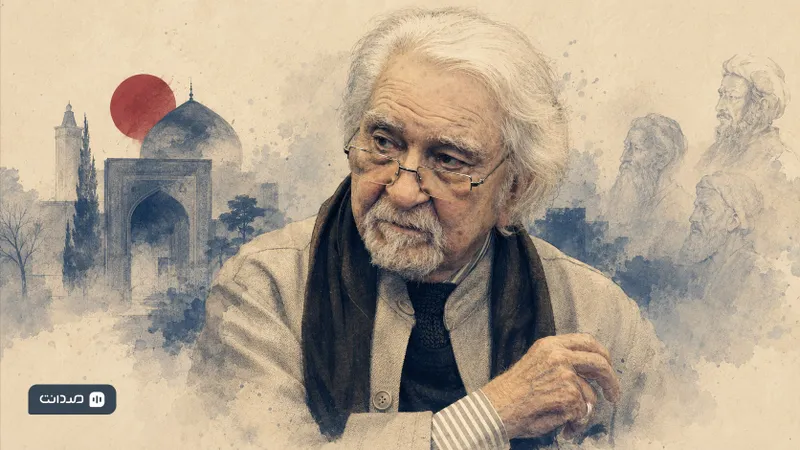
Drawing a distinction between “why we are Muslim” and “why we remain Muslim,” Yaser Mirdamadi does not necessarily condemn inherited religiosity. Comparing tradition to a paternal home, he argues that even anti-traditionalism needs tradition in order to endure.
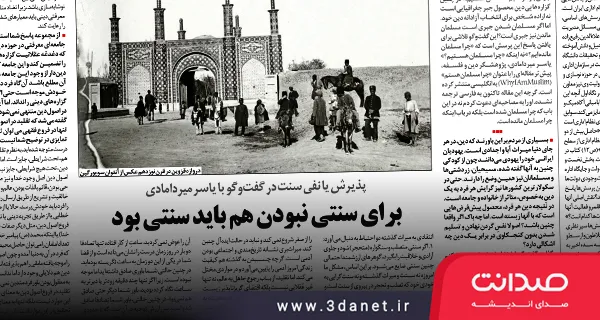
Even Anti-Traditionalism Needs Tradition
In an interview with: Yaser Mirdamadi
Interviewer: Saeed Dehghani
Published in Etemad newspaper, Saturday, 7 October 2023
Download the PDF of this interview from Etemad newspaper
He lives on the outskirts of Manchester and works in London. But even if his current place of residence were a city in Iran, I would still prefer to send him written questions so he could write his answers. I believe the mechanism of writing allows questions to be posed more thoughtfully and answers to be more precise. What you will read below is a series of questions and answers about why he has remained a Muslim.
The view that "religion" is a cultural phenomenon transmitted from society to the individual is very common in everyday language. They say, "If we had been born in Tibet, we would most likely have become Buddhists; if we had been born in the Vatican, we would probably have been Christians. Now that we have opened our eyes in an Islamic country, we are Muslims." In such statements, religion is a product of geographical determinism, not an individual's will to freely choose their own religion.
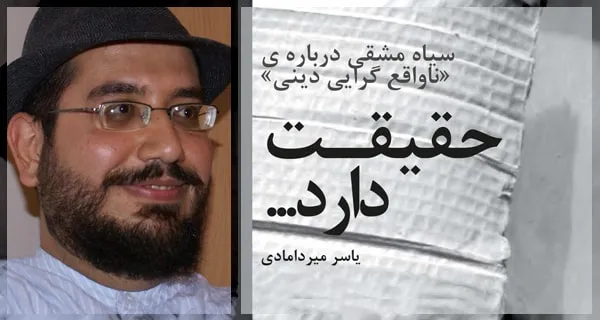
But if becoming a Muslim is deterministic, is remaining a Muslim also deterministic? This conversation is an attempt to find an answer to the question, "Why have we remained Muslims?" not "Why are we Muslims?" Yaser Mirdamadi, a researcher of religion and philosophy, previously published an article in English titled "Why I Am Muslim." Although this article has not yet been translated into Persian, I invited him for an interview not about why he became a Muslim, but about why he has remained a Muslim. What you will read below is based on a comparison between religion as an inherited matter and religion as a matter of reasoning and choice. The entire argument of Mirdamadi in his article is that religiosity as an ancestral heritage is, in principle, rationally defensible unless proven otherwise. However, there is no compulsion in remaining religious, nor can there be. Therefore, those who have chosen a religion other than that of their ancestors, or have not desired religiosity, are not the subject of this discussion.
He lives on the outskirts of Manchester, but even if his place of residence were Shiraz, the city where I live, I would still prefer to send him written questions so he could write his answers. Because years of experience in journalism in the field of philosophy and religion have taught me that the mechanism of writing allows questions to be posed more thoughtfully and answers to be more precise. What you will read below is the final text of this interview:
Dehghani: Many people believe that religion, everywhere in the world, is an ancestral heritage. Iranian Jews consider themselves Jewish because they have been told so since childhood; Christians, Zoroastrians, and Muslims are in the same situation. Even in the most secular countries, an individual's inclination toward a particular religion is influenced by family and society. Consequently, each person's religion is the product of the presuppositions they have lived with. But what does it matter if this is truly the case? In principle, what is wrong with submitting and surrendering to a religion without curiosity? Is it not the case that religion, at its very foundation, is of the nature of "faith" and unconditional acceptance?
Mirdamadi: Let me begin the conversation with a personal memory that also has a hidden connection to your question. When I was in Iran, unfortunately I was not at all fond of traveling and spent almost my entire life in Mashhad, the city where I was born and raised until I emigrated from Iran. I went to England and later to Scotland to continue my studies, and settled in Edinburgh, the capital of Scotland. The city's antiquity and beauty enchanted me, and I lived there for seven years. Edinburgh is Hume's city, and his favorite walk beside a beautiful hill overlooking the sea has been carefully preserved; Hume's grave is right opposite this spot. Many Iranians who have seen this city would say that Edinburgh could be called the "Shiraz of Britain." One of my regrets is that I have never traveled to Shiraz. But I can say I have seen its British counterpart. My wish is to visit Shiraz someday, not too far in the future, in health and peace. As Saadi Shirazi said: Sal al-masāniʿa rakban tahīmu fī al-falawāt / To qadr-e āb che dāni ke dar kenār-e Forāti. (Translation of the first hemistich: Ask the worth of water from those who wander, lost in the deserts).
After mentioning this memory, the discovery of whose relevance to our current discussion I leave to the reader, I will now address your question. It is a correct statement that individuals' religiosity is generally, though not always, inherited; if the continuation of an individual's religiosity is not influenced by inheritance, at least the origin of the formation of an individual's religiosity is generally inherited. Most people inherit their religion; for example, I became a Twelver Shia Muslim because my parents were Twelver Shia Muslims and raised me in such a culture. If I had been born in Birjand instead of Mashhad (where many Ismaili Shias live), I might have become an Ismaili Shia Muslim. If I had been born in Khaf (where many Sunnis live), I might have become a Sunni. If I had been born in Jolfa (now in the Nakhchivan Autonomous Republic, where many Armenians live), I might well have become Armenian, and so on.
However, the continuation of individuals' religiosity, especially in adulthood and after gaining independence from family, is no longer entirely hereditary; rather, individual choice plays/can play a role in it. Moreover, the inherited part of religiosity is not necessarily reprehensible. Many valuable things in the world are transmitted hereditarily. Language and culture are inherited. The Persian language is one of the oldest languages in the world still in use, and we became Persian speakers because we inherited this language; we did not choose it ourselves. This, however, does not diminish the importance of the Persian language. So being inherited, in and of itself, does not make something worthless or of little value. On the contrary, if something is valuable and does not become a tradition, it does not endure, and if something has endured, perhaps (though not necessarily) there was something valuable in it.
Even creativity, which by definition is anti-traditional, endures only if it is taught within an educational tradition. This means that even for anti-traditionalism, tradition is needed. In other words, knowing the paternal house is valuable, whether ruined or thriving. Because perhaps the paternal house is not ruined, and we have mistakenly considered it ruined and, in common parlance, "ready for demolition." Perhaps this house, with some repairs, is still habitable and also connects us to the distant past, and is better than demolishing it and building a new house in its place with no link to the past. Perhaps the house does need to be demolished, but to build a new house, one can use the materials of the old house and reconstruct the new house in connection with the paternal house. And of course, it is also possible that the paternal house needs total demolition and even its materials are of no use; but to reach such a radical decision, one must also know the ruined paternal house. So, there is no escape from critical attention to the heritage of the past.
Yes, of course, it is true that critical attention to the heritage of the past entails two cautions:
1_ If a tradition becomes rigid and fossilized (petrified) and hinders freedom and creativity, the possible valuable gems of such a tradition are lost. Accordingly, our problem today is not tradition and the heritage of the past, nor traditionalism per se, but rigidity and petrification in following tradition, and even worse, our problem is the governmentalization of religious tradition.
2_ Paying attention to the inherited nature of traditions makes us humble. Because others who are distinct from us also have a tradition, and if we are in principle justified in preserving the valuable parts of our tradition while inheriting it, others are also in principle justified in preserving the valuable parts of their tradition while inheriting theirs.
In a word, tradition is inescapable; such that if you take tradition away from someone, you have taken thought away from them. Thought does not form in a vacuum but takes shape within a tradition, even if, paradoxically, a reaction to that tradition itself causes the formation of a new tradition. In this sense, prophets are the tradition-breaking, tradition-making figures of history. We generally forget that Jesus himself was a reformist Jew, but his legacy led to the birth of a new religion. Muhammad ibn Abdullah himself was among the Ḥunafāʾ (in a sense, the religious intellectuals of his time) and intended to return his people to the Abrahamic message (the monotheistic essence of the Judeo-Christian tradition), but his legacy (especially his later Medinan legacy) led to the birth of a new religion.
This means that, paradoxically, to be non-traditional, one must also have a tradition. That is, to cultivate a new tradition, one must (re)cognize the old tradition and use its possibilities to transcend tradition and construct a new one. Otherwise, a rootless grappling with a deep-rooted tradition will be like a violet scream that, not arising from the throat, will be lost in the air. Or if the ice of rootless anti-traditionalism takes hold, it will be the fashion of the time and will sooner or later be blown away by the wind. One who marries the fashion of the time will soon find themselves widowed. For example, someone who so hates Persian that they want not to speak, write, hear, or even imagine a single word in Persian, has no choice, at least at the beginning of learning another language (German or English, for instance), but to use a bilingual dictionary. This means that to turn one's back on Persian, one must, at least initially, seek help from Persian. Religion is perhaps even more deep-rooted than language. On this basis, religion cannot be reduced to the simplistic binary of believer-unbeliever. There are many who have severed ties with religion in whose seven layers of the unconscious religion has taken up residence (Jung masterfully explains this point), and many religious people who are deeply alien to the religious tradition.
Dehghani: Suppose a religious and, of course, ethical person accepts the religion inherited from their family unconditionally and without thought. Throughout their life, they have pursued a spiritual and ethical existence but have never had any free thought or questioning about their religion; to put it more simply, they have practiced religiosity through imitation, not investigation. Under such circumstances, should we still consider investigative religiosity superior to imitative religiosity and tell them: "It would have been better if you had also investigated and questioned your religion?"
Mirdamadi: In response to the previous question, I explained that inheriting is not necessarily a negative thing; moreover, under certain conditions, not inheriting deprives a person of the blessings of the past. Humans are historical beings and do not start their lives from scratch, nor should they ideally do so. Inheriting is a sign of human historicity and sociality. Although clinging to the past also lowers the quality of a person's life today and, in some cases, disrupts it.
But imitation, in the sense of the ignorant referring to the knowledgeable, is not only not irrational but is an inescapable requirement of rational life. On the other hand, investigation does not always mean providing a propositional reason. Someone who has a stable spiritual and ethical life, their situation is in itself a reason for their religious living, even if, when asked, they cannot express a propositional reason or are even unaware of the reasons. In other words, the state of such a person is itself the very reason. Epistemologists draw a distinction between "being justified" and "having justification." Sometimes a person is justified without having a justification (a propositional reason). For example, someone who has fallen in love and this love has filled their life entirely with the colors of affection and fidelity, delicacy and serenity, is justified in being in love, even if, when asked, they cannot provide a reason for the justification of their being in love. Similarly, one can say that someone whose religiosity has led to a wholly spiritual, meaningful existence and a stable ethical life is justified in their religiosity, even if they have no justification for their religiosity and do not even seek justification.
Let me explain this point in another way. What is the value of justification? The general answer from epistemologists is that justification brings about truth-conducive stability, meaning it prevents truth from being merely accidental. To understand this, I should refer to the standard definition of knowledge in the analytic tradition. Until about four decades ago, this definition was: knowledge is justified true belief. If a person holds a belief that corresponds to reality and has a reason for it, then that person possesses knowledge. I will set aside the objections that have been raised against this definition over the past four decades or so. The question relevant to our discussion is: what is the added value of a justified true belief compared to a belief that is merely true but not justified? Put more simply, what is the value of epistemic justification?
Let me give an example to understand the value of epistemic justification. Suppose you look at the clock in your house and see that it shows 12 o'clock. The belief then forms in you that it is 12 o'clock. Suppose it really is 12 o'clock. In this case, your belief is true (i.e., corresponds to reality). But suppose the clock you looked at was broken, unbeknownst to you. Furthermore, you had not been maintaining this clock and had not changed its battery. The broken clock only coincidentally showed the correct time twice a day, and as it happened, you looked at the clock during one of those two times. In such a situation, you had a true belief, but it was not justified. Because if you had looked at the clock just a few minutes earlier or later, your belief would not even have been true. In this case, your belief became true by accident. So, the value of justification lies in the fact that it prevents, to some extent, accidentally true beliefs. That is, it brings about truth-conducive stability. Now, suppose the ultimate goal of religiosity is precisely a stable ethical, meaningful, and spiritual life, and someone who has achieved such a life through religiosity has already enjoyed the blessing of stability, and their condition is itself the very evidence, requiring no propositional reason.
But there is a point here that throws a wrench into our discussion. As the saying goes, "the devil is in the details." To understand this difficulty, let me return to the example of being in love. Suppose someone whose love has filled their life with joy and vitality faces serious objections claiming that their beloved is not at all worthy of their love (for instance, the beloved is unfaithful or is toying with them) or, even more, that the beloved has no external existence at all and is merely a product of the amorous mind's illusion. In such a situation, is the lover's love still the very evidence, requiring no propositional reason in its favor? I think in this case, the lover in our example must provide propositional reasons in favor of their love being justified; otherwise, the boundary between love and illusion disappears. But under normal circumstances, there is no need for a propositional reason. By "normal circumstances," I mean a situation where no serious objections have yet been raised.
Now, it might be said that in the modern world, religiosity resembles the situation of a lover who has faced serious objections, not a lover under normal circumstances. Accordingly, every religious person is entirely in need of propositional reasons for their religious practice. But I doubt that such a claim can be made absolutely. That is, I doubt that every religious person is entirely in need of propositional reasons for all their religious beliefs. Let me draw an example from the system of scientific knowledge for comparison. To trust science, it is not necessary for everyone to be a philosopher of science, nor to know and evaluate the workings of technologies derived from science. It is sufficient that the technologies derived from science are effective and that a scientific community exists to guarantee the trustworthiness of scientific institutions and technologies. Trust in science and technology is trust in an institution. In principle, a similar trust can be placed in the institution of religion. It is sufficient for an individual to be assured that within the epistemic community in which they live, there are religious scholars who have answers to the objections raised against the institution of religion, even if they themselves have no answer, and it is also sufficient to be assured that the institution of religion is effective. This effectiveness has been severely damaged, for example, by the entanglement of the institution of religion with the institution of governance, causing the institution of religion to drift from its primary function, and a large part of the distrust in the institution of religion is the result of this ill-fated union.
Dehghani: Why should questioning be considered part of religious knowledge in the first place? Do we have a rationally justified reason? If we regard religion as a purely sociological category and suppose that each person's religion is not the product of their will and choice but rather the result of their upbringing, can reasons still be offered to defend this type of religiosity? Is that correct?
Mirdamadi: As I explained in my answer to the previous question, an epistemic community is necessary for the rationality of religiosity. Otherwise, the distinction between religiosity and delusion is erased. In other words, if there is no epistemic community, it is difficult to distinguish religion from delusion. That religious epistemic community must also have certain characteristics: it must not be a closed community and must, for example, set aside excommunication (takfir); otherwise, it will be a dogmatic community, so to speak, not an epistemic one. Suppose, for instance, that research is to be conducted on the harmful effects of soft drinks on health. The financial sponsor of this research cannot be the soft drink factories because there is a conflict of interest. The religious epistemic community must observe the standards of transparency and scientific impartiality. In a religious epistemic community, if an Ayatollah does not think like the rest of the Ayatollahs and is placed under house arrest (like the incident that happened to Ayatollah Seyyed Kamal Heydari a few years ago and is still ongoing), then this is no longer an epistemic community but a closed and dogmatic one that merely presents itself as an epistemic community.
Dehghani: It can be inferred from your set of answers that if there is an epistemic community in the field of religious studies that ensures concern for the rationality of religious propositions and actions, and this community is effective, and the religious individual is aware of the existence of this epistemic community and its effectiveness, then the religious individual is justified in their religious belief, even if they do not know the justification for each individual religious proposition. But does this not practically lead to taqlid (imitation) in the principles of religion? Because it has traditionally been said that taqlid in the principles of religion (usul al-din) is forbidden, and one can only practice taqlid in the branches of jurisprudence (furu' al-fiqh), but such a distinction is absent in your explanation.
Mirdamadi: You have understood correctly. In my view, taqlid in the branches of the principles of religion is also permissible, under certain conditions. But taqlid in the principles of the principles of religion is not permissible under any conditions. By the principles of the principles of religion, I mean the principle of God's existence and also God's main attributes, such as being Alive, Self-Subsistent, Omniscient, Omnipotent, and Benevolent, being the Creator, and legislating through the sending of messengers. The individual must arrive at these attributes themselves, whether through reasoning, rhetorical persuasion, religious experience, or a combination of these. However, the branches of the principles of religion, such as other attributes of God (for example, God's Justice) or that Muhammad is the Prophet of God, or the Imamate and, say, the number of Imams, can be considered the product of the cultural environment in which the individual was born, and since they have found the intellectual principles of this environment justified, they have accepted the rest as well. There are reasons for the branches of the principles of religion too, but not knowing those reasons does not harm the rationality of the religious person's belief. Note that the permissibility of taqlid in the branches of the principles of religion does not mean the impermissibility of investigation into these matters, but only means the absence of a rational obligation to investigate them.
This is exactly like someone recognizing the institution of science as effective and reliable and then trusting the details of this institution. As long as these details are effective and trust in this institution continues, the individual's belief in the institution of science is rational, even if they have no reason for the details.
Dehghani: It can be inferred from your answer that although you consider the nature of religiosity's rationality to be social and not necessarily individual, you have criticisms of the religious epistemic community (especially the seminaries). In your view, the seminaries do not properly fulfill the role of an epistemic community. Can it be said that although religiosity, by referring to an epistemic community responsible for justifying religious teachings and actions, can be rational in principle, since our religious epistemic community (especially the seminaries) does not properly fulfill this role, religiosity has therefore lost its rationality?
Mirdamadi: This concern is ever-present, and now, because of the entanglement of religion and government in Iran, it is even more acute. My glimmers of hope lie in the fact that, fortunately, the Shiite seminaries (whether in Iran, Iraq, Lebanon, Syria, or even in other countries like Britain) are not monolithic, and moreover, the faithful now have sources of religious authority beyond the seminaries, such as religious intellectuals. In other words, if religious authority were limited to hidebound and fundamentalist sources of emulation, religious practice would have lost its rationality, and in that case, the duty of each and every believer to render their religious beliefs reasonable would become far more onerous; but fortunately, the diversity of religious authority (both seminary-based and intellectual) has prevented this rationality from being entirely lost. Nevertheless, the concern remains that reformist sources of emulation and clerics might remain on the margins and fail to become mainstream. In such a situation, the rationality of religious practice would also receive only marginal endorsement from the epistemic religious community, and this is dangerous for the future of reflective and rational religious practice.
Dehghani: But it seems that the dominance of the sources of emulation in the Shiite world is specific to Iran. It appears that in the cities of Najaf and Karbala, or even the Shiite seminaries in Lebanon, there is greater openness to accepting different readings of Shiite jurisprudence, tradition, and philosophy. Is this not the case?
Mirdamadi: The institution of tradition is by no means exclusive to Twelver Shiism; it exists in a particular form in all religions and denominations. Even religions that lack a clergy, such as the Baháʼí Faith, have instead the "Universal House of Justice," which is responsible for preserving and propagating the orthodoxy of that faith. Sunnis also have their own clerics and muftis. Catholic Christians have the Pope and the institution of the Church. Protestant Christians, depending on their numerous sub-branches, have their own churches. Jews, depending on their sub-branch, have their own official institutions, and their institution of ifta is similar to the institution of marja'iyya (source of emulation) in Twelver Shiism. The Bohra Ismaili Shiites have a Sultan, and the Nizari Ismaili Shiites have a living Imam. Tibetan Buddhists have the Dalai Lama; the fourteenth Dalai Lama is still alive today, and after his death, he will be succeeded by the fifteenth Dalai Lama.
But regarding the openness or closedness of the seminaries, the matter is complex. The openness to the teaching of theoretical mysticism and Islamic philosophy in the Qom seminary is far greater than in the Shiite seminaries of Najaf, Karbala, Syria, and Lebanon. Politically, however, all these seminaries (to the extent that they are not under the influence of the Iranian government) are more open than the Qom seminary, which is administered under the supervision of a governmental council called the "Seminary Management Council" and where there is constant pressure to conform to government policies. Recently, the policy of "purification" (the expulsion of dissident professors) being implemented in universities has also reached the seminary. The institution of tradition exists in science in a way as well. To distinguish pseudoscience from science, scientific institutions must exist. If the Enlightenment were not the institution of science, opponents of vaccination and climate change pseudoscience would likely have been far more successful. Religious institutions have a function similar to scientific institutions. Of course, these institutions themselves (whether religious or scientific) can suffer from dysfunction. But the solution is to remedy the dysfunctions of the institution of authority, not to eliminate it at its root.

Discussion1 comments
حالا اگر نهاد مرجع نخواست یا نتوانست کژکارکردهای خود را اصلاح کند چه باید کرد؟ آیا حامیان قدرتمند آشکار و پنهان این نهادها اجازه تضعیف یا اصلاح مسیر میدهند؟ چاره کار شناسایی و شناساندن و کوتاه کردن دست قدرتمندان حامی کژکارکردی نهاد مرجع است و سپس از نو ساختن نهاد دانش خالص...