Philosophy
Introducing Fear of Knowledge: Against Relativism
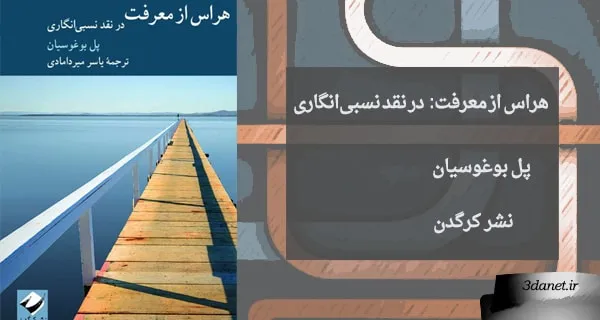
Relativism is widespread, yet its formulations remain vague. Paul Boghossian's Fear of Knowledge, translated by Yaser Mirdamadi, offers a rigorous critique of this view, clarifying the distinctions between various interpretations of reality and justification.
Mohsen Zamani:
Note: What you are reading is an introduction to the book Fear of Knowledge: Against Relativism, by Paul Boghossian, translated by Yaser Mirdamadi. This book has recently been published by Kargadan Publishing. Dr. Mohsen Zamani is a researcher and instructor of analytic philosophy at the Institute for Research in Fundamental Sciences (IPM).
1- Introduction
"Truth is relative." "Reality is our construct." "Whoever has power constructs reality and morality." "Paradigms are incommensurable." "The modern world is different from the traditional world." "Postmodernists have shown that there is neither truth nor rationality independent of tradition." "This rationality you speak of is a Western construct; we must construct our own rationality." "It cannot be proven that modern medicine is better than ancient medicine. The era of such proofs is over." "Christianity is true for Christians, and Islam is true for Muslims." "Einstein [sic] has shown that everything is relative."
You have probably heard such statements. Those who make such claims are usually called "relativists." Relativism about any domain, in brief, means that in that domain there is no reality independent of persons and societies. We need not search far to find that relativism, or what is thought to be relativism, is very popular in Iran, especially among the educated. If, for example, you tell an ordinary person on the streets of Tehran that if there were no humans, Mount Damavand would not exist, they will probably think you are mad. Yet in this same Tehran, if you tell many of the educated that you think mountains, electrons, or certain moral values exist independently of us humans, you should very likely expect to hear a lecture about Thomas Kuhn, Deleuze, quantum physics, grand narratives, and the like; if you are not accused of being dogmatic and fanatical yourself.
All this does not mean that relativism is of the ilk of folk beliefs and unworthy of reflection and scrutiny. On the contrary, great philosophers and prominent scientists of the empirical and human sciences, both among the ancients and the moderns, both among Continentals and Analytics, are relativists. But like any creed or school that becomes fashionable, relativism is also at risk of being misunderstood. Specifically, the following trouble may occur: a vague formulation of it is presented, such that one cannot distinguish between different interpretations of it. That is, by keeping in mind a correct interpretation of that formulation, one supposes that other interpretations of it are also correct. Let me give a few examples.
Claim 1: That the four humors do not exist is true for you.
First interpretation: You hold it true that the four humors do not exist. Others do not hold it true.
Second interpretation: Both your belief that the four humors do not exist is true in one sense of truth, and my belief that the four humors do exist is true in another sense of truth.
Second claim: The belief that the four humors do not exist is rational for you.
First interpretation: You have evidence that makes your belief that the four humors do not exist rational. Some people have other evidence that makes their belief that the four humors do exist rational.
Second interpretation: The evidence that you and I possess makes your belief that the four humors do exist rational, yet this same evidence makes my belief that the four humors do not exist rational.
Third claim: Your interests and benefits explain why you believe the four humors do not exist.
First interpretation: That you believe the four humors do not exist is due, among other reasons, to the fact that you are interested in this subject and derive some benefit from discovering truths about them. For this reason, you have tried to obtain evidence about it and, based on that evidence, have come to such a belief.
Second interpretation: the evidence played no decisive role in the acquisition of these beliefs. You hold such a belief simply because you like it or because it is in your interest.
Someone who is not a relativist can agree with the first interpretations of all three claims I made. By contrast, the second interpretations of these three claims announce the relativizing of, respectively, these three domains: facts, justification, and rational explanation. The point is that sometimes the three aforementioned claims are put forward and, given the intuitive plausibility of their first interpretations, it is thought that an argument has been made in favor of the second interpretations. If you have found what I have written so far interesting, you will very likely greatly enjoy reading this book: Fear of Knowledge: Against Relativism, written by Paul Boghossian, translated by Yaser Mirdamadi. Kargadan Publishing. 2016.
This book was written by one of the great contemporary analytic philosophers, and, as one would expect, it is full of clarifications about the nature of relativistic claims and an examination of the reasons for and against them. The distinctions I drew between the different interpretations of the three claims above are the simplest clarifications in the book, and you will find them in the first one or two chapters.
Although Boghossian's aim is to refute epistemic relativism, this book is also highly worth reading for defenders of epistemic relativism. This is both because by reading it one can become aware of the most refined formulations of relativism, and because the author has tried, at least in his own view, to present an account of the best arguments that might be made in favor of relativism. Perhaps some of these arguments have not even been presented by relativists themselves with the precision found in the book.
The author says in the introduction that although he wrote the book for the non-specialist reader, the book also has many points for those who pursue philosophy professionally. The reception other philosophers have given this book confirms this claim. With a simple search on Google Scholar, you will find that in the roughly ten years since this book was published, it has been cited over 700 times in specialized journals and books. Such a number of citations for contemporary philosophical works is rare.
2- What will you find in the book Fear of Knowledge?
Boghossian's book, in addition to the introduction and afterword, has seven chapters. "The Social Construction of Knowledge," "Constructing Facts," "Relativizing Facts," "Defending Epistemic Relativism," "Refuting Epistemic Relativism," "Resolving a Paradox," and "Epistemic Reasons and the Explanation of Belief." The translator has also added two appendices to the book. One is by the author and concerns moral relativism, and the other is a critical review of the book written by Harvey Siegel. In what follows, I will provide a brief report on these seven aforementioned chapters.
In the chapter "The Social Construction of Knowledge," the confrontation between objective and constructivist approaches to truth and justification is addressed. There is no doubt that some things, like money, are constructed by humans. Humans created money to achieve certain benefits and could have chosen not to. If there were no humans, there would be no money. At least at first glance, some things, like Mount Damavand or the electron, are not constructed by humans; they are objective. Relativists about facts consider these too to be constructed by humans, just like money, and try to strip the mask of objectivity from their face. Relativism can also be applied to two other matters related to knowledge: justification and rational explanation. According to relativism about justification, the fact that a piece of evidence supports a belief is something constructed by the community. Relativism about rational explanation means that one can never explain why someone holds a belief based solely on evidence. Interests and benefits must always be included in such an explanation. Someone who believes in at least one of these three relativisms is an epistemic relativist. The author then goes on to try to refute all three of these doctrines.
The chapter “Constructing the Facts” examines the doctrine of relativism about facts. This chapter examines the views of these relativists about facts: Goodman, Rorty, Putnam. Goodman and Rorty take the fact that reality is description-dependent to support relativism. It is clear that this claim entails relativism about facts. But Boghossian also notes that this claim is often conflated with another claim, the social relativity of descriptions, which does not necessarily have relativistic consequences. According to the latter claim, which conceptual scheme we choose to describe the world depends on our interests. Boghossian then turns to the cookie-cutter constructivism, a doctrine to which Putnam subscribes. Putnam’s main idea is that the world can be divided in completely different ways, and by choosing each of these ways, we commit ourselves to the existence of completely different objects. Therefore, relativism about facts is true. Boghossian says this argument only shows that there are multiple true ways of describing the world. Moreover, this picture presupposes a scheme-independent existence that is “sliced” in multiple ways. Boghossian considers the main problem with these accounts of relativism about facts to be that they violate the principle of non-contradiction. If I have constructed the fact that B is A, and you have constructed the fact that B is not A, then it must be true both that B is A and that B is not A.
In the chapter “Rorty’s Relativist Constructivism,” an account of relativism about facts is presented that is proposed, among other things, to deflect the last objection from the previous paragraph. In this conception of relativism about facts, being true is something dependent on the manner of speaking. It is possible that “B is A” is true in my manner of speaking, and “B is not A” is true in your manner of speaking. Of course, there is no contradiction here. Just as there is no contradiction in this: slurping food is desirable in the Far East and is not desirable in Iran. Boghossian then critiques this relativism. There is a traditional argument that is claimed to show that such relativism is self-defeating. Boghossian does not accept the traditional argument, but presents a similar argument against relativism. The main idea of the argument can be grasped with this question. Suppose I accept that when I assert A, I am really asserting that, according to the theory I have accepted, A. But is this latter claim absolutely true, or true in the theory I have accepted?
In the chapter “Defending Epistemic Relativism,” an argument is presented in favor of relativism about justification. According to this view, the same evidence may justify a proposition for one person and justify its negation for another. As Rorty says, in the dispute between Galileo and Bellarmine over whether the Earth is stationary or moving, both sides of the controversy were justified in their belief. Because they had accepted different epistemic principles. According to one of these principles, revelation is justificatory, and according to the other, observation. The point is that neither of these two epistemic principles is superior to the other. So, the claim that evidence does or does not justify a belief is incorrect; rather, it must be said that evidence does or does not justify a belief within a particular epistemic system. With this point in mind, Boghossian presents an argument in favor of relativism about justification, the gist of which is this: to argue that our epistemic principles are better than rival epistemic principles, we must use epistemic principles. If we use our own epistemic principles, we fall into a circle, a normative circle, and if we use the rival’s epistemic principles, we do not achieve our goal. Therefore, it is impossible to know which epistemic principles are absolutely correct.
The chapter “Refuting Epistemic Relativism” begins by explaining and rejecting Nagel’s version of the traditional argument against this doctrine. Boghossian then notes that the epistemic relativist, in order not to call their own epistemic claims false, must consider them incomplete. In other words, for example, this epistemic claim is neither true nor false: observing A justifies belief B. What is truth-apt is something like this: evidence A, in relation to epistemic system C, justifies belief in B. According to this conception, epistemic systems, which themselves include propositions that are more general forms of the aforementioned claim, are also incomplete. The question is, how do incomplete propositions stand in relation to other incomplete propositions?
Boghossian, in the chapter “Resolving a Paradox,” addresses the paradox of the conclusions of the two preceding chapters. In one chapter he has argued in favor of relativism about justification, and in the other against it. In his view, the solution is to reject one of the premises of the argument advanced in favor of relativism about justification: we are only permitted to employ epistemic principles when we have an argument for them at our disposal. Of course, rejecting this principle does not commit us to the view that we should never doubt our epistemic principles. The point is that as long as we have found no reason for such doubt, we are permitted to employ them.
The subject of the chapter “Epistemic Reasons and the Explanation of Belief” is an examination of the third relativist doctrine: relativism about rational explanation. The central idea is that our evidence is never sufficient to explain why we hold particular beliefs. Our interests and concerns are always involved in this matter. One of the arguments advanced in favor of this claim is the argument based on the underdetermination of belief by evidence. Kuhn and Quine have argued for this claim in two ways; the first is an a posteriori argument and the second an a priori one. Kuhn, by examining what occurs in scientific revolutions and paradigm shifts, accepts the doctrine of underdetermination. Quine notes that from a conflict between observation and theory it does not logically follow that the theory is in error; the culprit might be some of the many auxiliary hypotheses involved. Thus, which to retain and which to abandon ultimately depends on the scientists’ interests. In his critique of Kuhn, Boghossian examines, among other things, two different interpretations of living in different worlds. One is having different representations, and the other is having different things represented. The first is acceptable, and the second is not. Yet sometimes these two are conflated. In his critique of Quine, the author also points out, among other things, that a distinction must be drawn between two matters: one, that evidence does not logically entail beliefs, and the other, that evidence does not make beliefs rational. The first is true, and the second is false. Quine has only argued for the first.
3- Fear of Knowledge
We have said all this and not spoken of the fear of knowledge. Boghossian, too, addresses this subject only in the afterword. He considers one of the motivations for relativism to be the prevention of the oppression of the underprivileged. Activists in multicultural and postcolonial movements, by resorting to this philosophical doctrine, intend to prevent the oppression of those whose beliefs were deemed false and primitive. This is a respectable motivation. But the strategy these individuals have adopted also prevents the criticism of the powerful by the powerless. In Iran as well, those who, especially, impose restrictions on the humanities and harbor dreams of creating other sciences with different epistemic principles, in addition to the considerable manpower and resources at their disposal, also benefit greatly from the arsenal of philosophical relativism.
4- On the Translation
The translation is very fluent and free of stumbling blocks. This is due, among other things, to these three reasons: 1- The translator is neither Arabic-oriented nor Persian-oriented. By this I mean that he has generously and tastefully made use of appropriate Persian and Arabic expressions. The fact that “all his kinsmen were religious scholars” has enabled him to make good use of traditional terminology that adequately serves the purpose. His likely being from Khorasan has led him to also employ well-crafted Persian equivalents. He even, rightly, has no qualms about using a borrowed English word if he cannot find a suitable equivalent: “paradigm.” 3- The text is consistent. For instance, if the translator, contrary to my own preference, chooses to use a singular verb for an inanimate plural subject, he has done so throughout. 3- The text has been translated with “daring.” Both in finding equivalents and in choosing sentence structures. The confidence the translator has in his knowledge of Persian and English has led him, at times, to distance himself a little from the structure of the English sentences and “exact equivalents” without fear of the taunts of pedants. Examples are abundant. I will only mention two: (I have underlined the phrases I have in mind. Also, pay attention to the sentence structures)
[I]t’s a truism about most of the objects and facts that we talk about—electrons, mountains, dinosaurs, giraffes, rivers and lakes—that their existence antedates ours.
It is a truism about most of the objects and facts that we talk about—electrons, mountains, dinosaurs, giraffes, rivers and lakes—that their existence antedates ours. (p. 45)
If we can be said to know up front that any item of knowledge only has that status because it gets a nod from our contingent social values, then any claim to knowledge can be dispatched if we happen not to share the values on which allegedly depends.
If we can be said to know up front that any item of knowledge only has that status because it gets a nod from our contingent social values, then any claim to knowledge can be dispatched if we happen not to share the values on which it allegedly depends.
Reading this book was a delightful experience for me, both for its content and for its translation.
.
.
Introducing the book Fear of Knowledge: Against Relativism by Paul Boghossian
Introduction text by Dr. Mohsen Zamani
Translator: Dr. Yaser Mirdamadi
.
.
Download the PDF of the first twenty pages of the book Fear of Knowledge: Against Relativism
A one-minute video introducing the book Fear of Knowledge: Against Relativism
.
.





Discussion1 comments
این ترجمه در مجموع ترجمۀ قابل قبولی است. اما فی الواقع اشکالات جدی فنی هم دارد که باید بازخوانی بشود.