اندیشهفلسفهخردگفتگوحکمتمعناپرسشفرهنگ
Philosophy
Report on the Book Launch and Discussion of “Moral Feelings, Moral Reality, and Moral Progress”
A panel reviewing Thomas Nagel’s “Moral Feelings, Moral Reality, and Moral Progress,” featuring Abdolkarim Soroush, Mostafa Malekian, Yaser Mirdamadi, and Javad Heydari, tackled one of moral philosophy’s most fundamental questions: do moral values possess an independent reality, or are they grounded in human feeling, agreement, and judgment? The discussion examined Nagel’s realist stance alongside epistemological critiques and reflections on the place of virtue and inner human transformation.
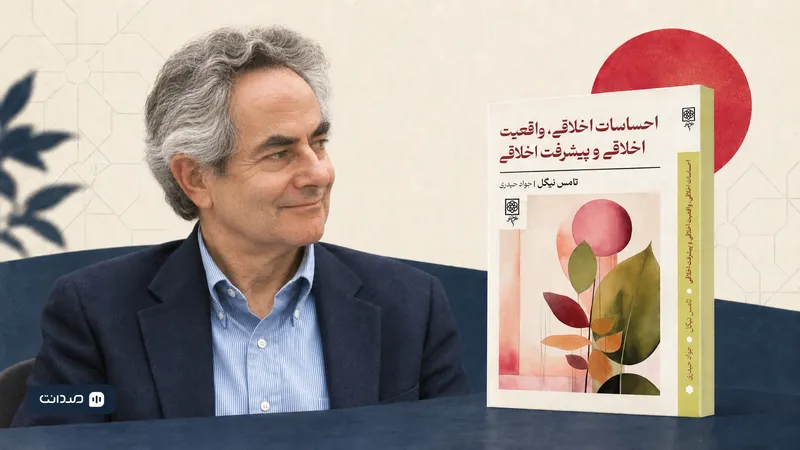
Thomas Nagel
Author
Javad Heidari
Book translator and panelist
Abdolkarim Soroush
Panelist
Mostafa Malekian
Panelist
Yaser Mirdamadi
Panelist
Hossein Kamaly
PanelistThe book launch and discussion session for “Moral Feelings, Moral Reality, and Moral Progress” by Thomas Nagel, translated by Javad Heydari, was held on Saturday, September 12, 2026, organized by the “New Perspective Circle.” Abdolkarim Soroush, Mostafa Malekian, Yaser Mirdamadi, Javad Heydari, and Hossein Kamali discussed the book’s three main questions in this session: What is the relationship between moral feeling and reality? Are moral judgments true or false independently of human desire and agreement? And if moral knowledge changes throughout history, by what criterion can we speak of “moral progress”?
What elevated the discussion beyond a mere book introduction was a disagreement that gradually emerged among three approaches: Nagel’s moral realism, which Heydari and Malekian expounded; Soroush’s view, which ultimately linked the validity of reason to the persuasion of rational beings; and Mirdamadi’s critique, which deemed realism independent of God insufficient and found the reduction of truth to consensus or persuasion problematic. Alongside this epistemological dispute, Malekian spoke of the absence of virtue ethics and the inner transformation of the human being in modern ethics.
Javad Heydari and the Formulation of the Book’s Problem
Javad Heydari began by explaining that he had dedicated the book to Abdolkarim Soroush: “In appreciation of a lifetime of his solitary intellectual struggle in times of hardship.” He saw two similarities between Soroush and Nagel: standing firm on intellectual beliefs against the attacks of opponents, and the decades-long persistence in pursuing a single concern. According to him, Nagel has thought and written about ethics for over six decades, and Soroush has also spent many decades expounding and interpreting Rumi.
Heydari summarized the book’s importance in five points. First, the book begins with a tangible and difficult problem, not an abstract definition. Second, it is the product of the reflections of a philosopher who has spent the greater part of his intellectual life on moral philosophy. Third, it simultaneously opposes two prevalent tendencies: reducing morality to biological and evolutionary mechanisms, and reducing morality to the calculation of utility and the maximization of good. Fourth, it attempts to transcend the dichotomy of absolutism and relativism. Fifth, it provides a criterion for distinguishing genuine moral progress from ideological claims of progress.
Nagel’s point of departure is a real incident involving Stuart Hampshire in 1944. Hampshire, who worked for British Army intelligence, was assigned to interrogate a prisoner whose information could save several lives. The prisoner said he would only speak if Hampshire promised to take him to Britain; however, he was scheduled to be executed the very next day. From the perspective of calculating consequences, a false promise could have led to saving human lives, but Hampshire could not make such a promise to a person on the verge of death.
According to Heydari, Nagel does not recount this story to make a final judgment on the rightness or wrongness of Hampshire’s decision. His problem is the familiar experience that sometimes emerges in the face of cost-benefit calculation: the feeling that “this cannot be done.” The book’s question is whether this inner prohibition is merely a psychological habit and a product of evolution, or whether it signals a moral reality. The answer to this question determines whether the historical crossing of such barriers should be considered progress or decline.
The Two Moral Voices: The Scale and the Red Line
Heydari emphasized that what Nagel means by “moral feelings” is not sentimentality or mere compassion. Moral feeling here is a kind of immediate perception that resembles seeing more than drawing a conclusion. Before making any calculation, a person may perceive that torture, killing the innocent, betrayal of trust, or a false promise is wrong.
Nagel identifies two voices in moral experience. The first voice, the “voice of the scale,” weighs consequences: pain is bad, pleasure is good, death is bad, and life is good; therefore, one must sum up the good and evil resulting from the options and choose the path that yields a better outcome for more people. This voice is the simple form of consequentialism or utilitarianism.
The second voice, the “voice of the red line,” says that certain acts are wrong regardless of their ultimate outcome. In this view, a person is not merely a container for receiving a certain amount of pleasure and pain who can be entered into an overall calculation; each individual has a domain whose boundaries others have no right to cross. According to Heydari, Nagel seeks human equality in this mutual inviolability and immunity. If this fence is removed, it is not merely that the quantity of equality is diminished, but that its meaning changes.
Nagel does not eliminate either of these two voices. On the one hand, the suffering and death of human beings truly matter in moral judgment; on the other hand, one cannot permit every encroachment upon the individual by appealing to the collective good. The difficulty of morality lies precisely in the occasional conflict between these two demands, not in the permanent victory of one over the other.
Moral Reality: Neither a Natural Object nor Personal Taste
To explain Nagel’s moral realism, Heydari juxtaposed three propositions: “Salt is sodium chloride,” “Ghormeh sabzi is delicious,” and “Torture is wrong.” The first proposition is true independently of human awareness; even if it had never been discovered, the chemical composition of salt would not change. The second proposition depends on taste and has no subject matter without a being who experiences flavor. But the third proposition fits easily into neither the first group nor the second. The wrongness of torture is not located somewhere in the world, like a chemical composition, to be discovered by empirical tools, yet a difference of opinion about it is not merely a difference of taste either.
Nagel sets aside three answers: placing moral truths in a separate realm and accessing them through reflection or revelation; equating moral judgment with personal likes and dislikes; and making right and wrong dependent on the customs of each society. His answer rests on the concept of “reason.” Morality is less about objects than about reasons for action: because I have promised, because another is in danger, because the property does not belong to me. A moral reason is not something material, but neither is it dependent on personal desire.
Nevertheless, unlike a chemical fact, a reason is always a reason for someone to do or refrain from doing something and has relevance only for a being capable of understanding it. This dependence on an “agent capable of understanding” does not mean relativism. There is a difference between someone who cannot understand a reason and someone who, due to self-interest, stubbornness, or self-deception, does not want to accept it. To explain this distinction, Heydari used the example of debt: forgetting or denying a debt does not make it disappear; but the realization of a debt requires an agent who understands the meaning of loan, commitment, and time.
Within this framework, moral objectivity means that the correctness or incorrectness of judgments is not a function of individual opinion or social agreement. It is possible for everyone to be mistaken about a judgment. At the same time, moral truth is not of the same kind as a natural fact unrelated to the human agent; it is a truth about reasons that hold validity for beings endowed with understanding and the capacity for action.
Moral Progress: Between Humility and Responsibility
For Nagel, a transformation in moral beliefs does not always signify progress. To judge the past, one must also separate two questions: Was an act wrong in itself? And did the people of that era have the capacity to recognize its wrongness? Confusing these two questions leaves the discussion vacillating between the wholesale condemnation of past people and the complete relativization of morality.
Heydari drew two complementary conclusions from this view. The first conclusion is “moral humility”: it is quite possible that some of today’s moral commonplaces will be recognized as errors in the future, and we currently do not even know which ones. Being situated at a point in history requires that we not consider our moral certainties the end of human understanding. The second conclusion is “moral responsibility”: historical limitation cannot serve as an excuse to deny truths that are now accessible to our understanding. A person is responsible for what they can understand but deny due to self-interest, stubbornness, or self-deception.
Therefore, for Nagel, moral progress is not merely a change in behavior or the widespread adoption of a norm; it can be progress in moral knowledge: the removal of an obstacle that has concealed a truth, or the emergence of the possibility of understanding a reason that was previously inaccessible. This conception preserves both the possibility of morally criticizing the past and links judgment about historical agents to their capacity for understanding.
Abdolkarim Soroush and the Criterion of Persuading the Rational
Abdolkarim Soroush began by noting that he had not yet received a copy of the book, and his assessment was therefore necessarily based on Heydari's explanations. He described Nagel as a subtle and unconventional philosopher, and spoke of his prior familiarity with the book "Mind and Cosmos"; a work he had taught after reading, finding in its arguments a kind of intellectual affinity with Nagel. Soroush recalled that despite his atheism and rejection of mind-body dualism, Nagel does not see nature as entirely lifeless and insentient, and posits a kind of continuum between nature and the emergence of human consciousness and free will. He also considered the translation of Nagel's works a service to introducing the capacities of analytic philosophy within the Persian-speaking intellectual sphere.
The main focus of Soroush's talk was a critique of the independence of moral truth from the "consensus of the rational." According to his account of the argument, Nagel says it is possible for all rational people to accept a judgment, and yet for that judgment to be false, or for everyone to deem something ugly that is inherently good. In response to this position, Soroush said he inverts the attempt to liken ethics to the natural sciences: instead of treating ethics like nature, he sees the natural sciences as similar to ethics in terms of epistemic validity. A proposition like "water is H2O," when raised in the realm of human knowledge, must also be made acceptable to the rational through reason.
In Soroush's view, "reason" has no practical meaning or validity apart from its persuasive function; reason is offered to convince the rational. When a proposition is articulated, its assessment ultimately returns to the reaction of the community of the rational and the persuasive power of the reasons. Therefore, even Nagel, to prove that moral truth is independent of consensus, must necessarily present an argument that persuades the rational.
Mostafa Malekian and Outlining Nagel's System
Mostafa Malekian sought to clarify the book's line of argument through conceptual distinctions. He began with the feeling that arises immediately in a person in a moral situation; for example, the unease after telling a lie. Regarding the relationship between this feeling and moral judgment, there are two answers. Emotivism says the sentence "oppression is wrong" is nothing but an expression of anger at the oppressor or empathy with the oppressed. Moral realism, in contrast, says a person encounters a reality, and that reality, in accordance with their psychological and physical structure, evokes a feeling; but the content of the moral judgment is a report of that reality, not a report of the speaker's feeling.
After accepting realism, the next question is the faculty for perceiving moral reality. Malekian separated two possibilities: reason and intuition. Reason proceeds from premises to a conclusion, but intuition is an immediate affirmation and should not be conflated with feeling. He then asked what the object of this perception is: ends and values such as pleasure, happiness, and security, or duties and actions such as truth-telling and avoiding arrogance? An emphasis on ends leads to consequentialism, and an emphasis on actions and duties themselves leads to deontology.
In Malekian's interpretation, Nagel is a pluralist in two respects: he considers both reason and intuition to be involved in moral cognition, and he grants validity to both values/consequences and duties/actions. He does not wish to eliminate the complexity of moral experience by reducing all judgments to a single principle.
Malekian then distinguished between progress in moral practice and progress in moral knowledge. According to him, Nagel, inspired by Walter Stace, focuses more on the progress of ethics as a theoretical and epistemological discipline than on the improvement of human behavior.
Malekian's main critique was directed at the scope of this project. He formulated ethics on three levels: first, "What kind of person should I be?" which pertains to inner beliefs, feelings, desires, and virtues; second, "How should I treat others?" which concerns interpersonal relations; and third, "What kind of society should we build?" which encompasses political and institutional ethics. In his view, modern ethics has seen significant theoretical progress at the third level, its progress at the second level has been more limited, and at the first level, it has offered almost no new theoretical achievements.
Malekian said that modern ethics largely asks what the moral agent does to reduce the pain and suffering of others, but it rarely asks what being moral does to the agent themselves. The weakening of attachment to wealth, status, and power, the taming of anger, liberation from self-centeredness, and inner transformation are issues that mystical traditions have emphasized, but they are marginal in modern ethical theorizing and also in Nagel's works. Thus, his critique was not a rejection of Nagel's realism or pluralism, but rather a demonstration of the empty space of "first ethics" and inner virtue in this framework.
Yaser Mirdamadi: From Translation Critique to Philosophical Challenges
Yaser Mirdamadi organized his remarks into three parts. First, he considered Heydari an example of a "thinker as translator"; a translator whose choice of works is not random or merely linguistic, but is situated within an intellectual project. From his perspective, this project, at the individual level, contemplates the possibility of combining rationality and spirituality, and at the collective level, a well-ordered society and peaceful coexistence, while simultaneously being a critic of scientism, relativism, and fundamentalism. The translations of works by Rawls, Nagel, Ronald Dworkin, and Quentin Skinner are also components of this same project.
The second part of his speech was dedicated to the language of the translation. Mirdamadi suggested that the unnecessary use of the impersonal "one" be reduced, long and convoluted English sentences be broken up in Persian, the succession of verbs be avoided, and the components of compound verbs be placed naturally within the sentence. Heydari accepted these considerations at the end of the session and promised to apply them in subsequent editions to make the text more fluent.
In the philosophical section, Mirdamadi raised three critiques. First, that Nagel balances consequentialist and deontological intuitions, but the place of virtue ethics in his theory is ambiguous or empty. This critique aligned with Malekian's observation about the absence of inner transformation in modern ethics.
The second critique concerned the possibility of defending moral realism without God. Nagel sees no need for a divine mind or a truth-maker prior to the emergence of humans for the truth of moral propositions. Mirdamadi considered this explanation insufficient for a full-fledged realism and said that moral reality without a transcendent source or mind faces metaphysical difficulty.
The third critique was directly aimed at Soroush's remarks. Mirdamadi said that if truth is reduced to the persuasion or consensus of rational beings, one can, inspired by G. E. Moore's "open question," ask: Is what rational beings have accepted really true? In other words, collective acceptance and truth cannot be equated without argument; because the possibility of questioning the correctness of the consensus itself remains open. In his summary, he added that a theory that bases validity on persuasion must itself possess sufficient persuasive power and metaphysical explanatory capacity.
Responses and the Dialogue's Endpoint
In his response, Heydari both accepted Mirdamadi's linguistic critiques and once again explained the philosophical goal of the translation: to show how a contemporary analytic philosopher tries to defend rationality and moral objectivity without falling into relativism or dogmatic absolutism.
Soroush, in response to Mirdamadi, said that requesting a reason for the theory of persuasion does not refute that theory; because that very reason must also be weighed and accepted by rational beings. He did not consider the open question objection unique to the theory of persuasion and said that the correspondence theory of truth is also not immune to similar questions. In his view, in the position of human judgment, there is no way outside of presenting a reason and assessing its persuasiveness before universal rationality.
The final discussion did not lead to a definitive resolution of the disagreement, but it clarified the point of contention. Nagel, as described in the session, wants to preserve moral objectivity without turning values into natural objects or referring them to a metaphysical realm. Soroush ultimately ties the epistemic validity of judgments to the persuasion of rational beings. Mirdamadi asks whether persuasion can take the place of truth and whether moral realism is complete without a transcendent support. Malekian also reminds us that even a successful theory about moral reality and knowledge, if it neglects the building of character and the inner transformation of the human being, has only covered a part of the realm of ethics.
The achievement of the session, more than providing a final answer, was the precise mapping of this very crossroads: morality is neither easily reducible to personal feeling, nor merely a copy of the natural sciences; not every historical change can be called progress, and the consensus of the rational people of one era is not an unquestionable criterion of truth. Nagel's book and the critiques raised in the session leave the reader facing an open question: how can one remain faithful to moral reality, accept the historical limitations of one's own understanding, and not flee from the responsibility of moral judgment and action?





Discussion0 comments
No comments yet; let yours be the first voice.