Philosophy
Introducing Issue 139 of Ettela'at-e Hekmat va Ma'refat: A Dossier on Friendship and Compassion
Issue 139 of Ettela'at-e Hekmat va Ma'refat, centered on friendship and compassion, explores the necessity of this relationship from the perspectives of philosophy and psychology. Drawing on Aristotle and Kierkegaard, it examines friendship's role in understanding 'the other.'

Have you ever considered the contribution of "friendship" in your life? Is "friendship" one of the essential needs of your life, or is it merely a grandiose concept to which you acquiesce in order to add to the splendor and beauty of your life? It seems that friendship, as a genuine need in life that simultaneously affects the inner and outer realms of human existence, plays a prominent role in the moral growth and flourishing of the individual and society. It is for this reason that it is fitting for philosophical reflections on the nature and essence of friendship, the types of friendship, the factors influencing the formation of friendship, its survival, permanence, and increase, as well as its decline, deficiency, and dissolution; its effects and consequences on each of the two parties of the friendship and their community; and finally, the benefits of friendship and even its promotion, to be placed among the most essential requisites of individual and social life.
There is no doubt about the vastness of the domain of friendship; from a brief acquaintance to that type of friendship in which, in Montaigne's words, "two souls mingle and become one... so that the seam that joined them can no longer be found." All of these are considered friendship. But the point is that standing at any point on this wide spectrum will influence a person's character and disposition, to a greater or lesser degree. It is this very point that has prompted philosophers and psychologists to examine the important matter of what effects, both psychological and sociological, the realization of friendship brings about in individuals.
The prominent status of friendship in human life opened a dialogue with Dr. Ali Sahebi, so that from the perspective of one of the important psychological approaches of this era, namely Choice Theory, we might observe what friendship and compassion do to our human souls, which compels a person to open a path for the "other" to enter the realm of their feelings and emotions. The role of the "other" and the relationship of the "other" with the human individual has also been examined from a philosophical perspective in an article on the position of the other from Kierkegaard's viewpoint; do we recognize ourselves in the mirror of the "other," or is the "other" an obstacle and a barrier to our self-knowledge? The human relationship with the "other" in this article is examined in three realms: ontology, epistemology, and axiology, and subsequently, in an article on empathy, you can peruse Edith Stein's phenomenological analysis of "empathy," which claims that it is only through empathy that one can truly understand the psychological states of another.
However, there is no doubt that when examining the philosophical concept of friendship, as with most philosophical concepts, one can look back to antiquity and claim, as Harnack did, that: "The history of the schools of Greek philosophy is at the same time the history of friendship," and thus, the discussion of the prominent effects of friendship in theoretical and social dimensions is largely indebted to the philosophical views of the philosophers and literary figures of that era. Friendship from Aristotle's perspective holds such a position that in his two ethical works, the Nicomachean Ethics and the Eudemian Ethics, he considers having concern for another and seeking the good for friends (solely for the friend's own sake) as an intuitive and accepted matter, and begins the discussion of friendship merely by enumerating the types of friendship, placing this matter among his most important achievements. In the present era, Nozick is among the philosophers who, following Aristotle, who "considers friendship to be the desire to be together," defines the core of friendship as the desire to share in activities, without the content of these plans and activities being of importance.
Scholars in the fields related to the soul and psyche, following Aristotle, also attribute the capacity for friendship to human intelligence and thought, calling it an intellectual and theoretical gift that can only flourish when the individual possesses a requisite degree of intelligence. Moreover, by introducing the discussion of friendship with oneself and presenting it as the foundation and basis for friendship with another, Aristotle argues that only virtuous human beings who enjoy inner harmony and integrity are capable of forming a friendship with their “own self” and, through it, with the “other.” Therefore, what Aristotle considers the destroyer of friendships is internal conflict; this is addressed in an article in this collection titled Friends as Other Selves. However, despite the breadth of Aristotle’s discussions on friendship, some do not consider him a suitable reference for answering the question of the nature and realization of friendship, deeming other alternatives, such as Montaigne and Emerson, preferable in answering this question. The article The Spirit of Friendship examines the meaning and spirit of a kind of “true friendship,” which they claim is very rare, from the perspective of these two thinkers.
In the world of Islamic sciences as well, two major currents have extensively addressed friendship and love. First, the Islamic philosophers, following the views of Aristotle and Plato on this matter; and second, the Sufi tradition, among whose most prominent figures one can mention Rumi (Jalal al-Din), who introduces love and friendship as the key to all human and divine relationships. Due to the importance of love and friendship in Islamic mysticism, we decided to dedicate this month’s Literature and Art section to a writing on this subject by William Chittick. We conclude the dossier on friendship and compassion with a piece by Sonja Lyubomirsky, who introduces practicing kindness and strengthening relationships as two very important factors for achieving a life based on well-being and happiness.
I conclude by stating that understanding the pattern of a friend’s behavior and having a holistic view of our friends is of great importance and will only be attainable over time. Only by grasping the overall pattern of our friends’ behavior, not just a part of it, can we understand their actions and conduct as a manifestation of their character, because in friendship, the totality of the friend is evaluated first, and then their behavior. Furthermore, a friendly relationship cannot be considered a completely free and chosen one, because accidental factors play a prominent role in it. So, if fate bestows upon us a bosom friend or bosom friends, let us strive artfully to preserve them. It is not without reason that the value of friendship is equated with artistic values, which arise due to differences and uniqueness, not solely due to moral commonalities. Let us remember that: “A man is fortunate if he sees even a shadow of true friendship.”
Seclusion is needed from strangers, not from the friend / The fur coat is for December, not for spring
If in solitude you become a Venus / Under the friend’s shadow, you become a sun1
.
.
1_ Rumi, Masnavi-ye Ma‘navi, Book Two, Section One
.
.
Editor’s Note
By: Naghmeh Parvan
Friendship;
Necessity or Luxury?
.
.
.
.
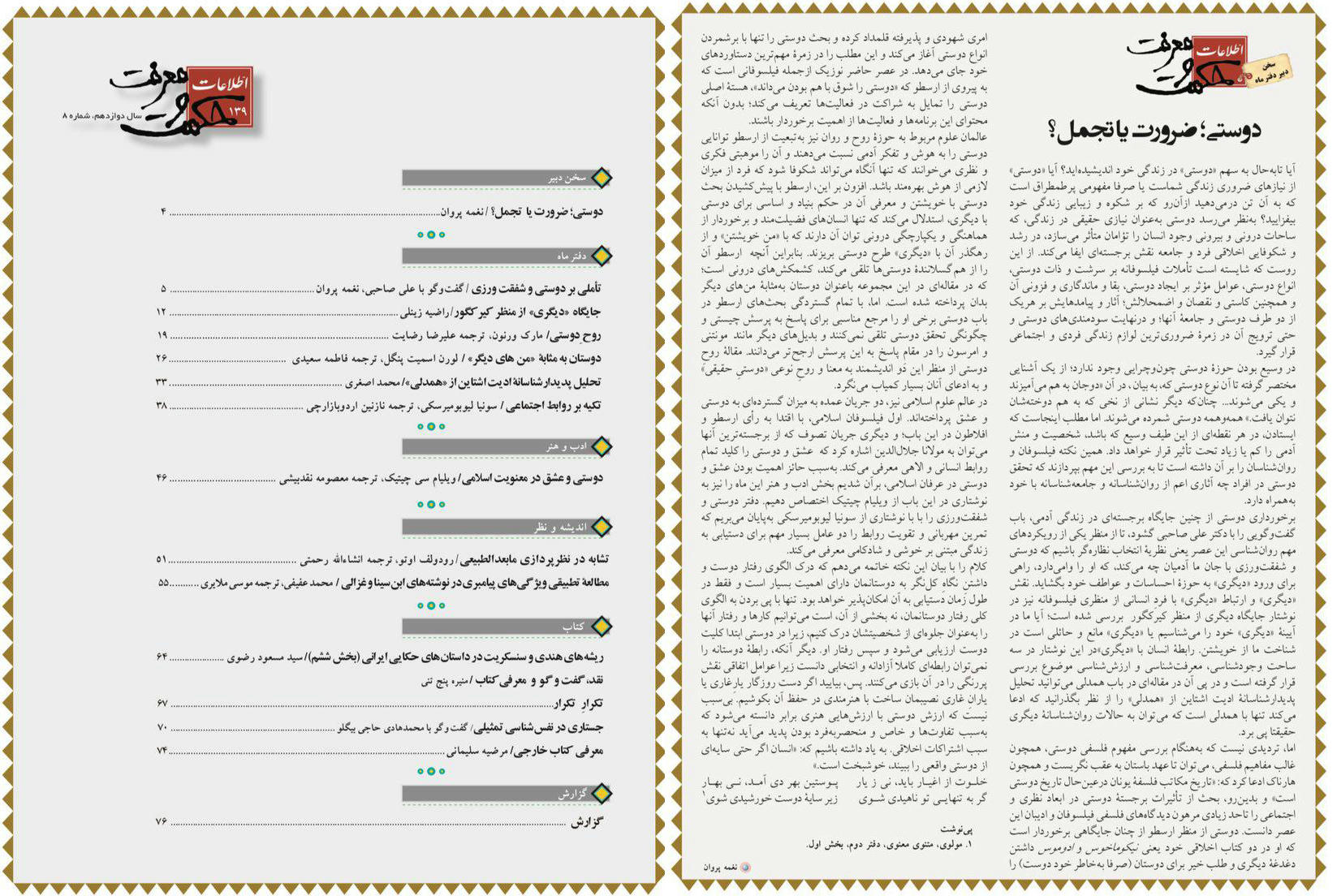
In the 139th issue of the “Ettela'at-e Hekmat va Ma'refat” monthly, you will read:
Editor’s Note:
Friendship; Necessity or Luxury?/ Naghmeh Parvan
Dossier: “Friendship and Compassion”
▪️A Reflection on Friendship and Compassion / A Conversation with Ali Sahebi, Naghmeh Parvan
▪️The Place of the “Other” from Kierkegaard’s Perspective / Razieh Zeinali
▪️The Spirit of Friendship / Mark Vernon, translated by Alireza Rezayat
▪️Friends as “Other Selves”? / Lauren Smith Pangle, translated by Fatemeh Saeedi
▪️Edith Stein’s Phenomenological Analysis of “Empathy” / Mohammad Asghari
▪️Relying on Social Connections / Sonja Lyubomirsky, translated by Nazanin Ardobazarachi
Literature and Art
▪️Friendship and Love in Islamic Spirituality / William C. Chittick, translated by Masoumeh Naghdbishi
Thought and Opinion
▪️Similarity in Metaphysical Theorizing / Rudolf Otto, translated by Enshallah Rahmati
▪️A Comparative Study of Prophetic Characteristics in the Writings of Avicenna and Ghazali / Mohammad Afifi, translated by Mousa Malayeri
Book
▪️Indian and Sanskrit Roots in Iranian Anecdotal Stories (Part Six) / Seyed Masoud Razavi
▪️Book Review, Dialogue, and Introduction / Monireh Panjteni
Repetition of Repetition
▪️An Inquiry into Allegorical Psychology / A Conversation with Mohammad Hadi Haji Biglou
▪️Introduction of a Foreign Book / Marzieh Soleimani
.
.
Email: ehvm86gmail.com
Telegram Channel: t.me/Doostanehekmatmarefat
.
.




Discussion0 comments
No comments yet; let yours be the first voice.