Philosophy
Introducing Issue 147 of Ettela'at-e Hekmat va Ma'refat
Issue 147 of the monthly Ettela'at-e Hekmat va Ma'refat is out, focusing on 'The Nature and Origins of the Phenomenological Movement'. This issue features seven articles along with sections on literature and art, thought, books, and event reports.
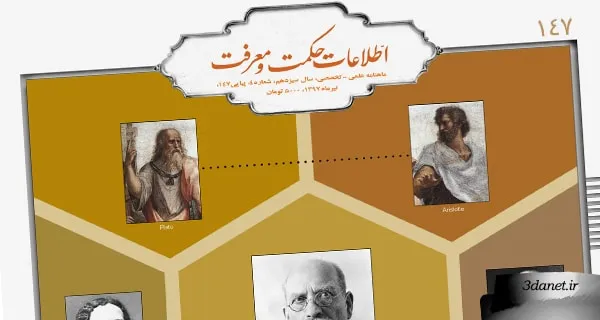
Issue 147 of the monthly journal Ettela'at-e Hekmat va Ma'refat, titled
The fifth and final section of the journal, titled
1 - First of all, various groups in Iran are engaged in different ways in the translation, authorship, and research in the field of phenomenology.
2- These individuals sometimes hold differing definitions and interpretations of phenomenology.
3- We occasionally witness various translations and multiple coinages of terms, and in some cases, there is not even an agreement on the translation of certain specialized words and concepts.
4- The absence of continuous critical communication and interaction among these individuals to examine authored and translated works, and the lack of effort to standardize equivalents or at least to question what the reasons for these differences are, how fundamental they are, and whether there is essentially a need for standardization or not.
5- The absence of critical examination of research conducted under the name of phenomenology, whether in the field of philosophy or in other areas outside the humanities.
6- Not subjecting research results to discussion and assessing their validity and generalizability.
Various questions about this dispersion formed in my mind, such as: What are the causes and reasons for these disagreements? Does the source of the disagreement and the origin of the emergence of this seemingly divergent situation lie within the phenomenological movement itself, or is it related to the manner of its introduction to Iran and the narrative of Iranian thinkers about it? To what extent do the disagreements stem from translations and renderings of texts? How much is due to tastes and the manner of selecting sources chosen for translation? Has the failure to translate works from their original language been effective in the degree of understanding of this movement? To what extent is the understanding of the phenomenological philosophical movement dependent on precise and conceptual knowledge of the history of philosophy, and what is the role of modern philosophy, especially from Descartes onward, in this regard? Has the rivalry for the precedence of German and French phenomenology over one another influenced our understanding of phenomenology? How effective have our cultural, historical, and geographical issues been in the reception of phenomenology and some of its renowned philosophers? In what "context" and "setting" and with what "aim" did the first teachers and narrators of phenomenology employ and teach the main concepts of this movement? When we say a "phenomenological" introduction to the philosophy of a certain philosopher, for example, Descartes, what is meant? What is the meaning of the word phenomenon and phenomenology for philosophers before Husserl, for instance, Hegel? What is the relation of phenomenology, which is used in other disciplines of the humanities and empirical sciences like medicine and nursing, especially as a method, to philosophical phenomenology? Essentially, to employ phenomenology as a "method" in qualitative research, is there a need for historical-philosophical knowledge and a deeper familiarity with the main concepts of the phenomenological movement? When we say following Heidegger's phenomenology in research, what do we mean? Has Heidegger provided the researcher with a step-by-step model, as is customary in the lexicon of conventional methodology? If such a model does not exist, how does research on a specific topic proceed for the first time? If Heidegger is fundamentally not supposed to provide such a model or it contradicts his philosophy, what meaning and concept of phenomenology do the studies conducted under the name of Heidegger's phenomenology have in mind? How will the generalization of the results of phenomenological research be? How are the results of research examined and evaluated? Do these studies have more application outside the field of philosophy, or might it also be possible to design phenomenological research that serves as a method for rereading philosophical concepts and works? And many more questions that can be raised considering the current situation.
Therefore, based on the evidence, questions, needs, and existing published works, I designed a series of several volumes for a better understanding of phenomenology and to find answers to some questions or to clarify fundamental questions. Although these volumes in no way claim to be comprehensive or to answer all of these questions, if they come to fruition, one can hope that they will address a part—even a small part—of the deficiencies in this field and shed light on some ambiguities. In the final summation, I arrived at seven plus one volumes. The first volume, titled
"Phenomenology: The 'Path' of Thinking and Inquiry" is the title of the second article. The main concern of Marzieh Piravi-Vanak is to distinguish phenomenology as a path from phenomenology as a method. In the author's view, phenomenology is originally a "path" for thinking and is beyond a philosophical school or a research method. Piravi-Vanak considers the way of phenomenology to be a resolute effort to enrich the world of human experience, and with an ontological concern, examines phenomenology as steps along the "path" of thinking (not a method) and describes the differences between path and method by relying on phenomenology.
In the third article, titled "Phenomenology as First Philosophy," Ali Nejat-Gholami attempts to describe the meaning of first philosophy from the perspective of phenomenology with reference to the thoughts of Edmund Husserl. The author considers the reason for the difficulty of understanding phenomenology to be "the failure to grasp the philosophical meaning of this concept prior to its application as a method." Ultimately, it can be said that the main goal of the article is to elucidate the principal positions of the phenomenological movement, especially in relation to the two approaches of positivism and historicism. The importance of these two approaches lies in the fact that they have, in a way, formed the methodological basis of the natural sciences and the human sciences.
The fourth article, "The First Contexts of the Emergence of Phenomenology: The Relation between Appearance and Being," is a phenomenological reading of the dispute between Plato, Aristotle, and Protagoras, penned by Mehdi Sahebkar. To examine the relation between appearance and being, the author begins with Plato's Theaetetus and, after investigating this issue in Aristotle's views, presents a phenomenological reading concerning the relation of these two concepts. By highlighting the concept of intuition, the author poses the question of how subjectivity must play its constitutive role while simultaneously enabling the self-manifestation of the phenomena themselves. This article was included in this collection not only because it is an example of a phenomenological reading but also because it searches for the earliest contexts of the formation of phenomenology in ancient Greece. The difficulty of this article and the multitude of its non-Persian terms did not prevent its inclusion in this collection.
"Phenomenology" is the title of the fifth article and a translation of the entry of the same name from the Historical Dictionary of Philosophy, compiled under the supervision of Joachim Ritter and translated from German into Persian by Hamed Safarian. The phenomenology entry of this dictionary consists of three main parts, which are: 1) From Lambert to Brentano, 2) Husserl, 3) Thinkers after Husserl, up to Heidegger and Jaspers in Germany and Ricoeur and Merleau-Ponty in France. In this issue, Safarian has translated the first part of the phenomenology entry, and the other two parts, by the same translator, will be published in subsequent issues.
The sixth article, "The Method of Phenomenology," is by Joel Smith and translated by Maryam Khodadadi. The author begins his article with a brief explanation of Husserl's Logical Investigations as the birthplace of phenomenology and then addresses the influence of this view on Heideggerian phenomenology and the development of French existentialist phenomenology, subsequently focusing his article on a discussion of the subject and method of phenomenology. Smith considers the precise description of the ways things appear to be one of the most important tasks of phenomenologists and, to explain this, addresses the difference between Husserl's and Heidegger's phenomenology in terms of phenomenological method. This article has also been placed in the first issue because it targets the method of phenomenology with reference to the most principal sources in this field.
The seventh and final article, titled “Husserl’s View of First Philosophy,” is by Robert Sokolowski, a contemporary Husserl and Aristotle scholar, translated into Persian by Mohsen Saber. In this article, the author seeks to highlight the most important philosophical issues of these two philosophers. Drawing on his philosophical knowledge of the Aristotelian tradition, Sokolowski examines the meaning, significance, and dimensions of first philosophy in Husserl’s thought. A crucial point Sokolowski emphasizes is that Husserl’s importance does not lie in his presentation of certain valuable analyses, such as his analytical descriptions of categoriality, perception, temporality, memory, embodiment, and logic; rather, in his view, the reason for the enduring nature of Husserl’s works is that those analyses preserve philosophy itself. The author holds that Husserl clarified the meaning of entering the philosophical life, developed first philosophy as a theoretical activity, and revived philosophy. In fact, Sokolowski believes that Husserl succeeded in rediscovering and preserving philosophy because, in his view, “Husserl shows how philosophy is a different form of thinking, and shows how it is distinct from other forms, especially the diverse forms [of thinking in] the sciences and world-views.” This article is placed in the first volume because it examines the relationship between first philosophy and Husserl’s phenomenology.
In the following, it is necessary to mention three brief but important points in this writing concerning the eight volumes:
1- At the request of the authors and translators, I tried to preserve their orthography as much as possible. Part of this emphasis is to show the differences in the interpretation and translation of texts related to phenomenology.
2- Regarding articles that are authored and not translated, we leave judgment to the specialist reader and hope they will send their written critiques to the journal for publication in the final issue, namely “We and Phenomenology,” which is dedicated to the critique and pathology of the state of phenomenology in Iran.
3- In issue 1 of the first volume (this present issue – July 2018), we do not have an interview. The main reason for this is that previously, in the three issues of “Philosophy of Architecture: Phenomenology of Place,” we had outlined the primary and main discussions for entering the topic of phenomenology, and arranging a new interview was not beneficial; however, in the second issue of the first volume (August 2018), we will have an interview about the origins of the formation of phenomenology from Descartes to Husserl.
In closing, I am infinitely grateful to all the specialists, translators, and researchers in this field who accepted my invitation and made their works available for publication in this monthly; it goes without saying that the credibility and quality of this collection are indebted to the knowledge and expertise of individuals who sincerely and committedly cooperated with us for a more precise understanding of the phenomenological movement.
.
In the book section of these multiple volumes, we strive to provide a report on the most important works translated and authored in the field of phenomenology.
The issues of these three volumes and their publication dates are, respectively: 112 and 113, August and September 2015, and issue 132, April 2017.
For example, one can refer to the articles “Application of the Phenomenological Research Method in Clinical Sciences,” “Phenomenology of Aesthetic Experience: A Case Study of Naqsh-e Jahan,” “Social Needs of Individuals with Cerebral Palsy: A Qualitative Study Using the Phenomenological Method,” and “Phenomenology of the Body.”
I raised discussions close to this topic in an interview with Mohammadreza Rahimzadeh titled “Phenomenology and Research in Architecture” in issue 132 of Ettela'at-e Hekmat va Ma'refat monthly.
I discussed this topic in an interview titled “Phenomenology Outside the Boundaries of Philosophy” with Yazdan Mansourian in issue 113 of Hekmat va Ma'refat monthly.
The article “Phenomenology: The ‘Way’ of Research and Thought” in this issue – 147 – pursues similar concerns.
I will confine myself to just one example, namely “Reduction,” for which four translators have each chosen a different equivalent: Fereydoun Fatemi, in the book Husserl’s Thoughts (David Bell, Markaz – 1376), has chosen the equivalent “فروکاست” for this term. Abdolkarim Rashidian, in Husserl in His Own Texts, has chosen “تقلیل.” Siavash Jamadi, in Context and Time of Phenomenology: An Inquiry into the Life and Thoughts of Husserl and Heidegger (Qoqnus – 1392), has chosen “فروکاست” and “توقیف,” and Masoud Olia, in The Phenomenological Movement: A Historical Introduction (Herbert Spiegelberg, Minouye Kherad, 1392), has chosen “تحویل.”
What I mean by this critical engagement is a space that recognizes differences, engages in dialogue about them, and makes the outcome of this available to the audience of these works through written media, rather than merely resorting to oral rejection and denial.
In what sense do studies conducted under the title of “phenomenology” in method and approach—whether those in the field of philosophy or those in other branches—employ phenomenology? Does indifference to these studies not amount to dissolving the problem? If these studies lack validity—and of course, we need to say why, how, and by what criteria—would not a critical examination of them and an analysis of their relation and connection to philosophical phenomenology prevent, as far as possible, the waste of material and spiritual resources? And if those studies are the practical and applied aspect of phenomenology, perhaps their examination and pathology could correct the perception of critics who say we have no phenomenological research.
It was initially in the form of a preliminary proposal that was gradually completed.
I hope news of the first volume’s publication reaches the rest of the specialists in this field whom I was unable to correspond with. One can be optimistic that the first volume will become a connecting link, so that other researchers and translators in this field will join us and make their specialized knowledge and experiences available to us for the publication of ever richer future issues.
In the three volumes of “Philosophy of Architecture: Phenomenology of Place,” we had seven conversations, each of which addressed a part of phenomenological discussions, especially the subject of research method, but among them, the conversation with Dr. Shamsolmolouk Mostafavi, titled “The Phenomenological Movement,” is directly devoted to the entirety of the subject.
.
.
PDF file of the Secretary's Note
Monireh Panjtani
Monire.panjtani@gmail.com
.
.






Discussion0 comments
No comments yet; let yours be the first voice.