Philosophy
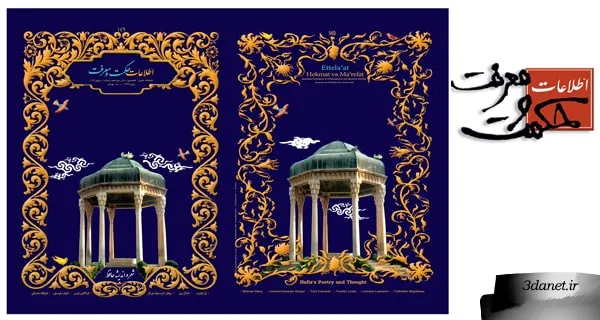
Introducing Issue 160 of Ettela'at-e Hekmat va Ma'refat
Issue 160 of the journal Ettela'at-e Hekmat va Ma'refat is devoted to the thought of Henry Corbin and is the fruit of a year-long research project by the Iranian Society of Philosophers. Its articles explore individuation, personal encounter with the text, and apophatic theology.
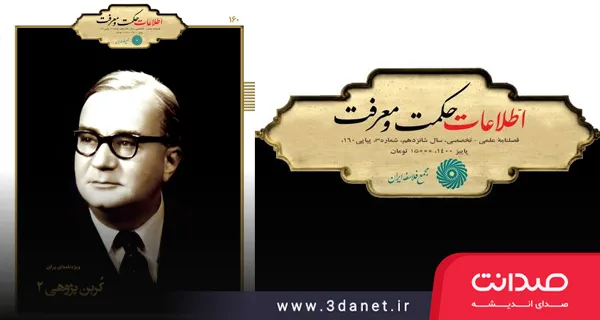
The articles in this collection are drawn from a research project that was carried out over the course of a year with the support of the Iranian Society of Philosophers. This research group was formed around 2016, emerging from Dr. Enshallah Rahmati's lecture courses on Corbin studies, and found a more cohesive structure with the support of the Society of Philosophers. Research on this subject continues alongside Dr. Rahmati's weekly lecture courses on Corbin studies.
Special Issue
▪️Editor's Note / The Question of Contemporary Humanity: A Re-reading of Henry Corbin's Views, Zahra Bahremand ▪️Eternal Sophia / Henry Corbin, translated by Mitra Sarhadi ▪️Individuality in Corbin's View / Maryam Zaeri ▪️Is the Birth of "Iran" Only Possible in the Realm of the Nation-State? An Inquiry into Spiritual Experience in the Works of Henry Corbin and Bijan Elahi / Hesam al-Din Saffari ▪️Presence in the "Act" of Bijan Elahi's Poetic Translations with Regard to Henry Corbin's Theories / Zahra Bahremand ▪️Apophatic Theology as Narrated by Corbin / Sasan Yaghmai ▪️Philosophical Aspects of Corbin's Thought (Corbin in Another Frame) / Alireza Semnani ▪️A Reflection on the Possibilities and Obstacles of Henry Corbin's Phenomenological-Hermeneutic Intellectual Framework in Reading ▪️ A Reflection on the Possibilities and Obstacles of Henry Corbin's Phenomenological-Hermeneutic Intellectual Framework in Reading Persian Painting / Monireh Panjtani
Book
▪️A Bibliography of Henry Corbin in Persian / Monireh Panjtani
New Publications / Sasan Yaghmai
.
.
Editor's Note / The Question of Contemporary Humanity: A Re-reading of Henry Corbin's Views
Zahra Bahremand
"Meditate with the author, rather than repeating his work. Find your way to yourself, without fearing, if necessary, to go alone. Here, the question of debate and dispute has no place, and knowledge is no longer a matter of virtue — this meditation is intertwined with the absolutely personal destiny of the wayfarer."
This is Corbin's statement regarding the religious philosopher's or sacred scholar's encounter with a text like Jung's Answer to Job, wherein Corbin seeks to introduce us to a different kind of encounter, free from the limitations arising from common categorizations: a kind of personal encounter, a kind of meditation, which communes with the secret of wisdom. In Corbin's view, this is how Jung re-reads the story of Job. He is an individuated person who relies solely on the powers of his own soul and is the spokesperson for no religious belief, no dogmatic creed, and no institution. He represents only himself, and such a description of a person is not a destruction of his credibility, but rather represents his greatness, influence, and originality. Corbin says:
"How many people today can truly claim to be the 'representative' of themselves, while they are merely representatives of nothing but collective norms, official opinions, and ready-made beliefs? It is solely because of our existence in the presence of this human being that I wish to invite all individuated persons, if they are truly individuated, to reflect upon this book [Answer to Job] and to listen to this message. Authentic wholeness is attained only through solitudes and in individuation. This kind of theology is understood not in manuals or historical critiques of texts, but in the dark night and spiritual weariness, in a sacred inner struggle without compromise, without cowardice, and without retreat. This is in harmony with that very ideal of individual religion which the theologian Schleiermacher strove to describe with such passion. That he might one day become our contemporary again is not impossible. Only a person whose central personal intuition allows him to connect with the entire edifice of his religion can establish himself at the heart of any given religious form. Only such a person truly holds 'the keys to the city in the religious world.'"
The collection you hold in your hands begins with a translation of this very essay by Corbin, Sophia Aeterna, which is his rereading of Jung's Answer to Job, and continues with studies written around the themes of individuation, personal encounter, apophatic theology, presence, and this very spiritual birth. Scholars who wished to be individuals, the individual in opposition to collective religion and the norms that often lead to the denial and suppression of this very presence and spiritual birth. Scholars who offer a fresh reading of Corbin's works, a reading born of reading and rereading and reflection and rereading again and many times over. A reading that is the product of a hermeneutic circle that roams through the mind, psyche, and soul and returns to the text and again to the mind, psyche, and soul, transforming each time, and of course the cosmic text and the everyday world are also present in this circle. But the final, inner transformation, according to Corbin himself, occurs in the interlocution and the specific time of the soul: the time of presence. The scholars in this collection have each found this presence in some way in Corbin's project, each according to the degree of their reading and interpretation and that very meditation or wayfaring with Corbin's texts. This mode of reading and presence in reading, as Corbin himself teaches us, is of the same nature as Suhrawardī's encounter with the Quran: "You must read the Quran with ecstasy and rapture and with subtle thought. Read the Quran as if it were revealed solely for you" (Corbin, 1391, vol. 2: 11); quoting Suhrawardī in Kalimat al-Taṣawwuf). In fact, by contemplating this very statement of Suhrawardī and, of course, other theologians including Luther according to his rule of the imperative mode (see Corbin, 1383: 25) and also Johann Albrecht Bengel (1687–1752) who says: "Apply your whole self to the text, so that the whole of the text may be applied to you" (Corbin, 1391, vol. 1: 552), Corbin introduces us to a special method for reading texts, especially sacred texts, which arises from the reader's personal encounter with the text and the birth of the text from this encounter, because fundamentally, in Corbin's view, "the mode and manner of understanding is conditioned by the mode and manner of being of the one who understands" (ibid: 248). Thus, a person's understanding and knowledge are not superimposed upon existence; rather, it is existence that unfolds and knows itself. (See ibid: 550)
In this way, the wise text and its wisdom are recollected within the person's being, and through this recollection, which takes root in their own existence, the person becomes a wayfarer, a wayfarer of their lost self, their celestial self: the God who calls them. For the voice of God, the voice of the sacred book, must first be heard from within the person's own being so that the person can then see this voice in the world and sit in visionary revelation: "The Word, the divine Word, is a resonant incantation [or spell] that causes existence and is perpetually the nature or mystery of every being. This nature, which is established in this existence, is at the same time not apparent to the physical eye but to another eye, the insight of the inner self that perceives other places" (ibid: 255). This eye or "inner vision" (Suhrawardī in A Day with the Community of Sufis) or "the eye of the soul" (Philo) is the very temple we must build within ourselves, a temple whose image is built in all the temples of the external world, each a symbol of the Image of the Temple (Imago Templi), the celestial Jerusalem or the Heavenly House of Holiness, the Malakūt, which, through recollection and the resonating of God's voice in the soul, opens within the soul—the temple, Jerusalem, or the khānaqāh of the soul/heart that, by deepening and becoming more cultivated, transforms into a world: an imaginal world that reflects the Malakūt of the heavens. The soul becomes a mirror, and it is because of this that it sees.
It is at this very moment and time of theophany, and the time of the soul's intoxication, that a faculty becomes active in the soul, a faculty resulting from the totality of the soul that becomes the light of the eye of its soul and is, of course, the result of an illumination from that very celestial Temple to display its reflection in the soul of the wayfarer, the reflection of the Image of the Temple, so that in this temple, in this place open wide to the heaven of the soul, visionary revelation may occur: "[That] wise thought which sees God and loves God. Seeing precedes hearing, meaning the ears become eyes ... for if the voice of humans is received through hearing, the voice of God is received through seeing, like light. The same can be said of active visionary revelation. When a human being is thus, that human being is truly a temple" (Corbin, 1389: 439). And it is for this reason that Corbin, in this very position, establishes his own specific phenomenology, which is based on this very seeing or inner vision, and is therefore a Kashf al-Maḥjūb (Unveiling of the Veiled), because it is a spiritual-psychic event that concerns the contemplation of eternal matters reflected in the mirror of the soul, and which are, of course, moment by moment unveiled and veiled.
Thus, here the individual is not meant to be enchanted and subjugated by the wrath and dominion of a ruler who possesses divine glory, through a cataphatic theology based on external levels of existence that find no connection with him and that create a "religion of fear"—akin to the immense wrath Yahweh pours upon Job. Rather, here the individual discovers the levels of existence within himself, in the labyrinthine corridors of the psyche and the boundless aspects of his personal issues, and in his relationship with himself, with the Spirit of the World, and with the very suffering he encounters in the events of his life. How can one find an answer to the wrath and cruelty inflicted upon Job? In this confrontation, how can contemporary man find an answer for his own faith? A faith that becomes terribly shaken in dreadful times of crisis and finds itself facing a sliver of existence that is on the verge of evaporating (citing Heidegger's quotation of Nietzsche, see Heidegger, 1396: 94 and 358), and where the Divine Book and the Book of the World no longer have a voice to be heard or seen? Man is always seeking justice within himself against this wrath and mercilessness present in his destiny, and this quest for justice, through that very faith, gives birth to a wisdom or Sophia from within; the mercy and love of God that establishes justice within us (Corbin's reference to Luther in Corbin, 1383: 25) and is the balancer of the conflicting forces of existence and the destiny of each of us. Sophia is the creative feminine divine force that gives birth to the celestial self of each of us, the divine mercy and love that resides in the heart of the believer (the Throne of the All-Merciful), the dwelling, the Shekhinah, and the silent contemplation (see Corbin, 1395: 137 and 145) within each individuated person who finds the homeland and the earth of the Kingdom within himself and attains the second birth: He it is who sent down the Sakinah into the hearts of the believers, that they might add faith to their faith—and to God belong the hosts of the heavens and the earth, and God is All-Knowing, All-Wise.
Following this very profound and extensive article by Corbin, which has been translated into fluent and precise Persian for the first time—a translation from the English version of an unfinished and unpublished book by Corbin, a limited online version of which has recently become available—we witness several studies revolving around these same focal themes in this new and meticulous reading derived from Corbin's works; a quartet of the categories of individuality, the birth of the homeland, presence, and apophatic theology. Each of these articles has endeavored to re-examine these central axes in Corbin's thought. In the first article, what is distinctive is the spiritual dimension of individuality according to Corbin and the role of the Angel in the soul's passage to the transpersonal level of its life and the relationship between the soul and the Angel. The second and third articles are the result of a joint project focusing on the views and poems of one of the contemporary creative poet-translators, Bijan Elahi, and the researchers sought to re-read the individuality-centered interpretation of Corbin's project in a different way, considering this avant-garde, important, and yet obscure voice in contemporary literature. The question of one is an assessment of the various possibilities of the birth of Iran as an existentialist experience concerning the spiritual implications of the alchemical power and the issue of the "I" in encountering the "Other," and the issue of the other article is the question of the creative presence of the agent-translator in the translation of poetry, so that the text is recreated with his presence and individuality, and the translator can once again see those poetic truths and present them for us to view. In the final article, apophatic theology, the discussion concerns the relationship between the unknowable essence of God and the levels of His manifestation, and the possibility of knowing Him through the soul and the Imam realized within the soul.
The two final articles, however, represent two other readings of Corbin. One seeks to re-read Corbin's thought within a new framework that argues Corbin was avant-gardely attempting to critique modernity and oppose history, a central axis that directs him toward the phenomenon of Gnosis, so as to elevate philosophy to a kind of hermeneutic phenomenology through the perspective of the Mundus Imaginalis. The final article also seeks an initial reflection on the possibilities and obstacles of the phenomenological and hermeneutic apparatus of Corbin's thought in re-reading Persian miniature painting. In both of these articles, we see less of that central axis of individuality and the previous reading, and readers encounter other interpretations.
Previously, in May 2009, a special issue on Henry Corbin was published by this same journal, which contained valuable interviews and articles about Corbin, and this collection is the second issue of articles about Corbin. And of course, another issue on Corbin is planned to be published, God willing, in the coming year.
In closing, I must note that each of the articles in this collection is drawn from a research project that these scholars carried out over the course of a year with the support of the Iranian Society of Philosophers. This research group was formed years ago (around 2016), emerging from the Corbinology lectures taught by Dr. Enshallah Rahmati, and found a more cohesive structure with the support of the Society of Philosophers. This research continues alongside his weekly lectures on Corbinology. And all of this is due to the interest and the attraction that captivates souls with the divine breaths rooted in the earth of divine wisdom. This collection is an invitation to a different kind of study. We must contemplate the divine book that resides within our souls.
Bibliography
Corbin, Henry (2004). From Heidegger to Suhrawardi. Translated by Hamed Fouladvand. Tehran: Ministry of Culture and Islamic Guidance; Printing and Publishing Organization.
——— (2010). Temple and Contemplation. Translated by Enshallah Rahmati. Tehran: Sophia.
——— (2012). Spiritual and Philosophical Perspectives: Iranian Islam. Vol. 1. Translated by Enshallah Rahmati. Tehran: Sophia.
——— (2012). Spiritual and Philosophical Perspectives: Iranian Islam. Vol. 2. Translated by Enshallah Rahmati. Tehran: Sophia.
——— (2016). Earth of the Kingdom: The Resurrectional Body of Man from Mazdaean Iran to Shiite Iran. Translated by Enshallah Rahmati. Tehran: Sophia.
Heidegger, Martin (2017). Introduction to Metaphysics. Translated by Enshallah Rahmati. Tehran: Sophia.
.
.
Email Address: ehvm86gmail.com
Telegram Channel: t.me/Doostanehekmatmarefat
.
.

Discussion0 comments
No comments yet; let yours be the first voice.