Philosophy
Issue 151 of Ettela'at-e Hekmat va Ma'refat: 'Making the Humanities Practical'
Issue 151 of the quarterly Ettela'at-e Hekmat va Ma'refat, themed 'Operationalising the Humanities', features an interview with David Archard on applied philosophy and examines Quranic sciences, philosophy for everyday life, and philosophical therapy.
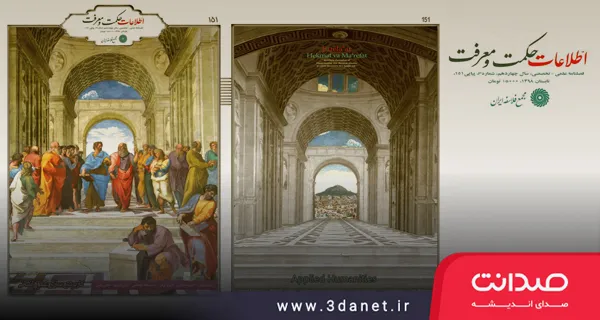
The 151st issue of the quarterly Ettela'at-e Hekmat va Ma'refat, titled 'Making the Humanities Practical,' has been published, edited by Ahmad Pourqasem Shadehi and Naghmeh Parvan.
'What is Applied Philosophy?' The first piece in this issue is a conversation with Professor David Archard, Vice President of the Society for Applied Philosophy in England, conducted by Ahmad Pourqasem.
In the second conversation, namely 'Making Quranic Sciences Practical within the Scope of Making the Humanities Practical,' Dr. Hadi Vakili, a researcher and professor in the field of Quranic sciences, answers Hassan Baqerian's questions in this area.
The third piece is an article titled 'A New Approach to Making the Humanities Practical' by Ahmad Pourqasem Shadehi, which examines the practicalization of the humanities based on its function.
The fourth article in the special issue on making the humanities practical is a piece titled 'Philosophy for Everyday Life' by Finn Janning, translated into Persian by Reyhaneh al-Sadat Azimi.
'Teaching Methods in the Humanities' by Elham Gerami and Mohammad Tajbakhsh is the fifth article in the present issue, which analyzes traditional and modern teaching methods by drawing on one of the new approaches to learning.
'Health-Oriented Humanities Will Save Human Lives' is the sixth article in the discussion on making the humanities practical. This article was written by Stephen Toulmin and translated into Persian by Elham Shamsi.
The seventh piece in this issue, titled 'Branches of a Tree,' is a chapter from the book 'The Integration of the Humanities and Arts with Sciences, Engineering, and Medicine in Higher Education,' translated by Maryam Pouraskari.
The eighth and final piece is an article on 'Philosophical Therapy' by Elliot Cohen, translated into Persian by Naghmeh Parvan, which introduces one of the most important functions of philosophy in the present era as helping to alleviate moral and spiritual crises.
The Thought and Opinion section features four articles with the following titles:
'Beauty' by Jerome Stolnitz, translated by Ensha'allah Rahmati
'Jesus, Son of Mary' by Hekmatollah Mollasalehi
'What is the Reason for Translating?' by Elad Lapidot, translated by Mitra Sarhadi
'Prayer Treatises and Those Related to the Occult Sciences in Suhrawardi's Illuminationist School' by John Walbridge, translated by Saeed Anvari
In the Book section, edited by Monireh Panjtani, we read:
Book Review, Discussion, and Introduction / Monireh Panjtani
Walden: Re-posing the Question 'Why and How Do I Live?'
Walden: A Critical Work on Conventional Ways of Living / A Conversation with Alireza Beheshti Shirazi
The Book section includes a report on 'Peace and Religions,' compiled and edited by Sasan Yaghmaei.
.
.
Editor's Note (Naghmeh Parvan): Making the Humanities Practical
The humanities, which in contemporary societies are considered fundamental pillars and the most important components of a society's dynamism and sustainability, if they can enter the process of becoming practical, will help humans and their societies in numerous ways; to the extent that it can be claimed that only through the application of these sciences can societies optimally find the path to interaction and adaptation with issues and problems, and engage in identifying and removing obstacles to growth and development. It is for this reason that practicalization and entrepreneurship have, in the current era, become the focus of attention for universities and academics more than ever before.
But what does making the humanities practical mean? Since making the humanities practical requires examination from various dimensions, different interpretations can be offered depending on the different foundations and purposes envisioned for it, such as a technological view of the humanities, commercialization, skill-building, entrepreneurship, technicalization, and so on. In this special issue, we intend to show what steps have been taken since the late twentieth century, when the need to employ the humanities as a foundation for other sciences and a way to harness them for cultivating good citizens and giving meaning to the life of the individual and society was felt, toward applying these sciences in human life.
Given the lofty status of philosophy in the humanities from past to present, we begin this issue with a conversation about applied
philosophy. In a conversation with Professor David Archard, Vice President of the UK's "Society for Applied Philosophy," Ahmad Pourqasem subjects applied philosophy, its issues, and its approaches to problem-solving to inquiry and examination, which, in addition to exploring some issues related to this field, also looks at the concerns of Iranian society. Professor Archard introduces the field of medicine and biotechnology, as well as the field of social issues, as two broad areas where practical methods in philosophy are employed more than in any other area.
Since the indigenization of the humanities is considered one of the important tasks of making this science practical, in Iranian society, making the humanities practical cannot be achieved without attention to Islamic and religious texts. The pervasiveness of religious values in the Islamic society of Iran is a solid reason for the importance of dedicating a major part of making the humanities practical in Iran to making religious concepts practical, especially the Quran as the sacred and revealed text of the manifest religion of Islam. Dr. Hadi Vakili, a researcher and professor in this field, answers Hassan Baqerian's questions on this subject in the second conversation, titled "Making Quranic Sciences Practical within the Scope of Making the Humanities Practical." Questions about the "meaningfulness" and "scientific nature" of speaking about making Quranic sciences practical, and... the dimensions of making Quranic sciences practical, and...
The third article, titled "A New Approach to Making the Humanities Practical" by Ahmad Pourqasem Shadehi,
examines making the humanities practical based on its function. By defining making the humanities practical as a process that, between the two poles of producing raw science and supplying its products, undertakes the task of processing to establish the necessary proportion between the production of science and the supply of products that society needs, the author points to more precise meanings and domains of making practical and believes that the new meaning crystallized in these domains neither rejects nor confirms interpretations of making practical, such as commercialization in the humanities, but fundamentally considers adopting the meaning of commercialization within the meaning of making the humanities practical as viewing the issue from an incorrect angle.
The fourth article of this issue is a piece titled "Philosophy for Everyday Life" by Finn Janning, translated into Persian by Reyhaneh al-Sadat Azimi. The author believes that if we want to flourish and savor life, we must bring life from a humble position closer to a position we do not know where it is, a place where no suggestion for starting is rejected. This flourishing requires a will and a free mind that allows us to encounter whatever comes toward us. For this reason, he speaks of the necessity and manner of philosophy's presence in everyday life and discusses which philosophical domains can help us improve our lives, and also explains through what means these philosophical domains assist humanity in this important matter. He seeks to find answers to questions such as: Does humanity have the courage to live according to its own taste? Does it dare to live in a form of life that is delicious and still produces new flavors? Or does it prefer to let its taste be guided by moral ideals that often reflect the norms, values, and tense situation of contemporary capitalist society?
“Teaching Methods in the Humanities” by Elham Gerami and Mohammad Tajbakhsh is the fifth article in the special issue on making the humanities practical. In this paper, the authors aim to analyze traditional and modern teaching methods by drawing on one of the new approaches to learning, and to offer a new strategy and perspective for making the humanities practical. Given the importance and broad impact of these sciences in society, and on the other hand the gap between humanities education and its practical application for societal development, it is necessary to bring about a transformation in the learning process so that education is carried out with the goal of creating efficiency, independence, and capability in the learner.
“The Health-Oriented Humanities Will Save Human Lives” is the sixth article in the discussion on making the humanities practical. This article, authored by Stephen Toulmin, has been translated into Persian by Elham Shamsi. In it, the British philosopher and educator Stephen Toulmin states that medicine has saved philosophy from disproportion and potential extinction, and raises the point that to counter the decline of the humanities, the health-oriented humanities can have a similar, broader function. In Toulmin’s view, the health-oriented humanities regard all disciplines as different ways of knowing about illness and healing, and therefore considers an interdisciplinary perspective, serving as a bridge between the pure sciences and the humanities, to be useful.
The seventh article in this issue, titled “Branches of a Tree,” is a chapter from the book “The Integration of the Humanities and Arts with Sciences, Engineering, and Medicine in Higher Education,” translated by Maryam Pouraskari. This article, which views religious sciences, art, and the empirical sciences as branches of a single tree, points to the necessity of comprehensive, integrated education to prepare citizens for life, work, and civic participation. It introduces this type of education under the general name of “integration” and seeks to answer questions such as: “In what part of the higher education curriculum should integrative approaches be adopted or tested? In general education? In academic disciplines? In co-curricular activities?”
“Philosophical Counseling” is the eighth and final article of this discussion, published by the National Philosophical Counseling Association of America and translated into Persian by Naghmeh Parvan. One of the most important functions of philosophy in the present era can be seen as helping to alleviate moral and spiritual crises. Turning to philosophy for help is a method that, through foundational study, can provide humans with comprehensive and beneficial models and plans for escaping the crises and consequences of the globalization process. The field of “philosophical counseling” is one of the areas that deals with making philosophy practical in everyday life. This article seeks to provide interested parties with information about two types of philosophical counseling used by the National Philosophical Counseling Association of America and the difference between these “philosophical therapies” and “psychological counseling.”
It is evident that making the humanities practical, like any other nascent phenomenon, faces numerous problems and issues. Problems and issues at the level of the epistemological domain of the humanities, issues related to the institution of the humanities, and the relationships the humanities have with other institutions. In addition to the issues that the practical application of the humanities faces in its entirety, obstacles are also visible on the path to making the humanities practical in Iran, which cannot be ignored. Among these local obstacles is the deep contradiction in using modern scientific and cultural achievements within the context in which those achievements were formed. It seems that until the issue of philosophical foundations and innovation in the production, dissemination, and application of science is resolved, we will succeed neither in advancing it nor in applying it.
“An Introduction to Making the Humanities Practical in Iran,” compiled by Dr. Zahra Hayati and edited by Dr. Ali Asghar Bashiri, is a collection of articles by specialists in this field on “how the humanities can play a role,” published by the Institute for Humanities and Cultural Studies. Some of its content has been used in writing this editorial.
In closing, it is fitting to mention the "Think Tank for Making the Humanities Practical," which has served as the editorial coordinator for this special issue on making the humanities practical. This think tank, under the direction of Dr. Ahmad Pourqasem, began its activities in 2016 aimed at rendering the humanities practical, and over these three years has strived, with the help of specialists in the field, to raise discussions on the practical application of the humanities and to introduce practical activities within the domain of the humanities. Among the most important steps taken by this think tank in advancing the goals of making the humanities practical is the production of related theoretical discussions, of which the present special issue is considered an example. It is hoped that after establishing these theoretical discussions, effective activities in this area will be pursued. Those interested in the field of making the humanities practical can contact the Humanities Think Tank through this address.
.
.
Email Address: ehvm86gmail.com
Telegram Channel: t.me/Doostanehekmatmarefat
.
.

Discussion1 comments
سلام کجا میشه این نشریه رو پیدا کرد؟