Philosophy
Introducing Issue 138 of Ettela'at-e Hekmat va Ma'refat
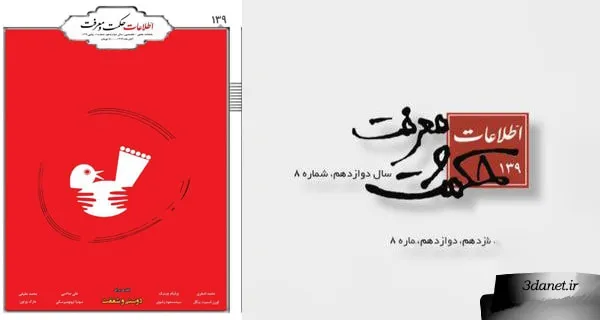
Issue 138 of Ettela'at-e Hekmat va Ma'refat, themed 'The Philosophy of Photography 4' and guest-edited by Monireh Panjtani, has been published. In six essays, this issue explores the ontology of the image, the relationship between the photograph and reality, and the ceaseless presence of photography in everyday life.
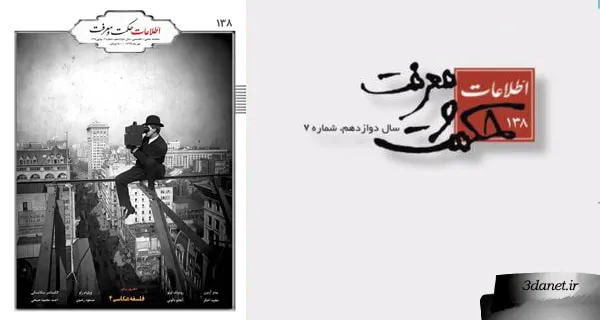
Issue 138 of Ettela'at-e Hekmat va Ma'refat, themed
The second piece is an article titled The Sophist and the Photograph by Oliver Richen, translated into Persian by Sayyad Nabavi. In this article, the author first provides a definition of the image in Plato's Sophist and then juxtaposes and compares this definition of the image with the description of a photograph taken from the text of a novel.
The third piece, by Peter Osborne, is titled Unlimited Exchange: The Social Ontology of the Photographic Image, translated into Persian by Zaniar Boloori. Osborne addresses the issue of the ontology of the photographic image after digitization with a historical approach. In this article, the author mainly deals with three important topics: first, that photography is better understood by focusing on the form of the image it produces, rather than as a specific art or medium; second, that the photographic image is the primary social form of the digital image; and third, that from an indexical perspective (referential quality), there is no fundamental ontological distinction between digital photographic images and chemically produced photographic images.
The fourth article in this collection, titled The Pre-reflective and Unthought Aspect of Photography, is written by Reza Niazi. In this article, the author has attempted to recognize a form of photographic action and experience that, in his interpretation, has been eliminated in the connection between art and photography today, and whose emergence has been prevented by the conceptual turn in contemporary aesthetics. Niazi's effort in this article is to illuminate a form of photography that he considers to arise from the phenomenological aspect of the photographic image, particularly the unthought aspect of photography.
The Photographic Reasoning of Philosophy is the title of the fifth article in this issue, written by Alexander Sekatsky and translated by Arash Dehghani. Sekatsky's concern is that photography, more than anything else, records a different experience of time, and the photograph is capable of revealing the limitations of human perception of time. In this short article, the author attempts to examine the evolution of the idea of photographic time in the thoughts of Plato, Augustine, and Bergson.
Finally, the Book of the Month section of this issue of Ettela'at-e Hekmat va Ma'refat monthly concludes with a critique of one of the contents from previous issues. The sixth piece and the conclusion of this issue is an article titled The Photographer and the Author: A Critique of the Photographer-Author Theory, written by Mehdi Habibzadeh. This article is a critique and review of the ideas of Roham Shiraz, with whom Monireh Panjtani had a conversation in the second and third issues of The Philosophy of Photography.
The second section of Ettela'at-e Hekmat va Ma'refat magazine is called "Literature and Art" and consists of two articles. The first article, titled Islamic-Iranian Thoughts in the Poetry of Parvin E'tesami, is written by Zhila Dehbozorgi, and the next article, titled Translation and Justice from the Perspective of Paul Ricoeur, is written by Angelo Batoni and translated into Persian by Mitra Sarhadi.
The third section of this monthly is called "Thought and Opinion" and consists of three other articles. The first article, titled The Creature and Maya, is by Rudolf Otto, translated by Enshallah Rahmati. The article The Idea of God is written by William Rowe and translated into Persian by Alireza Rezayat. The last article in this section is titled Ethics and the Thought of the Ikhwan al-Safa. The author of the article is Ahmad Mahmoud Sobhi and its translator is Mojtaba Rahmati.
The two final sections of Ettela'at-e Hekmat va Ma'refat monthly are Books and Reports. In the Books section, the first piece is the sixth part of an article titled Indian and Sanskrit Roots in Persian Anecdotal Stories, written by Seyed Masoud Razavi. Following this critique, there is a conversation and book introductions. Monireh Panjtani, the editor of the Books section, first wrote a piece titled Death, the Heart of Heidegger's Philosophy of Being, in which she reviews the book Heidegger and Death: On the Possibility of the Impossibility of Dasein in Being and Time (Shavand Publications - 2017). Then, Monireh Panjtani had a conversation titled Death, the Impossible Object with Mehrdad Parsa, the translator of the work, to critique and review the articles of the book Heidegger and Death. Subsequently, several book titles are introduced. The final section of the magazine, edited by Manouchehr Dinparast, is dedicated to reporting some of the most important events in the field of thought over the past month.
Issue 138 of the Ettela'at-e Hekmat va Ma'refat periodical (Mehr 1396), under the editorship of Dr. Enshallah Rahmati, is available to those interested at a price of 5,000 Tomans.
.
.
Ettela'at-e Hekmat va Ma'refat Monthly
Publication Frequency: Monthly
ISSN: 1735-9333
Language: Persian
License Holder: Iranchap Company (Ettela'at Institute)
Managing Director: Enshallah Rahmati
Editor-in-Chief: Enshallah Rahmati
Executive Manager: Sasan Yaghmaei
Persian Copy Editors: Nemat Parvan, Abbas Goodarznia, Farzaneh Sedighi
Place of Publication: Tehran
Telephone: 29993224 (021)
Fax: 22258022 (021)
Address: Tehran, Mirdamad Blvd., South Naft Street, Ettela'at Institute, Ettela'at-e Hekmat va Ma'refat
Postal Code: 1549953111
Dedicated Website: www.ettelaathekmatvamarefat.com
Email Address: ehvm86gmail.com
Telegram Channel: t.me/Doostanehekmatmarefat
Subscription Department: Mr. Hajili, Mr. Abbasi
Subscription Department Telephone: 2-29993471 (021)
Subscription Department Fax: 22258011 (021)
.
.

Discussion0 comments
No comments yet; let yours be the first voice.