اندیشهفلسفهخردگفتگوحکمتمعناپرسشفرهنگ
Philosophy
Introducing the Latest Issue of Ettela'at-e Hekmat va Ma'refat
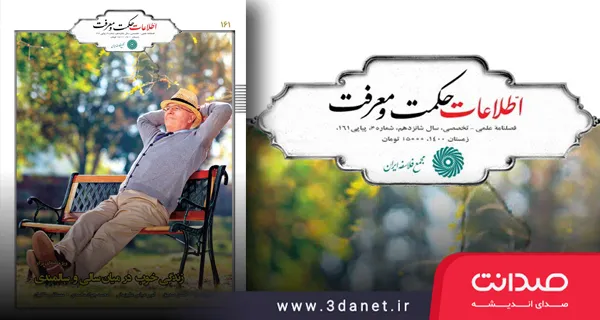
Issue 137 of *Ettela'at-e Hekmat va Ma'refat* is devoted to virtue ethics, an approach that takes the agent's character and intention as the measure of an act's goodness. Six essays explore virtue's relationship with duty, utility, the environment, and law through neo-Aristotelian and sentimentalist lenses.
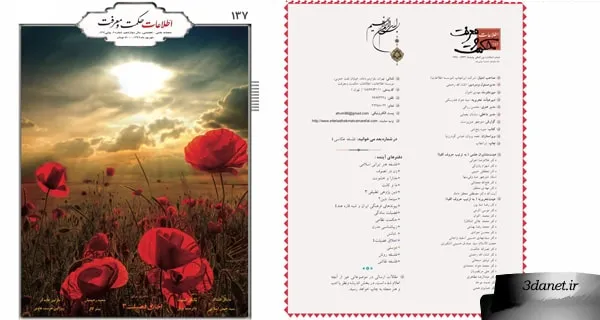
Two previous issues of this monthly magazine have been devoted to the topic of virtue ethics. Mehdi Akhavan, the editor of this issue, introduces virtue ethics as follows: “Virtue ethics originated in ancient Greece and, after a period of dormancy in the modern era, was revived in the second half of the twentieth century by foregrounding the inner ‘states’ of the agent rather than looking at their action in explaining the ‘moral matter,’ and it claims superiority.
According to virtue ethicists, even if a moral action is outwardly commendable, this is not the primary condition or the central criterion for ‘deeming it good’; rather, the ‘state’/motivation/intention [psychological expressions] and, in moral language, the virtue or vice that lies behind that action (and is hidden from the observer’s perspective) is the determining component of that action being ‘good/beautiful.’” The editor of this collection goes on to identify the most important issue in this field as the connection and relationship between these concepts. That is, “which of the key concepts of rival theories—namely ‘utility,’ ‘duty,’ and ‘virtue’—determines the other and takes precedence. In other words, which one is based on the other, which is the foundation, and which is complementary.
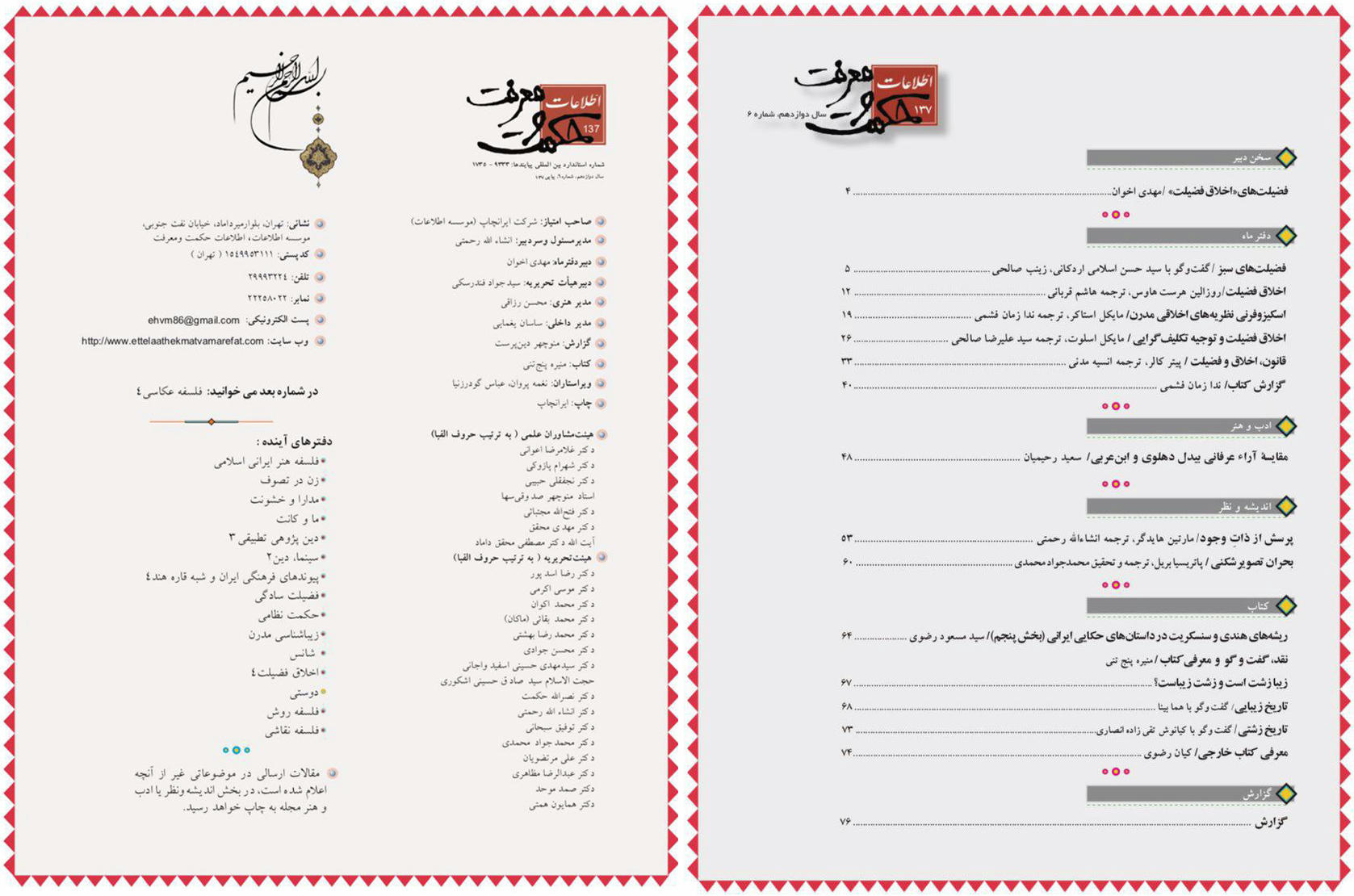
Issue 137 of Ettela'at-e Hekmat va Ma'refat, with the theme of “Virtue Ethics,” contains six articles: The first article, titled “Green Virtues,” is a conversation between Zeynab Salehi and Seyyed Hassan Eslami Ardakani. The focus of this piece is “environmental ethics” as one of the important and popular fields of ethics. Those concerned with living ethically can use this branch to understand the requirements of ethics in the environmental sphere (in relation to nature and other animals). “Various approaches have emerged in this field, each seeking to outline the ethical foundations of these issues.
One of these is the virtue-oriented approach, which has many advocates in ethics today and attempts to answer theoretical questions and practical concerns by emphasizing the character of the agent and the necessity of cultivating virtues within them.” In this article, Seyyed Hassan Eslami analyzes this approach and, while pointing out its differences from other approaches, explains its weaknesses and strengths. He then suggests considering certain virtues as “green virtues” or “environmental virtues” and explains their importance in engaging with the environment. He goes on to emphasize the importance of enhancing citizens’ “environmental literacy” and considers this knowledge a prerequisite for the formation of attitudes and skills that lead to action and practice. Finally, he briefly refers to “environmental vices” and shows how these vices lead to the degradation and destruction of the environment.
The second article, titled “Virtue Ethics,” is by Rosalind Hursthouse, translated into Persian by Hashem Ghorbani. In this piece, Rosalind Hursthouse examines the neo-Aristotelian approach, which is one of the approaches in contemporary virtue ethics, and analyzes issues concerning its various aspects and its points of convergence and divergence with deontological and utilitarian approaches, as well as raising some problems in the field of virtue ethics and attempting to analyze them. Hursthouse is one of the revivers of virtue ethics and hopes that virtue ethics can also be discussed in various fields of applied ethics, political philosophy, and other branches. Hursthouse sees the future of virtue ethics as very bright.
The third article in this collection, titled “The Schizophrenia of Modern Ethical Theories,” is written by Michael Stocker and translated into Persian by Neda Zaman Fashami. Modern ethical theories, except for a few that are praiseworthy, deal only with reasons, values, and justificatory matters. They cannot specify the motives, motivational structures, and constraints of moral life. Not only can they not do this, but by failing to do so, they lose their function as an ethical theory; with these explanations, Michael Stocker discusses this topic in the article and attempts to do two interrelated things: to show some of the constraints that motivation imposes on ethical theory and moral life, and to expand his understanding of the relationship between reason and motive.
"Virtue Ethics and the Justification of Deontology" is the title of the fourth article in this dossier, by Michael Slote and translated by Seyed Alireza Salehi. In the introduction to his article, Slote writes: "I am a virtue ethicist of the sentimentalist variety, but this article does not seek to address the possible advantages that virtue ethics or moral sentimentalism may have over other ethical approaches. The subject of this article is a problem, or set of problems, that all major ethical theories grapple with: the problem of deontology. The problem for all of us is justifying deontology; something that Kantian ethics in particular has sought to do, but which [rationalist] neo-Aristotelian virtue ethics (and not so neo, either) has generally avoided.
Moreover, it is clear that consequentialists also do not think that deontology can be justified; so, in essence, from the perspective of the rest of us [non-consequentialist moral philosophers], this is also their [i.e., the consequentialists'] problem. In this article, I want to show how difficult it is to justify deontology. I do not consider Kantian ethics' attempt to justify deontology successful, but at the same time, I believe that [rationalist] Aristotelian virtue ethics would also face numerous problems if it were to attempt to justify deontology. The final point is that, looking at another approach to virtue ethics, namely sentimentalist [as opposed to rationalist] virtue ethics, we will perhaps, to our great surprise, find that sentimentalists have something to say in defense of deontology. Nevertheless, you will see that this kind of defense also entails serious problems."
The fifth piece is "Law, Morality, and Virtue" by Peter Koller, translated by Ensieh Madani. In this article, Peter Koller aims to demonstrate the importance of virtues in moral action by considering the relationship between law, morality, and virtue, and he addresses this in three stages: In the first part, to explain the functions of virtue in morality, he deals with the conceptualization of virtue and morality, and examines the types of virtues, conventional and rational morality, and the types of moral norms, including "pure moral obligations," "limited moral obligations," and "praiseworthy moral ends." In the second stage, he addresses the moral functions of law and examines the question of whether and to what extent the law can, through cultivating or enforcing relevant character traits, legally compel its subjects to be virtuous.
In the third part, he discusses the importance of virtue in law and analyzes the issue of whether and to what extent an effective legal ruling relies on the moral virtues of citizens. Regarding the first question, the claim of this article is that a legitimate moral system is not supposed to enforce virtues, but may only cultivate them in a limited way. In other words, the law's involvement should be in the form of indirect support for virtues, not their direct enforcement. Conversely, the discussion concerning the second question leads to the conclusion that a legal ruling will only function properly when it is backed by moral virtues. If officials and citizens think only of their personal interests, the law will not function successfully. The final piece of the Monthly File section is a book report on "Virtue Ethics."
The second section of the journal, named "Literature and Art," comprises one article by Saeed Rahimian, titled: "A Comparison of the Mystical Views of Bidel Dehlavi and Ibn Arabi"
The third section of the journal is called "Thought and Opinion" and contains two articles: the first article, titled "The Question of the Essence of Being," is by Martin Heidegger, translated into Persian by Inshallah Rahmati. The second article is "The Iconoclastic Crisis" by Patricia Brill, translated by Mohammad Javad Mohammadi.
The fourth section of the journal is called Book. The first article in this section is an essay titled “Indian and Sanskrit Roots in Persian Anecdotal Stories” by Seyed Masoud Razavi. Then, Monireh Panj-Tani, the book section editor of the journal, has written an article titled “Is the Beautiful Ugly and the Ugly Beautiful?” In this article, the issue of beauty and its antiquity in the history of thought is first addressed, and then a brief classification of theoretical books in beauty studies is presented, and finally the author critiques and reviews the two books History of Beauty and History of Ugliness (Farhangestan-e Honar – Text). Continuing in this section, Monireh Panj-Tani has separately interviewed the translators of the two books History of Beauty and History of Ugliness, Ms. Homa Bina and Ms. Kianoush Taghizadeh Ansari, for a more in-depth examination of both works. The final section of the journal, edited by Manouchehr Din-Parast, is dedicated to reporting the most important events of the past month in the field of thought.
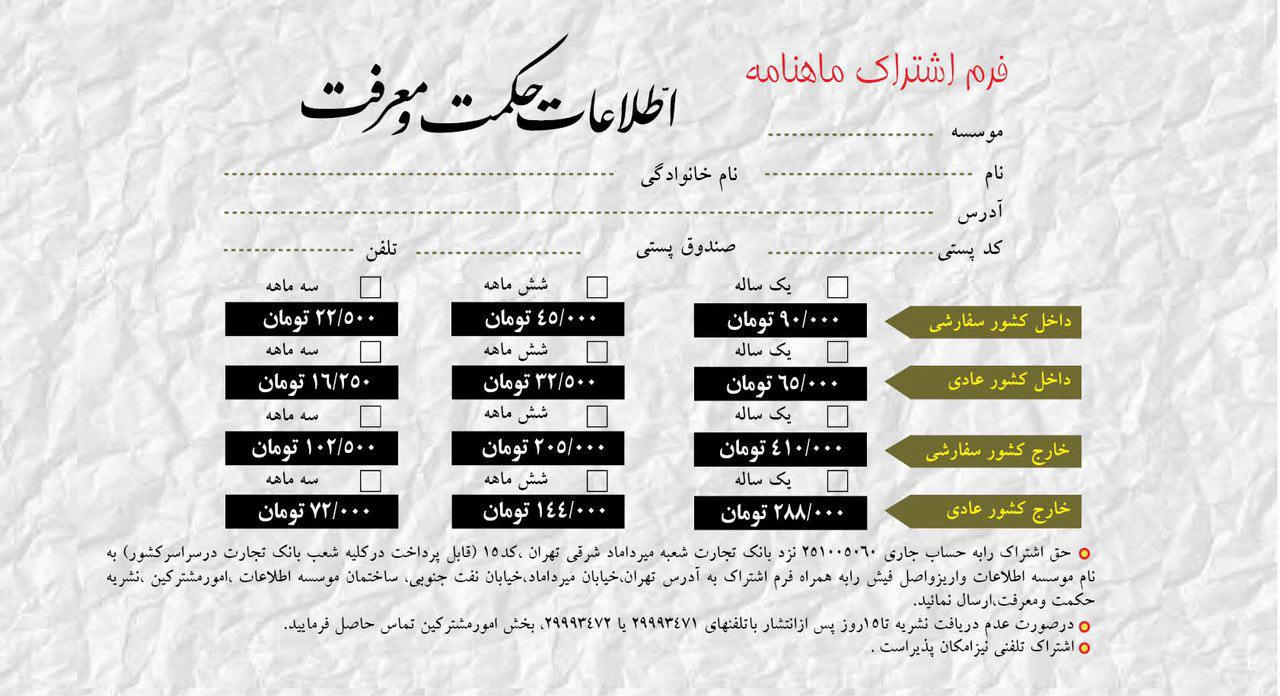
Issue 137 of Ettela'at-e Hekmat va Ma'refat, with the theme “Virtue Ethics 3,” under the editorship and managing directorship of Enshallah Rahmati, has been made available to enthusiasts at a price of 5,000 Tomans.
.
.
.
.
Ettela'at-e Hekmat va Ma'refat Monthly
Publication Frequency: Monthly
ISSN: 1735-9333
Language: Persian
License Holder: Iranchap Company (Ettela'at Institute)
Managing Director: Enshallah Rahmati
Editor-in-Chief: Enshallah Rahmati
Internal Manager: Sasan Yaghmaei
Persian Editors: Nemat Parvan, Abbas Goodarznia, Farzaneh Sedighi
Place of Publication: Tehran
Telephone: 29993224 (021)
Fax: 22258022 (021)
Address: Tehran, Mirdamad Blvd., South Naft St., Ettela'at Institute, Ettela'at-e Hekmat va Ma'refat
Postal Code: 1549953111
Dedicated Website: www.ettelaathekmatvamarefat.com
Email Address: ehvm86gmail.com
Telegram Channel: t.me/Doostanehekmatmarefat
Subscription Department: Mr. Hajili, Mr. Abbasi
Subscription Department Telephone: 2-29993471 (021)
Subscription Department Fax: 22258011 (021)
.
.

Discussion0 comments
No comments yet; let yours be the first voice.