Philosophy
Introducing Issue 159 of Ettela'at-e Hekmat va Ma'refat
Issue 159 of the quarterly Ettela'at-e Hekmat va Ma'refat is a special issue on hermeneutics and a selection from the Routledge Companion to Hermeneutics; it traces the field from its theological origins to Heideggerian ontology and includes articles on literature, psychoanalysis, and the philosophy of language.
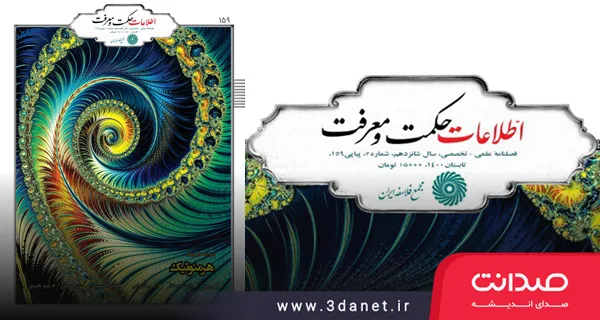
The Middle Ages, with Saint Augustine and Thomas Aquinas, and later with Martin Luther, who was a fierce critic of traditional interpretations of sacred texts, paved a path from Spinoza, Leibniz, Wolff, and Ast to German Romanticism, which provided the conditions for the formation of the modern science of hermeneutics. Schleiermacher, the father of modern theology, offered a coherent conception of a general or universal hermeneutics, and thus Schleiermacher became the founder of general or universal hermeneutics, as his theory explicitly advanced the universality of hermeneutics. The art or technique of understanding, as the art of understanding every utterance in language, emerges as a knowledge that, methodologically, is a hermeneutics whose mission is the study of understanding itself. After Schleiermacher, Dilthey revived an interest in hermeneutics that, after Schleiermacher, had been increasingly forgotten, at least in German theology. Dilthey's methodological hermeneutics became the foundation that distinguished the human sciences from the natural sciences. Heidegger gave hermeneutics an ontological status and set the philosophical aspect of the hermeneutic circle against the method of understanding texts. The hermeneutic circle had previously been a part of the interpretation of the words of a text, but Heidegger established this insight not as a methodological tool, but as one of the most fundamental aspects of being. The special issue, number 159, of the quarterly Ettela'at-e Hekmat va Ma'refat is a selection of articles from the Routledge Companion to Hermeneutics. The titles of the articles in this issue are as follows:
Special Issue
Editor's Note / Hermeneutics in the West, Alireza Semnani
Hermeneutics, Religion, and God / Jean Grondin, translated by Behzad Saleki
Hermeneutics and Literature / Andrew Bowie, translated by Peyman Khan Mohammadi
Hermeneutics and Psychoanalysis / Philippe Cabestan, translated by Farnaz Abdolbaghian / Alireza Semnani, edited by Behzad Saleki
Hermeneutics and the Philosophy of Language / Lee Braver, translated by Hani Ashrafi
Hermeneutics and Phenomenology / Robert Dostal, translated by Sahar Tayebzadeh
Hermeneutics and Feminism / Georgia Warnke, translated by Farnaz Abdolbaghian, edited by Behzad Saleki
Strauss: Hermeneutics or Esotericism? / Catherine H. Zuckert, Michael Zuckert, translated by Mohammad Reza Sohrabi
Thought and Opinion
A Comparative Inquiry into the Recommendation of Optimism in Two Ethical-Religious and Scientific-Empirical Approaches / Mohsen Jahan, Ali Jahan
Common Foundations of Buddhist Ethics / Peter Harvey, translated by Maryam Bagherzadeh, edited by Behzad Saleki
Ala al-Dawla Semnani / J. van Ess, translated and researched by Jamshid Jalali Sheyjani
A Brief Look at the Book Truth and Method by Hans-Georg Gadamer / Steve Fiffel, translated by Reza Davoodi
Report
Abrahamic Religions: Judaism and Christianity / Mehrab Sadeghnia, compiled and edited by Fatemeh Mohammad
Book
The Land of Heavens (A Wander in the Poetic World of Qasem Ahanin Jan) / Monireh Panjteni
In Life and on the Courtyard (On the Origin of Qasem Ahanin Jan's Poetry and its Relation to the Other Poetry Movement) / Behnoud Bahadori
New Publications / A Mystic in Western Exile (Conversations with Dr. Seyyed Hossein Nasr), Manouchehr Dinparast
.
.
Editor's Note / Hermeneutics in the West
At the end of Plato's dialogue Ion, a conversation between the philosopher Socrates and Ion, the Greek poet and rhapsode, an agreement is reached between them that Ion the poet is "inspired/possessed or a man of God."[1] The poet here is Homer, and Ion, the messengers of the goddess or goddesses of poetry. Plato sets the chain or sequence of inspiration and interpretation against knowledge/sophia and art as techne. Ion's beautiful speeches find no dwelling in his art. Ion is an orator who recites about Homer under the magnetic pull of inspiration. Homer has this same relationship with the god of poetry, and at the end of the chain, Ion's audience establishes this same relationship with him. Hermes, the Greek messenger god, deciphers the symbolic words of the gods. Thus, the origin of hermeneutics is theological and begins with sacred texts. Hermeneutics, its noun form hermeneia and its verb form hermeneuein, derived from the root Hermes, signifies the role of linguistic mediation and mediation for understanding, bringing to comprehension. Aristotle, in his treatise "On Interpretation" (Perihermeneias), and the Stoics laid the first foundations for a project concerning the understanding/understanding of the text. Philo of Alexandria[2] spoke of the esoteric/allegorical meaning as opposed to the literal meaning of the Testament. The Middle Ages, with Saint Augustine and Thomas Aquinas, and then with Martin Luther, who was a fierce critic of traditional interpretations of sacred texts, paved a path from Spinoza, Leibniz, Wolff,[3] Ast,[4] to German Romanticism, which provided the conditions for the formation of the modern science of hermeneutics.[5] Friedrich Daniel Ernst Schleiermacher (1768–1834), the father of modern theology,[6] provided "a coherent conception of a general or universal hermeneutics,"[7] and thus Schleiermacher became the founder of general or universal hermeneutics,[8] as his theory "explicitly advanced the universality of hermeneutics."[9] The art or craft of understanding, as "the art of understanding every utterance in language,"[10] emerges as a knowledge that is, methodologically, a hermeneutics whose mission is the study of understanding itself. The act of understanding, that is, the art that reconstructs the author's mind, is "the reverse of composition."[11] However, meaning is revealed in the hermeneutic circle, for understanding is founded in comparison with prior understandings and reference to what has previously been understood. Understanding each part of the text depends on understanding the whole, and since the whole is also dispersed in the parts of the text, "the operation of the hermeneutic circle involves taking the element of intuition for granted."[12] After Schleiermacher, according to Rudolf Bultmann (1884–1976), Wilhelm Dilthey (1833–1911) revived interest in a hermeneutics that, after Schleiermacher, "had increasingly fallen into oblivion, at least in German theology."[13] Dilthey's methodological hermeneutics became the foundation that distinguished the human sciences from the natural sciences. With his project of historicism, Dilthey called himself the "methodologist of the historical school."[14] Heidegger gave hermeneutics an ontological status and set the philosophical aspect of the hermeneutic circle against the method of textual understanding. "The hermeneutic circle was previously part of the interpretation of the words of a text, but Heidegger established this insight not as a methodological tool, but among the most fundamental aspects of being."[15] The modes of Dasein's being make the understanding of the world possible, and the world is only revealed through Dasein. Hence, Heidegger's ontology, which "is possible only as phenomenology,"[16] that is, ontology by phenomenological method, has been called "phenomenological ontology based on the hermeneutics of the human,"[17] or "hermeneutic ontology."[18] Therefore, "hermeneutic phenomenology"[19] and "phenomenological hermeneutics"[20] have been used together to describe his research.[21] Later thinkers influenced by Heidegger, from Gadamer to Ricoeur, and the post-structuralists/postmoderns who made
Alireza Semnani
References
Spiegelberg, Herbert, (2012). The Phenomenological Movement: A Historical Introduction, translated by Masoud Olya, two volumes, second edition, Tehran, Minouye Kherad Publishing
Skilleås, Ole Martin. (2014). Philosophy and Literature: An Introduction, translated by Morteza Naderi Dareshouri, second edition, Tehran, Akhtaran Publishing
Plato. (1957). Complete Works of Plato, translated by Mohammad Hassan Lotfi – Reza Kaviani, 4 volumes, Tehran, Publisher: Kharazmi Publishing Co.
Plato. (1972). Five Dialogues: On Courage, On Friendship, Ion, Protagoras, and The Symposium, translated by Mahmoud Sana'i, second edition, Tehran, Institute for Translation and Publication of Books
Bultmann, Rudolf, (2001). Jesus Christ and Mythology, translated by Masoud Olya, first edition, Tehran, Markaz Publishing
Palmer, Richard E. (2016). Hermeneutics: Interpretation Theory in Schleiermacher, Dilthey, Heidegger, and Gadamer, translated by Mohammad Saeed Hanai Kashani, ninth edition, Tehran, Hermes Publications
Ramberg, Bjørn and Gjesdal, Kristin. (2015). Hermeneutics; Stanford Encyclopedia of Philosophy, translated by Mehdi Mohammadi, Tehran, second edition, Phoenix Publishing
Sahakian, William. (2019). History of Philosophy from the Beginning to the Present Day, translated by Hamidreza Bashagh, third edition, Tehran, Cheshmeh Publishing
Sykes, Stephen. (2014). Friedrich Schleiermacher, translated by Manouchehr Sanei Darehbidi, Tehran, second edition, Hermes Publications
Schnädelbach, Herbert. (2016). History and Explanation of the Concept of Reason, translated by Rahman Afshari. First edition, Tehran. Mehrandish Publications
Forster, Michael. (2016). Schleiermacher, translated by Seyed Masoud Hosseini, first edition, Tehran, Phoenix Publishing
Grondin, Jean. (2016). Introduction to Philosophical Hermeneutics, translated by Mohammad Saeed Hanai Kashani, second edition, Tehran, Minouye Kherad Publishing
Heidegger, Martin. (2010). Being and Time, translated by Siavash Jamadi, second edition, Tehran, Phoenix Publishing
[1]- The interpretations are based on differences in translation. See (Plato, 1972:148) and (Plato, 1957, Vol. 2: 623).
[2]- Philo of Alexandria
[3]- Friedrich August Wolf
[4]- Friedrich Ast
[5]- (See Ramberg and Gjesdal, 2015:13 to 20)
[6]- (Sykes, 2014:88)
[7]- (Ramberg and Gjesdal, 2015:21)
[8]- allgemeine Hermeneutik
[9]- (Forster, 2016:41).
[10]- (Palmer, 2016:105)
[11]-(Ibid:97)
[12]- (Ibid:98)
[13]- (Bultmann, 2001:60)
[14]- (Grondin, 2016:138)
[15]-(Skilleås, 2014:155)
[16]- (Heidegger, 2010:136)
[17]- (Sahakian, 2019:493)
[18]- (Schnädelbach, 2016:198)
[19]- (Spiegelberg, 1392, Vol. 1: 586) and (Palmer, 1395: 138)
[20]- (Ibid: 145)
[21]- These phrases refer to the early Heidegger and the project he outlined in Being and Time.
[22]- For instance, it has been read as the “ontological destruction of the entire Western rationalist tradition.” (Gillespie, 1398: 54)
[23]- First published 2015
[24]- Jeff Malpas
[25]- Hans-Helmuth Gander
[26]- The equivalents “hermeneutic entanglements or interferences” are, of course, suggested with attention to the root meaning of the bab-e tafa’ul in the Persian language.
[27]- Gianni Vattimo
.
.
Email Address: ehvm86gmail.com
Telegram Channel: t.me/Doostanehekmatmarefat
.
.




Discussion0 comments
No comments yet; let yours be the first voice.