Philosophy
Introducing the Book On Love, Translated by Arash Naraghi
The book On Love, translated by Arash Naraghi, is a collection of contemporary philosophical essays on romantic love that examines the shift from the traditional distinction between metaphorical and true love to a modern understanding.
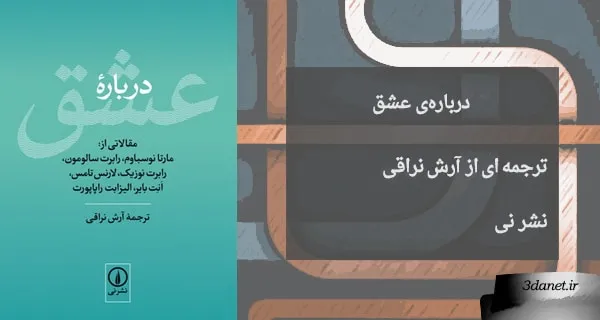
The book On Love comprises translations of a number of important philosophical articles on love, or more precisely, “metaphorical love” (ʿishq-i majāzī), that is, romantic or erotic love between human beings. The authors of these articles are among the renowned philosophers of the contemporary philosophical tradition, thinkers such as Martha Nussbaum, Robert Solomon, Laurence Thomas, Annette Baier… each of whom endeavors to analyze and examine the experience of human love from a particular philosophical angle.
Loves that are for the sake of a color (appearance) / Were not love; in the end, they are a disgrace
(Masnavi, 1/205)
Be joyful, O Love, our sweet passion / O physician of all our ailments
O remedy of our pride and our honor / O you who are our Plato and our Galen
(Masnavi, 1/23–24)
“If we destroy love and friendship, what else remains in the world worth desiring?”
David Hume
The difference and distinction between the new world and the old world is evident in many respects, among which one can point to the differing approaches of these two worlds to love. In the traditional world, love whose object is a human being (romantic/earthly love) was not desirable in itself; rather, if this love guided a person toward true love and the source of beauty, it was a permissible love, and otherwise, it was considered “lustful love” and was forbidden. The first couplet from Rumi placed at the beginning of this text aptly describes this approach. The next two couplets are in praise of divine love; a love that is the savior of the human soul and spirit. In the new world, the most important transformation that has occurred in the realm of the study of love compared to the old world is the predominance of metaphorical love over true love. In other words, “the love studies of the ancients generally placed ‘true love’ or ‘divine love’ at the pinnacle, and viewed metaphorical love either with contempt, or merely considered it a means (albeit a valuable and even irreplaceable one) for attaining true love. But in the love studies of the modern world, true love is precisely what was considered metaphorical in the eyes of the ancients” (1390: 20). The quotation from Hume above represents this viewpoint.
The publisher, in describing the book, has stated: Probably the most important transformation that has occurred in the realm of the study of love in the new world is the predominance of metaphorical love over true love. The love studies of the ancients generally placed “true love” or “divine love” at the pinnacle, and viewed metaphorical love with contempt, or merely considered it a means (albeit a valuable and even irreplaceable one) for attaining true love. But in the love studies of the modern world, true love is precisely what was considered metaphorical in the eyes of the ancients.
This book comprises translations of a number of important philosophical articles on love, or more precisely, “metaphorical love,” that is, romantic or erotic love between human beings. The authors of these articles are among the renowned philosophers of the contemporary philosophical tradition, and each endeavors to analyze and examine the experience of human love from a particular philosophical angle.
This book comprises translations of a number of important philosophical articles on love, or more precisely, “metaphorical love,” that is, romantic or erotic love between human beings. The authors of these articles are among the renowned philosophers of the contemporary philosophical tradition, and each endeavors to analyze and examine the experience of human love from a particular philosophical angle.
The book begins with a brief and useful introduction by the translator. In this introduction, Naraghi has sought to depict the ancients’ conception of “true love” and “metaphorical love” in Islamic culture, including and especially within the domain of Islamic mysticism, and to show its relationship with Greek wisdom. In his view, “the understanding of Muslim mystics and sages regarding the nature and degrees of love was influenced by Greek wisdom, and particularly by Plato’s views”; especially, Socrates’ speech and Aristophanes’ speech in the Symposium have been influential on the love studies of Muslim mystics. “In these two speeches, two different models of the nature of love are presented, and the tension between these two models is evident even in our contemporary understanding of love.”
The contents of this book are interesting in that the selected articles focus on the views of philosophers and theorists on love who mostly lean toward analytic philosophy and pragmatist philosophy. Being in love and loving, which belong to the realm of human existential and concrete states, were traditionally the object of contemplation for mystics and poets rather than for philosophers and theologians engaged in rational arguments and logical syllogisms. In Western philosophy, too, it was the existentialist philosophers who considered human states and existential upheavals; but in this book, it is analytic philosophers who have made being in love and loving the subject of their philosophical analyses.
Since the selected articles address the theories of contemporary American philosophers, and the views of mystics of the Islamic and Iranian tradition are absent from the articles, the translator, in the introduction he has written, has attempted, albeit briefly, to introduce the reader to some of the views of Iranian mystics on love.
In the essay "The Speech of Alcibiades: A Reading of Plato's Symposium," Martha Nussbaum offers a fresh analysis of this dialogue that has often been overlooked by Plato scholars. "The Virtue of (Erotic) Love," by Robert Solomon, is the second essay in the book. In this essay, Solomon defends human love against the critiques of philosophers and theologians who deem the passionate and emotional aspects of this love worthy of contempt. In "Love's Bond," the third essay in this collection, Robert Nozick considers the goal of romantic love to be the formation of a new identity called "we" and attempts to explain some of the metaphysical difficulties of this new identity. The fourth essay is "Reasons for Loving" by Laurence Thomas. For Thomas, love is not subject to, nor the product of, reasoning and rational calculation. Consequently, reasons for loving should be seen more as "explanations" of the phenomenon of love, rather than justifications for it. The fifth essay, "Unsafe Loves," is written by Annette Baier. In this essay, she contrasts two different conceptions of love—"theological" and "naturalistic or biological"—and ultimately defends the Humean (naturalistic) model. The final essay in this collection is "On the Future of Love: Rousseau and the Radical Feminists," by Elizabeth Rapaport. In this essay, the author examines feminist critiques of the experience of love and, based on an analysis she presents of Rousseau's theory of love, argues that romantic dependency can be mutual. She also believes that, contrary to Rousseau's theory, the romantic relationship is not always destructive. "What makes romantic dependency hazardous is not an intrinsic element of romantic experiences, but a kind of distortion arising from unjust social relations."
Introduction to the book On Love by Roya Fahim
.
.
The book On Love is published in 272 pages by Ney Publishing.
Essays by: Martha Nussbaum, Robert Solomon, Robert Nozick, Laurence Thomas, Annette Baier, Elizabeth Rapaport, and translated by Arash Naraghi
.
.



Discussion1 comments
سلام.واقعا وبسایت خوبی دارید