Philosophy
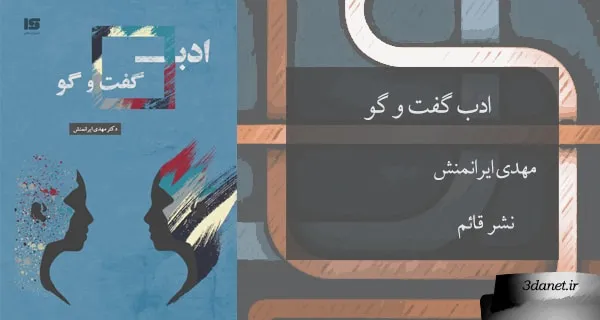
Introducing the Book The Etiquette of Dialogue by Dr. Mehdi Iranmanesh
In The Etiquette of Dialogue, Dr. Mehdi Iranmanesh presents dialogue as the foundation of ethics, spirituality, cultural development, and social contentment. Offering a fresh definition of etiquette, the author frames dialogue as a path to social maturity and a means of managing differences.
Undoubtedly, Mr. Mehdi Iranmanesh, in this valuable research of his, has addressed one of the most important topics needed by our society. This researcher has not only thoroughly examined the issue from a theoretical standpoint and identified the social and internal factors necessary for the realization of dialogue, but the methods of practically achieving dialogue in society have been an even more important concern for him. Even more interesting is that due attention has been paid to the role of this issue in the realization of the moral and spiritual dimensions of human beings, to the extent that the author has dedicated a part of the book to "The Etiquette of Dialogue with God." Therefore, this book enjoys special merits, both due to its theoretical solidity and identification of foundations, and in terms of its appropriateness to the religious culture of society and attention to spiritual and moral dimensions. A study of the book shows that this researcher has reviewed countless sources on this subject and has analyzed the issues from sociological, psychological, and theological perspectives.
Dr. Iranmanesh has engaged with the subject logically from various angles and has presented deeper perspectives, to the point where one can boldly say that a book of this caliber was missing among the works of religious intellectuals. He rightly notes that the breadth of this subject's connection to major social, political, religious, and educational issues is such that neglect or insufficient attention to this topic, whether by universities or other academic centers, is by no means acceptable.
He seeks to answer this fundamental question: how and when can misunderstanding and lack of understanding at various levels be resolved? He points out that both those who consider ethics an individual and otherworldly matter that deals with the inner and esoteric aspect of the human being, and therefore, expect it primarily to help purify souls and bring about their otherworldly happiness and salvation, and secondarily, to aid in regulating the social relations of humans, and those who, especially in the modern era, consider ethics to be more responsible for regulating human relations and social institutions and ensuring the collective and worldly welfare and happiness of humans, placing its impact on individual and otherworldly happiness and salvation in the second degree of importance—both groups intensely need the issue of "dialogue," and he explains why and how.
Also, in the section on the dialogue of cultures and civilizations, he answers the question of why we Muslims, or religious people, should have a dialogical relationship with non-Muslims and other believers, as well as with other cultures, and how we can realize this. Therefore, it is necessary to learn its etiquette. But we must clarify what we mean by etiquette more explicitly. Hence, as stated at the beginning of the book, usually when the term "etiquette" (adab) is mentioned, a kind of measured behavior accompanied by modesty and dignity comes to mind. Behavior that relates to the manner of speaking, walking, socializing, looking, requesting, questioning and answering, and so on. To the extent that if someone knows their limits and boundaries and does not transgress them, they are said to possess etiquette. Lack of etiquette is also a kind of entry into a forbidden zone and overstepping limits and boundaries. Dignity in speech and gravity in behavior are signs of etiquette; and thoughtlessness, ugly speech, foul language, irascibility, vulgarity, insult and abuse, frivolity and obstinacy, stubbornness and enmity, and so on, are recognized as examples of lack of etiquette.
However, what the author means by etiquette in "The Etiquette of Dialogue" is not merely the etiquette of speaking (in this limited sense of the word), but a deeper meaning is intended. A meaning in which a kind of maturity, tolerance and the ability for positive interaction with others, humility, appreciation, truth-seeking (and not just truth-telling), and the ability to listen are also embedded. On this basis, it has been said that although the recommendation to learn "the etiquette of dialogue" is a necessary one, achieving success in it is not so easy.
In principle, every practical social recommendation is usually based on many theoretical descriptions and explanations; one can only expect the person receiving the recommendation to act upon it when they share those theoretical descriptions and explanations with the recommender. Therefore, if these descriptions and explanations are not acceptable or are not accepted, the recommendation will be null and void. Based on this principle, the author believes that if the countless descriptions and explanations in this book concerning the subject of "the etiquette of dialogue" are properly understood and accepted, the recommendation to engage in "dialogue" at various levels will become more feasible and realizable. If we look at the subject from the perspective of development as well, we must note that one of the important dimensions of development is the behavioral-cultural dimension, and for creating, reforming, and strengthening this dimension, we need scholarly attention to three types of national capital: cultural capital, social capital, and symbolic capital. It is by strengthening the behavioral-cultural dimension that we can achieve "satisfaction." Otherwise, even with prosperity, there will be no satisfaction. All kinds of material-civilizational manifestations may exist, but hope, vitality, trust, and satisfaction in living together may be absent. In this case, even with relative prosperity, depression may accompany it. A large percentage of the people may have higher university education, yet feelings of futility, identity loss, or ineffectiveness may also exist. There may be many thinkers, yet society may suffer from an affliction like brain drain. All of these are signs of the absence of "satisfaction," and to attain satisfaction, we must invest in these three areas. Investing in the behavioral-cultural dimension polishes the sharp edges of human beings and causes them to hurt and be hurt less in their encounters with one another, to have a humane existence, and finally to behave lawfully and become more patient and happier.
... and this book claims: Our capability in "dialogue" is at the forefront of all our investments in the behavioral-cultural dimension. Because many factors of human development are directly and indirectly related to this issue.
For us to let reason prevail over emotion, to achieve satisfaction in addition to prosperity so that we may associate or transact with one another with the least tension, and reach a stage where we grant others the right to think differently and be different; to attain a kind of social maturity, to have parties, to reach understanding and resolve differences, or to have tolerance for a partner and the ability for positive interaction with others, and to reduce the scope of violence and deceit, to have successful cultural, ethical, behavioral, and social management; for all of these, we need dialogue. Without proper dialogue, we cannot realize any of these characteristics. Because, possessing many tools for progress, since we ourselves do not change, these tools also become harmful.
Despite all this, unfortunately, the realization of dialogue is considered among the easy-yet-impossible matters. On the one hand, everyone considers it feasible and practicable, and on the other hand, because it is linked to a multitude of psychological, sociological, and anthropological issues, its desirable realization is not so simple, and only after seeing its complexities can one hope to offer real and practical solutions. It is not hard to accept that the culture of dialogue has not become very prevalent among us but has rather fallen into extreme weakness. This is while this matter can play a key role in solving many of our social problems and is a factor that can, in practice, cause the intellectual elevation, cooperation, national and cultural rapprochement, and spiritual and moral growth of human beings. The effect of this factor in the elevation of knowledge, mutual understanding, and the spiritual and moral growth of human beings in an environment free from violence, on the one hand, and also in reforming managerial, executive, and cultural systems, on the other hand, is extraordinary. Because, as we shall see, reforming the mechanisms of these systems, in a healthy context, is only possible through collective reason and collective acceptance, and therefore will only be possible through proper dialogue.
Most importantly, “dialogue” is the missing link in our triumph and success in attaining an ethical society, and in this age, until it is addressed, other efforts may remain fruitless. The role of dialogue in solving the issues and resolving the problems of any society, including our own, is unique, and the more dialogue expands within a society, the more the scope of violence and deceit diminishes. The author demonstrates at length and with evidence that this life-giving and spirit-enhancing lost element is connected and homogeneous with many ethical subjects such as piety, humility, patience, and truth-seeking, and is sometimes born and nurtured only in that atmosphere, while being incompatible with many vices such as self-centeredness, arrogance, selfishness, conceit, self-righteousness, megalomania, impatience, and recklessness. “Dialogue” is an elixir whose practice is the practice of patience, and whose skill is the skill of emerging from oneself. Although “dialogue” relies on a minimum of ethics, it is also the practice of living ethically in a group and society. It both relies on pre-religious or innate piety and can generate its higher levels. A great portion of self-opinionatedness, arrogance, self-absolutism, superficiality, and other ethical contaminations (which incidentally prevent the realization of dialogue) can be considered the results of the failure to properly realize “dialogue.” That is, on the one hand, ethical contaminations prevent dialogue, and on the other hand, the absence of dialogue intensifies these contaminations.
From the author's perspective, among all issues, resolving ethical problems holds a special status and importance. Something whose necessity everyone acknowledges, but unfortunately, less attention is paid to the executive mechanisms for its realization in society. He claims that creating a foundation for the realization of dialogue is among the most important executive mechanisms for making social relations ethical. And for this purpose, he cites the words of a Western philosopher named Habermas regarding human communication, who, in his valuable book called The Theory of Communicative Action, summarizes the humanization of humans through “communication” in this sentence: “If we discover the rules of a fair and free dialogue, we have discovered the rules of a humane society.”
A human being shows their humanity, justice, and freedom more than anywhere else in a free, just, and humane dialogue. A society is more humane where the “other” in dialogue is respected as much as the “I.” Not artificially, but based on the fact that because I am human and not God, I need others to discover the truth. On this basis, dialogue is the most serious matter that occurs in the life of a wise human being, although for individuals who consider the outcome of everything predetermined, dialogue is nothing more than a plaything.
We usually pass our days based on our own perspective. But the ability to set aside our own perspective and look at an issue from another's viewpoint can be infinitely beneficial. This is a skill that will be especially useful when conflicts arise, and in any intellectual matter, it is more than just useful—it is essential. Without this skill, problems that are unsolvable within the framework of our familiar perspective cannot be solved.
In the depths of our conscience, we know that our perspective is not the only valid one, but we usually tend to marginalize the new perspective; because if we encounter a perspective that is the opposite of our own, we become uncomfortable or fearful. Because by accepting that our perspective is ultimately built upon debatable assumptions, we feel insecure, as we feel we have lost our support. But if we learn that by seeing issues from the perspective of others and gathering different and sometimes conflicting viewpoints, more stable supports can be provided, these baseless fears will vanish, and perhaps by collecting various insights and integrating them, we may achieve a more worthy insight.
Our physical eyes are similar. When only one of the two is open, it provides us with a two-dimensional perspective that is completely different from the perspective the other eye provides. But when we open both eyes together, those two perspectives become one and create a three-dimensional image for us. Likewise, if we combine the insights that are the product of our familiar viewpoint with the insight resulting from an opposing viewpoint, this gives us a more complete picture that can remove the confines of being and thinking in a more limited world. Viewpoints help us see the truths of the world through them, but if we become overly attached to the answers that are the product of, or endorsed by, our own viewpoint, we become oblivious to other viewpoints. Therefore, having a viewpoint is as much concealing as it is revealing. But if we can learn the skill of distancing ourselves from our own viewpoint, we free ourselves from the confines of our habitual answers.
.
.
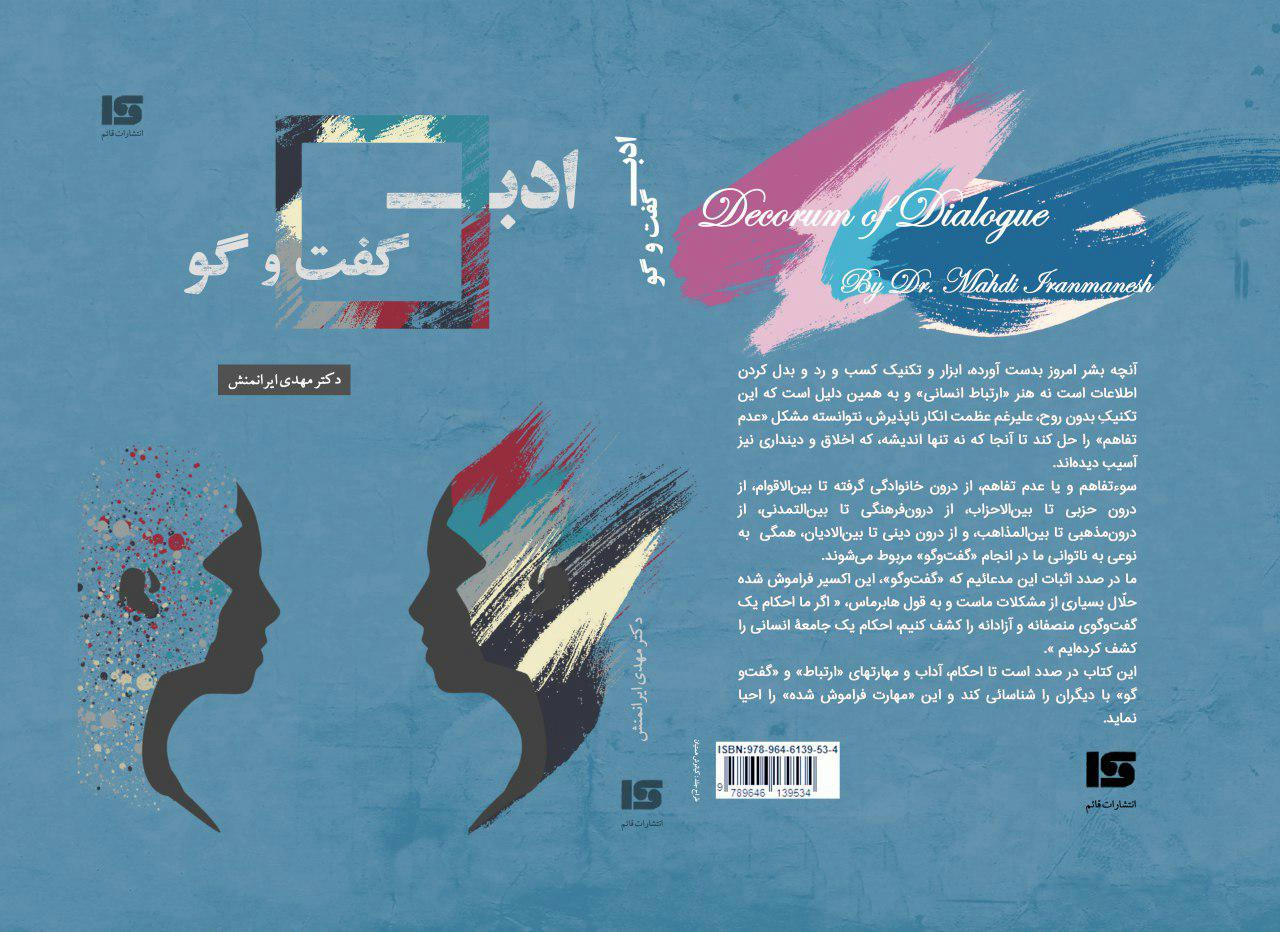
Book Cover:
.
.
Back Cover Text:
What modern humanity has acquired are the tools and techniques for obtaining and exchanging information, not the art of "human connection," and it is for this reason that this soulless technique, despite its undeniable grandeur, has failed to solve the problem of "lack of understanding," to the extent that not only thought, but also ethics and religiosity have been damaged. Misunderstanding or lack of understanding, from within the family to among nations, from within parties to among parties, from within cultures to among civilizations, from within sects to among sects, and from within religions to among religions, all relate in some way to our inability to engage in "dialogue." We seek to prove the claim that "dialogue," this forgotten elixir, is the solution to many of our problems. As Habermas said, "If we discover the rules of a fair and free dialogue, we have discovered the rules of a humane society." This book seeks to identify the rules, etiquette, and skills of "communication" and "dialogue" with others and to revive this "forgotten skill." .
.
PDF file of the specifications and table of contents of the book The Etiquette of Dialogue
.
.
Distribution Center: Tehran, Enghelab Street, Fakhr Razi Street, after Ravanmehr Crossroads, Didban Alley,
No. 2 (formerly 130) - P.O. Box: 13145/1755 Tel: 66415772 - Fax: 66950965
30th Tehran International Book Fair: Hall C2, Booth 172 or Hall 106, Booth 220
Price with hardcover: 24,000 Tomans
.
.
Online purchase of the book The Etiquette of Dialogue
.
.



Discussion2 comments
محتوا بینظیر است. فقط ایکاش فونت چاپ کتاب فونت بهتری میبود.
عالی! تلاشی با معنا برای تقلیل مرارت و تقریر حقیقت. ادب گفتگو, ابزاری لازم برای فلسفه ورزی. فقط برای توجه مولف مولف محترم، باید بارها از ایشان تشکر کرد.