Political Science
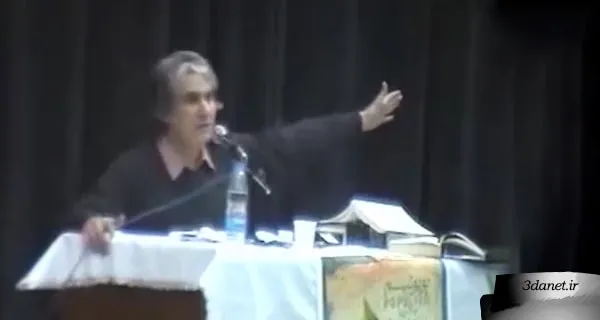
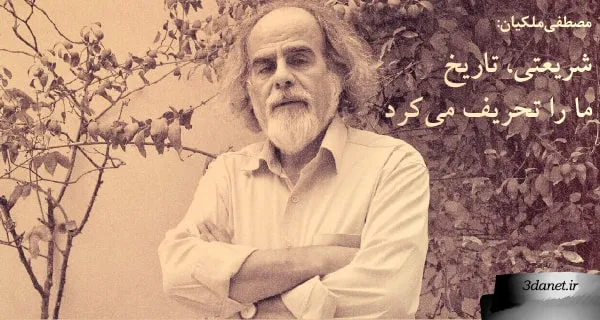
Lectures by Hashem Aghajari, Yousef Abazari, and Ehsan Shariati at the 40th Commemoration of Shariati
The fortieth commemoration of Shariati centred on Shariati and today; Aghajari spoke of deconstructing his legacy to resume the 'unfinished project', while Ehsan Shariati identified the core of his thought as an alternative to 'gold, coercion and deceit'.
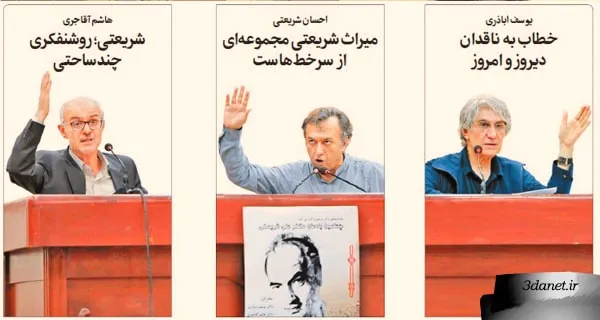
What is Shariati’s relation to our present? This was the question raised at the seminar for the 40th commemoration of Shariati in the Ibn Khaldun Hall. How can Shariati’s simultaneous stance toward socialism and Islam, and his creation of a controversial synthesis under the name of Islamic Marxism, still be considered important for Iran’s situation today? This was a question about which the audience ultimately heard nothing—an audience of many who were exasperated by disarray such as lack of space, heat and poor ventilation, and the lengthy remarks of the moderator. At this gathering, Hashem Aghajari spoke of repeating, reconstructing, and precisely updating Shariati’s unfinished project so that perhaps a different outcome might emerge from it, without answering whether what actually occurred in historical reality was the logical result of Shariati’s project or a deviation from it. Yousef Abazari framed his lecture as a response to the criticisms leveled at Shariati. In his view, Shariati has become a kind of myth, and because of the many signifiers constructed around it, we are not dealing with a single signified. Thus one cannot speak of a single Shariati. Ehsan Shariati spoke of the difference between our era and Shariati’s era, and that Shariati did not have the opportunity to deepen his research into his dynamic views. Nevertheless, he considered the coherent core of Shariati’s thought to be the presentation of an alternative to the trinity of “gold, force, and fraud.” The session “Now, Us and Shariati” was held yesterday at the Faculty of Social Sciences, and what follows is a summary of the lectures from this meeting.
Hashem Aghajari: The One-Dimensional Intellectual, the Public Sphere Intellectual
I intend to discuss the deconstruction of Shariati for designing and formulating a new path and resuming an unfinished project due to unforeseen political developments. He was unable to achieve the plan he had for an intellectual renaissance, a cultural movement, and the creation of a kind of collective self-consciousness for a resurrection from below.
The chain of events on the eve of the revolution took everyone by surprise. About a year and some months after Shariati’s emigration, the revolution triumphed, and his project has remained unfinished to this day. The Islamic Revolution occurred under the conditions that Shariati had created. Today we need not merely a repetition and reconstruction of exactly the same project, but a kind of deconstruction of Shariati’s legacy in order to resume that project in our own era. Shariati had a path full of ups and downs and an Odyssean conscience. Our history is a history of Sohrab-killing, like Ayn al-Quzat, Suhrawardi, and Hallaj. At the age of 44, Shariati imagined that with the miraculous escape he made from Iran, he could continue his project beyond the borders. This thought has flourished over the past 30 years.
It is futile to expect to find no contradictions or changes in his works, and to date none of Shariati’s admirers have made such a claim; nevertheless, in Shariati’s thought, from his earliest works as a teenager in the form of the translation of “Abu Dharr as a God-Worshipper and Socialist” (from Arabic) to his very last sentences, we ultimately see an inner unity. We must separate the hard core of Shariati from his shell. We must also do this work regarding Imam Ali and Nahj al-Balagha, because it was in a historical era of slavery, patriarchy, and tribalism, and all these elements enter into language and culture. Our task as deconstruction is to separate the core from the accidental elements and the shell. Ijtihad, in the true sense of the word, is precisely this.
Our intellectualism today is in crisis. This crisis, of course, is not specific to the Iranian intellectual and is, generally speaking, a crisis of authorities. Society goes its own way and pays the least attention to intellectuals, and sometimes, conversely, it is the intellectuals who follow after the masses. Of course, this problem exists on a global level. Today, unlike in the past, we do not see intellectuals like Sartre, Bourdieu, or Marx who possess authority. The reason for this is the expansion of financial capital, neoliberalism, globalization, the network society, and the replacement of vertical relations with horizontal ones. The previous authority of intellectuals belonged to an era when virtual space and multiple horizontal groups had not yet come into being. Today’s intellectuals have no place in this network.
Today’s intellectuals represent no stratum or class whatsoever. The traditional religious class has its own representatives. The working class in Iran has no representatives at all. The toilers are without representatives, and the right-wing current tries to forcibly act as the workers’ representatives, though it has been unsuccessful. The new middle class, which lives on social networks, has also lost its connection with intellectuals. Big capital, meanwhile, is represented by bureaucracy and technocracy. Intellectualism in Iran today is one-dimensional, so its language is profoundly distant from the language of the people. The intellectualism of the 1960s and 70s had solved this problem. Read Jalal Al-e-Ahmad; he says somewhere that he went to a place where workers, laborers, and manual workers were present and was called a laborer because of his clothing, and Jalal considered this a badge of honor. The guerrilla movement had the same outlook and considered genuine coexistence and real work—for instance, in brick kilns—as one of the ways of drawing close to the people.
Today, the lifeworld and language of intellectuals have become separated from the people, and they have turned into the very embodiment of Marcuse’s one-dimensional man. An intellectual is someone who bears a Promethean responsibility. We need a public intellectual, especially in Iranian society, where many fundamental tensions remain unresolved. Shariati regarded intellectualism as a kind of prophethood, but the one-dimensional intellectual approaches the definition of a philosopher. In our society, the pair of freedom and justice stand in opposition. Some intellectuals concern themselves with freedom and bypass justice, and for this reason they cannot connect with the masses, because the people’s concern is bread. Another opposition is between Iran-centrism and cosmopolitanism. Some promote Iranian nationalism, from which the foul stench of chauvinism can sometimes be smelled. Conversely, some intellectuals set aside the question of Iran entirely. As a result, our intellectual has become one-dimensional and without ideology—an ideology whose death was proclaimed with Thatcherism and Reaganism. Why? Because it was an ideology that spoke of change. Today we need a multi-dimensional intellectual like the later Shariati. An intellectual who, if he thinks about freedom, does not bypass poverty, injustice, and exploitation, and vice versa. He must also not forget his own existential development and not see struggle merely as a way to change society, but must himself change in the process; this is the interdependence of the self and the world.
Ehsan Shariati: An Effort at “Return”
At the fortieth commemoration of Shariati, we are compelled to return to the subject of Shariati. Shariati himself and his legacy. To see again: who was Shariati? And what was the essence of his speech? That is, to pose this seemingly obvious question: of whom and of what are we speaking? So let us get to the heart of the matter! So that we may reveal a new level and horizon of the Shariati question. “Back to the things themselves” was the slogan of phenomenology. Contrary to the positivist (and logical empiricist) approach, however, this thing, matter, subject is not a calculable and measurable material object, but rather a meaning and content around which there is contention among researchers. On the occasion of the fortieth anniversary of the teacher Shariati, we have come to ask and to know: what relevance does Shariati’s project have today? Among all these virtual Shariatis, which one is the authentic Shariati? What was Shariati’s main speech and the essence of his word?
We all more or less know that the coherent core (the firm foundations) of Shariati’s thought was to offer an alternative to the trinity of “gold, force, and fraud,” by delineating the triangle of “mysticism, equality, freedom” (human-spiritual self-consciousness, social justice, and political democracy). What we may be less likely to know, however, is the way he struck a balance between a kind of spirituality (mystical, ethical, religious) and a kind of critical-social rationality.
Shariati was a thinking intellectual. A thinker is not necessarily the same as a philosopher and metaphysician (in the Platonic-Aristotelian sense of these terms), but a true philosopher must certainly be a thinker or a thought-provoker; otherwise, like myself, he is at best a researcher of philosophy, a lecturer, a commentator, and the like... Shariati was an intellectual who knew the prevailing contemporary thought of the world. Yet he did not lose himself before the formidable stature of the world's great thinkers; rather, he taught us, in the Kantian phrase, to "think for ourselves" in the face of these thinkers! And he considered this a sign of maturity and emancipation from the tutelage of the two poles of rigid tradition and self-alienated modernism. Nevertheless, the conditions of Shariati's work were very difficult, and he did not have the opportunity to deepen his research into his dynamic views; for this reason, Shariati's legacy, which is a collection of outlines, naturally requires critique. Critique is a necessary condition and the principal characteristic of thought in the contemporary era. For example, the Kantian critique consisted of purifying reason of false claims and the illusion of the possibility of knowing everything. This critique, however, was not for the negation of reason, but for installing reason itself on the throne of legitimate and rational power. The critique of Shariati can only recover its rational and principled form through those familiar with his thought, that is, Shariati scholars, whether believers in or critics of his views. Hence, this year we are organizing a symposium in which Shariati scholars, not only in the academic sense of the word, will engage in critical discussion and debate with one another. Will the observing audience merely witness a scene of specialists' disputes over his opinions? That is not the goal; our aim, on the contrary, is to demonstrate the seriousness, caliber, level, and depth of the subject under discussion in both specialized and enlightening forms—to the cultural community on the one hand, and on the other hand, to convey the universal emancipatory message of his legacy to society at large, to Iran, and then to our communities of shared destiny.
Our era differs from Shariati's era: the first difference, at the level of universal thought, is having passed through the phase of deconstruction or the dismantling of the grand narratives or ideologies of the modern era. Today, I believe, we are living in an era that can be called the era of
"post-postmodernism." Whether in continental philosophical thought or in the post-positivist (logical empiricist) and neoliberal tradition of Anglophone countries. The most important characteristic of this contemporary thought is the effort to "return," in the sense of "resumption," a new beginning and another start in all spheres, from culture and religion to politics and economics. It is as if Wittgenstein's prophetic prediction has been realized that "the former culture will turn into a heap of rubble, and finally into a pile of ashes, but over these ashes, spirits will take flight."
We will speak of further details and the characteristics of this new era on whose threshold we stand, and the descriptive features of these returns, at the upcoming symposium. In brief, our era, in the words of the young French philosopher Quentin Meillassoux, is the era "after finitude," and an invitation to a kind of fidelity, and a Mahdist-messianic expectation of the "God to come" on the part of atheist thinkers, coupled with an "uncertainty" that is this time "positive and constructive" and not resigned and nihilistic!
Another difference between our era and Shariati's era is the eruption of the fire of violence in the phenomenon of religious fundamentalism in Muslim lands. This phenomenon still requires an analysis deeper than journalistic discussions. Because here, in the words of Alain Badiou, we are confronted with a mute, anonymous, misguided, and bewildered subject, and a dark-minded, obscure, and delusional agent and actor who has adopted the "blindest" type of terrorism in history, and its significance lies in the breadth and diversity of those joining this current, the insane thirst for collective death-seeking, and the staggering methods encompassing all manner of misdemeanors and crimes, to flaunt itself in the imaginary world and virtual space. We, of course, have been vaccinated in Iran, and this current, fortunately, no longer poses a danger or attraction for our society!
What, however, is a source of concern and thought-provoking in our society is our own national and cultural experience, the record and balance sheet of society, and our own crises and problematics in Iran.
In short, our society, which is supposedly in “transition,” suffers from an uneven way of life and path of development. Culture, as an effective factor in development—if not the most important factor—plays a central, or at least a symbolic and meaningful, role in this. Among the constituent elements of culture, religion, despite all the repulsions arising from tradition and fundamentalism, still plays the most important role. Therefore, the critique of religion through Shariati’s emancipatory theology is essential for today and has an up-to-date function. Over the past four decades, a generation of us heeded Shariati’s call and paid a heavy price for this faith in practice; it is fitting here to express gratitude for the collection of figures who, by staking their lives and youth, kept this torch alight, especially in the most difficult times. And finally, the last and most important characteristic of that teacher’s thought and approach is social commitment and the continuation of struggle, which has persisted to this day in all arenas of civil and cultural life.
For all the reasons we know and do not know, it is natural that there is no ceremony for Shariati on state radio and television or in official institutions (and even independent ones like Hosseiniyeh Ershad, etc.), and we are forced once again to retreat from society to the university! This duality and avoidance regarding a name inscribed on the walls of the city, institutions, and the official calendar, incidentally, shows that the memory of that teacher is alive, current, and momentous. Today we have gathered in the Faculty of Social Sciences at the University of Tehran, which is in fact Shariati’s spiritual home, and we know that one of the characteristics of Shariati’s discourse is its “interdisciplinary” nature, centered on sociology and history. History, that other continent which Althusser claimed Marx discovered, and we say that in our own history, we have had our Ibn Khalduns.
Taking all these considerations into account, today’s ceremony should be considered an announcement of the prelude to the main commemoration this year, the fortieth anniversary of Shariati’s passing, which will still take place later this year. And in this way, we renew our covenant with that teacher of the people, so that from now on and from this point, we may begin another departure, and by fulfilling the task of reconstructing a “neo-Shariati” discourse, each and every researcher and seeker who thinks within this intellectual horizon may, with their pen and step, act upon their historical responsibility on the path of consciousness and emancipation, and this is the true commemoration of the memory, path, and legacy of former teachers and the elevation of their thought.
Abazari: On Shariati’s Critics
When we talk about Shariati, we are talking about a kind of myth. Someone around whom so many signifiers have been constructed that one cannot speak of a single Shariati. I try to decode this myth: an Islamic Marxist, a person who belonged to his own time and whose time is over. I am talking about this myth. They say he was one of the most important causes of the Islamic Revolution, and that’s it. Some say we were emotional back then and now we must be rational. With the help of science, epistemology, and today’s realities, we must take a look at some “scientific” values. Two groups attack Shariati from this perspective; one is the Islamic Thatcherites, who have mostly gathered around the Mehranameh magazine. The second group is the Cyrus the Great followers, a combination of monarchists and others. They also think Shariati does not belong to our era. These two groups are neither pure economists nor political philosophers.
Benjamin has an essay titled “Capitalism as Religion” in which he discusses the similar characteristics of capitalism and religion. Both are a kind of cult and ritual, and in both, utilitarianism is evident. The first concept that, according to Benjamin, turns capitalism into a kind of cult and ritual is that there is a sense of transgression and guilt within it. Islamic Thatcherists in Iran also introduce capitalism as a new cult. According to Benjamin, we are not dealing with a social and economic system, but with a religion and a cult. In 1973, Shariati spoke about the freedom of trade and the freedom of investment and their transformation into exhilarating concepts. People think that in this cult, everything is sacred. Here, Shariati’s point is the same as Benjamin’s. It is not without reason that today Shariati and Al-e Ahmad are under attack by Islamic Thatcherists. Ten years ago, Dr. Ghaninejad, in an article titled “Reformism of Leftist Populism,” said that Shariati is nothing more than an essayist. In that article, he also refers to Article 44. Today, the results of this article have become clear. The results of the immoral economy that he spoke of in that article have become evident in today’s pervasive situation and corruption, a glimpse of which we witnessed in this year’s presidential debates.
Islamic Thatcherists constantly talk about economic surgery. All the structural and legal surgeries of the economy have been carried out during this time; however, it is not clear why this patient is still lying on the bed and cannot get up. One of Hayek’s ideas is artificial reason (that is, a reason that seeks to construct society, like the reason of Descartes, Kant, and Hegel). Hayek condemns this type of reason and says it leads to totalitarianism. His second belief is that the rules of the market have evolved throughout history and proceed based on the survival of the fittest. Islamic Thatcherists believe that Popper and Hayek are alike; whereas for Popper, reason is important and exists in the form of science, and the process of critical reason helps us replace bad customs with good ones in society, but Hayek founded a new path. Islamic Thatcherists also do not accept any kind of reason. Today, it may have become clear who writes essays, Dr. Shariati and Al-e Ahmad or Dr. Ghaninejad or Dr. Nili? Dr. Nili, unlike Dr. Ghaninejad, is a Friedmanite and not a Hayekian. He believes that what constitutes economic science is prediction. My explicit question to Mr. Nili is: what has he predicted so far? The Queen of England asked the exact same question of free-market economists after the 2008 crisis, and they answered that they were so immersed in the ideology of market fundamentalism that they did not understand the crisis.
Benjamin spoke of spatialized time in the process of progress. He contrasted it with Messianic time. The Fall was a fundamental issue that was important both for Benjamin and for Shariati.
.
.
Audio of Ehsan Shariati’s lecture at the 40th Commemoration of Shariati
Audio of Hashem Aghajari’s lecture at the 40th Commemoration of Shariati
Audio of Yousef Abazari’s lecture at the 40th Commemoration of Shariati
.
.
Lectures by Hashem Aghajari, Yousef Abazari, and Ehsan Shariati at the 40th Commemoration of Shariati, titled “Now, Us, and Shariati”
Ehsan Shariati: Shariati’s legacy is a collection of headlines
Hashem Aghajari: Shariati; a multidimensional intellectual
Yousef Abazari: Addressing Yesterday's and Today's Critics
Text report source: Shargh Newspaper - No. 2892 - Tuesday, 20 June 2017
.
.

Discussion0 comments
No comments yet; let yours be the first voice.