Philosophy
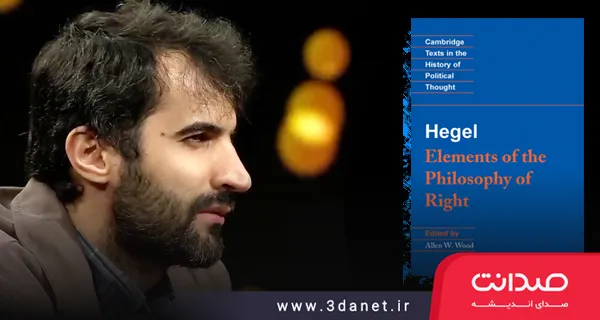
Mohammad Mashinchi Interview with Stephen Hicks: Hegel Is Poison!
Stephen Hicks sees the return to Hegel as a symptom of the poverty of twentieth-century philosophy and considers the liberal reading of him mistaken. In his view, Hegel's philosophy leads to obedience to the state, and the experiences of Russia and Japan testify to this authoritarianism.
— Interviewer's Note (Mohammad Mashinchi): Stephen Hicks is a professor of philosophy at Rockford University in Illinois and the director of the Center for Ethics and Entrepreneurship there. The Iranian reader's familiarity with Hicks comes through his book titled Explaining Postmodernism: Skepticism and Socialism from Rousseau to Foucault, which is available in the Iranian market in two different translations. Hicks's book Nietzsche and the Nazis, translated by Mohsen Mahmoudi and through the efforts of the online magazine Bourgeois, was also published after this interview.
The following is a translation of a short, exclusive interview we conducted with Hicks about Hegel's philosophy. What is the reason for the wave of contemporary philosophers returning to Hegel? What elements can be sought in Hegel's philosophy that both deepen human understanding of the universe and enrich social life for them? In this interview, Hicks presents the view of Hegel that he elaborated on in Explaining Postmodernism.
The English version of the interview can be read on Hicks's website.
Also, his numerous video lectures on YouTube provide useful resources for those interested in familiarizing themselves with his philosophical project.
Q. Let our first question be the title Benedetto Croce once gave to one of his books: "What is living and what is dead in the philosophy of Hegel today?"
A. We are now witnessing a renewed interest in the great philosophers, which has more or less led to their revival. But the reason for this is, above all, the poverty of twentieth-century philosophy, and the fact that many of its major movements reached the dead end of skepticism. Hence, our generation has turned to the greats of philosophy in search of a spark of inspiration, and Hegel is one of them.
Q. In your opinion, what is the main reason for the return to Hegel and efforts such as linking Hegel's philosophy with forms of philosophy with which you might be more sympathetic?
A. Hegel's philosophy is like a renovated old house, part of it modern, part of it pre-modern. Hegel is a philosopher with a systematic thought. He has reasoned positions on all the major philosophical questions. Therefore, contemporary thinkers can find elements in his works that can be made to fit with almost any philosophy they favor.
I am a liberal socially, economically, and politically, and Hegel is one of the most prominent authoritarian political philosophers. Hence, reading the writings of those who try to produce a softer reading of Hegel has always been agonizing for me. This usually happens when Hegel makes a political point and then the interpreter takes that point out of the overall framework of Hegel's philosophy.
For example, one might encounter statements in Hegel's works implying this meaning: "finding one's own self through freedom." At first glance, this seems very modern and politically liberal. But you will only be able to arrive at a correct interpretation of that statement when you connect it to Hegel's deeper views; that is, his view that each person's self is nothing but an aspect of the collective, that the Divine will realizes itself through the collective, that the State is the very manifestation of the Divine will.
Therefore, "finding one's own self through freedom," when placed in the full context of Hegel's philosophy, means nothing other than "doing whatever the State commands"—which is clearly an anti-liberal statement and, of course, in complete harmony with the rest of Hegel's political philosophy.
Q. What is interesting about contemporary Hegelianism is that the new followers and interpreters of Hegel's thought do not belong only to one specific philosophical tradition (for example, the continental or German tradition), but to various philosophical traditions. What is this diversity a sign of?
A. This has always been true of Hegel. In the nineteenth century, many Russian thinkers found their country's intellectual traditions backward, and turned to the modern West in search of new approaches. In their view, Germany appeared as the West to the west of Russia. So they went to German universities and brought German philosophy back to Russia—especially the philosophies of Kant, Fichte, Hegel, and Marx. Today we know how the course of events unfolded for Russia in the twentieth century.
In the nineteenth and early twentieth centuries, when Japan opened its doors to the West and sought to modernize, a similar thing happened there. Many Japanese thinkers went to Germany and returned to their country bearing the gift of Hegelianism. That gift of Hegelianism in Japan was used to construct and elaborate the militaristic and nationalist authoritarianism that rose to power in the first half of the twentieth century and created those catastrophes.
In my judgment, those thinkers should have searched a little further west than Germany; those Russian and Japanese thinkers, in order to find a healthier form of dynamic modernism, should have turned to English philosophy, the philosophy of the Scottish Enlightenment, and that part of French philosophy belonging to the Enlightenment tradition.
The same pattern has been repeated in the twentieth century, for instance when Richard Rorty sought an alternative from within the analytic philosophical tradition to remedy the weaknesses and deficiencies of that philosophy. Rorty, too, turned to Hegel and the post-Hegelian traditions. What this Hegelianism spawned is precisely postmodernism, American-style.
Q. Many followers and interpreters of Hegel believe that, contrary to your view, he is a radically rationalist philosopher, and that one can set aside some of the seemingly anti-rational aspects of his thought and use his philosophy for rationalist ends. Is such a thing possible?
A. Great philosophers choose their words carefully, and their statements carry authority and authenticity. These are intelligent people, and they know what they are saying. It is always a great mistake to try to whitewash the formulations that philosophers themselves have made of their own thinking.
This is especially true regarding a great thinker's positions on fundamental philosophical questions. The truth of this statement is even more pronounced when those positions are consistently repeated across all the works that thinker wrote over the years of his life.
In Hegel's case, his intellectual project is clearly a battle against the entirety of the logical tradition that arose from Aristotle up to modernity. He advances his project in this way because he wants to be a believer in a metaphysics whose driving force is spirituality, and whose evolution is dialectical; in his battle against the logical tradition, he is fundamentally seeking something that cannot be contained in logical expression.
Q. In our country, Iran, a kind of Hegelian wave has emerged. Writers and researchers with various political and intellectual leanings are seeking to write or translate new works about Hegel, with the notion that Hegel's philosophy is one of the important ways to properly understand modernity and a groundwork for more effective utilization of its achievements. In your opinion, how correct is this belief, and does Hegel's philosophy fundamentally have anything to say about the situation of non-European countries?
A. Those bold thinkers who sail their ship to the far reaches of the ocean to hunt for the best ideas are, to me, highly admirable. For a thinker to subject the ideas of his own culture to critical scrutiny, and to select from among them only those whose validity his reason independently affirms, is a sign that he is a true intellectual and thinker. Moreover, a thinker's readiness to transfer ideas from other cultures is another sign of the strength of his thinking.
But Hegel is poison. His anthropology is crude and dreadful. Even more terrifying is his philosophy. Consider that his ideas are part of the German philosophical world of the nineteenth century, whose luminaries are Kant, Hegel, Marx, and Nietzsche. Yes! All of these philosophers are part of the modern world, but together they form a counter-Enlightenment tradition that is suspicious of science and technology, anti-individualist (even Nietzsche), and anti-liberal. All of them, to varying degrees, share in laying the philosophical foundations for those authoritarian systems that emerged in the twentieth century; from various forms of authoritarian nationalism to international socialism, National Socialism, and fascism. These counter-Enlightenment philosophers are complicit in the responsibility for the murder of tens of millions of human beings and the misery of tens of millions more.
What made the modern world a success was its commitment to science, to technology, to reason, to individualism, to economic and social liberalism, and to democratic-republican politics. And all of these are rooted in pre-Hegelian and anti-Hegelian philosophy.
Therefore, my advice to those Iranian thinkers who want to understand modernity and reconcile it with Iran's situation is to first turn to the English and Scottish philosophers of the seventeenth and eighteenth centuries, and also those French philosophers of the Enlightenment tradition who followed them. Of course, these philosophies are not flawless, and our generation, in the neo-Enlightenment project, is still developing and improving them. But it was these philosophies that, despite all their weaknesses, made the successes of the modern world possible. So, it is from these that one must begin.
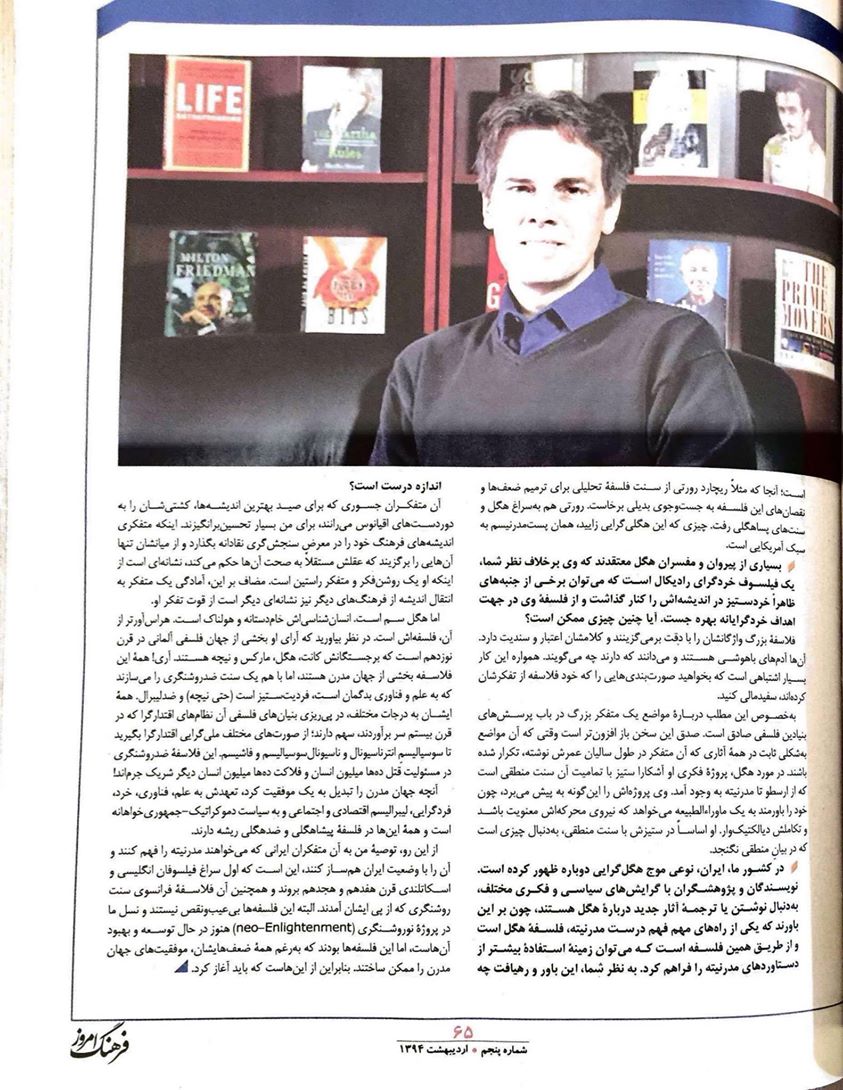
This interview was conducted by Mr. Mohammad Mashinchi and published in 2015 in Farhang-e Emrooz magazine.
.
.
1. The first question we would like to ask is the one that Benedetto Croce has once asked: “What is living and what is dead of the philosophy of Hegel?”
Stephen Hicks: There is a resurgence across the board of interest in the great philosophers. In large part this is driven by the emptiness of much twentieth-century philosophy, as many of its major movements reached skeptical dead ends. So our generation is looking for renewed inspiration by returning to the greats, Hegel included.
2. What, in your opinion, is the reason behind the recent comeback of the Hegel’s ideas, and the efforts to marry them with such schools of philosophy as you, for example, may subscribe to?
Stephen Hicks: Hegel’s philosophy is a halfway house, partly modern and partly pre-modern. And he is a systematic thinker, with argued positions on all major issues. So contemporary thinkers can find elements in Hegel’s writings that fit with almost any overall philosophy they find attractive.
My views are liberal socially, economically, and politically. But Hegel is one of the major authoritarian political philosophers. So it is irritating when I read those who try to give softer readings of Hegel. Typically that occurs by taking a political point he makes out of its fuller philosophical context.
For example, one can read Hegel saying favorable things about finding yourself through freedom. That sounds very modern and liberal politically. But to interpret properly one must connect such statements to his deeper views: that one’s self is but an aspect of the collective, that the Divine works through collective self-realization, and that the State is the manifestation of the Divine.
So, in full context, “finding yourself” ends up meaning “doing what the State tells you” – which is anti-liberal and in keeping with the rest of Hegel’s political philosophy.
3. What’s interesting about Hegel is the fact that his new followers, these days, aren’t necessarily coming from a particular philosophical tradition (e.g., German, continental) but a variety of traditions. What would you say that variety signifies?
Stephen Hicks: That has always been true of Hegel’s followers. In the 1800s, many Russians saw their country’s intellectual traditions as backward and went to the modern West for new approaches. To them, Germany looked like the West. So they went to German universities and brought German philosophy — especially Kantian, Fichtean, Hegelian, and Marxist — back to Russia. We know how that turned out for Russia in the 1900s.
The same is true of many Japanese intellectuals in the late 1800s and early 1900s, as Japan opened to the West and wanted to modernize. Many went to Germany and returned home with Hegelianism and contributed to the militaristic, nationalistic authoritarianism that developed there in the first half of the twentieth century.
In my judgment, all of those thinkers should have looked further West — to English and Scottish Enlightenment philosophy, as well as to some French Enlightenment philosophy, for the healthier form of dynamic modernism.
The pattern also continued in the 1900s, as Americans such as Richard Rorty came out of the Analytic tradition and were seeking alternatives to its failings. Rorty also returned to Hegel and the post-Hegelian traditions that followed. We know that results in American-style postmodernism.
4. Many of Hegel’s proponents and followers would argue that, contrary to your view, Hegel is a radical rationalist, if one would look past some of the so called anti-rationalist rough edges of his ideas. In fact his philosophy may be used as means to achieve one’s rationalist ends. Is that likely, or rather possible?
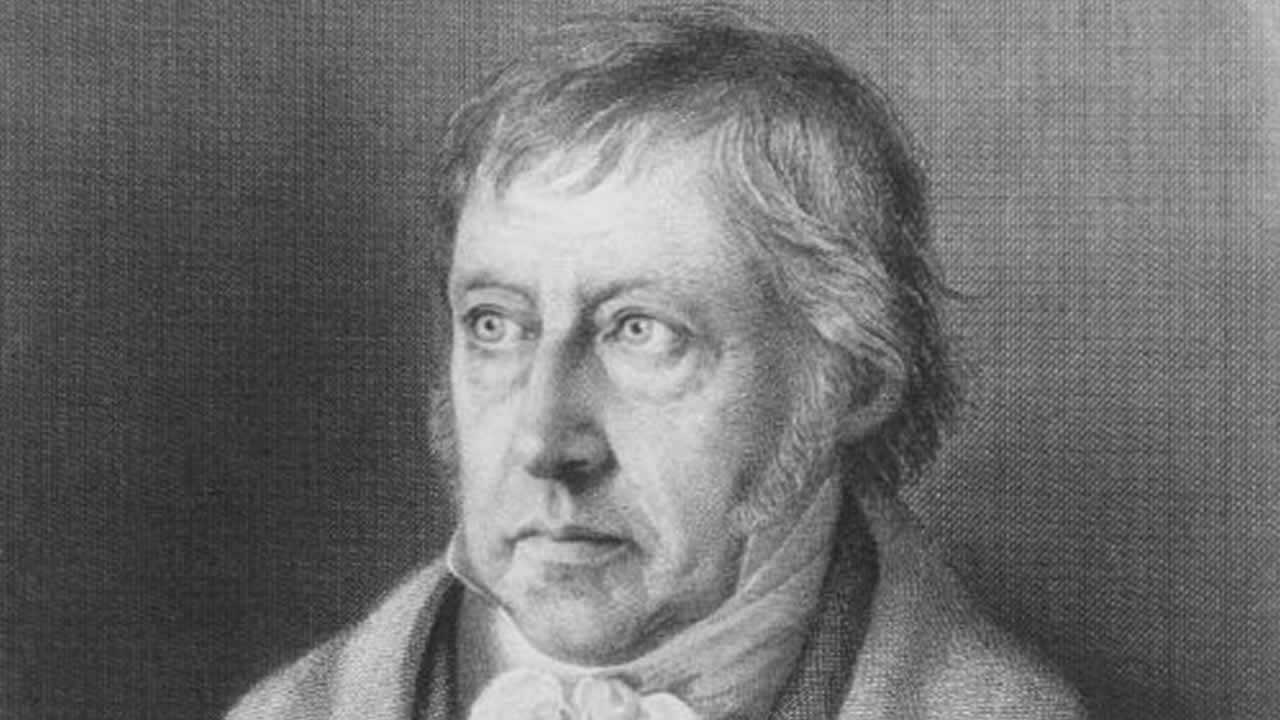 Stephen Hicks: One should always take great philosophers at their word. They are smart people and they know what they are saying. It is always a mistake to whitewash their published formulations.
That is especially true on a thinker’s fundamental positions in philosophy — and especially when those stated positions are constant theme across the thinker’s many works over the course of many years.
In Hegel’s case, he is explicitly attacking the entire tradition of logic as it had developed from Aristotle to modernity. And he is doing so because he wants to believe in a kind of spiritually-driven, dialectically-evolving metaphysics that cannot be expressed logically.
5. We’re currently facing a new wave of Hegelism in Iran. Scholars and intellectuals alike with different back-grounds and political or academic persuasions, are looking to write and translate new material of and about Hegel. They are convinced that Hegel is one of the keys to properly understand modernity, and that his philosophy can help to find better use of modernity. How much, would you say, this belief has merit, and does Hegel’s philosophy have anything to say about non-European cultures and countries?
Stephen Hicks: I applaud those courageous thinkers who seek far and wide for the best ideas. It is the mark of being a true intellectual when one is open to critically examining one’s own culture’s ideas and accepting only those one independently judges to be true. And it is a strong sign of being a real intellectual to be willing to import the best ideas from other cultures.
But Hegel is a poison. His anthropology is awful and embarrassing.
But more dangerous is his philosophy. Consider that his views are part of an 1800s German philosophical world in which the leading names are Kant, Hegel, Marx, and Nietzsche. All of them are part of the modern world, but make up a Counter-Enlightenment tradition that ends up being suspicious of science and technology, anti-individualistic (even Nietzsche), and anti-liberal. They all contributed in varying degrees to the authoritarian regimes that developed in the 1900s – the various forms of authoritarian nationalisms, the national and international socialisms, the fascisms — and that were responsible for the deaths of tens of millions of people and for the misery of tens of millions more.
What made the modern world a success was its commitment to science, technology, reason, individualism, social and economic liberalism, and democratic-republican politics. And those have their roots in pre-Hegelian and anti-Hegelian philosophy.
So for those intellectuals who want to understand modernity and adapt it to Iran’s context: first look to the English and Scottish philosophers of the 1600s and 1700s, as well as to their followers among the French philosophes of the Enlightenment. Their philosophies were imperfect, and improving and extending them is the current neo-Enlightenment project that our generation is working on. But for all their weaknesses, they did make possible the modern world’s successes. So they are the essential place to start.
February 2015
.
.




Discussion6 comments
نقل قول عجیب از نویسنده: " آنچه جهان مدرن را تبدیل به یک موفقیت کرد تعهدش به علم، به فنآوری، به خرد، به فردگرایی، به لیبرالیسم اقتصادی و اجتماعی، و به سیاست دموکراتیک-جمهوریخواهانه است. " و آن چه جهان مدرن را تبدیل به زندان فکری کرد چه بود؟ چه چیز باعث این همه جنگ و این همه تحمیل شد؟ چگونه است که demogogهای لیبرال با لبخند از آزادی رای در کشور خود می گویند و به کشورهای دیگر حمله نظامی و تحمیل عقیده می کنند؟ آن چه را فاشیسم swastika نتوانست انجام دهد فراماسونری و لیبرالیسم با لبخند و فریب و تحمیق مردم انجام دادند. ابتدا از آزادی اندیشه بگو وقتی بر گرده مردم سوار شدی با رسانه، miolitarism,و با تحمیل ارزشها در دانشگاه کمپانی هند شرقی، و ورزش تنیس و کریکت را به جای آب و نان و ریاضیات بومی هندی به مردم هند غالب کن. همان استراتژی که در ایران نسخه پهلویش اجرا شدو اکنون در ایران دست و پا می زند اما در زادگاه خود میلیون ها آمریکایی علیه اش فریاد اعتراض در زیر ضربه های باتوم و گلوله پلیس سر می دهند و برخی سر از قبر در می اورند.
درود و عرض ادب. میخواستم خیلی خیلی از سایت و دست اندرکاران سایت سپاسگذاری کنم برای همه زحماتشون. چقدر خوبه که مصاحبه اصلی رو هم گذاشتید.
زنده باشید
گر نماند هیچ ضدی پس نماند هیچ ندی الله باشد چون صمد بسکه باشد خود أحد ببست ره تک روی فرمود در خیر همرهی همدست شویم گر بشر بیداد آریم خود بسر
مشکل اساسی این مصاحبه این است که پر است از ادعاهایی که هیچ دلیلی برای آن ها ارائه نمیشود، و در نتیجه خود مصداقی است از خردستیزی.
هگل سم است,سمی که خودش پاد سمِ خودش را با فرایند دیالکتیکی می سازد..