Religion
Mohsen Armin on Abolfazl Bahrampour’s Remarks: God Will Not Speak on the Day of Resurrection to Those Who Distort and Conceal His Word
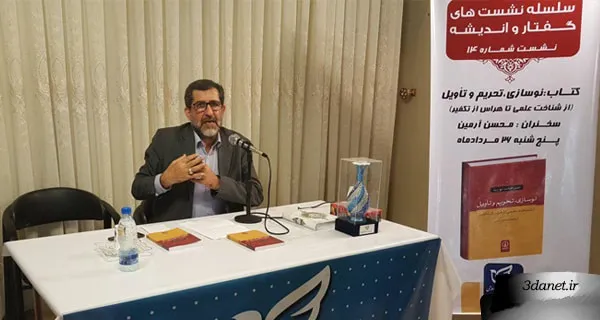
Critiquing Bahrampour's remarks on punishing protesters, Mohsen Armin writes that by distorting the verse on waging war against God and concealing its merciful aspects, he has portrayed God as a supporter of rulers—an act that brings the divine promise against those who conceal the Book upon him.
Mohsen Armin
AuthorI complain to God about a group who live in ignorance and die astray. Among them, no commodity is more stagnant than the Book when it is recited as it truly deserves to be recited, and no commodity is more profitable in trade and more precious in value than the Book when it is distorted from its proper meanings, and nothing is more detestable to them than what is right, and nothing more familiar than what is wrong. (Nahj al-Balagha, Sermon 17)
(I complain to God about a community that lives in ignorance and dies astray. In their market, no commodity is more worthless and stagnant than the Book of God when it is recited truthfully and worthily, and when it is recited with alteration and distortion, no commodity is more profitable and valuable than it, and in their sight, nothing is uglier than what is right and more beautiful than what is wrong.)
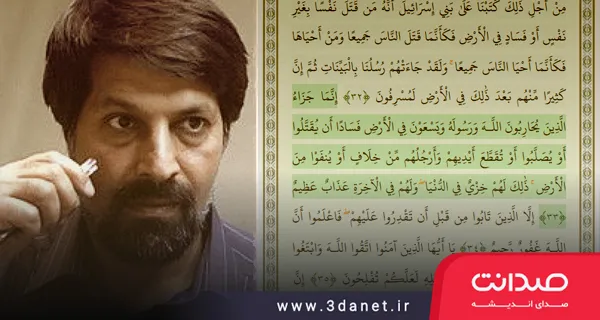
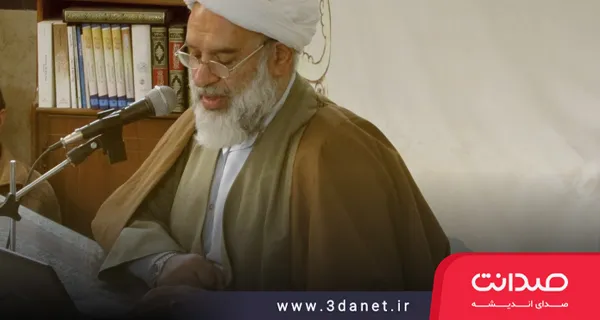
Mr. Bahrampour, in a television program citing verse 33 of Surah Al-Ma'idah, claimed that the youths arrested during the recent protests should be tortured (mutilated). He claimed he was reciting and translating the exact verse and that "if he does not speak the truth, he has betrayed the Quran." But the truth is that with these vile words, he betrayed the Quran. Because he distorted the meaning of the verse, deceived in its application, and concealed parts of it.
The phenomenon of the spiritual distortion of the Quran is not new. The Master (Ali) complained to God about the distortion of the Quran's meaning in his own time, which was not far removed from the Prophet's lifetime, lamenting how, when they displace the meaning of God's word from its proper context, no commodity is more profitable and precious to them.
The spiritual distortion of God's word has various causes and factors; the most catastrophic of all is the distortion of God's word due to political attachments and dependencies of power. History is replete with tales of the Umayyads' and Abbasids' efforts to invert Quranic verses to consolidate their own positions. Bahrampour's political attachment can be understood from his statement: "Why weren't these [arrested youths] emotional for the martyrs and the regime? ...If this ruling (being tortured) is carried out once, the next ones who are lying in wait will not dare to come out into the streets... These very people [if they could have gotten their hands on us] would have killed us." As is evident, Bahrampour's wrathful stance against the arrested youths stems from seeing himself on the opposing front and imagining that if they could have reached him, they would have killed him. Moreover, if these youths were on the front he approves of and had become emotional in favor of the regime and taken to the streets, their ruling would be to be honored and elevated, but because they did not protest in favor of the regime, they must be "tortured"!!
If Bahrampour had issued a ruling on his own, it would not be worth criticizing. Haven't we often seen the likes of him, who in Friday prayers praised the judiciary for executions and called for more people to be executed? But the issue is that Bahrampour has turned the Quran into a plaything for his political desires.
I proceed on the assumption that the penal ordinances of the Qur'an must be implemented exactly as they are in every age, and that one can never, and must never, discover their causes and purposes, nor replace them in any time or circumstance with rulings that fulfill those causes and purposes. With such an assumption, I submit that verse 33 of Surah al-Ma'idah concerns "those who wage war (muḥāribūn)." "Ḥarb" in Arabic lexicons means plundering, raiding, and war with the intent to plunder. A "muḥārib" is someone who undertakes armed action with the aim of plunder and creating insecurity. For this reason, although the word "muḥārib" in Arabic is also used to mean warrior, the Qur'an never refers to Muslims who fight in the way of God as "muḥāribūn." Based on the narrations of the occasions of revelation and the consensus of exegetes and jurists, this verse concerns armed robbers who, using weapons, deprive society of security, create terror and fear, plunder people's property, and violate people's honor. And Bahrampour, who is captive to his political inclinations, distorts the verse and presents unarmed youths—who, by the admission of officials, mostly belong to the deprived classes of society and protested the tripling of gasoline prices—as instances of this verse. Truly, what difference is there between Bahrampour's exegesis by opinion and the exegesis by opinion of ISIS, who burned the helpless Jordanian pilot based on the verse "And if you punish [an enemy, O believers], punish with an equivalent of that with which you were harmed"—which concerns retribution and has nothing to do with the battlefield?
Bahrampour has not only committed distortion by applying the verse on waging war (muḥārabah) to a matter alien to waging war; he also knowingly translated the verb "yuqattalū"—which in this verse indicates emphasis and intensification—as killing with torture (mutilation). I say "knowingly" because he is a translator of the Qur'an and knows the meanings of the verses well, and he knows that the root "q-t-l" in the tafʿīl form does not mean "to torture to death." Just as "yuṣallabū" in the same verse, which is also in the tafʿīl form, does not mean execution with torture, and no exegete or translator has translated the verse in this way. The baselessness of the meaning he has given to this word becomes even clearer when we know that he is a translator of the Qur'an, yet in his own translation, he did not translate this word in this manner. This means that he does not believe his own words, and what he said on television is, in the Qur'an's expression, "they distort words from their [proper] usages (yuḥarrifūna al-kalima ʿan mawāḍiʿihi)."
I wish Bahrampour's falsehoods in those few minutes of televised remarks had ended there, but unfortunately, they did not. In addition to distortion, he concealed the Word of God. He did not say that the Qur'anic verse not only did not decree the torture-killing of armed, rebellious thieves, but also gave the government a choice between execution, amputation of the hand, and exile, or at least established proportionality between crime and punishment, and in the case of an armed rebel whose hands are not stained with blood, decreed exile. And he did not say that in this ruling, which is among the severest ordinances of the Qur'an, the merciful face of God shines forth, and in the very next verse, He explicitly states that this same armed rebel who deprived society of security and plundered people's property will be forgiven if he repents before being captured: "Except for those who repent before you apprehend them. And know that Allah is Forgiving and Merciful" (al-Ma'idah: 34). As is evident, God concludes this, His severest ruling, with His forgiveness and mercy, and Bahrampour, by concealing this truth, tries to portray the God of the Qur'an as a merciless God who is the supporter of rulers and the enemy of the deprived. If Bahrampour's words are not a concealment of the Word of God, then what are they? And if they are, he should fear for his Hereafter, for God has said: "Indeed, those who conceal what Allah has sent down of the Book and exchange it for a small price—those consume not into their bellies except the Fire. And Allah will not speak to them on the Day of Resurrection, nor will He purify them; and they will have a painful punishment" (al-Baqarah: 174).

Discussion4 comments
اقایان صادق خلخالی و محمدی گیلانی با توسل به همین ایات حکم اعدام صادر میکردند منبع احکام که ایات باشد موجود است فقط میماند مصداق که انهم توسط حاکم شرع تعیین مصداق میشود
مستندات گروه داعش هم همین ایه سوره مائده و نظایر ان است.چه خوب است طرفداران اسلام رحمانی با اقای بهرام پور و یا همفکران انها در میز گرد تلویزیونی دلائل خود را ارائه دهند تا کنه قضیه روشن شود
اگر صوت کامل را گوش می کردند، می دانستند که ایشان آیه بعدی را هم خواند، و گفت که «من قبل ان تقدروا علیهم» ملاک پذیرش توبه است. به نظرم بیش از آن که در ترجمه این آیه اشکالی وجود داشته باشد، اشکال در فهم سیاقی این آیات است. باید بافت سوره مائده به درستی واکاوی شود تا منظور از این شدت عمل معلوم گردد. ولی متاسفانه ناقدان ما نیز اعتنای چندانی به بررسی عالمانه قرآن ندارند و صرفا در فضای ملتهب شروع به خرده گیری های غیر دقیق می کنند.
حضرات جواب بدید! با داعشیات مرام و مسلکمون چه باید بکنیم؟ خود رو به کوچه علی چپ زدن نه جوابه نه راه حل. جواب بدید