Philosophy
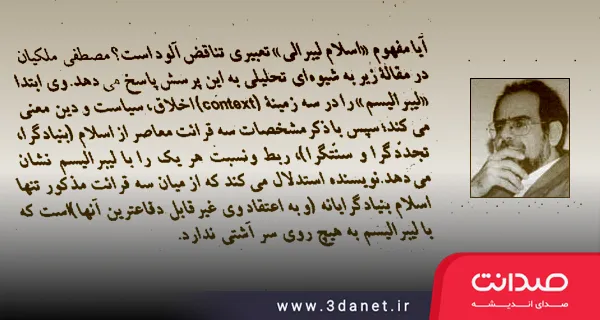
Mostafa Malekian's article “A Word on the Nature of the Relationship Between Islam and Liberalism”
In ethics, liberalism is more flexible than legalistic religionism, recognizing a sphere of discretionary space; in politics, it emphasizes the primacy of the individual; and in theology, it considers the restatement of religious truths using new concepts essential for modern humanity.
1_1_ In ethics, liberalism can be contrasted with legalism or nomocentrism2 and rigorism or strictness3. Liberalism is more flexible than either of these two ethical doctrines.
1_1_1_ Legalism or nomocentrism is that type of ethics which seeks to prescribe a rule for every conceivable situation in which a moral choice arises; or it is that type of mentality which, in every situation, follows what it considers its sole rule. Indeed, some ethical systems have constructed and elaborated exceedingly detailed and exhaustive rules of conduct, the mere memorization and recollection of which is a taxing task, let alone their observance. In practice, however, even these ethical systems have always shown, according to the exigencies of the situation, a degree of flexibility. At any rate, legalism, at the cost of turning a blind eye to broader, realistic4 moral considerations, accords an excessive reverence to the letter of the law and the sharia, and to legal and religious formalities and institutions. It was said that legalism applies both to a type of ethics and to a type of mentality. If I may be permitted a value judgment here, I must say that the legalistic mentality and attitude is probably far more dangerous than the legalistic ethical system.
2_1_ 1_ Rigorism or strictness, which may also be called precautionism5, in ethics and moral theology, refers to a system which holds that in all cases of doubt one must do that which is closer to caution; in other words, when in doubt we must obey the law and disregard how probable it is that the law is inapplicable in this case. The only exception is when the probability of the law's inapplicability reaches the level of certainty. But this opinion yields no result other than that we should never disobey a law unless we are certain that the law has been abrogated or has lost its applicability. Such a rigoristic ethical system has always held an attraction for persons of a rigid and acutely sensitive disposition; and its major crux is that it promotes and encourages sanctimony and inhibits action and activity; for if we are not entitled to engage in action and activity unless we have assured ourselves that the action and activity is legal and legitimate, that is, only when our doubts and hesitations, however slight and negligible, have all been dispelled, then in most cases we cannot act at all; and to refrain from acting is, in truth, nothing but a neglect of duty.
3_ 1_ 1_ Liberalism, in this respect, acquires a negative definition, for it is an ethical system which: firstly, does not hold that for every conceivable and possible situation there exists a single moral rule, but rather maintains that many situations lie within a "zone of discretion"; and secondly, does not hold that so long as we are not certain that a moral law has been abrogated or has lost its applicability, we must obey it.
2_1_ In politics, liberalism advocates a) changes that are orderly and systematic (= non-revolutionary), b) limiting or, where possible, eliminating traditional privileges and distinctions, and c) expanding opportunities and possibilities. In other words, liberalism a), while welcoming change, opposes sudden, revolutionary, and naturally violent political changes; it seeks, as far as possible, b) to weaken and abolish privileges and distinctions based on race, skin color, gender, freedom and slavery, language, ethnicity and nationality, inherited social status and standing, wealth and poverty, religion and creed, and opinion and belief; and c) to make opportunities and possibilities equally available to all citizens. All three of these claims are normative6 and value-based7 claims founded upon three more fundamental claims that are half normative and value-based and half factual8, namely that a) humanity has always been, is, and will always be progressing, b) human nature is good, and c) the human individual is autonomous. This third claim, in particular, is emphasized: liberalism, as a political philosophy, gives primacy to the individual, meaning it holds that the individual, first and foremost, possesses rights to whose preservation the activities of the state must be limited. These rights, which are in fact the rights of the individual vis-à-vis the state and correspond to the duties of the state toward the individual, include, among others, freedom of expression and action, and freedom from religious, creedal, and ideological restrictions and compulsions.
3_1_ In theology, liberalism stands in opposition to strict and inflexible traditional orthodoxies9. Theological liberalism seeks to break the rigidity and inflexibility of the old intellectual systems that have emerged and grown within religious culture, while at the same time preserving the essential truths of religion and re-expressing and re-explaining these truths using different words and concepts and within the framework of new intellectual systems. This liberalism has two major presuppositions: one, that the essential truths of religion are not tied to any particular cultural epoch and do not share a single destiny, and therefore, for modern humans as for pre-modern humans, they still possess force and validity; and the other, that the old religious intellectual systems, because they were completely under the influence of the sciences and human knowledge of pre-modern humans and, in fact, reflected the ancients' understanding and interpretation of religious truths, are today incomprehensible and unacceptable to modern humans. For religious truths to be intelligible and acceptable to the contemporary modern human and to have presence and life in the realm of mind and consciousness, they must sever their umbilical cord from the sciences, knowledge, methods, and attitudes of the ancients. Theological liberalism, with that intention and with these two presuppositions, has become an intellectual and religious movement whose greatest emphasis is on the ethical dimension of religion. In other words, if we summarize the set of rulings and teachings of any religion or creed into beliefs, rituals, and ethics, it can be said that the distinguishing difference between theological liberalism and traditional orthodoxies is that these orthodoxies attach the greatest importance, above all else, to beliefs—that is, propositions that allegedly express the content of the religion and whose affirmation is demanded of the faithful as a necessary or necessary and sufficient condition for the enjoyment of eternal felicity—and then, in order, attend to rituals and ethics, whereas theological liberalism devotes its greatest concern to ethics, and then addresses beliefs and rituals, reducing the number and value of the theoretical and dogmatic teachings of religion to the absolute minimum, and even considers the emergence of a set of dogmatic religious teachings, verbal confession or heartfelt belief in which is a condition for salvation, to be a distortion of the truth of religion.
4_1_ If we disregard the minor and secondary disagreements that moral liberals have with one another, as well as the minor disagreements of political liberals and the secondary disagreements of theological liberals, and also overlook the differences among these three meanings of liberalism themselves, it can perhaps be said that the semantic components of the word “liberalism,” in its broadest sense, are: a) open-mindedness and acceptance of change, b) a concern that change be subject to order, sequence, and gradualism, and c) respect for the freedom and value of each individual human being. These three components, of which the third is perhaps the most important, are the enduring elements of the liberal tradition. Some researchers and thinkers, such as Jaspers10 and Widler11, have suggested that the word “Liberality,” roughly meaning “free-spiritedness,” be applied to those elements of liberalism that have retained their value and validity. If we accept this suggestion, I believe the set of these three components can be called “free-spiritedness.”
2_ “Islam” is sometimes used to mean the sacred religious and sectarian texts of Muslims, i.e., the collection of the Quran and authentic hadiths (which I refer to as “Islam One”), and sometimes to mean the totality of commentaries, interpretations, explanations, and defenses that have been left regarding the Quran and authentic hadiths, i.e., the works of theologians, ethicists, jurists, philosophers, mystics, and other scholars of Islamic culture (“Islam Two”), and sometimes to mean the totality of actions that Muslims have performed throughout history, together with the effects and results that have ensued from those actions (“Islam Three”). In this article, I will only address Islam Two, which is, in fact, the readings and narratives that religious scholars have had of Islam One and have presented.
All of these readings and narratives, in our time, can be placed into three large groups: fundamentalist Islam12, modernist Islam13, and traditionalist Islam14.(1)
1_2_ Fundamentalist Islam, examples of which we see in Wahhabism and Salafism:
a) If it grants authority and value to discursive reason15, it is only for the purpose of discovering and extracting truths from the heart of the Book and the Sunnah, and it does not, in practice, consider reason as a source alongside the two sources of the Book and the Sunnah, apart from this instrumental role it assigns to it; and, in this respect, it is intensely text-oriented and tradition-bound; b) It emphasizes the outward aspects16 of Islam, not its spirit17; c) It is sharia-minded and considers religiosity, above all and before all else, to lie in observing the rulings of sharia and jurisprudence, and it regards these rulings as unchangeable and inviolable; and therefore d) It strives to re-establish a society (or societies) in which sharia and jurisprudence are disseminated and promoted in the most complete and perfect manner; and since establishing such societies is difficult, and indeed impossible, in the presence of secular18 and value-neutral19 governments that do not take the side of any of the various conceptions of the good life, e) It is in a state of irreconcilability with all such governments and intends to overthrow them, and it tries to create sharia-based and jurisprudence-oriented governmental systems; f) It does not believe in religious pluralism20; g) It also does not look favorably upon political pluralism; h) It considers religion to be the fulfiller of all human needs, both spiritual and material needs and otherworldly needs, and, hence, i) It believes that by establishing a religious government, an earthly paradise can be created; j) It is opposed to modern Western culture (e.g., Western philosophy and its moral, legal, and aesthetic values) and even, in some cases, to its civilization (i.e., empirical sciences, technology, and the resulting state of livelihood), because it sees all of these as incompatible with Islam, which is, of course, more or less confined to sharia and jurisprudence, and/or it considers the West to be the source of the current issues and problems of the Islamic world, which, with its hegemonism21 and colonialism, as well as its cultural invasion, especially in the last two centuries, has afflicted almost all Islamic societies, to varying degrees, with misery and misfortune.
2_2_ Modernist Islam, of which figures such as Sir Syed Ahmad Khan of India, Muhammad Abduh of Egypt, Ziya Gökalp of Turkey, and Sayyid Jamal al-Din Asadabadi are prominent representatives: a) considers discursive reason not only a tool for discovering and extracting the truths of the Book and the Sunnah, but also a source alongside the two sources of the Book and the Sunnah; more importantly, it seeks to enlist reason to prove the authority and truth-representation of the Book and the Sunnah; furthermore, it even wants, by finding the purposes and ends of religious and doctrinal rulings and teachings, to remove adherence to them from mere devotional submission and present it as a rational matter; and as soon as it senses the slightest conflict between the apparent meanings of verses and narrations and rational findings, it departs from the apparent meanings of the verses and narrations and resorts to their esoteric interpretation; and, in this respect, it is rationalist and, as far as possible, freethinking and averse to devotional submission; b) emphasizes the spirit of the message of Islam, not its outward forms; c) sees religiosity, more than and before anything else, in living ethically, and that an ethics that is this-worldly, humanistic, and sentimental۲۲(by sentimental ethics I mean an ethics in which good and bad, right and wrong revolve around giving pleasure and causing pain); d) does not consider the rulings of Sharia and jurisprudence unchangeable, but rather considers most of them bound to the time, place, and social and cultural circumstances of the Arab society of fourteen centuries ago and considers rigidity upon them a cause for distancing from the spirit of the universal and eternal message of Islam, and, therefore, has no concern whatsoever for establishing a society in which the rulings of Sharia and jurisprudence are implemented exactly, point by point, as they were implemented fourteen hundred years ago; rather, it strives more to rationalize the rulings of Sharia and jurisprudence and to bring these rulings closer to human rights and a kind of universal ethics understood and accepted by contemporary humans, and, for this reason, e) does not strive to create Sharia-oriented and jurisprudence-centered governments and believes that the existence of a religious society is also possible in the shadow of a non-religious۲۳ (non-religious, not anti-religious) government, and, therefore, the separation and disentanglement of politics from religion and religion from politics is certainly possible and perhaps desirable; f) believes in religious pluralism; g) welcomes political pluralism; h) sees religion as fulfilling worldly-spiritual needs and otherworldly needs; i) does not believe that by establishing a religious government and creating a religious society, material welfare is necessarily attained; j) defends modern Western civilization and, in many instances, its culture as well, and sees this civilization and culture as successful in fulfilling worldly-material needs, which religion is not responsible for; k) considers the enemy of the Islamic world to be more domestic than foreign; and says: "It is from us that is upon us"; it is true that Westerners have also had domineering and colonialist tendencies, but it is also true that: God does not change the condition of a people until they change what is in themselves.
3_2_ Traditionalist Islam, whose most prominent spokesmen in this century have been figures such as René Guénon24, Frithjof Schuon25, Titus Burckhardt26, Martin Lings27, Seyyed Hossein Nasr, and Gai Eaton28, (2) a) regards discursive reason merely as an instrument for uncovering and extracting the truths of the Book and the Sunna, but does not consider it a source alongside these two, and reserves this latter status only for intuitive intellect29, which is the guarantor of the authority and validity of religion. If it undertakes the esoteric interpretation (taʾwīl) of the Book and the Sunna, it does so more by the ruling of intuitive intellect, not discursive reason; and in this respect, it is not rationalist30, nor freethinking and averse to religious authority; b) like Modernist Islam, it emphasizes the spirit of Islam's message, not its outward forms; c) it is experientialist and considers religiosity more as a kind of inner, spiritual wayfaring and conduct for which strict observance of the rulings of the Sharīʿa and jurisprudence is a necessary, but insufficient, condition for success; it in no way regards the Sharīʿa and jurisprudence as the aim and end, but considers them a means and instrument from recourse and adherence to which there is no escape; and, hence, it censures both those who regard the Sharīʿa as an end instead of a means, and those who deny even its inescapable instrumentality; d) it has no concern for establishing a Sharīʿa-oriented, jurisprudence-centered society, but rather seeks, at the level of the general public, for a kind of morality based on "Do not wish for others what you do not wish for yourself," and for tolerance, magnanimity, and leniency toward others and strictness toward oneself to become prevalent, and at the level of the elite and elect, that is, those who have the aptitude for inner, spiritual wayfaring and conduct, for the potentiality and capacity for spiritual orientation and the quest for transcendence to draw closer to actuality and realization; and, therefore, e) like Modernist Islam, it is not displeased with the separation of religion from politics and does not see non-religious governments as much of an obstacle or hindrance to the individual's perfection within society; f) like Modernist Islam, it believes in religious pluralism; and, g) it also welcomes political pluralism; h) it sees religion as solely fulfilling spiritual needs; i) it does not at all believe that religion has promised the realization of an earthly paradise, but rather emphasizes the contrary; yet j) like Fundamentalist Islam, it is seriously at odds with modern Western culture and even civilization, and considers this culture and civilization the product of an age of darkness, the result of humanity's distance from its spiritual origin and primordial nature, and possessing an anti-religious and non-spiritual essence; but k) like Modernist Islam, regarding the wretchedness and decline of Islamic societies, it holds Muslims more deserving of blame and criticism than Westerners and foreigners.
3_ Now, in a very concise manner, we will discuss the nature of the connection and relationship between liberalism and Islam.
1_3_ It goes without saying that Fundamentalist Islam is compatible neither with ethical liberalism, nor with political liberalism, nor with theological liberalism.
2_3_ And again, there is no doubt that Modernist Islam is compatible with ethical liberalism, with political liberalism, and with theological liberalism. And the reality is that although modernism has numerous other forms and shapes besides liberalism, the current proponents of Modernist Islam, throughout the Islamic world, in the vast majority of cases, adhere to a liberal persuasion.
3_3_ As for Traditionalist Islam, it holds a favorable position toward ethical liberalism, and an intermediate position toward political liberalism. This narrative of Islam, more than being concerned with changing and reforming the political substructures of society, devotes its endeavor to changing and reforming the inner and esoteric state and condition of each individual; in weakening and abolishing the privileges and distinctions that liberalism seeks to abolish, it broadly agrees with this persuasion; however, it does not share in this persuasion's conception of freedom, and its conception of human rights does not fully accord with the liberal conception; contrary to liberalism, it does not consider humanity to be ever-progressing, but, on the contrary, points the finger of "hope" at a kind of spiritual and inner regression of human beings; it considers human nature good and regards it as a divine breath and inbreathing, yet, with all this, it does not agree with the liberal conception of individualism.
4_ The conclusion, therefore, is that one cannot claim that Islam, in an absolute sense, is incompatible with liberalism, and that Islamic liberalism and liberal Islam are paradoxical concepts۳۱. However, one can certainly say that one reading of Islam, namely the fundamentalist reading, is incompatible with liberalism. As for which of these three Islams is logically more defensible, that is another long story that does not fit within the scope of this article. I should not leave unsaid that, in the opinion of the author of these lines, the most indefensible reading of Islam is precisely its fundamentalist reading.
.
.
Notes
۱_ liberalism
۲_ legalism
۳_ rigorism
۴_ factual
۵_ tutiorism
۶_ normative
۷_ evelative
۸_ factual
۹_ orthodoxy
۱۰_ Jaspers
۱۱_ Vidler
۱۲_ fundamentalist
۱۳_ modernist
۱۴_ traditionalist
۱۵_ reason
۱۶_ letter
۱۷_ spirit
۱۸_ secular
۱۹_ value neutral
۲۰_ plularism
۲۱_ imperialism
۲۲_ sentimental
۲۳_ secular
۲۴_ Rene Guenon
۲۵_ Frithjof Schuon
۲۶_ Titus Burckhardt
۲۷_ Martin Lings
۲۸_ Gai Eaton
۲۹_ Intellect
۳۰_ rationalist
۳۱_ paradoxical
.
.
(1)_ See Nasr, Seyyed Hossein, The Need for a Sacred Science, (Albany: SUNY, 1993), PP.138-140
(2)_ Traditionalist Islam should not be confused with the traditional Islam that has been spoken of in our country in the last two decades. This traditional Islam is, in reality, nothing but a type of traditional jurisprudence that has been employed by a kind of fundamentalist Islam, which also carries with it a very slight seasoning of modernist Islam and traditionalist Islam.
.
.
PDF file of the article "A Word on the Nature of the Relationship Between Islam and Liberalism"
.
.
Author: Mostafa Malekian
Kian Magazine, Issue 48, Year 9 (August-September 1999)
.
.


Discussion0 comments
No comments yet; let yours be the first voice.