Philosophy
Mozhgan Khalili: How Can We Re-establish Our Relationship with the World? (Part Two)
Drawing on Wittgenstein's philosophy, Mozhgan Khalili sees wisdom not as book-learning but as a way of being that, for self-knowledge, requires moving beyond deep knowledge. Through 'language games' and 'forms of life', she re-examines our relationship with the world.

How Can We Re-establish Our Relationship with the World?
Mozhgan Khalili[1]
Part Two:
“Language-game,” “Form of Life,” and “Philosophy”
Read Part One here
1- Introduction:
In order to philosophize in a novel sense, borrowed from Wittgenstein’s later philosophy, it is essential to obtain an image of our world with the aim of grasping “what is,” so that we may then, by focusing on the image of this “form of life,” arrive at a narrative of the relations within it and the connections through which we have thought about ourselves and our world. We must find where the fragments of philosophical thought about the manner of our lives have remained ruptured and been left concealed, so that by revisiting and reflecting upon the whole of it, we may pursue the logical continuity of the position of which we are now the product, and become aware of the horizons and boundaries of “what we have and are,” so that through this path, philosophizing about a way for a new connection to the world becomes possible. However, it is crucial to note that here, “what is” does not mean a reflection of reality, and we are not seeking an explanation of the reflection of reality, or what is supposedly going on in reality; rather, we are seeking the insight and wisdom that reveals our gaze upon the image we have obtained of our world.
By wisdom [2] in its most ancient and broadest sense, we mean the human capacity to cope with life, the very capacity that enables us to make judgments about specific matters. The more crises and problems we face in life, the more we need wisdom to confront them, and by it we mean, in its common understanding, something good or right; the more we possess it, the better individuals we are and the more appropriately we will face the transformations ahead. In other words, we need a kind of philosophical wisdom[3]; people of wisdom, depending on their share of wisdom, strive and struggle for this “good/right” life. But success in such an endeavor is tied to correct judgment, and this, in turn, requires adequate knowledge and especially self-knowledge. To attain this self-knowledge, we need an interconnected and interdependent science and practice to successfully confront the situations that arise with the surrounding world and with ourselves. This mode of action for a successful encounter with the world also requires orienting knowledge[4], a knowledge that is an essential and inseparable aspect of such wisdom. (Wah, pp. 9-12)
Therefore, such wisdom, with the aim of self-knowledge and sound judgment, necessarily needs to pass through the depths of a certain kind of knowledge. Such knowledge must, above all, be comprehensive and holistic, meaning it can choose the best possible path from among diverse and varied ways, and from among different modes of action, find the one that can be called "good/right." To be this comprehensive and holistic, it must be able to overlook unimportant details, overcome the temptation of pedantry, be content only with what is important and essential, and strive with all its might to deeply grasp the whole (ibid., 12-13). And such a task is not easy in the form of life in the contemporary world. Because vast masses of jumbled knowledge must be sifted, and in this sifting, attention must be paid not only to correctness but also to utility and importance. And overlooking this excess of knowledge is impossible for someone who has never swum sufficiently in the sea of knowledge and does not even know what knowledge is, let alone being able to make a selection from within the mass of knowledge. Nevertheless, the knowledge required for wisdom does not necessarily have to be bookish or taught knowledge; rather, it is learned knowledge, which may arise more from practical experience than from theoretical instruction. Even an unlettered and illiterate person may possess more wisdom than many educated and well-read individuals, provided, of course, that they have acquired the necessary conditions for wisdom. (ibid.) This knowledge necessary for wisdom is far removed from our current situation, where we are bewildered in the vastness among the wandering islands of various sciences.
The fragments of the specialized sciences of our time drift further and further apart day by day, so that they become less and less illuminating for us. To live well, we need a kind of deep, sapiential knowledge that, despite its holism, has matured over time and is not superficial. The valuable sign of such knowledge is that it shakes us and is effective. Such an effect only emanates from within a deep and profound knowledge that we can feel and be shaken by, and this does not happen unless it has established a connection and bond with our existential sphere. (ibid., 12-14)
Deep knowledge directly affects the person themselves, and for our knowledge to be deep, we need self-knowledge, and the prerequisite for self-knowledge is self-criticism. It is this very criticism and knowledge that makes a person aware of their limits and limitations and grants them the humility to make claims and pursue goals only in proportion to their real abilities and talents; freeing them from both theoretical pride and practical pride. This knowledge can be acquired in any way; therefore, we need any source of knowledge and learnable practical experience that brings us closer to this wisdom. And in the course of this inquiry, we must always pay attention that we are not researching using common scientific and cognitive methods, but are doing philosophical work with the aim of attaining wisdom. One of the important differences between science and wisdom is that the scientist constantly tends to change the world in accordance with their scientific advances, but the philosopher-sage does not want to purposefully change the world; rather, they only want to put everything in its proper place in order to see the world as it is, ever more clearly, and understand it more comprehensively. Knowledge is something we have and is a possession. But wisdom is not having something; it is a way of being. (ibid., p. 11 and pp. 14-15) And relying on the later philosophy of Wittgenstein along this path can be inspiring, because, as Malek Hosseini narrates, in Wittgenstein's case it is difficult to separate the person himself from his works, knowledge from wisdom, and this is reason enough to consider him, in the role of philosopher-guide, a fitting and appropriate choice for traversing this path.
2- The Relationship between "Language-game" and "Form of Life"
The term "language-game" is Wittgenstein's famous expression and a key concept in the system of his innovative philosophical literature. To explain and demonstrate the important role of "language" in action and in the living experience of the flow of life, which constructs the path and manner in which our thought is shaped and formed in relation to the world, he uses the expression "language-game."
We all have a common understanding and an old assumption about language, thinking that language has a fixed essence and a single logic, but Wittgenstein, by enumerating a list of language-games as examples,[5] makes us aware of the unlimited logics of language—not to say that we have a vast collection of separate, everyday life activities under the title of "language-games," but rather, through the term "language-game," he shows his audience how, depending on where one stands each time, in every time and place, diverse living linguistic uses of words appear according to the logic of various grammars and criteria of meaningfulness, and how this particular, situation-dependent linguistic use is rooted in a network of relations and connections within his "form of life," shaping and directing his view and thought about the world.
"Thought" is of the nature of concepts; its seeds take life, take form, and emerge within the words and concepts of "language." If it is not adequately expressed in language and narrated, it is not transmitted or preserved and perishes. However, the role that language plays in this is twofold, making philosophical inquiry complex and requiring special precision. On the one hand, by its very nature, language is prone to rhetoric, and through this path, it sickens and poisons "thought." On the other hand, again by its nature, it is creative, and if its words are used in their proper places, it narrates the world we will from our "form of life" and makes it visible. Yet, on this path, we also fall into the trap of the similarities of "language-games" and, due to generalization and misinterpretation, we find problems.
Therefore, extracting the how of our "language and thought" relationship in the world requires a deep linguistic inquiry that does not remain on the surface, showing how this relationship is built upon the "experience" of a particular "form of life," and how specific "language-games" play an important and significant role in that "experience." Hacker,[6] the renowned commentator on Wittgenstein's philosophy, says that language and its forms cast the mold of our nature, shape the essence of our thought, and penetrate the depths of our life. For this reason, in Wittgenstein's view, the problems arising from the misinterpretation of the forms of language are deep anxieties whose roots are as deep as the forms of our language and have a value equal to language, and philosophy is an activity we must undertake to untie knots in thought, a task as complex as the knots themselves. (1396, pp. 15-16)
According to Wittgenstein, although none of our language's "language-games" are identical and each is unique in its structure, they nonetheless bear a "family resemblance"[7] to one another. With this innovative term, he explains that if our language-games "do not have one thing in common... they are related to one another in many different ways" (PI: 65). This is the very source of falling into deep philosophical and intellectual problems in life, because it traps us in the spoken and written similarities of the diverse functions of words, causing us to mistakenly construct uniform patterns and generalities for the different functions of language. (Kenny, 2006, p: 96-97) In other words, the rich diversity and capacity of language manifests in its various living uses, but the similarities lead us to seek a single definite form, classification, and modeling for all forms of speech, whereas each "language-game" has its own specific grammar,[8] logic, meaning, and unique rules. The concept of "grammar" for Wittgenstein is not a grammar or a network of rules that we prescribe for language to show where one of its rules has been violated and is incorrect; rather, it refers to our set of criteria for the use of a particular concept (Conant, 2005, p: 64), which determines the criterion for its meaningfulness or meaninglessness. Therefore, this kind of philosophical inquiry is not about the correctness or incorrectness of the rules for using language within a form of life, but about meaningfulness and that which, within this form of life, crosses the boundaries of meaning.[9] So, when language-games acquire a family resemblance in the relations and connections they establish with one another, the same thing happens with their grammar,[10] and we carry out the same homogenization regarding the criteria for the use of that particular concept, even though they play completely different roles in a game and language, but we fall into the trap of their similarities.
Thus, grammar is the set of "criteria of meaningfulness for language-games" within a "language" and within its "form of life." A crucial point is that none of these criteria of meaningfulness for the use of language can have a private meaning, because every criterion gains its official status through general agreement within a community. This topic, known as the "impossibility of a private language," is one of the most controversial and famous discussions of Wittgenstein's later philosophy. He believes that outdated and incorrect old notions are the origin of the belief in and acceptance of a private language, whereas, if such a language were accepted, as Glock[11] puts it, each person could produce an arbitrary criterion for judging the meaningfulness or meaninglessness of the use of a "language's" words, while what seems correct only to "me" cannot attain general value and official status. In that case, there is no criterion other than "me," and this "me" can never itself be the criterion for being meaningful or meaningless. (Glock, 1996: 312-313) Wittgenstein's innovation in rejecting a private language goes back to his important and rich reflection that considers the human interior and mind to be a reflection of the exterior.
It is with this novel approach that the task of philosophy becomes the clear representation of the origin and those parts of language that create our conceptual confusions and intellectual knots, because we lack a clear view of the use of our words and the discernment of differences and the distinction between meaningful and meaningless criteria and their origins. For this reason, we need deep philosophical inquiry to gain the insight and wisdom necessary for understanding the relations between concepts and their criteria of meaningfulness—the very relations we often forget, and this very neglect causes our confusion. Although we already know these rules and unconsciously act according to the criteria, we cannot simply arrive at a general and clear overview of them. (Hacker, 1396, pp. 16-17)
و باید توجه داشت درک روابط میان گرامرها یا مجموعه معیارهای معناداری «بازیهای زبانی» را نمیتوان جدا و قبل از، ارائهی یک دیدکلی از روابط و نسبتهای آنها، درک کرد و مجموعهی این ارتباطهای معنیدار را فقط میتوان روی سنگ بسترِ مفهومِ «شکلزندگی» مورد نظر ویتگنشتاین توضیح دادکه در واقع، چگونگیِ نشان دادنِ این نسبتها و روابط مفاهیم مختلف، در «گفتن» است. و وقتی این نسبت و رابطه بین اجزای مختلف «بازی زبانی» و «شکل زندگی» و «دیدِ کلی» لازم از آن چه «هست» با دیدنِ دقیق و با این سبک فلسفهورزی خاص، به دست آمد، پژوهشگر میتواند راه و سبک خودش را برای گفتن و روایت این روابط به کار بگیرد.
و واضح است که آنچه از منظر او به دست میآید، تنها راهِ دیدن ِچگونگیِ این ربطها و نسبتها محسوب نمیشود، چون برای روایت چگونگیِ این نسبتها، فقط یک راه وجود ندارد. مثال مشهور اردک- خرگوش ویتگنشتاین هم همین نکته را میگوید: «...و باید بین «دیدنِ پیوسته»ی یک جنبه و «آفتابیشدن» یک جنبه تمایز بگذارم، ممکن است شکل به من نشان داده شده باشد و من هرگز در آن چیزی جز یک خرگوش ندیده باشم...»(پ. ص346) ویتگنشتاین تصویر زیر را مثال میزند و میگوید میتوان آن را از دو زاویه دیدِ خرگوش یا اردک دید در حالیکه ممکن است یک نفرهمیشه آن را خرگوش دیده باشد. بنابراین دیدن و توصیفکردن این نسبتها و روابط از نظر او، راههای مختلف و ابعادِ متنوع دارد. اما علاوه بر این، ویتگنشتاین با تصویر زیر یادآور میشود که باید با تمرین فلسفهورزی، باورها و پیشفرضهای کهنه را کنار بگذاریم و عینکِ عادت را از روی چشممان برداریم تا اگر تا به حال فقط خرگوش میدیدیم، توانِ دیدنِ اردک را به دست بیاوریم. بنابراین حتما اول باید توانِ دیدنِ نسبتها و روابط را آن طورکه هستند به دست بیاوریم، ونه آن طورکه عادت داریم ببینیم، تا بعد بتوانیم آن را درروایت خاص خودمان نشان بدهیم.
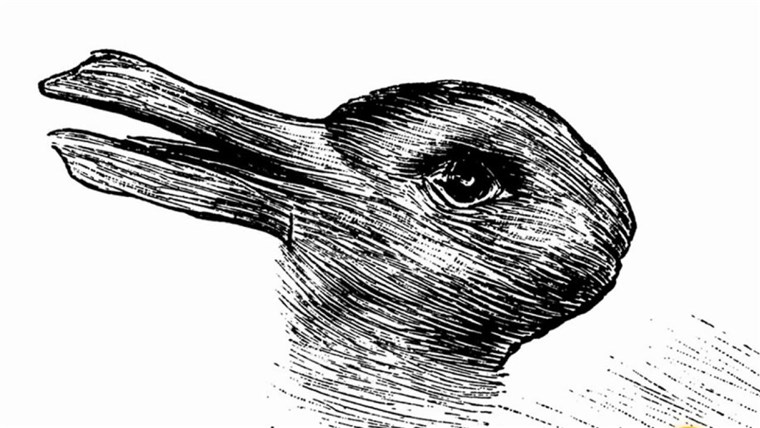
3- «زبان خصوصی» و «فلسفهی مدرن»
همان طور که گفتیم معنا و معیار بازیهای زبانی درون روابط پیچیدهی شکل زندگی، نمیتواند از راه تجربهی خصوصی به دست آمده باشد، ویتگنشتاین میگوید ما چون معنای واژههایی مثل «درد» را با اشاره به احساس درونیِ آن بهدست میآوریم، با همین پنداشتهی نادرست فکر میکنیم معنای ِواژههای یک « بازیزبانی» پدیدهای شخصی و ذهنی است، درحالی که کاملا برعکس، معنای یک مفهوم بهکاربردِ متنوع و سیالِ مطابق با معیارهای پذیرفته شده در توافقهای عمومی درون «شکلزندگی»، وابسته است. به عبارتی از نظر ویتگنشتاین اگر کلمات «معنا» دارند به خاطر این نیست که از ذاتِ بهخصوصِ یک پدیده خبر میدهند، بلکه معنایشان ناشی از مجموع کاربردهای توافق شده برسرِ معیارهای آنهاسـت و آنچه در قلبِ قواعد یا پیروی از قاعدهی بازی زبانی و یا الگوهای زندگی، درون شکلهای زندگی، مرکزیت دارد «تجربه»ای غیر شخصی است که نه تنها خصوصی و درونی نیست بلکه این امکان در سرشت آن نیست که بتواند خصوصی باشد، بنابراین ما هرچند به راه وروشِ خودمان و تاریخ شخصیای که از سر میگذرانیم تجربه میاندوزیم اما سرچشمهی تجربهی شخصی ما، تجربهی بیرونی و جمعی، درون یک «شکل زندگی» است که از درون روابط و نسبتهای آن، در اثر فعالیت و عمل اتفاق افتاده است و ما بدون آن، به درک معناها نمیرسیم.
In interpreting this Wittgensteinian attitude, Hacker writes that we consider the contents of our inner world to be inherently private; therefore, when we experience a pain in our inner world, we cannot doubt its existence or think it is a mistake, because the description of our private mental experiences is not based on external behavior—that is, it is not the case that we first look to see if we are moaning and then tell others we are in pain. Nor do we wait to see what we have said and, from that utterance, know what we have thought. Thus, we imagine that the inner world or mind is epistemologically independent of the outer world and our physical behavior, and this is why we see the behavior of others as a veil or screen behind which their private experience occurs, and we believe that human behavior is merely its physical movements and linguistic sounds, and that if someone has a particular inner experience or state, they can choose not to express it. We conclude that the relationship between behavior and mental experience is not a logical one, and we cannot logically infer the experiences or inner states of others from their behavior. Therefore, we cannot gain any knowledge of the inner life of others akin to the direct knowledge we have of our own inner world; the only thing we can do is guess what is going on in the minds of others. But Wittgenstein considers all these assumptions and the common picture we have of human nature to be nothing more than an illusion, although he accepts that there are elements of truth in it; in Wittgenstein's view, we look at these elements as through a glass, darkly, and this perception is based on aspects of our language that distort and misrepresent them. This Wittgensteinian critique firmly rejects Cartesian dualism[12] in its distinction between body and soul, as well as mind and the external world. (Hacker, 1998, p:18-20) In this way, it calls the foundations of modern philosophy into question.
Descartes[13] has been considered the father of modern philosophy. He began his philosophical journey with the famous phrase "I think, therefore I am," establishing a rational foundation and certainty for Western philosophy and thought, which became the basis of the rationalist philosophy of the Enlightenment. Marie McGinn[14], interpreting sections 234 to 275 of Wittgenstein's Philosophical Investigations, addresses the problem of privacy[15] and "private language," and says that conventional modern philosophy, relying on Cartesian rationalism, is built upon an intuitive private language and individual inner experience. This has led us to imagine that through this path, we connect to the knowledge and understanding of the external world and others. In the empiricist schools and Locke's empiricism, we again think that the meaning of words for private ideas is the basis and origin of our knowledge, and through them, we arrive at knowledge of the world and others. Whereas Wittgenstein, by drawing a line of nullification over these accepted and common assumptions, declares in section 243 of the Investigations that we cannot form a private language, and meanings do not come into being for us through a private process and cannot have personal criteria and meaning. In fact, by nullifying the self-evident presuppositions held by philosophers before him, Wittgenstein challenges the foundations of the epistemologies of the philosophies that preceded him. (McGinn, 1997, p: 115 – 116) And he does this not by theorizing or introducing a new system of thought, but succeeds in doing so through concrete and simple examples from everyday life, showing what is the case so that we see that the basis of our knowledge is not built in the mind.
Fogelin[16] considers the reason for the greater attention paid to Wittgenstein's "private language argument" compared to other aspects of his philosophy to be that if Wittgenstein's critique is valid, we must accept that the foundation of modern philosophy (rationalism and empiricism) has been fundamentally incorrect (Fogelin, 1955, p:166), because the basis of both schools of thought is organized around personal meanings.
Anthony Kenny writes that in mainstream philosophy[17] many thinkers believed that our knowledge of our experiences in language, at least in our own language, can be expressed without any need for acquaintance with the external world and other minds; in other words, our real language is a private language, meaning that the meaning of words for each of us is acquired through an essentially private process. (Kenny, 2006, pp: 143-144) Whereas Wittgenstein merely shows us what is the case, so that we realize the possibility and ability for such a task is not in our nature, and that we inherently lack the possibility of a rule-governed private model for an individual "language-game"; our "language-games," in accordance with their nature, stem from a general, normative model rooted in a "form of life."
But now the question arises: where is the root of this impossibility? In other words, what are the preconditions for the possibility of a particular language-game being constructed and elaborated?
Wittgenstein's answer is not that the community within which we play our "language-game" confers validity upon the use of our words, or that if meaning has determinacy, it acquires it through "community"; nor does he mean by "agreement" conventions that were chosen by us or others somewhere in the past. For Wittgenstein, "community" is merely a tangible, concrete example for a case study and workshop, a means to convey his point about "form of life," so as to show, by relying on it, that the "diverse possibilities of general models"—living and natural ones—for "language-games," and the impossibility of a "private model" thereof, lie as a predisposition within the heart and nature of the specific, "given" "forms of life" of the human "form of life."
Kripke[18], one of Wittgenstein's most famous interpreters, says: let us suppose a Robinson Crusoe isolated on an island, who has never experienced life among a community and has not seen even one other human being in his lifetime, but has managed to invent a personal language for himself or to have a monologue with himself. However, the point of rejecting a private language is not the impossibility of such a language. In other words, the issue is not whether we can invent symbols and signs for our personal feelings and meanings in relation to our surroundings, and based on that, speak and understand our intended meaning ourselves or not. Rather, the issue is that only in a connection involving at least two people or more does a shared, rule-governed linguistic model, imbued with action and reaction toward the surroundings, take shape. In other words, "form of life" means connection, a relation and nexus that is alive and comes to life during the activity of the necessary factors within it, and according to its nature, gives the content arising from these connections and relations its necessary and specific normative structure. Therefore, when we say that not everyone is supposed to derive the same meaning from a "word" in order to use it correctly, it is because this given, living model of relations and connections is the criterion for correctness or incorrectness, not the private, ostensive meaning of this or that person, which leaves us in the trap of skepticism. In fact, the collective and general "agreement" takes place upon the acceptance of the complex, given relations that, in the living course of their birth, growth, and continuous developments, construct the intertwined texture of human action and reaction toward the environment, and is termed the specific "form of life" of a group. Therefore, what now serves as the criterion for the correctness and incorrectness of meaning is not an arbitrary agreement (WRPL, pp: 86-111), but a compulsory agreement upon those conditions that, in the complexity of humans' mutual relations with each other and their surroundings, have been and are given to them in a living process, and are expressed in the concepts and words formed within these conditions. On this basis, justification and the criterion for the correctness and incorrectness of the relations between the concepts of the language-game arise from this "given" structure and are determined within it. And if we carefully examine the roots of the formation of the acceptance of these compulsory agreements, we see that they are so obvious, natural, and identical with life itself that we do not pay attention to them. (Adapted from: (CoW: 110-111-185-186)
Therefore, when Kripke writes that these general, law-governed models are not pre-existing patterns or a pure, abstract possibility separate from the "form of life," and that the conditions of their emergence cannot be explained cognitively, it is because they themselves constitute the basis and foundation of all cognition and, in practice, appear during a living process in accordance with conditions. It bears repeating that, on this basis, we say the application, meaningfulness, and meaninglessness of a word is not meant to be based on a uniform understanding of it. Of course, others and we, from the past to the present, through our conscious and unconscious actions and the intentions and purposes we hold, play a role in the specific formation of a form of life and its criteria. However, the "I" or any particular individual or human being is only considered a part of the complex set of factors that shape the necessary conditions for the appearance of these criteria. Thus, agreement on meaning is not arbitrary for anyone, but arises from the compulsion and necessity of a particular "form of life," which Kripke calls an "inexplicable fact." (WRPL, p:105)
So, if in his view, and according to what he has received from Wittgenstein, "meaning" does not come into existence based on a criterion of truth and falsity in reality, it is because "meaning" emerges depending on the numerous and unlimited possibilities of relations established between words and propositions interwoven with daily unconscious and conscious action and activity. It is as multiple as the number of uses, "language-games," and possible relations and connections, taking on diverse dimensions. The crucial point here is that the property and nature of the creation of normativity latent within the various levels of the "form of life" opens up multiple ways for using language and arriving at "meaning." If we consider the origin of "meaning" to be a humanly arbitrary and private matter of an individual, we have considered it apart from a general "language-game" and detached from the connections and relations within its "form of life." And this very abstraction and separation causes it to have no place in the practice and texture of our lives.
With this description, "what is" has emerged in the manner and way we use concepts, and there are also latent structural possibilities that emerge and will emerge. The "form of life" carries complex, general pre-theoretical, pre-empirical, and pre-linguistic patterns that, before emerging, cannot be described because they do not yet exist, and when they emerge, they cannot be explained. Nor can they be described or expressed in the way we tend to simplify them and arrange a single cause or a chain of specific, clear causes for them. These specific forms, arising from a complex network of living linguistic and non-linguistic relations and connections, are each a model of life that has sprung from the "form of life." It must be said that with the understanding of this point, as much as the question of how these "forms of life" are becomes magnificent and awe-inspiring, the question of why they are is equally futile. And philosophical work concerning these relations is not possible through theorizing or constructing and fabricating a system of thought, but is achieved through concrete and simple examples of everyday "language-games" that have preserved their internal link with this particular "form of life." Philosophizing and the phenomenal description of this set of concrete examples can also only provide an overview from the specific conditions we have within this "form of life," just as Wittgenstein does with a collection of selected, thought-provoking examples and instances from everyday life. Our license to tell each other what we mean by, say, a certain concept, is part of the language-game that sustains itself solely by virtue of the inexplicable fact upon which we have agreed. Also, there is no independent essence or specific characteristic in the understanding of concepts to guarantee that this "language-game" will not be annulled; as long as their rules and order exist, we employ them. Kripke calls this "inexplicable fact," with direct reference to Wittgenstein's words, things that must be accepted; "the given" or "forms of life." (Ibid, p:97-98)
These complex and possible general patterns of linguistic agreements on meaning, within a particular natural "form of life," are a living stream of change and transformation of relationships, and as long as they have not changed, we continue to follow their grammar, that is, their criteria and rules, and we assume their rule-governedness, normativity, and order as a primitive and basic fact. Kripke says, no pre-existing paradigm or model, of the way our concepts should be applied, is based on all "forms of life" or even our "form of life"; our game in applying concepts depends on agreement, and we obtain the "criterion and standard" of meaningfulness by observing behaviors in the practical experience of a "form of life" that has come to life only within that same "form of life." ( Ibid, p: 97 ) This is precisely the reflection on old, deeply rooted assumptions that Kripke, heeding Wittgenstein's invitation, has undertaken to show in a fitting manner that we must seek the most precise meanings in the breadth and diversity of the use of words, not in the depth of the words themselves!
With this exposition, it should be noted that the concept of "game" in Wittgenstein's philosophy is self-sufficient and determines the criterion and standard of meaning within the framework of the purpose we have in mind for the use of the word. Therefore, it is not the word that has meaning; rather, for every number of language-games in which the word is used, it takes on different meanings. Hence, to obtain a reliable sense of meanings, instead of understanding words through a linguistic method, we must seek a way to gain ever greater mastery over the diverse domains of their use, so as to understand the different purposes that a diverse range of people intend with the use of a word.
.
.
References:
Hacker, Peter. (2017). The Nature of Human Nature from Wittgenstein's Perspective. Translated by Sohrab Alavinia. Tehran: Hermes.
Wittgenstein, Ludwig. (2014). Philosophical Investigations. Translated by Fereydoun Fatemi. Tehran: Markaz : P.
Cavell, Stanley. (1979). The Claim of Reason: Wittgenstein, Skepticism, Morality, and Tragedy. Oxford University Press: Cow
Conant, James. (2005). Stanley Cavell’s Wittgenstein. The Harvard Review of Philosophy. vol. XIII. No.1
Glock, Hans-John. (1996). A Wittgenstein Dictionary: Black Well
Hacker, P. M. S. (1998). Wittgenstein: on human nature. Publisher: Phoenix
Hanfling, Oswald. (1989). Wittgenstein's Later Philosophy. New York: State University of New York press.
Kenny, Anthony. (2006). Wittgenstein. Blackwell
Kripke, Soul. (1982). Wittgenstein on Rules and Private Language. Harvard university press, Cambridge, Massachusetts: WRPL
Mcginn, Marie. (1997). Wittgenstein and the Philosophical investigations: Routledge
Fogelin, Robert J. (1995). Wittgenstein. Routledge
Wittgenstein, Ludwig.(2009). Philosophical Investigations (en face German-English edition). Translated b G. E. M. Anscombe, P. M. S. Hacker and Joachim Schulte: Wiley-Blackwell: PI
.
.
[1] PhD in Philosophy from Allameh Tabataba'i University
[2] Wisdom
[3] Adapted from Wah: p. 21
[4] knowledge
[5] Such as: giving orders, obeying, creating stories, acting in a play, singing, telling jokes, describing measurements, reporting, testing a hypothesis, solving a problem, translating, requesting, thanking, insulting, praying, greeting and welcoming, etc. (PI: 23)
[6] Peter Hacker:1939
[7] Family resemblance
[8] Grammar
[9] Adapted from: Hacker/ Baker. 1985, p: 39-40
[10] PI:48, 85, 222, 567
[11] Hans-Johann Glock (1960)
[12] Cartesian dualism: for further study, see:
Audi, the Cambridge dictionary of philodophy, p: 684
[13] René Descartes (1596- 1650)
[14] Marie McGinn (1951)
[15] Privacy
[16] Robert John Fogelin ) 1932- 2016)
[17] In this study, the philosophies of "modern," "conventional," "common," "traditional," and "academic" are used synonymously.
[18] Saul Aaron Kripke (1940)
.
.


Discussion3 comments
البته ویتگنشتاین فیلسوف نبوده و راسل هم گفته بود که بعد از کتاب رساله منطقی از تفکر جدی فرسوده شده بود. ویتگشنتاین فیلسوف عوام است و هیچوقت در حد فیلسوفی مثل هایدگر یا گادامر نیست.
کدام یک از programs فلسفه با موفقیت انجام شده آقای بهروز؟ اگر شده نام ببرید. اگر نشده چرا بعنوان اتوریته مورد تایید و نقل قول قرار میگیرد؟ تعهد برنامه های فلسفی به نتایج عقلی و یا تجربی (در فلسفه تجربی و طبیعت گرا) پروژه شرط عقلانیت هست این فقط تحلیلی ها نیستند که پایبند نیستند کانتیننتال فیلاسفی هم ناموفق بوده. در over simplification ساده سازی مسائل در فلسفه ویتگنشتاین و راسل که تردیدی نیست.
مطالبی که ویتگنشتاین در دوره دوم فلسفه خود نگاشت پیش از او در حوزه سمانتیکس بیان شده بود. نگاه ویتگنشتاین به زبان در دوره متاخر اظهار اشتباهات وی و راسل در دهه 1920 است. کسی که فلسفه زبانی oversimplification در دوره متاخر حتی به اذعان خودش بوده نمیتواند تا این حد تعیین کننده باشد. فلاسفه تحلیلی اصولا به تحقیق تجربی در linguistics توجه ندارند. گرچه که نوام چامسکی و برخی دیگران که بر فیلسوف تحلیلی بودنشان بزعم منابع فلسفه تحلیلی نبایست تکییه کرد. این که فردی که این مقدار توجه در کشور شما به خود اختصاص داده چنین تمرکزی در محافل جهانی ندارد باید توجه خانم دکتر خلیلی را به خود تا حدی جلب کند.فلسفه ای که در آن appeal to authorityحاکم است در چارچوب فکر کردن است و اجازه حل مسآله و اندیشه به مسائل خود فرد را به او نمیدهد. ویتگنشتاین در میان دانشگاهیان ایرانی تا حدی این گونه است.