Philosophy
Mozhgan Khalili: How Can We Re-establish Our Relationship with the World? (Part Four, Final)
Philosophising that studies 'forms of life' yet divorces itself from everyday life makes language delirious. By describing 'what is', philosophy strips away superfluous ideas to offer a holistic view for self-knowledge and our relationship with the world.
How Can We Re-establish Our Relationship with the World?
Mozhgan Khalili[1]
Part Four, Final:
“Philosophizing” Means “Investigating” a “Form of Life”
Read Part One here and Part Two here and Part Three here.
To be human is to be a fundamental “form of life” that determines the mode of being of his species and distinguishes it from other forms of life such as “being a virus,” “being a horse,” “being a tree,” and other alien and unknown forms. Both the universal and uniform patterns of human life emerge from the nature of this shared, universal, fundamental “form of life”: such as the biological patterns of birth and death, etc., as well as behavioral patterns of eating, walking, speaking, ... and also the numerous specific and non-uniform normative schemas that, as potential, diverse, and variable possibilities, are ready to construct the “forms of life” of his language and social culture, national identity and psyche, and personal individuality[2] and are woven into the fabric of his behavior, the context of his social life, and his psyche.
The “overview” that Wittgenstein has in mind is the comprehensive and synoptic form of representation that expresses the way of looking at the “form of life” and constitutes an individual’s “worldview.” He says the product of philosophy is the uncovering of sheer nonsense that has been expressed within the complex forms of language, and the reduction of the bumps that the understanding has got by running its head up against the limits of language. (PI 119) Stanley Cavell considers this constant bewitchment of our intellect and consciousness by language to be a natural possibility in its nature (CoW, p:206-207). But this latent potential of “language” becomes active and manifests itself when it has become detached from its “form of life,” and the “form of life” provides the conditions for “language” to fall out when it suffers from a lack of “philosophizing.” In the absence of an appropriate philosophy, the possibility of narrating a “form of life” within a comprehensive and synoptic picture of its relations and connections becomes impossible, and consequently, there is no way to attain an overview, to see and revise, to prune and correct the “form of life,” and thus to understand one’s own position within it and achieve self-knowledge.
In other words, when continuous philosophizing is not a companion to everyday “life,” its fragments drift apart and we cannot see its “form,” because there is no philosophy to delineate and establish the necessary relations and connections between these fragments. Drawing these relations requires a comprehensive and synoptic overview; attaining this overview and synoptic insight also requires “wisdom,” which is achieved through a kind of continuous and novel philosophizing and must pass through the depths of a “profound knowledge”[3] that deals with, and finds an inner connection with, the most difficult personal, spiritual, and ethical stage of our individual lives, in “experience and practice.”
On this basis, it can be said that the axis of Wittgenstein’s philosophical style is: “the manner of philosophizing as an investigation” into the “history” of a “form of life” of “language and thought.” Such an investigation is carried out with the aim of achieving a multi-dimensional insight and seeks the way to embark on a path that is one of a thousand possible ways for “change and transformation” in our “view” of how to see life, which is not possible through theorizing and constructing an epistemological system. We witness that in the history of philosophy, and at its peak with the event of modernity, presuppositions have constantly been taken for granted and have been falsely placed as the foundation of knowledge of the world from a position outside it. Many efforts have also been made to prove their certainty, and this has led to a method detached from the essence of philosophy and has brought about the rupture of human consciousness from its “form of life” and “language” in the contemporary period, whereas genuine philosophy shows us that “the basis of human existence in the world as a whole, in relation to the world insofar as it is the world, is not founded on cognition and knowledge.” (Cow: 241)
Hence, in a sense, one might say that a particular "form of life," both collectively and personally, requires constant philosophical investigation. Wittgenstein says: "I cannot draw the boundaries of my world, but I can draw the boundaries within my world." (CV, p. 217) This clear picture of the inner world is essential for understanding oneself and for self-knowledge. In fact, this style of philosophizing is precisely what Socrates did in the middle of the agora and the city market. Our thought and language are interwoven with numerous diverse practical experiences and constantly develop complex problems due to falling into everyday conceptual confusions. The "form of life" always provides the necessary content for a person's experiences in a specific time and place, and language, correspondingly, provides the formal structures. This ensemble constantly collapses, and its various fragments fall into tension and contradiction, and we have a constant need to philosophize in order to confront existential issues and our most significant fears within our own narrative of the particular personal and collective history we have had, and accordingly, to construct the path to our security and to be able to see ourselves as real and authentic.
This is while a large part of academic philosophy in the modern era, imprisoned behind university doors, has fallen out of the stream of life, and its "language" has become delirious; consequently, no matter how polished the thought it produces, it does not fit the measure of our form of life and turns out to be non-standard. This is why the output of a great volume of today's academic research, especially in our own country, has turned to archaeology of the past and the collection of information as dead relics, and daily produces a mass of extra knowledge detached from the everyday, of which we do not know where its place is amidst the heap of collapsed information of the communication age, or through which path it can find a way into the stream of our life. The result is that it cannot find application in our lives and ultimately, without any use, merely adds another row to the dreary, dust-covered shelf of previous theses and books in libraries.
From Wittgenstein's perspective, authentic philosophizing begins with the description of "what is." An enlightening description through which we ultimately succeed in uprooting and discarding swollen, superfluous, rejected, and idle thoughts from the ground of our mind and language, and we must remember that on this path, we are by no means supposed to arrive at new knowledge or add a fresh mass of awareness to previous accumulations. Rather, this description is actually a kind of act of seeing, and precisely because it is not a mere copy of reality or a purely empirical matter, it is very difficult, since we think that to understand realities we must explain and complete them, whereas the goal of "philosophical description" is by no means this.
Wittgenstein gives the example that it is as if we see a canvas with scattered spots of color and say they are incomprehensible this way, that they only become meaningful when we turn them into a complete form, whereas in his view, the whole matter is just this; if we complete it, we have distorted it. (CV, pp. 78-79) For him, the primary importance of this "philosophical description" is that it gives us an overall, wisdom-laden view, and having this comprehensive view prevents us from accepting another person's system and framework of thought merely because "we do not see it as correct." (Adapted from CV, p. 81)
For this reason, the path Wittgenstein shows for undertaking such a description is a kind of companionship of philosophy with the manner of life's formation. Instead of system-building and causal explanation, he carries out this philosophizing through the description of concrete examples of everyday "language-games" that have preserved their internal connection with their specific "form of life," because it is the phenomenal description of this set of concrete examples that can gradually construct, from the specific conditions we have within this "form of life," a particular way to achieve an "overview."
Some thinkers believe that humanity will eventually conclude that it needs an independent institution to convey “philosophical reason and wisdom” coherently to everyone’s awareness, granting the strength and insight necessary to improve life, increase contentment, free oneself from anxiety, and attain peace, while aiding one’s existential personhood in living consciously in the world. This kind of philosophizing has an ancient bond with the wisdom of the Persian Magi and is a path for seeking the roots of the Iranian human’s philosophizing, which has long taken hold somewhere in our soil—though it needs new garments and must, like sheaves of barley, be threshed, stripped, cooked, separated from the chaff, and ground, so that it may reveal a clear countenance suited to today and sit well on the body of the name “modern wisdom”[4]. Therefore, if we wish to undertake a philosophical inquiry into our own lives by relying on this style of philosophizing, we must find a path into the depths of our “form of life,” living and current today, in the hope that through it we can extract an integrated picture of our own particular life experience.
But since we have not had an independent philosophy for centuries, this makes our task doubly difficult, and with this very difficulty we need to conduct philosophical research into the history of the Iranian “form of life,”[5] “language,” and “thought.” All the examples and instances suitable for this philosophical research are paths into the depths of the relations and the trajectory of the formation of connections within our form of life.
And it is clear that our primary source for recovering the past is “the last century and a half” or the “contemporary period,” which has played a fundamental role in shaping our life today, but we must note that our aim is by no means a linear causal explanation of the course of contemporary Iranian history; rather, it is to arrive at a philosophical understanding that opens the eye of our insight to “seeing the connections” within the particular form of life we have.
In fact, the goal is to describe “the relations among the concepts we have thought about ourselves and our world” so that through it we can become aware of connections we are often oblivious to. Accordingly, each of the examples arising from the history of the formation of contemporary and modern Iranian language and thought, as a unique and separate instance, can become the subject of this philosophizing, and we are not meant to gather information in a linear historical progression; rather, we want, through the philosophical description of each, to extract a picture of the how of “that which is and the game that has been played and is finished,” and not a why. This work is one of a thousand possible paths and a method for “a transformation in the way of looking at the world and how one sees life,” and it is carried out in the hope of making possible an inspiring and awareness-raising analysis and approach to “the situation we are in today.” Thus, the main goal of this philosophical research with the subject of “the contemporary Iranian” is, in fact, a path to attaining the wisdom that leads to self-knowledge.
Wittgenstein says: “It is difficult to understand oneself properly, difficult to live well; you must tear down the edifice of your pride, and that takes a great deal of terrible work.” (Wah, p. 221) We have been familiar with the word wisdom since ancient times and know that “wisdom is difficult.”[6] Today we need to uproot old ways of thinking and see wisely. To do this, it is necessary to re-examine knowledge and scrutinize our understanding of everything we already possess and know, and to critique ourselves in such a way that we become conscious of the contradictions and the jumbled nature of our knowledge, and discover where we ourselves suffer from lawlessness, behavioral and moral weakness, pride, intellectual illness, linguistic-conceptual confusion, and mental knots—things that are completely intertwined with our personality, emotional and livelihood issues, work, and the living manner and flow of our lives, and are inseparable from them. So that, in the face of this broad and fragmented spectrum of awarenesses of the communication age and the empty spaces between them, with the narrow, limited horizons each possesses, we confess the depth of our confusion and ambiguity, and are guided toward Socrates’ famous message, “Know thyself,” and in confronting this inner and outer self, cut off from the world and feverish, cosmopolitan awarenesses, we confess: “I know that I know nothing.” Therefore, the main line of inquiry in this philosophical project is, in fact, working on the self and the critique of knowledge and the scrutiny of one’s own understanding, both through the critique of what has reached us from the past and with which we have lost connection, and also everything we now have or toward which we are moving.
This wisdom and insight, for Wittgenstein, as Malek-Hosseini narrates, is something learnable, and “philosophy” for such a person is the same as “life” and is inseparably linked with his person, his self-critique, and his self-knowledge, and the wisdom resulting from it must ultimately manifest itself in his action and behavior. (Wah, p. 60) To attain such insight and self-knowledge, we need profound and orienting knowledge that connects with our existential dimension; we must feel it, and it must shake us. (Ibid., pp. 12-14) Thus, if Socrates began his path of self-knowledge with “I know that I know nothing,” Wittgenstein, in a manner fitting today, moves toward “it” with “I know I am dishonorable” and considers this the sole honorableness of his own—which is, in fact, a naked confession from confronting the self! (Inspired by Wah, pp. 151-152) Hence, we need a kind of modern self-knowledge to grow into a mature, deep, and comprehensive holistic view that can choose the best possible “good and right” path among various ways. Such profound knowledge, although it is learned, arises more from practical experience than theoretical instruction; it is an interconnected and interdependent science and practice that helps us have a successful encounter with the situations arising in the surrounding world, because through this path, we have acquired the necessary strength and ability to “cope with life.” (Ibid., pp. 9-12)
And our most important and deepest human problem is that when genuine philosophy becomes separated from our lives and we cannot look at our world in a conscious way, the conditions are prepared for the “bewitchment of language.” The important and primary role of “language” is to construct, in practice and in the living experience of the flow of life, the path and manner in which our thought is formed and elaborated in relation to the world. But if life suffers from a lack of wisdom and philosophy, the proportions and relations of the form of life fall apart, and language, by its nature, separates from it, falls into “verbosity,” and produces a labyrinth of meanings detached from the flow of life, and through this path, it bewitches and sickens “thought”; this characteristic and potential possibility is one of the side effects of the inherent creativity of language. In general, if the words of a particular language are used in their proper place, many of the major problems of humanity are solved, but because of this very innate talent of language and also the constant danger of falling into the trap of the similarities of “language-games,” this ideal condition is never created. Therefore, we need a perpetual philosophical inquiry so that, through the constant companionship of philosophy and wisdom with everyday life, we can have a prudent encounter with the deep existential and cognitive problems of our lives.
It is on this basis that, in order to extract the nature of our "thought's" relationship with the world, we must turn to "language" and discover, within the complexities of the bond it should have formed with the form of life, which vital arteries of its connections have been severed and where, from the fever of this separation, it has fallen into delirium and become problematic. Otherwise, we will not be able to become conscious of the boundaries of our world or gain a general insight into our contemporary position. A comprehensive view and insight cannot be attained unless we have the patience to carefully examine each of our problems from every possible angle. If we cannot fix our gaze on a single perspective for more than a short time, we will not grasp the way and method in which we are using our language, and we will be perpetually lost in the enchanting labyrinths of the city of rhetorical language. For this precise seeing, we must each time change the place where we stand, circling around the problem so that we can observe it from every possible perspective.
"Form of life" is "given" to us at birth, a schema of contradictory, irregular, floating fragments of meanings and knowledge, some of which, by the time we come to our senses, have been piled up and accumulated in a corner, while others are either in a state of constant, tense collision or in a painful flight from one another. Genuine philosophy, by drawing the necessary connections between these fragments, grants us individuality within our form of life, so that in a unified, comprehensive, and narrativized picture of it, we may be freed from tensions and attain security. Therefore, even if we seek to understand the cultural form of life or the global era in which we live, it is so that we can find "our own place" within the overall picture obtained from it. This secure image, in another interpretation, is the same transcendence and self-actualization which, when we achieve it, means we have passed through the inherent stages of our psyche and are standing atop the peak of Maslow's pyramid[7]. Self-actualization is the final stage of the spiritual need woven into human existence, the practical navigation of which runs into difficulties. Difficulties that, in Wittgenstein's terms, demand the endurance of ascending a steep path on a mountain ridge, and if we have not made ourselves aware and trained, and are not accompanied by the experiences of a "guide" who knows the way and can navigate, we will fall onto the slippery slopes to the left and right of the path,[8] among the vast multitude who are Sisyphus-like in their slipping and, in a deep unconsciousness, believe they have no choice in this falling and sliding back to the starting point. Wittgenstein recommends that to gain the ability and strength to climb this crucial pass—which reminds us of Avicenna's interpretation of reaching the peak of Mount Qaf—we must change our way of seeing, and this means a change in the self. Therefore, philosophy, in his view, is actually work on the self, but since "change in the self" is impossible without a change in the way of life, we must create a fundamental change in our mode of being and our way of living.[9]
Wittgenstein says that when a person contemplates a transformation of the external situation, life becomes difficult to endure, whereas what is even more difficult is this transformation that must occur in our own perspective to "change and improve" the world, something that requires work and consumes tremendous energy. For this reason, it is necessary to demolish the edifice of our pride and our beliefs so that we can confront our true selves, which requires great courage because we dare not face our ugliness and shortcomings nakedly. Accepting and confessing these flaws in the first step makes our narrative of life personal and unique, and the resolve we accept to correct it leads to transformation.[10] For this reason, we hardly decide to do this work or maintain resolve and persistence in it; the easier path is always the downward slope where a person loses themselves and dedicates and gives their life away to others.
« به خود دربارهی خود دروغ گفتن ، به خود دربارهی ناراستی خود دروغ گفتن... پیامدش این خواهد بود که نتوانیم در آدمی راست را از ناراست تمایز گذاریم... وقتی آدمی برای خودش بازیگری میکند سبک باید آن باشد. آن وقت این سبک مال خود آدمی نیست. کسی که نمیخواهد خودش را بشناسد نوعی فریب مینویسد. کسی که نمیخواهد به درون خویش برود، چون زیاده دردناک است. طبیعتا درنوشتن هم در سطح میماند. (کسی که فقط بهترین را میخواهد با این حال میتواند فقط به جایگزین امر خوب برسد.)» ( وح، ص 91-90)
بنابراین منظورمان از فلسفهورزی ِهمراه با زندگی این است که بتوانیم با الهام ودستگیری از تجربه و اندیشههای دیگران، خودمان، پیوندهای لازم را بین پارههای «شکلزندگی» از همگسیختهمان رسم کنیم و این توانایی را به دست بیاوریم که در تصویری جامع و فراگیر، قصهی خاص خودمان را از جریان زندگیِ درگذر روایت کنیم. اما مسیر دستیابی به سرچشمهی این نیرو و توانایی کجاست و برای افتادن به این مسیر از کجا شروع کنیم؟
در قدم اول، به یک دید گسترده و ناروشن از مسئلهمان نیاز داریم. ویتگنشتاین توصیه میکند در نگاه اول تلاش کنیم یک دیدِ گسترده به کل ِ«مسئلهی بزرگی» که داریم بیندازیم، ولو هنوز مبهم باشد. این گریزگاهی است که ویتگنشتاین نشانِ ما میدهد و میگوید: «خودمان را گرفتار سوالهای جزیی نکنیم و بگریزیم به آنجایی که دید کلی فراخی بر کل یک مسئلهی بزرگ داریم ولو اینکه این دیدکلی هنوز ناروشن باشد!» ( وح، 83)
براین اساس اگر بخواهم تصویری ناروشن از وضعیتِ فعلیِ «انسان ایرانی» فرض کنم شاید با چشمپوشی از برخی جزییات، بتوانم بگویم که «ایرانیِ معاصر» در مواجهه با شکل زندگیاش، با «سه گسست مهم» و « دو مسئلهی بزرگ»ِ روبهروست که در نبودِ «فلسفه»، بین «زبان»، «عمل»، «اندیشه» و «قانونمداری» او گسل ایجاد کرده، بعضی از این گسستگیها از عمق سیر تاریخی و فرهنگی «ایران» بیرون آمدهاند و برخی ناشی از تحولات تاریخِ جهان. ذکر این نکته هم ضروری است که در این تصویر فرضی از کلیتِ شرایط«شکل زندگی» امروز، تعیین ترتیب و نظم منطقی مدنظر نیست و قصد ندارم به فهم چرایی آن بپردازم و تعیین کنم در سیرشکلگیری این گسلها و مسائل آن، کدام یک علت بوده و کدام معلول.
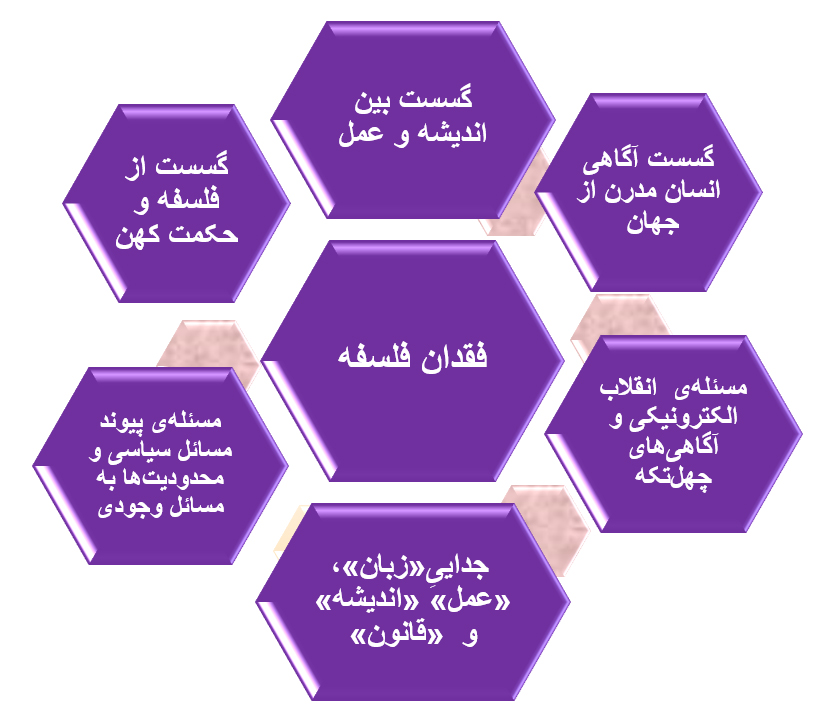
«سه گسست مهم و دو مسئلهی بزرگ»:
همانطور که در تصویر فرضی بالا میبینیم دو گسست عظیم در سطح تاریخ شکل زندگی ایرانی داریم، اول گسستی که در جهتی دورتر، به دست اتفاقات، حکومتها و پادشاهیها، اتفاق افتاده و به مسیر راندنِ حکمت کهن از جریان زندگی روزمره مردم رفته تا «گسست از حکمت و فلسفه کهن» اتفاق بیفتد و دوم در جهتی نزدیکتر گسستی است که از آغاز فرمانروایی صفویان تا پایان عصر عباسی در عمل، اتفاق افتاده و کمکم به زوال اندیشه رسیده و به «گسیختگی» نظام اجتماعی، اقتصادی و سیاسی منجر شده و ما از آن موقع تا امروز در همه زمینهها، با «گسست بین اندیشه و عمل» مواجهایم ( طباطبایی، 1389، ص: 17-12) و این وضعیت از همان موقع، همواره در پیوند دائم و درونی با «شکل زندگی»ِ روزمره، «زبان» و «طرز فکر» ِانسانِ ایرانی بوده است.
اما گسست مهم سوم در سطح جهانی ، جدا شدن آگاهی «انسان معاصر» از «زندگی و جهان» در اثر حادثه تاریخی مدرنیته است. به باور برخی متفکران، مدرنیته با فاجعهای نظیر هبوط، بحران روحی و سیاسی عظیمی را در «شکل زندگی»ِ انسانِ معاصر در «جهان»، رقم زده است. Rothman, 2000, p: 64)) تا جایی که ویتگنشتاین وظیفهی شایسته و مناسب فلسفه در دنیای امروز را این میداند که ما را مجبور کند دیدگاههای نادرست قبلی را که در اثر حادثه مدرنیته برایمان به وجود آمده، کنار بگذاریم و با یک شروع نو و جهتگیری دوباره، زاویهدید جدیدی را کشف کنیم و متوجه شویم چرا در دوران مسخ مدرنیته، به خاطر جهتگیری نامناسب، اسیر پنداشتههای نادرستی بودیم که نقطهی آغاز نگرش به جهان قرار داده بودیم و همین، ما را از موقعیت حقیقیای که در جهان و درون «شکلزندگی»مان داریم جدا کرده بود. از نظر او این نقطهی آغاز نگرش تا اندازهای دچار روش نادرست شده که نه تنها قابل اصلاح نیست بلکه تا آن را کامل کنار نگذاریم نمیتوانیم دوباره آگاهیمان را به جهان پیوند بزنیم.
مسئلهی اول بزرگ ما هم مربوط به شرایط «داخلی» است، «ناکارآمدی عمیقِ دولت» در ایران خصوصا در دهههای اخیر باعث شده، مسائل اجتماعی، فرهنگی، انواع تنشهای سیاسی داخلی و خارجی، روزانه از راه برسند و با ساحت وجودیِ «انسان ایرانی» عجین شوند و به انبوه مشکلاتِ خصوصیِ عاطفی و معیشتی روزمرهی او گرهِ کور بخورند و آن را دچار ناامنی شدید کنند و درنتیجه، هر کدام از ما، مجبور باشیم مدام جای دولت، فکر کنیم و دنبال چارهجویی برای زندگی و ارائهی راه حل برای ادارهی کشور باشیم.
و مسئلهی بزرگِ دوم در سطح «جهانی» مربوط به «بودن» و «زندگی» در عصرِ ارتباطات است. امروزه آگاهیهای ورودی ذهن ما محدود به درون مرزهای خودمان نیست بلکه همزمان به تعبیر داریوش شایگان در جهانی چهلتکه و شهرفرنگوار از انواع ِآگاهیهایِ ناشی از انقلاب الکترونیکی گرفتاریم. فضای سیالی که ما را به عنوان انسان معاصر «افسونزده و چندهویتی» کرده، (1393، ص16- 8) تا مدام دچار انفجار اطلاعات مختلف و متنوعی باشیم که در هر ثانیه، به ذهنمان، ورود پیدا میکنند. هرچند این آگاهیها هر کدام در جای خود جالب و جذاباند اما ما نمیتوانیم این دریافتها را به هم پیوند دهیم و آنها را در جریان زندگی به کار ببریم و به انسانِ بهتری تبدیل بشویم، بنابراین بخش اعظم آنها از شکل زندگیِ ماجدا افتادهاند.[11] و به جای سازندهبودن، عامل ابهام و سرگشتگی بیشترمان میشوند.
در فقدان فلسفه، این گسستها و مسائل بزرگ، دست به دست هم دادهاند تا شرایطی فراهم کنند که «زبان» ِما از جریان و «شکلزندگی»مان جدا شده و استعدادِ لفاظی و افسونگریاش، فعال شود و روز به روز گسل بین «اندیشه» و «عمل» و «رفتار»مان را عمیقتر کند و از این رهگذر، گرههای درهم و سردرگمِ عمیقی در فکرِمان به وجود بیاورد که هم با ساحت «وجودی» و هم با «شناخت و «معرفت»مان در پیوند درونی است و روی نحوهی «عمل اخلاقی» ما تاثیر میگذارد و شخصیتِ «قانون» و پیروی از آن را در جامعهمان، به شدت بحرانی و ضعیف میکند.
بنابراین همه مسئلهی پیچیده روبهروی ما، فقط ناشی از «گذشته» و درگیری با ترمیم جراحتها و برقراری پیوندهای تازه با آن نیست وعلاوه برآن، با دو مسئلهی بزرگ «امروز»ی هم دست به گریبانایم، یکی «هجوم هر روزهی آگاهیهای چهلتکه» و دیگری «سرازیرشدن مشکلات ناشی از ناکارآمدی دولت به مسائل روزمره و عمیق زندگیمان». اگر به این مجموعه، احتمال بلایای طبیعی و بحران بیماریهای واگیردار نظیر کرونا را هم اضافه کنیم، میپذیریم که یک رشتهی دانشگاهی به روشهای رایج، به تنهایی نمیتواند وضعیت درهم ِگرهخوردهی فعلیمان را توصیف و تحلیل فلسفی کند، بلکه همان طورکه گفتیم نیازمندِ «حکمت»ایم.
The path to the source of wisdom’s strength and capability also passes through the depth of philosophical description of the examples and instances of life itself. Regarding “the past,” the most important source that provides us with the course of the formation of the life of thought and reflection of the Iranian person is “literature and art.” There is no doubt that one of the most important paths to achieving a “comprehensive and holistic” view in any culture passes through its literary and artistic works, and fortunately, our “literary works,” in a special way, in terms of weight and richness, as Mohammad Hoquqi put it, represent our greatest cultural manifestation and expression over many centuries. (1998, p. 3) Living philosophical inquiry into this important source is one of the valuable and essential paths that leads to the source of profound and directional knowledge. Sometimes it even becomes possible to see the spirit, psyche, and fundamental character of a nation in a literary work and in a fictional character in the mirror of literature, and this is one of the wonders of literature and the magical power of language. The contemporary writer Hossein Sanapour writes about this:
“Literature is a strange thing, and if we are dealing with a text that can truly be called literature, then by reading it we have certainly become acquainted with important corners of the spirit and psyche of the nation that formed the background of that literature. But literature is sometimes even more astonishing than this… I think the more astonishing point is that in a literary text, and with just one character, the fundamental characteristic of a nation can be shown, in such a way that this single character becomes a symbol of that nation; at least as it was in the author’s view. This will certainly be a controversial point, but it is also certainly worth saying and thinking about… I think nothing is more astonishing than being able to embody a nation and its future not just in a book, but in a single character, and to show the entire past, present, and future of that nation through them.”[12]
Therefore, there is no doubt that for “referring to the past” and recovering ourselves in the mirror of the history of the last approximately 120 years of the Iranian “form of life,” as a wisdom-laden entry ritual into the new century in the year 1400, our most important source, and perhaps all that we have, would be those literary heritages that have emerged from the heart of the “form of life” of history and the events that have passed upon them, and which depict and show the spirit of the age and the fundamental character of the “Iranian person” of that period.
Some works of our “literature,” from the distant past to today, have borne the tensions arising from our major ruptures and great problems, and in the absence of philosophy, by enduring the suffering of a broken “form of life,” have succeeded in carrying the general psychological burden of Iranian humanity on their shoulders and narrating it through the voice of a single individual, while many other works have not succeeded and have gone astray. In general, the “language” of literature, in the absence of “philosophy,” due to the very nature mentioned, has manifested two contradictory aspects and potentials: one is “rhetoric,” which I interpret as “the literature of despotism”[13], and the other is “philosophical reflection and foresight,” which can be called literature as philosophy or philosophy as literature[14]; this aspect of language is that magical power of writing and recording the experience of life in a unified philosophical narrative, which leads to the delineation of a wisdom-laden overview and the reflection of the spirit of the age and humanity, and even the prediction of a nation’s future, for which, in contrast to the term “literature of despotism,” I have used the term “simya-gari” (alchemy)[15]. In this respect, over the past two centuries, both the satirical and playful aspects of our Persian language have emerged, as well as its modernized narrative aspects.
The history of Persian literature itself clearly demonstrates what a special capacity its “language” has for opening up new worlds and how, through alchemy, it has realized a transformed world and led us onto new paths to discover who we are. Persian literature remains our only rich heritage that, by shattering boundaries and depicting the lost dimensions of the world, opens the gate to a pristine and wild world before us. All those fervent and burning philosophical thoughts that have transformed our past world have moved along the grooves carved by the Persian language. A language that, when it clothes itself in the body of a literary work and art, can transcend all borders, fit into no mold, and we can delve deep into its earth to the very roots and reach the human being whose product we are today. This philosophical task has always rested on the shoulders of writers who have felt the responsibility of narrating it and have striven to rewrite the form of life, with a language made aware and an insight gained by relying on their experience within it, so that its emendation and correction become possible; with the hope that, through the magic of the pen, they can consciously shape a good future for it from within this change and transformation.
Here it is necessary to emphasize again two different conceptions of the concept of “philosophy”; one is the common academic conception, the other a completely novel meaning intended by Wittgenstein, which is not only not an academic science but a specific activity and a kind of modern wisdom that calls into question the foundations of common philosophical “systems” by precisely describing the history of their formation and their mode of coming into existence. Wittgenstein does this valuable work to show how these philosophies, in the course of investigating the human being, have gone outside language-games and astray, and are trapped like a fly in a bottle.[16] He says I want to show these philosophies the way out of the bottle so that, becoming aware of what they have been taken captive by, they may be freed and return to the stream of life.
And this important emphasis is also necessary: literature is by no means a tool for expressing philosophy; rather, literary works are themselves a form of philosophical thinking that, especially in the last century, have reflected the mode of being of the Iranian human within a “language” severed from its “form of life,” and this is a very valuable path through which we can approach our difficult ontological problems. And our goal in rereading them is the rediscovery of the past history of the “form of life” of the Iranian human and the recovery of ourselves through philosophizing — not, as Dariush Ashouri says, to gather relics by the scientific method or the method of the Orientalist and archaeological school, but with all our strength we must seek within their texts to evaluate, rethink, and employ their living and flourishing resources in language and thought (1392, p. 9) and be able to set the lost wisdom and philosophy flowing alongside today’s “form of life.”
However, although this philosophizing through describing the history of the “form of life” of the Iranian human’s language and thought in literature, as well as examples in artistic works, will grant us rich knowledge, it will only provide the necessary condition for attaining philosophical insight and living consciously. In other words, “continuous philosophizing” and “literature” are two complementary sides sitting together for attaining “modern wisdom”[17] that are obtained through research on the history of the form of life of the past language and thought of a nation and culture. But to secure the sufficient condition and complete it, we need an understanding of the stream of life and “philosophizing or philosophical activity in practice and experience” in the “present time” to come and complete and enliven this “triangle.” But where should we seek and experience this essential third side that has the power to complete the triangle of our “modern wisdom”?
“Tourism as the Third Side of Modern Wisdom”
Although the term “tourism” refers to a nascent, modern industry and is generally understood to mean “sightseeing, recreation, hotel reservations, airline tickets,” and the commerce of other travel services, my intention in using this term relates to an important, limited, and more specific branch of this industry that deals in the commerce of “experience” and purposefully valorizes “experience-oriented travel,” puts a price tag on it, and sends it to market. This important branch encompasses a spectrum of special journeys, from the active experience of others’ “form of life,” literary tourism, religious tourism, responsible and culture-oriented travel, to diverse activities centered on breaking habits and striving for life change. In my view, it can therefore be considered a positive and thought-provoking development in the contemporary world, because it consciously makes the “human experience of existence” a purchasable commodity as a practical activity for philosophizing, and in this regard, it can be seen as a source of significant transformation in the modern world.
Through this lens, the relationship between the two concepts of “philosophy” and “tourism” can be seen as a novel and original subject that can be considered a way for thought and for “contemporary human beings” to understand their own way of “being” in the present time. A way that provides the necessary ground for an activity based on breaking habits, liberation from anxiety, and untangling other problems of modern human life, especially through the active understanding of another’s “form of life.” For this very reason, it can be a very important and essential complement for gaining an insightful overview in practice. It recalls distant pasts when our ancient ancestors were willing to exchange their jar full of gold coins for a travel map and a path undertaken with the intention of obtaining the world-revealing cup and immortality. The confirmation of the key role of the archetype of the “journey” in our ancient Magian wisdom needs no proof or evidence. It suffices to say that its clear and powerful reflection has echoed through all time periods, in the winding corridors of the history of Iranian “language,” “thought,” and “literature,” and has penetrated to the depths of the psyche, thought, and speech of today’s writers and poets. For us, “travel,” apart from its feelings of liberation and joy, is still considered an ancient and valuable rite and custom, and in the contemporary world, it has entered the cycle of global commerce in an accessible and tangible form, and in this modernized form, it can tell us, in practice and experience, about our way of being in the world today.
It is from this perspective that one can say the phenomenon of experience-oriented tourism has, in the present era, opened a new chapter in the philosophical understanding of contemporary human beings and has made a novel and pristine resource available to the public for modern philosophizing. The subject of tourism is the “human being,” a human being who, by virtue of the possibilities of today’s world, is no longer compelled to have the text of a book resulting from the experience of a philosopher, thinker, a specific person, or another globetrotter as their only source for understanding themselves and their world, and can independently obtain the deep secrets of life in practice, through the generalized and pervasive experiences during travel, without relying on the sights and sounds of another. Now they themselves can delve into the depths of new experiences, live with another to understand their “form of life” in active participation, expand their world, and thereby arrive at an important and essential mode of thought that opens the eye of their insight to the understanding of “differences.”
“Forms of life” and “language games” are in complete harmony with human history and the world, and precisely because they also arise from the singular truth of the “form of life” and “language” of humankind, they are indeed very similar to one another, yet each is distinguished from the other by a “special difference.” It is very essential that we learn these differences so that we can take the first step toward accepting the unpleasant “self” that we are and gradually move beyond it. Understanding these distinctions is so important to Wittgenstein that he wanted to use the sentence “I’ll teach you differences” from King Lear as the motto for the beginning of his book. For this same important reason, Wittgenstein cannot get along with Hegel, because, as Dr. Malek Hosseini recounts, Hegel always wants to say that “things that appear different are in fact the same”; whereas Wittgenstein’s entire concern is to show that “things that appear the same are in fact different.” (PI, p. 112)
The value of understanding differences in the modern world must also acquire immense importance for the “Iranian human,” because almost all of us have this intense, Hegelian, and misleading tendency toward homogenization, which at the very first step prevents us from seeing and understanding correctly; we constantly want to generalize and reduce all differences to a single theory and intellectual system with a singular, unique meaning of truth! Wittgenstein writes: “Among humans who all had the same facial features, we could not find ourselves.” (Ibid., p. 230) He shows why we must accept that “forms of life,” and even a single “form of life,” cannot be explained by a single intellectual system. The factors that, in the course of our intellectual history, have caused us to have this intense tendency to unify all differences and say they are essentially similar, and to constantly seek the single “cognitive system” that is the best and most correct, have left behind destructive “beliefs” that have become our best ways of escaping from ourselves and our fears. Therefore, with a temporary and provisional understanding of all that has been said, we can see to some extent why the tangled mass of problems arising from the “formlessness” of a broken and problem-ridden “life” requires constant collective and personal philosophical inquiry.
But the important final point is this: such an inquiry, because of its accompaniment with the acceleration of the everyday flow, must be a “philosophical business” and, as Wittgenstein says, akin to “mercantile” behavior. Ray Monk[18] writes: philosophy for Wittgenstein was an activity and work for solving philosophical problems, not a theoretical subject or an academic profession, and he said that just as his father’s profession was commerce, he too, like a merchant who, in a crisis, seeks an effective way to save his business, seeks activity and the discovery of a quick, practical, and effective way to confront the daily problems of the profession of philosophy and to solve them. (Monk, 2005, p:14)[19]
Every single one of us needs this philosophical inquiry; we have all lost dreams and have aspirations whose path to realization is more complex than what can be made possible by alien thoughts or those borrowed from others. Only each person themselves can understand their own fascination with their goal and realize it through philosophizing, but they usually lose which way to go, and sometimes at a bend in the road, they leave themselves behind and forget that they are, heedlessly and unwittingly, moving further and further away from the path that led to their hopes. Understanding life’s and existential problems requires undergoing specific experiences; the understanding and grasping of these problems in practice, and their realization in everyday life, usually falls along a trajectory full of ups and downs, so as to transform the history of a person’s personal life within the collective form of life and their world, and to fundamentally change their perspective time and again.
Wittgenstein considers the cure for the rebellions of language and the chronic intellectual fever and the foggy paths we have fallen into to be a kind of philosophizing that, as we have seen, is completely different from what the name philosophy brings to mind. This philosophy is not only not a science or a mere academic discipline, but a specific activity imbued with a kind of modern wisdom that single-handedly uproots the entrenched foundations of the philosophies that became conventional after modernity, numerous philosophies and “isms” with a long historical pedigree, which not only have not reached an agreement among themselves in understanding the world, but have also been unable to reach a conclusion on their own, and instead, a great part of their energy has perhaps been spent on flourishing the deceptive talent of language. Wittgenstein says: “Only if you think much more madly than the philosophers can you solve their problems.” (PI, p. 147) And by this being more mad, he means clearing the ground of language and uprooting all the conceptions that these philosophers have built for us with the promise of truth. Whereas, if each person understands themselves in connection with their “language,” they can discover the nature of their relationship with the history and nature of the living stream of everyday life, in a specific way suited to their “form of life,” and by flourishing the courage and bravery hidden and complex in the layers of their psyche, prepare for an adventure in the habit of life, so that with the constant change of its astonishing perspectives, facing the pristine and wild attractions of the world, they may understand the wisdom of existence and know themselves within it.
.
.
References:
Ashouri, Dariush. (2013). We and Modernity. Tehran: Serat Cultural Institute
Hosseini, Malek. (2010). Wittgenstein and Wisdom. Tehran: Hermes: WH
Shayegan, Dariush. (2014). New Enchantment. Translated by Fatemeh Valiani. Tehran: Farzan Rooz
Tabatabai, Seyyed Javad. (2010). A Prolegomena to the Theory of Iran's Decline. Tehran: Negah-e Moaser Publishing
Hoghoughi, Mohammad. (1998). A Review of the History of Contemporary Persian Literature and Letters. Tehran: Qatreh Publishing
Wittgenstein, Ludwig. (2014). Philosophical Investigations. Translated by Fereydoun Fatemi. Tehran: Markaz: P.
Wittgenstein, Ludwig. (2016). Culture and Value. Translated by Omid Mehrgan. Tehran: Gam-e No: F.A.
Cavell, Stanley. (1979). The Claim of Reason: Wittgenstein, Skepticism, Morality, and Tragedy. Oxford University Press: Cow
Rothman, William. ( 2000). Reading Cavell's The world viewed. Publisher: Wayne State University Press
Monk, Ray. (2005). How to Read Wittgenstein. Granta Books
.
.
[1] PhD in Philosophy from Allameh Tabataba'i University
[2] Inspired by the article by Danièle Moyal-Sharrock:
Sharrock, Danièle, Moyal. (2015). Wittgenstein on Forms of Life, Patterns of Life, and ways of Living. Nordic Wittgenstein Review Special Issue
[3] See: WH, pp. 12-15
[4] The term "modern wisdom" is inspired by: (WH, p. 37)
[5] Stanley Cavell, with this same Wittgensteinian approach, finds numerous examples in literature and film to show how these works, not as a tool for expressing philosophy, but as the very mode of modern human's philosophical being, reflect within a "language" detached from its "form of life." According to Cavell, with the possibilities arising from the contemporary way of life, one can sit outside the images of films and, in a detailed and objective manner, approach difficult human ontological problems. In his view, film and literature can create a concrete example for describing the reality of humans' mode of existence within their specific contemporary "form of life" and make understanding the complex linguistic and living conditions of modern humans possible.
[6] See: WH, pp. 88-89
[7] According to the American humanistic psychologist Maslow, the hierarchy of human psychological needs is, in order: "physiological" needs, "safety" needs, "love and belonging" needs, "social and esteem" needs, and the need for "self-actualization and transcendence." Without passing through and overcoming the lower needs, one cannot fully enter the next stage and achieve spiritual maturity.
[8] “Life is like a path on a mountain ridge; to the right and left are slippery slopes on which you inevitably slide down in one direction or the other, I constantly see individuals sliding this way and say, ‘What can an individual do here!’ and this means: ‘the denial of free will’” (W, p. 229)
[9] See W: pp. 65-69 and p. 88
[10] See W: pp. 150-151
[11] See: (W, 12-14)
[12] Read Hossein Sanapour’s full note: “A Character, A Nation” from here.
[13] I have taken this expression from one of the chapter titles of the book “The Travel Diary of Ebrahim Beg”: Haj Zeyn al-Abedin Maraghei. (Spring 2537). Sepideh Publishing. p. 284
[14] Inspired by: Dr. Karim Mojtahedi. (1389). Tehran: Kavir Publications. pp. 53-80
[15] Simiya means “the magical science of the word.” In the past, simiya was considered one of the five abilities of the secret wisdom of the occult sciences, and the simiyagar pursued the same alchemist’s dream of turning copper into gold, but through the rhetorical combination of linguistic words and eloquence. In fact, the simiyagar had access to the knowledge of the secrets of letters, was aware of the power of words, and could, by juxtaposing letters to form magical names and words, take hold of others’ imaginations, and also imagine thoughts and ideas with the aim of creating a reality externally and in the future. Suhrawardi, the founder of the Philosophy of Illumination and reviver of Khosravani wisdom, is among the famous thinkers known to be knowledgeable in the science of simiya, and one of the reasons for his execution was precisely that he was accused of simiya and the magic of words. But if one of our most famous philosophers and sages lost his life in the sixth century because of his knowledge of the secrets of language, now in the contemporary period, the magical power of “language” is a pillar of the most important and famous philosophical schools and movements, and indeed, it is considered a mysterious and magical ability and power of humans because it shapes their way of thinking, their mode of being, and their human existence. It is with “language” that we are able to disseminate our thoughts and ideas across a vast expanse of space, time, and in the minds of others, to depict the character of a nation, and to see the future.
[16] See: (P: section 309)
[17] “Cold, gray, and modern wisdom” taken from W: pp. 54-55
[18] Ray Monk (1957)
[19] And also see: (W, pp. 129, 130)
.
.



Discussion0 comments
No comments yet; let yours be the first voice.