Philosophy
“On Confusing Motive and the Motivated” by Abolghasem Fanaei
Can we consider a claimant's motives when critiquing their claim? Some see this as always fallacious, others never; a third view holds it is fallacious in the context of inquiry but not in that of imitation. Abolqasem Fanaei defends this third position.
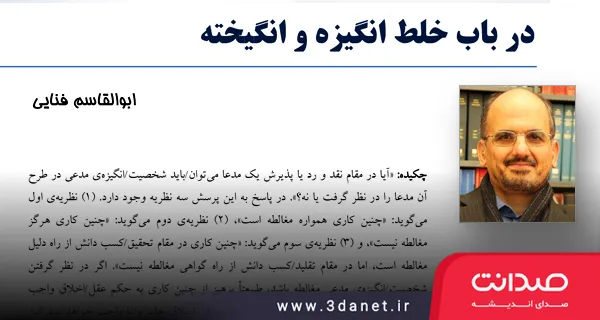
Abstract: “When criticizing and rejecting or accepting a claim, can/should one take into account the personality/motive of the claimant in putting forward that claim, or not?” There are three theories in response to this question. (1) The first theory says: “Such a thing is always a fallacy,” (2) the second theory says: “Such a thing is never a fallacy,” and (3) the third theory says: “Such a thing is a fallacy in the context of inquiry/acquiring knowledge through reason, but it is not a fallacy in the context of imitation/acquiring knowledge through testimony.” If taking the claimant’s personality/motive into account is a fallacy, then naturally avoiding such a thing will be obligatory according to the dictates of reason/ethics. But if this is not a fallacy, it will be permissible and/or obligatory according to the dictates of reason/ethics. This article, penned by Dr. Abolghasem Fanaei, critiques the first two theories and defends the third.
Opening Discussion
Some time ago, a debate arose between two erudite and learned bloggers regarding whether “when criticizing and evaluating a claim, does the critic have the right to also consider the claimant’s motive, or not?” Some other bloggers with philosophical, psychological, and hermeneutic interests also endeavored, in their own way, to shed light on the dark and hidden corners of this debate, which indicates an understanding of its importance. This key question has fateful consequences in the realms of theory and practice, making addressing it and arriving at a clear, reasonable, and well-defined answer a duty for all thinkers and researchers in the humanities, social sciences, and natural sciences, as well as for scholars of religion.
In response to this question, the author Imaiyan believes that such a thing is absolutely a fallacy, because an individual’s motive is an internal matter and therefore impossible for others to know, unless the possessor of the motive expresses it himself. Hamed Ghoddusi, however, believes that such a thing is not problematic in itself and that under certain conditions we have no choice but to do it. One of the cases Ghoddusi mentions to support his claim is when we are faced with the statements of two experts and, for some reason, cannot investigate the truth or falsity of their statements, and when we review the reasons of each side, we feel that both are telling the truth and are in the right. I think the notes by Imaiyan and Ghoddusi on this subject are themselves a clear instance of Ghoddusi’s claim, because when the reader reviews the reasons of both sides, they feel as if both are telling the truth. Nevertheless, it is clear that logically it is impossible for both of these claims to be true; rather, one of them is false. Thus, we are faced with a paradox here. The question is whether there is a solution to this paradox.
In the author’s view, the answer to this question is positive. We know that logicians and philosophers have mentioned eight or nine conditions for a contradiction to occur, the first of which is “unity of subject.” If A says: “Hasan is tall” and B says: “Hasan is not tall,” these two claims contradict each other, and inevitably one of them is false. But if A says: “Hasan is tall” and B says: “Hossein is not tall,” both of these claims can be true, because, although one of these two claims/propositions is negative and the other is affirmative, one is about Hasan and the other is about Hossein. Therefore, these two claims/propositions do not contradict each other, simply because their subject is not the same.
In this note, I will try to show that Imaiyan and Ghoddusi, in their written exchanges, are in fact speaking about two different subjects, not about one subject, and therefore the statements of both of them can, in principle, be true, although both apparently think they are conversing with each other about a single subject. Of course, this objection seems to apply more to Imaiyan than to Ghoddusi, because Ghoddusi’s claim is smaller than Imaiyan’s. Imaiyan’s claim is formulated in the form of a proposition with a “universal” quantifier, while Ghoddusi’s claim is expressed in the form of a proposition with a “particular” quantifier. Whether the claim of which of these two is “negative” and the claim of which is “affirmative” has no effect on the outcome of the discussion. One can say that Imaiyan is trying to prove a universal claim, and Ghoddusi is trying to negate its universality. And one can also say that Imaiyan is trying to negate a claim universally, while Ghoddusi is trying to prove it particularly.





Discussion0 comments
No comments yet; let yours be the first voice.