Philosophy
Once More on Allameh Tabatabai's Proof of the Veracious, Dr. Mahmoud Morvarid
In response to recent critiques, Mahmoud Morvarid emphasizes that Allameh Tabatabai's Burhan al-Siddiqin cannot reach its conclusion without the theory of the personal unity of existence and a maximalist correspondence theory of truth. He also finds the critic's formulation of the argument to be flawed.
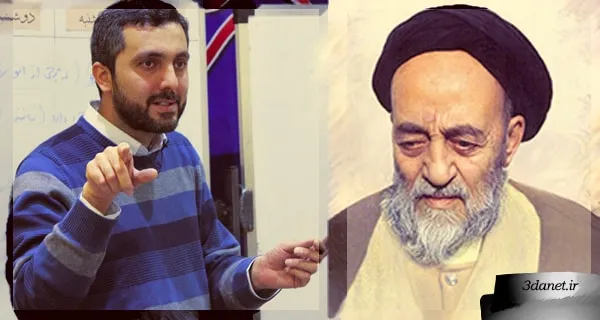
Mahmoud Morvarid
AuthorMahmoud Morvarid:
Abstract:
It is sometimes said that the proof Allameh Tabatabai put forward in his gloss on the Asfar for demonstrating the existence of God is not based on any philosophical principle or issue. In this paper, we show that this statement is incorrect and that Allameh's proof cannot reach its desired conclusion without drawing upon two philosophical theories, namely the maximalist theory of correspondence with the world of existence and the generalized theory of the personal unity of existence. The present paper elaborates on some of the points raised in my previous article, Before entering the main discussion, it is fitting to offer a preliminary account of the notions of scope[2], necessity de re[3], and necessity de dicto[4]. This preamble has a significant bearing on the arguments to come. Unfortunately, because the formalization of language has not been taken very seriously in our logical-philosophical tradition, errors and confusions sometimes creep into philosophical arguments, the recognition of which is only possible with the aid of logical tools and a careful scrutiny of the premises and steps of the argument. One source of such confusions is the failure to specify the scope of logical operators[5]. But what is meant by the scope of a logical operator? In the language of logic, there are various operators, such as the universal and existential quantifiers, negation, conjunction, disjunction, the operators of necessity and possibility, and so on. Roughly speaking, the scope of an operator is that part of the sentence upon which the operator acts. For example, in the sentence "It is raining and it is not the case that the ground is wet", the scope of the negation operator is the sentence "the ground is wet", and in the sentence "It is not the case that it is raining and the ground is wet", the negation acts upon the entire conjunctive sentence "it is raining and the ground is wet", and therefore its scope is this entire sentence. If we wish to employ two or more operators in a sentence, which operator falls within the scope of another has a fundamental effect in determining the content of the sentence, and leads to the emergence of different sentences (with possibly different truth conditions). The following examples illustrate this point well. It is worth noting that each of these examples corresponds to propositions we will encounter in the subsequent discussion. To begin, consider the following two sentences: Everyone loves someone (for every x, there is at least one y such that x loves y). There is someone whom everyone loves (there is at least one y such that for every x, x loves y). The difference between sentences (1) and (2) is that in sentence (1), the existential quantifier falls within the scope of the universal quantifier; whereas in sentence (2), conversely, the universal quantifier falls within the scope of the existential quantifier. In technical terms, it is said that in sentence (1), the universal quantifier has wide scope[6] and the existential quantifier has narrow scope[7], and conversely, in sentence (2) the existential quantifier has wide scope and the universal quantifier has narrow scope. This difference yields a completely different meaning for the two sentences. The import of sentence (1) is that everyone has one or more beloveds, but sentence (2) means that there is a person or persons who are beloved by all. It is evident that (2) is stronger than (1), in the sense that (2) logically entails (1), but is not entailed by it[8]. That everyone should have a single beloved entails that everyone has a beloved, but the converse entailment does not hold. More interesting examples of scope interaction are cases where a quantifier (universal or existential) and a modal operator (necessity or possibility) are employed in a sentence. For instance, suppose room A is a particular room, and time t is a specific moment. Now consider the following two sentences: Every human being possibly is in room A at time t (for every human being, such as x, it is possible that x is in room A at time t). It is possible that every human being is in room A at time t (it is possible that for every human being, such as x, x is in room A at time t). In sentence (3), the possibility operator has narrow scope and the universal quantifier has wide scope, and conversely in sentence (4) the possibility operator has wide scope and the universal quantifier has narrow scope. What is the truth value of these two sentences? Sentence (3) is true; because for each and every human being, it is possible that they are in room A at time t, but sentence (4) is false under normal circumstances; for room A (if it is an ordinary room) does not have the capacity to contain all human beings at one time. It is worth noting that (4) is stronger than (3). If it is possible that all human beings are in room A at time t, then it is also possible for each and every one of them to be in room A at time t. The next example concerns the order between the existential quantifier and the necessity operator, and closely resembles the main discussion of this paper. Suppose that a is a particular material object (for instance, a piece of wax). In this case, the sentence “a has a shape” is true. Now, if we wish to add the necessity operator to this sentence, we can do so in two completely different ways: Necessarily, a has a shape (Necessarily, there is a shape that a has). a has a shape necessarily (There is a shape that a necessarily has). Here too, the difference between the two sentences comes down to the difference in order between the quantifier and the necessity operator. In (5), the existential quantifier falls within the scope of the necessity operator, whereas in (6), the necessity operator falls within the scope of the quantifier. The parenthetical equivalents show this difference more clearly. Sentence (5) is true; for material objects cannot be without shape. But whatever shape a has—whether it is a cube, a sphere, a pyramid, etc.—that shape is not necessary for a, since a could have had a shape other than that one. Therefore, sentence (6) is false. Here too, (6) entails (5), but (5) does not entail (6). One might explain the truth of (5) and the falsity of (6) as follows: none of the particular shapes is necessary for a, and for this reason (6) is false. But the very fact of having a shape (or, in another expression, having one shape or another) is necessary for a, and hence (5) is true. On this basis, the difference in content between (5) and (6) goes back to the difference between the object of necessity in these two sentences. In sentence (5), the object of necessity is the very fact of having a shape, whereas in (6), necessity attaches to having a particular shape. This explanation is not incorrect, but it does not reveal the logical structure of the two sentences (5) and (6), and therefore does not state the fundamental root of the difference between them. The fundamental root of the difference can only be properly grasped after the logical structure of (5) and (6) is revealed. In both sentences, both the necessity operator and the existential quantifier are used, so where does the difference lie? The answer is that in one, the quantifier falls within the scope of necessity, and in the other, necessity falls within the scope of the quantifier, and this is the principal basis of the difference between the two sentences. According to the common terminology among analytic philosophers, if in a sentence the scope of the necessity operator is wide (as in sentence (5)), that necessity is called “de dicto necessity,” but if the scope of necessity is narrow (as in sentence (6)), the necessity employed is called “de re necessity.” This nomenclature may not be entirely precise, but its rationale is fairly clear: in sentence (5), the scope of necessity is the entire sentence “a has a shape,” and in a manner of speaking, necessity applies to this whole sentence; hence it can be called “de dicto necessity.” But (6) expresses the necessity of a particular shape for the object a. In this respect, the necessity employed in (6) is called “de re necessity.”[9] It is worth noting that the two terms “de dicto necessity” and “de re necessity” should not lead us to suppose that de dicto necessity is merely a linguistic matter and has no connection to the real world. De dicto necessity and de re necessity are not two different types of necessity. Both have the same semantics, and according to a realist view of modality, both pertain to extra-linguistic realities. As was said, their difference comes down solely to the order of their application in the sentence.[10] As we saw in the case of the two sentences (5) and (6), sometimes the necessity operator can be added to a sentence in different ways. In some simple affirmative existential propositions (existential sentences), the matter is the same. The following sentence is clearly true: There is a reality. The necessity operator can be added to this sentence in two different ways: Necessarily, there is a reality. There is a reality that necessarily exists (There is a reality that exists necessarily). The relation between (8) and (9) is very similar to the relation between (5) and (6). The necessity operator in (8) has wide scope and in (9) has narrow scope. On this basis, de dicto necessity and de re necessity are employed in these two sentences, respectively.[11] این تفاوت را به صورت سمانتیکی (با استفاده از ابزار جهان ممکن) نیز می توان نشان داد. شرط لازم و کافی برای صدق (8) این است که در هر جهان ممکنی چیزی وجود داشته باشد، هرچند با چیزهایی که دیگر در جهان های ممکن وجود دارند، یکسان نباشد. اما (9) تنها در صورتی صادق است که شیئ یا اشیای یکسانی در همه جهان های ممکن وجود داشته باشند. بنابراین (8) و (9) به ترتیب معادل با جملات (10) و (11) هستند: در هر جهان ممکن واقعیتی وجود دارد. (به ازای هر جهان ممکن W، x ای در W وجود دارد). واقعیتی هست که در هر جهان ممکن وجود دارد (x ای هست که به ازای هر جهان ممکن W، x در W وجود دارد). بر این اساس، اگر فرض کنیم در هر جهان ممکنی چیزهایی تحقق داشته باشد، ولی هیچ شیئ یکسانی در همه جهانهای ممکن تکرار نشود، جملههای (8) و (10) صادق، و دو جمله (9) و (11) کاذب خواهند بود. از همین جا آشکار می شود که (9) و (11) از (8) و (10) قوی تر هستند. گفتنی است نسبت میان (10) و (11)، مشابه نسبت میان (1) و (2) است. در (10)، همانند (1)، سور جزئی در دامنه سور كلی قرار گرفته است؛ ولی در (11)، بسان (2)، سور کلی در دامنه سور جزئی است. تا این جا دیدیم که عملگر ضرورت را می توان به دو گونه متفاوت به جمله (7) «واقعیتی وجود دارد» افزود و جملاتی با شرایط صدق متفاوت به دست آورد. در دیگر هلیات بسیطه مسئله از چه قرار است؟ اگر در موضوع یک هلیه بسیطه، واژهای عام به کار رفته باشد، مانند «انسانی وجود دارد»، باز هم به دو شیوه می توان عملگر ضرورت را به جمله اضافه کرد: «ضرورتاً انسانی وجود دارد» و «انسانی هست که ضرورتاً وجود دارد».[12]این دو جمله آشکارا ارزش صدق متفاوتی دارند. اما چنانچه موضوع جمله یک اسم خاص باشد، مانند «زید وجود دارد»، عملگر ضرورت تنها به یک شیوه می تواند در جمله عمل کند. به عبارت دقیق تر، دو جملۀ «ضرورتاً زید وجود دارد» و «زید ضرورتاً وجود دارد» شرایط صدق یکسانی دارند. هر دو جمله در صورتی صادق هستند که زید در همه جهان های ممکن وجود داشته باشد. ریشه این مطلب آن است که واژۀ «زید» اصطلاحاً یک دال ثابت است، یعنی در همه جهان های ممکنی که مدلول این واژه وجود دارد، این واژه بر شیئ یکسانی دلالت می کند[13]. نتیجه سخن این که اگر در یک هلیه بسیطه عملگر ضرورت به کار رفته باشد، نخست باید بررسی کرد که آیا موضوع جمله یک اسم خاص یا یک واژۀ عام. در صورتی که اسم خاص باشد، موقعیت عملگر ضرورت در جمله، تاثیری در شرایط صدق آن ندارد. ولی اگر موضوع اسم عام باشد (مانند «واقعیتی وجود دارد» و «انسانی وجود دارد») باید به دقت معین شود که آیا عملگر ضرورت با دامنه موسع به کار رفته است یا با دامنه مضیق. در پایان این بخش لازم است به نکته مهم دیگری اشاره کنیم. چنان که گذشت، می توان گفت جمله (5) «ضرورتاً الف شکلی دارد» بیان گر ضرورت اصل شکل داشتن برای الف است، و جمله (6) «الف شکلی را ضرورتاً دارد» ضرورت یکی از شکل های خاص را برای الف بیان می دارد. به همین قیاس، می توان گفت محتوای جمله (8) «ضرورتاً واقعیتی وجود دارد»، ضرورت وجود اصل واقعیت است، حال آن که با جمله (9) «واقعیتی ضرورتاً وجود دارد»، ضرورت وجود یک واقعیت خاص ابراز می شود. بر این اساس، جملۀ (8) معادل است با: ’(8) وجود اصل واقعیت ضروری است (ضرورتاً اصل واقعیت وجود دارد). اما باید توجه داشت که ’(8) ظاهری گمراه کننده دارد. شاید گمان شود ترکیب «اصل واقعیت» (یا «اصل الواقعیه» در زبان عربی) در این جمله همانند یک اسم خاص عمل می کند و به شیئی معین اشاره دارد، و از این رو ساختار جمله ’(8) همانند جمله «وجود زید ضروری است» (= ضرورتاً زید وجود دارد) می باشد. این گمان نادرست است. ترکیب «اصل واقعیت» در اساس یک عبارت اشاری[14] نیست بر واقعیتی معین دلالت نمی کند. در کنار همۀ واقعیتها، واقعیت دیگری به عنوان اصل واقعیت نداریم، همان گونه که اصل شکل داشتن خود شکلی خاص در کنار دیگر اشکال هندسی نیست، واژه «اصل» در این گونه ترکیبها، جایگزین یای نکره، یا همان سور جزئی است. مثلاً وقتی می گوییم «به وجود اصل تکالیف در شریعت یقین داریم» (یا «به اصل وجود تکالیف در شریعت یقین داریم») منظور این است که یقین داریم تکالیفی در شریعت هست، نه این که یقین داریم تکلیف خاصی در شریعت تحت عنوان اصل تکالیف جعل شده است. آشکار است که نخستین قدم در ارزیابی هر برهانی تقریر دقیق آن است. ناقد محترم تقریر زیر را از برهان صدیقین علامه ارائه داده است که از این پس با عنوان تقریر (1) از آن یاد خواهیم کرد: تقریر (1) (الف) واقعیت (در برابر سفسطه)ذاتاً قبول بطلان و نیستی نمی کند (بدیهی اولی). (ب) هر چیزی که ذاتاً قبول بطلان و نیستی نکند، واجب الوجود بالذات است (بدیهی اولی). (ن) پس واقعیت (در مقابل سفسطه) واجب الوجود بالذات است. در مقالۀ تاملی در برهان صدیقین به تقریر علامه طباطبایی، برهان علامه را به گونه ای دیگر و در طی دو مرحله صورت بندی کردم. اما در اینجا، برای همراهی با ناقد محترم بحث خود را بر تقریر (1) متمرکز می کنم و نشان می دهم این تقریر نیز به مشکلاتی دچار است که برای برطرف کردن آنها باید از نظریه مطابقت حداکثری با عالم وجود و نظریه وحدت شخصی وجود بهره گرفت. در بررسی تقریر (1) نکات متعددی وجود دارد که باید به دقت آنها را از یکدیگر تفکیک کرد. چنان که میبینیم، در هر سه بند این تقریر، واژگان «ذاتاً» یا «بالذات» به کار رفته است. این واژهها تا حدودی ابهام دارند و لازم است به صورت مستقل نقش آنها در استدلال معین شود. از این رو، برای سادهتر شدن مسئله مناسب است که تقریر ناقد را در دو مرحله بررسی کنیم. در مرحلۀ نخست، دو واژه یاد شده را از هر سه بند برهان حذف می کنیم و به تقریر دیگری می رسیم: تقریر (1*) (الف*) واقعیت (در برابر سفسطه) قبول بطلان و نیستی نمی کند (بدیهی اولی). (ب*) هر چیزی که قبول بطلان و نیستی نکند واجب الوجود است (بدیهی اولی). (ن*) پس واقعیت واجب الوجود است. Formulation (1*) is in fact a weakened version of Formulation (1). Each and every premise of this formulation is weaker than those of Formulation (1). The conclusion of Formulation (1*) is also weaker than that of Formulation (1); for the conclusion of Formulation (1) is the existence of a Necessary Existent by essence, whereas the conclusion of Formulation (1*) is the existence of a Necessary Existent in the absolute sense (i.e., encompassing both by-essence and by-another). We know that neither Allameh nor the esteemed critic had Formulation (1*) in mind, because they sought to prove the existence of a Necessary Existent by essence. Nevertheless, one can surmise in advance that if Formulation (1) can prove the existence of a Necessary Existent by essence, Formulation (1*) will likewise be capable of proving the existence of a Necessary Existent in the absolute sense; for the structure of the argument is exactly the same in both, with the difference that all the clauses of the argument in Formulation (1*) have been weakened to the same degree. Accordingly, in order to properly expose the roots of the problems with Formulation (1), it is simpler to first examine Formulation (1*) and reveal its weak points, and then, in a second stage, proceed to examine Formulation (1). As we shall see, Formulation (1) suffers from the same weak points—or ones like them. The benefit of this two-stage examination is that in the first stage, we are no longer confronted with the ambiguities of the terms "essentially" and "by essence." I emphasize that making the issue two-staged is solely for greater clarity and simplicity of discussion; otherwise, one could directly proceed to evaluate Formulation (1) in the very first step. In fact, I present Formulation (1*) only as an auxiliary tool so that, through its precise evaluation, a clearer view of the problems with Formulation (1) may be obtained. Examination of Formulation (1*) To evaluate this formulation, it is first necessary to look more carefully at its premises. Let us first consider (A*): (A*) Reality does not accept nullification and non-existence. The first question that comes to mind is: what is meant by the phrase "does not accept nullification and non-existence" in this premise? "Does not accept" here means "is impossible." Therefore, when it is said "x does not accept non-existence," it means "non-existence is impossible for x," or "the non-existence of x is not possible." This is also synonymous with or entails "x necessarily exists"[15]. Thus, (A*) is synonymous with or equivalent to the following proposition: (A*1) Reality necessarily exists. Henceforth, it is simpler to use (A*1) instead of premise (A*). Given the synonymy or entailment of the two mentioned sentences, this substitution creates no disruption in the subsequent discussions. However, sentence (A*1) itself suffers from ambiguity. This sentence is a simple predicative proposition in which the necessity operator is employed. As we saw in the previous section, to find the logical structure of such a sentence, we must first examine whether the subject of the sentence (i.e., the word "reality") is a proper name or not. It is evident that "reality" can be predicated of different subjects; therefore, it is not a proper name. Of course, (A*1) can also be written as: "The principle of reality necessarily exists"; but as noted earlier, the use of the phrase "the principle of reality" should not give rise to the supposition that the subject of (A*1) is a proper name.[16] Now that the subject of (A*1) is not a general term, the question immediately arises as to whether the necessity operator in (A*1) has a wide or narrow scope? In other words, is the necessity operator in this sentence necessity de re or necessity de dicto? (A*1) is ambiguous in this respect, and its content is one of the following two statements: (A*2) Necessarily, there is a reality. (A*3) There is a reality that necessarily exists.[17] [18] In Formulation (1*), it is not explicitly clear which of the two above sentences is intended as the first premise of the proof. These two sentences are, respectively, the same as sentences (8) and (9) that we presented earlier, and it is evident that (A*3) is stronger than (A*2). Now, with these points in mind, we proceed to state the first problem with Formulation (1*). This problem consists of two claims: First claim: For this exposition to be productive, (A*3) must be taken as the first premise of the proof, not (A*2). Second claim: The argument that Allameh has presented for premise A, if it is complete, proves (A*2) and not (A*3). To prove the first claim, it is necessary to also clarify the second premise of exposition (1*), namely (B*): (B*) Anything that does not admit of nullification and non-existence is a necessary being. This premise can also be expressed in conditional form: (B*1) For any x, if x does not admit of nullification and non-existence, then x is a necessary being. As mentioned, "x does not admit of nullification and non-existence" is synonymous with or equivalent to "x necessarily exists." Therefore, (B*1) can be written as follows: (B*2) For any x, if x necessarily exists, then x is a necessary being. In this sentence, the necessity operator falls within the scope of the universal quantifier; that is, it is the necessity of the thing, not the necessity of the proposition. Now it is evident that from (A*3) and (B*2), with the help of the rule of modus ponens, the desired conclusion can be reached; because both in (A*3) and in the antecedent of (B*2), the necessity of the thing is employed: (A*3) There is a reality that necessarily exists. (B*2) For any x, if x necessarily exists, then x is a necessary being. Conclusion: There is a reality that is a necessary being. But based on no logical rule can this conclusion be derived from (A*2) and (B*2). The first claim can also be explained using the semantics of possible worlds as follows: The proposition (A*2) is true if in every possible world there exists some thing, even if it differs from the things that exist in other possible worlds. Therefore, the truth of (A*2) does not entail the existence of a necessary being; because a necessary being—by definition—is a thing that exists in all possible worlds. Now we turn to proving the second claim, which is that Allameh's argument for (A), if it is complete, proves (A*2) and not (A*3). Of course, what exactly Allameh's argument for (A) is and what structure it has is itself a matter of discussion and debate. But it seems that, while preserving the spirit of Allameh's argument, it can be rewritten in the form of a reductio ad absurdum as follows: Assumption: It is not the case that necessarily there is a reality. (The negation of (A*2)) Thus, there is a possible world, such as W, in which no reality exists. (From (1), according to the semantics of modality). In this case, in W, there really is no reality. Therefore, in W, there is a reality. (From (3), with regard to "really") But there is a contradiction between (2) and (4); therefore, the assumption of the argument cannot be correct, so: Necessarily, there is a reality. The important point in the above argument is the transition from clause (3) to (4). As was discussed in the article "A Reflection on the Proof of the Veracious as Expounded by Allameh Tabatabai" and will also be addressed in the second objection, this transition is not correct unless the maximal correspondence theory of existence is also added to the premises of the argument. However, here we do not wish to impugn the validity of the above argument. For now, we assume that this argument is valid, whether in itself or with the addition of other assumptions. The point we now emphasize (in the first objection) is that the above argument, even if it is complete, only proves (A*2). It can easily be seen that an analogous argument cannot be employed to prove (A*3). Assuming the negation of (A*3), with the help of the techniques used in the above argument (such as inferring the existence of a reality from the qualifier "really"), does not lead to a contradiction. In this way, both claims of the first objection are established. As we saw, the main point in this objection is the distinction between (A*2) and (A*3), that is, the distinction between the necessity of the proposition and the necessity of the thing. Since Allameh Tabatabai and his commentators did not pay attention to this distinction, they also provided no answer to it. However, as was discussed in the previous article, it seems that, considering the foundations of Sadrian philosophy, there is a way to resolve this objection. If the generalized theory of the personal unity of existence is accepted, one can move from (A*2) to (A*3). The explanation is that the generalized theory of the personal unity of existence (the personal unity of existence across possible worlds) states that all beings, in whatever possible world they may be, are manifestations of a single reality. On the other hand, according to (A*2), in every possible world there exists a being. Therefore, it can be concluded that in all possible worlds, that single reality exists, and in this way it is proven that in every possible world, the same reality exists, and this means (A*3). Thus, the gap between the necessity of the proposition and the necessity of the thing is filled, but Allameh's proof will no longer be without philosophical presuppositions. The Esteemed Critic's Response to the First Objection and Its Examination The esteemed critic believes that the aforementioned objection does not fundamentally apply to Allameh's proof, so there is no need for the theory of the personal unity of existence to resolve it. He writes as follows: It seems that this problem arises from a lack of attention to the qualifier "lithātihā" (by its essence) in Allameh's phrase. Allameh's phrase is that "it [reality] does not accept nullification and removal by its essence." That which does not accept non-existence by its essence is a reality that exists in every possible world, and something that exists in every possible world is the Necessary Existent, and for this very reason, the reality that cannot be negated is the essentially Necessary Existent. But contingent beings are negatable due to their contingency. For this very reason, Allameh concludes at the end that contingent reality is not that reality which we prove by negating sophistry.[19] A few lines later, the esteemed critic expresses his response more clearly: The answer to this objection is obtained from the preceding points. Allameh's proof demonstrated that in every possible world, reality must be present. Now, if this reality is contingent, alongside it one can conceive of a world in which that contingent reality is non-existent. In this assumed possible world, which is devoid of contingent realities, Allameh's proof necessitates that there is a reality; therefore, such a reality is certainly the Necessary Existent, because the assumption is that we are considering a possible world empty of contingent beings. And if this assumed world contains the Necessary Existent, then the Necessary Existent is also present in any other assumed world. Therefore, in negating sophistry, Allameh's proof is based on this necessary judgment of reason that sophistry is in no way acceptable and reality necessarily exists, and the nature of this reality cannot be the nature of a contingent existent, because the negation of a contingent existent in itself entails no contradiction or sophistry."[20] As we can see, the esteemed critic's response is expressed in two paragraphs, but it is not clear whether he intended to offer two separate answers to the objection, or whether both paragraphs express a single point. In any case, we will proceed to examine both paragraphs. In the first paragraph, the esteemed critic says that the solution to the objection lies in paying attention to the qualifier "lithātihā," but he does not show at all how introducing this qualifier fills the gap between the necessity of the proposition and the necessity of the thing. We accept from the esteemed critic that the qualifier "lithātihā" in the phrase "it [reality] does not accept nullification and removal by its essence" must be taken seriously. But even in this case, the aforementioned phrase remains ambiguous; because it is not clear whether the scope of the operator essential non-nullifiability (= essential necessity) is wide or narrow. In other words, there are two possibilities regarding the content of this phrase: That a reality exists is essentially non-nullifiable (by essential necessity, a reality exists). There is a reality which that reality is essentially non-nullifiable (there is a reality that exists by essential necessity). To prove the essentially Necessary Existent, we need (B), but Allameh's proof, at most, proves (A). Now, how can we get from (A) to (B)? Therefore, introducing the qualification "essentially" does not help resolve the difficulty and is fundamentally unrelated to it. We will speak more about the role of this qualification in Allameh's proof when examining exposition (1). Now let us consider the second paragraph. The points that the esteemed critic raises in this paragraph, unlike the first paragraph, are related to the first difficulty, but again they do not provide an answer to it. At first glance, the esteemed critic's idea in this paragraph can be explained as follows: We choose an arbitrary possible world, such as W. Based on Allameh's argument for (A), no possible world is devoid of all realities. Therefore, in W as well, there exists one or more realities. We call these realities a1 through an. The matter is not outside of two states: either at least one of these realities is the Necessary Existent, or they are all contingent existents. If the first state holds, meaning there is at least one Necessary Existent in W, then according to the definition of "Necessary Existent," that reality will exist in all possible worlds, including the actual world. In this way, the existence of at least one Necessary Existent is proven. But if the second state holds, meaning a1 through an are all contingent existents, then according to the definition of "contingent existent," the non-existence of each and every one of them is possible; therefore, another possible world, such as W', can be supposed in which none of a1 through an exist. In this case, W' would be devoid of contingent realities. But according to Allameh's argument for (A), W' also cannot be devoid of any reality, so there must exist one or more Necessary Existents in W', in which case the existence of one or more Necessary Existents is also proven. This argument suffers from an obvious flaw, which is that in the second state, the existence of at least one Necessary Existent cannot be proven. In this state, a1 through an are all contingent existents and (we will accept for now that) for this reason, a possible world like W' can be supposed in which none of a1 through an exist[21]. However, from the fact that a1 through an do not exist in W', one cannot conclude that no other realities besides a1 through an exist in W' either. Considering this flaw, perhaps the esteemed critic could express his response in another way that does not fall into the aforementioned difficulty: Suppose set M is the set of all contingent realities in all possible worlds. Now we choose possible world W. Based on Allameh's argument for (A), W contains one or more realities (a1 through an). Now, if at least one of them is the Necessary Existent, the desired conclusion is established. But if a1 through an are all contingent existents, there is another possible world, such as W', in which not only a1 through an but none of the members of M exist. But why is such a possible world supposable? Because all members of M are contingent existents, and a contingent existent is that whose non-existence is possible; therefore, the non-existence of all members of M together is also possible, and this means supposing a possible world like W' in which none of the members of M exist. But according to Allameh's argument for (A), W' also cannot be devoid of all realities. Thus, W' necessarily contains one or more Necessary Existents, and in this way, the claim is proven. If the esteemed critic has such a response in mind, we can express it in a simpler form, but without speaking of the assumption of two possible worlds (W and W') in the argument: Suppose M is the set of all contingent realities in all possible worlds. Each and every member of M is a contingent existent. (From the definition of set M) Therefore, for any member of M we consider, it is possible for that member not to exist. (From (1), considering the definition of "contingent existent") Therefore, it is possible that none of the members of M exist. (From (2)) Therefore, there is a possible world, such as W, in which none of the members of M exist. (From (3), considering the semantics of modality) W cannot be devoid of any reality. (Considering Allameh's argument for (A)) Therefore, in W there is at least one Necessary Existent. (From (4) and (5), given that M includes all contingent realities) Therefore, at least one Necessary Existent exists in all possible worlds, including the actual world. This argument is a reconstruction of the idea that the esteemed critic likely had in mind in the second paragraph. However, this argument is also inconclusive; for one cannot move from clause (2) to clause (3). To clarify the matter, let us rewrite (2) and (3) a bit more precisely: '(2) For every x that is a member of M, it is possible that x does not exist. '(3) It is possible that for every x that is a member of M, x does not exist. Here too, the difference between '(2) and '(3) comes down to the difference in the scope of the operators. These two sentences express possibility de re[22] and possibility de dicto[23], respectively. '(3) is neither synonymous with '(2) nor deducible from it. The relationship between the two is exactly like the relationship between sentences (3) and (4) discussed in the first part of the article. In fact, to fill the gap between necessity de re and necessity de dicto, the esteemed critic has fallen into conflating possibility de re with possibility de dicto. Using the language of possible worlds, (2) and (3) can be expressed as follows: "(2) For every x that is a member of M, there is a possible world like W in which x does not exist. "(3) There is a possible world like W such that for every x that is a member of M, x does not exist in W. It is clear that "(2) does not entail "(3). The relationship between "(2) and "(3) is like the relationship between sentences (1) and (2) in the first part of the article. Given these points, the esteemed critic might pursue another path to prove clause (3), and instead of deducing it from clause (2), derive it from the following two premises: The proposition "none of the members of M exist" (= no contingent reality exists) is neither itself a contradiction nor does it logically entail a contradiction. For any proposition p, if p is neither itself a contradiction nor does it logically entail a contradiction, then p is a possible proposition. Conclusion: The proposition "none of the members of M exist" is a possible proposition. This conclusion is another expression of clause (3) in the argument above. But clause (3) cannot be proven in this way either; for (B) is false. Numerous propositions can be cited as examples that are neither themselves contradictions nor logically lead to a contradiction, and yet are impossible rather than possible propositions (i.e., they are not true in any possible world). The negations of a posteriori necessary truths[24] are all of this kind. For instance, the sentence "Hesperus is not identical with Phosphorus" is neither a contradiction nor does it logically lead to a contradiction; yet this sentence is not true in any possible world ("Hesperus" and "Phosphorus" were terms the Babylonians used to name the morning star and the evening star, without knowing that the morning star is in fact the same as the evening star). On this basis, the aforementioned method is also ineffective for proving clause (3).[25] The conclusion is that the esteemed critic's observations do not provide an answer to the first problem. In the first problem, we assumed that Allameh's proof in favor of (A) was complete, and the problem was that this argument only proves (A*2), whereas for Allameh's proof to be complete, (A*3) is needed. Here, we set aside the first problem, that is, we assume that one can move from (A*2) to (A*3), and examine the question of what reason there fundamentally is for accepting (A*2). The respected critic, following Allameh and Ayatollah Javadi, has made two claims regarding (A). First, that (A) is self-evident, and second, that there is also an argument in favor of (A).[26] Since we are currently considering the weakened version of the proof, we will limit our discussion to (A*). It is clear that (A*) is weaker than (A), and therefore, the two aforementioned claims, if correct, must also be valid for (A*). As noted, (A*) itself is ambiguous, and its content is either (A2*) or (A3*). (A2*) is weaker than (A3*), but as stated, in the second objection we have assumed that one can move from (A2*) to (A3*). Thus, the main discussion in the second objection is whether the two aforementioned claims are valid with respect to (A2*) or not. First, let us examine the claim of self-evidence. Can it be said that (A2*) is self-evident? In other words, can we, relying on the self-evidence of reason, rule that in every possible world there exist realities? The answer seems to be negative. Of course, we grasp through the self-evidence of reason that realities (such as the self, mental states, and possibly sensibles) exist in the actual world,[27] but the reach of rational self-evidence falls short of ruling on the existence of realities in all possible worlds. In other words, the negation of sophistry is self-evident, but the negation of the possibility of sophistry is not self-evident and requires argument.[28] The respected critic, however, adopts a different view. In his belief, self-evident reason not only negates sophistry but also considers its possibility to be negated, as if "sophistry" has such a negative resonance that even its possibility must be considered self-evidently invalid. Here, my intuitions and those of the respected critic are not the same, and in such cases, there is usually no recourse but to argument. Before addressing Allameh's argument for (A2*), it is worth recalling a point. The respected critic writes: "Allameh's admonitory proof is a remedy for the minds of those who consider the probability of sophistry reasonable."[29] It seems that in this statement, a confusion has occurred between the probability of sophistry and the possibility of sophistry. What is important for Allameh's Proof of the Veracious, and for which Allameh has also provided an argument, is the negation of the possibility of sophistry. But the negation of the probability of sophistry (which is among the most self-evident matters) does not, by itself, assist Allameh's Proof of the Veracious. I emphasize again that I too do not consider the probability of sophistry reasonable, but I believe that, setting aside rational arguments, one cannot negate its possibility. Now let us address the second claim. Can Allameh's argument for (A) prove (A2*)? As mentioned, this argument can be reconstructed as follows: Assumption: It is not the case that a reality necessarily exists. (The contradictory of (A2*)) Therefore, there is a possible world like W in which no reality exists. (From (1), considering the semantics of modality). In this case, in W, really no reality exists. (From (2)) Therefore, in W, a reality exists. (From (3), considering "really") But (4) contradicts (2); therefore, the assumption of the argument is false, so: A reality necessarily exists.[30] The problem with this argument lies in the transition from clause (3) to (4). One cannot infer the existence of a reality from the use of the word "really" in negative existential sentences (negative simple propositions). For example, when we say, "The Simurgh really does not exist," we are not affirming the existence of a reality with this sentence; rather, we are precisely negating the existence of something (namely, the Simurgh). Similarly, the proposition "In W, really no reality exists" does not entail the existence of a reality. On this basis, one cannot move from (3) to (4). The respected critic has raised an objection to Allameh's argument that is similar to the point expressed above, and has then attempted to respond to it: In response, it can be said that what matters is attention to the content of "really is not." Its content is that a negative thing is negative in the real world and does not exist. For example, when it is said "there is no partner for the Creator" or "my grandchild does not currently exist," this means that the real world exists, in which there are realities, but a partner for the Creator is not in it. And my grandchild is also not currently in it, meaning that a partner for the Creator and my grandchild are not currently among its members. But if what is negated is the real world itself, and this negation is also, by hypothesis, real, this means that we accept that "the real world exists in which there is nothing," i.e., "we have a real world whose members are reality or realities, and reality or realities are not among its members," and this is precisely the acceptance of reality within the context of negating reality. Therefore, if real negation is directed at reality itself and not at specific realities, it already entails the acceptance of reality itself... Thus, "really" consists of reality or realities. Consequently, wherever the word "really" is used, it can be said that there is a reality[31] (emphases are mine). Here, the esteemed critic has put forward a specific view regarding negative simple existential propositions (negative existential sentences), which can be expressed as follows: (T) Every sentence of the form "A does not exist" is synonymous and equivalent with "The real world exists, in which there is a reality, and in that world A does not exist." In this thesis, A can be a proper name or a general name. For example, according to the aforementioned view, the sentence "No unicorn exists" is synonymous with "The real world exists, and in that world there is a reality, and in that world no unicorn exists." Now, if thesis (T) is correct, the sentence "No reality exists" would be contradictory; because in that case, the said sentence is synonymous with "The real world exists, and in it there is a reality, and in it there is no reality," and in this way, the second objection can be answered. But thesis (T) is completely incorrect. According to this thesis, the sentence "A does not exist," in addition to negating the existence of A, affirms the existence of other things. However, the content of this sentence is solely the negation of A's existence, and it is silent and makes no judgment regarding the existence or non-existence of other things.[32] The sentence "A does not exist" is the contradictory of the sentence "A exists," and just as the latter sentence speaks only of A (and affirms its existence), the former sentence also pertains only to A (and negates its existence). This point can also be expressed in a more technical manner: According to thesis (T), the following two sentences are synonymous: A does not exist. The real world exists, and in that world there is a reality, and A does not exist in that world. But if these two sentences are synonymous, their contradictories must also be synonymous (note that the contradictory of a conjunctive sentence like (B) is a disjunctive sentence): (~A) A exists. (~B) The real world does not exist, or there is no reality in the real world, or A exists in the real world. Now, are (~A) and (~B) synonymous? No, because (~B) is a disjunctive sentence whose third part is (~A) itself, and therefore (~A) and (~B) cannot be synonymous[33]. In this way, it becomes clear that the esteemed critic's solution does not resolve the problem of moving from premise (3) to premise (4) – in the aforementioned argument for (A*2). However, as discussed in the previous article, this problem might perhaps be overcome in another way. And that is by utilizing some forms of the correspondence theory.[34] Here, we need a theory that has two characteristics: first, that it is maximalist; that is, according to it, the truth of all propositions, even negative existential propositions, consists in correspondence. Second, that it considers truth as correspondence with the world of existence (i.e., with some existents), not correspondence with the thing-in-itself (in the broader sense, encompassing existence). By accepting such a theory, Allameh's argument for (A*2) can be rewritten as follows: Assumption: It is not the case that a reality necessarily exists. (Contradictory of (A*2)) Thus, there is a possible world such as W in which no reality exists. (From (1), given the semantics of modality) Thus, the proposition "no reality exists" is true in W. The truth of any proposition in any possible world is by virtue of that proposition's correspondence with some of the realities existing in that possible world. (The maximal correspondence theory with the realm of existence) Therefore, a reality exists in W. (From (3) and (4)) But (5) contradicts (2); therefore, the assumption of the argument is false, so: Necessarily, a reality exists. It is worth noting that the maximal correspondence theory with the realm of existence is itself a subject of discussion and debate, and only some versions of the correspondence theory of truth are compatible with it. This point was elaborated in detail in the article "A Reflection on the Proof of the Veracious as Formulated by Allameh Tabatabai." Up to this point, we have examined formulation (1*). In this formulation, what is sought to be proven is the Necessary Existent in the absolute sense (encompassing both by-itself and by-another), not the Necessary Existent by-itself. Nevertheless, we saw that even this conclusion cannot be reached without employing two philosophical issues, namely the generalized theory of the personal unity of existence and the maximal correspondence theory with the realm of existence. We now arrive at the original formulation of Allameh's Proof of the Veracious, that is, formulation (1). As was stated, the examination of formulation (1*) was intended only as an auxiliary and preliminary tool for evaluating formulation (1). This formulation is designed as follows: (A) Reality (as opposed to sophistry) does not by its essence accept nullification and non-existence. (Primary self-evident) (B) Anything that does not by its essence accept nullification and non-existence is the Necessary Existent by-itself. (Primary self-evident) (C) Therefore, reality (as opposed to sophistry) is the Necessary Existent by-itself. The difference between this formulation and formulation (1*) lies in the addition of the terms "by its essence" or "by-itself" in all three of its clauses. It is evident that these terms are employed with the aim of ultimately proving the existence of the Necessary Existent by-itself (as opposed to the Necessary Existent by-another). In examining this formulation, many of the discussions mentioned in the evaluation of (1*) apply equally; hence, we will analyze the two premises (A) and (B) with greater brevity. (A) is synonymous with or entails (A1): (A1) Reality has necessity by-itself. This sentence is a simple predicative proposition in which the operator necessity by-itself is used, and its subject (i.e., "reality") is a general term. Therefore, we are again faced with the question: is the scope of this operator wide or narrow? At first glance, (A1) is ambiguous in this respect, and its content is one of the following two statements: (A2) By necessity by-itself, a reality exists. (A3) There is a reality that exists by necessity by-itself. These two sentences express the necessity by-itself of the proposition and the necessity by-itself of the thing, respectively. The important point here is the analysis of the term "by-itself." This term is an adverb modifying the necessity operator, and it describes its mode. In the tradition of Islamic philosophy, it is customary to divide necessity into the by-itself and by-another types, but from the statements of Muslim philosophers, it roughly appears that the subject of this division is solely the necessity of the thing. For example, Allameh Tabatabai writes in Nihayat al-Hikmah: What is meant by [necessity] by-itself is that the state of the essence, disregarding all other things, is sufficient for its attribution to necessity, and what is meant by [necessity] by-another is that the state of the essence, disregarding all other things, is not sufficient for its attribution to necessity; rather, the attribution of the essence to necessity depends on the granting and requirement of another thing.[35] According to this passage, what possesses necessity by essence or by another is an entity (a thing), not the truth of a sentence or proposition. It seems that since the distinction between the necessity of a thing and the necessity of a sentence was not common in the tradition of Islamic philosophy, the division of necessity into by-essence and by-another was also not explicitly and clearly proposed for the necessity of a sentence. In any case, the question remains whether a reasonable and precise conception of the by-essence necessity of a sentence (i.e., the very necessity used in (A2)) can be provided or not. It seems that presenting such a conception is possible, but pursuing this issue requires another occasion, and for the sake of brevity we will pass over it. In any event, if the by-essence necessity of a sentence has a meaningful sense, there are two possibilities regarding the content of (A1): (A2) and (A3). Otherwise, the only possible reading of (A1) will be (A3). Now let us consider premise (B). This premise can be written in the following form: (B1) For every x, if x does not essentially accept nullification and non-existence, then x is a necessary existent by essence. Which is itself synonymous with or equivalent to (B2): (B2) For every x, if x exists by-essence necessarily, then x is a necessary existent by essence. This sentence is a direct result of the definition of "necessary existent by essence," and the necessity used in its antecedent is the by-essence necessity of a thing. Now, with these premises in mind, we will address the problems of Version (1). The problems of this version correspond to the same difficulties that Version (1*) suffered from. The second difficulty of Version (1*) applies here without any change, and therefore we will not repeat it. The first difficulty can also be raised here with a slight modification. In presenting this difficulty against Version (1), we assume that the second difficulty does not apply, meaning that from "in reality, no reality exists," one can deduce the existence of a reality. The first difficulty consists of two claims: First claim: For Allameh's Proof of the Veracious, (A3) must be taken as the first premise of the proof, not (A2). Second claim: Allameh's argument for (A), even if we disregard the second difficulty, does not prove (A3). The reason for the first claim is clear. In both (A3) and the antecedent of (B2), the by-essence necessity of a thing is used, and by the rule of modus ponens the desired conclusion can be derived from the two: (A3) There is a reality that exists by-essence necessarily. (B2) For every x, if x exists by-essence necessarily, then x is a necessary existent by essence. Conclusion: There is a reality that is a necessary existent by essence. But from (A2) and (B2) this conclusion cannot be reached. The correctness of the second claim also becomes clear from the preceding discussions. Allameh's argument for (A), assuming the acceptance of the maximalist correspondence theory with the world of existence, proves (A*2): (A*2) Necessarily, there is a reality. This proposition is the strongest result that can be obtained from Allameh's argument for premise (A); but (A*2) is weaker than (A3) in two respects. First, in (A3) the necessity of a thing is used, whereas in (A*2) it is the necessity of a sentence, and second, (A3) expresses by-essence necessity, whereas (A*2) is silent regarding the necessity being by-essence. To move from (A*2) to (A3), these two gaps must somehow be filled. In what follows, we will examine possible ways to obtain (A3): 1— As we recall, in examining Version (1*) we reported some points from the respected critic in response to the first difficulty with that version. There we showed that these points are incapable of proving (A*3) "there is a reality that necessarily exists." For precisely the same reason, the aforementioned points cannot prove (A3); because (A3) is stronger than (A*3). 2—In examining the exposition (1*), it was noted that to resolve the first objection to that exposition, one can draw on the generalized theory of the individual unity of existence. Is that theory also effective here, and can it be used to prove (A3)? In the article “A Reflection on the Proof of the Veracious as Exposited by Allameh Tabatabai,” my answer to this question was negative. My reason was that Allameh’s argument for (A)—assuming the maximal correspondence theory with the world of existence—proves only (A*2), and is incapable even of proving (A2), “there necessarily exists a reality by essential necessity.” On the other hand, by combining (A*2) and the generalized theory of the individual unity of existence, we arrive at the conclusion that the single reality of existence necessarily exists, and thus (A*3), “there is a reality that necessarily exists,” is proven. The content of (A*3) is the existence of a necessary being in the absolute sense (i.e., encompassing both essentially necessary and necessary-through-another), whereas what is sought is the existence of an essentially necessary being, i.e., (A3), and we have not yet reached this sought conclusion[36]. In other words, in the previous article I was under the impression that the generalized theory of the individual unity of existence fills only the first gap between (A*2) and (A3), not the second gap. However, upon further reflection, one can readily see that the theory of the individual unity of existence can fill both gaps. The explanation is as follows: after combining the theory of the individual unity of existence and (A*2) to reach the conclusion that the single reality of existence necessarily exists, this conclusion is immediately obtained as well: the single reality of existence exists by essential necessity; that is, it has not acquired the necessity of its existence from anything else. For, according to the theory of the individual unity of existence, there is nothing in the world besides the single reality of existence from which this reality could acquire its necessity. On this basis, it must be said that the single reality of existence exists by essential necessity, and thus (A3) is proven. Therefore, contrary to what was stated in the previous article, the rule of entailment is not needed for the completeness of Allameh’s Proof of the Veracious. Nevertheless, in what follows we will present and examine the rule of entailment (as well as the rule of essential entailment). The reason for this is that one might suppose that the rule of entailment (or the rule of essential entailment), on its own and without needing the theory of the individual unity of existence, can prove (A3). If this supposition is correct, then Allameh’s Proof of the Veracious would no longer be based on the theory of the individual unity of existence. 3—Another way to prove (A3) is to use a rule that has been put forward in the words of Ayatollah Javadi Amoli: “That whose affirmation follows from the supposition of its cessation is necessarily essentially impossible in its cessation, and if its cessation is essentially impossible, then its affirmation and realization will be essentially necessary.”[37] This rule can be called the “rule of entailment” and formulated as follows: If the non-existence of a thing entails its existence, then that thing exists by essential necessity.[38] Three questions arise concerning this rule. First, can (A3) be proven with the help of this rule and without utilizing the theory of the individual unity of existence? Second, is the rule of entailment acceptable or not? The third question is whether Allameh also employs this rule in his proof. The answer to the first question is negative. The explanation is that the rule of entailment can be used to prove (A3) only if we first prove the following proposition: There is a thing (a reality) whose non-existence entails its existence. It is in this case that, by combining (A) and the rule of entailment, (A3) is obtained. But what reason do we have for accepting (A)? Allameh’s argument for premise (A) does not prove (A); instead, it yields (B) as a result: (B) That no reality exists entails that a reality exists. (B) can also be expressed as follows: (B1) The falsehood of the proposition “a reality exists” entails its truth. The difference between (B) and (1B), on the one hand, and (A) is clear. The truth of (B) and (1B) does not entail the truth of (A). The crux of the matter is that the subject of the proposition "there is no reality" is a general term that does not refer to any particular thing. If, instead of "a reality," a proper name, such as "C," had been used as the subject of this proposition, and the falsehood of "C exists" entailed its truth, we could easily conclude that there is a thing (namely, C) whose non-existence entails its existence.[39] Of course, (B) can also be written in other forms: (2B) The non-existence of the principle of reality entails its existence. (3B) The falsehood of the proposition "the principle of reality does not exist" entails its truth. The surface form of these two sentences paves the way for the mistaken assumption that (A) can be deduced from (2B) or (3B): when, according to (2B), the non-existence of the principle of reality entails its existence, then we have a thing (namely, the principle of reality) whose non-existence entails its existence. However, as noted earlier, one must be careful that the phrase "the principle of reality" does not function like a name in these cases. When we say in (2B) "the non-existence of the principle of reality entails its existence," the meaning is not that we have a particular thing called the principle of reality whose non-existence entails its existence. Rather, what is meant by (2B) is precisely what is expressed in (B). Thus far, it has become clear that the rule of entailment alone does not prove (A3). Now, if, alongside this rule, the theory of the individual unity of existence is also accepted, (A3) is proven. The explanation is as follows: Allameh's argument for (A) — with the help of the maximalist correspondence theory with the world of existence — proves (1B): (1B) The falsehood of the proposition "there is a reality" entails its truth. On the other hand, according to the theory of the individual unity of existence, the following two entailments hold: (a) The falsehood of the proposition "the unitary reality of existence exists" entails the falsehood of the proposition "there is a reality." (b) The truth of the proposition "there is a reality" entails the truth of the proposition "the unitary reality of existence exists." Given the transitivity of the entailment relation, the following conclusion is easily drawn from (a), (1B), and (b): (c) The falsehood of the proposition "the unitary reality of existence exists" entails its truth. The phrase "the unitary reality of existence" in (c) functions like a proper name, and according to the theory of the individual unity of existence, it refers to a unique and determinate entity.[40] Therefore, from (c) we can deduce (A): (A) There is a thing (namely, the unitary reality of existence) whose non-existence entails its existence. From (A) and the rule of entailment, (A3) is also obtained[41]. But the important point is that if the rule of entailment cannot prove (A3) without the help of the theory of the individual unity of existence, why not simply use the theory of individual existence from the very beginning? As stated above, this theory alone (without employing the rule of entailment) can fill both gaps between (A*2) and (A3). In summary, the rule of entailment is ineffective without the theory of the individual unity of existence, and redundant with it. Now we turn to the second question, which is whether the rule of entailment is correct or not. As discussed in the previous article, there are counterexamples to this rule; according to Allameh Tabatabai's assumptions, it can be shown that the non-existence of the First Emanation entails its existence, even though the First Emanation is not essentially necessary of existence. On this basis, the rule of entailment is incorrect. اما پرسش سوم؛ علامه به تصریح قاعده استلزام را مطرح نکرده است، ولی شاید به تلویح آن را به کار برده باشد. او می گوید «وهی لا تقبل البطلان و الرفع لذاتها، حتی ان فرض بطلانها و رفعها مستلزم لثبوتها و وضعها». علامه در این عبارت دو مطلب را بیان می کند: (1) واقعیت ذاتاً پذیرای بطلان نیست. (2) فرض بطلان واقعیت مستلزم ثبوت آن است. از سخن علامه چنین برمی آید که او (2) را دلیل بر (1) گرفته است؟ اما چگونه (2) می تواند دلیلی برای (1) باشد؟ تنها در صورتی که علامه از پیش پذیرفته باشد که «اگر فرض بطلان چیزی ثبوت آن باشد، آن چیز ذاتاً پذیرای بطلان نیست»، و این همان قاعده استلزام است. (توجه داشته باشید که «بطلان ناپذیری ذاتی» معادل با «ضرورت بالذات» است). به هر حال، هدف اصلی این مقاله بحث تفسیری دربارۀ عبارت علامه نیست. هدف بررسی این مسئله است که قاعده استلزام (که برخی همچون آیت الله جوادی مطرح کرده اند) چه نقشی را میتواند در برهان صدیقین علامه ایفا کند. چنان که دیدیم، این قاعده به تنهایی کارساز نیست و افزون بر آن، به مثال نقض دچار است. 4ـ راه دیگری که شاید برای اثبات (الف3) پیشنهاد شود، بهره گیری از قاعده ای است که ناقد محترم مطرح می کند، و به جای قاعده استلزام، به علامه طباطبایی نسبت می دهد: اگر عدم شیئی بالذات مستلزم وجود آن باشد، آن شیئ واجب الوجود بالذات است.[42] این قاعده را می توان «قاعده استلزام ذاتی» نامید، و تفاوت آن با قاعده استلزام، افزوده شدن واژه «بالذات» در مقدم آن است. هدف ناقد محترم از آوردن این قید، جلوگیری از مثال نقضی است که در مقاله پیشین مطرح شد. به گفته وی، نبودن صادر اول بالذات مستلزم وجود آن نیست، و از این رو نقضی برای قاعده بالا محسوب نمی شود. نکته کلیدی در بررسی این قاعده، تحلیل مفهوم «استلزام بالذات» است. متاسفانه ناقد محترم به هیچ روی روشن نکرده است که از «استلزام بالذات» چه چیزی را اراده می کند. تا این مفهوم به دقت تحلیل نشود، نمی توان قضاوت کرد که آیا قاعده استلزام ذاتی دچار مثال نقض است یا نه، و بر فرض که دچار مثال نقض نباشد، آیا بدیهی است یا نه، و بر فرض که بدیهی نباشد، آیا می توان برهانی بر آن برپا کرد یا نه.[43] حال فرض کنید که بتوان تحلیلی از «استلزام بالذات» ارائه داد که مطابق آن، قاعده استلزام ذاتی دچار مثال نقض نباشد، و بالاتر از آن بدیهی باشد (طبیعی است که به دست دادن چنین تحلیلی بر عهده ناقد محترم است)؛ حتی در این صورت نیز قاعده استلزام ذاتی بدون همراهی با نظریه وحدت شخصی وجود نمی تواند (الف3) را به اثبات رساند. از مطالبی که دربارۀ قاعده استلزام گفته شد، آشکار می گردد که هر تفسیری از «استلزام ذاتی» داشته باشیم، استدلال علامه برای (الف) حداکثر نشان می دهد که معدوم بودن همه واقعیات "بالذات مستلزم" وجود واقعیتی است، ولی اثبات نمی کند که شیئ خاصی داریم که معدوم بودن آن "بالذات مستلزم" وجود آن است. بر این اساس، تلاش ناقد محترم برای ثمر رساندن برهان صدیقین علامه بدون بهره گیری از نظریه وحدت شخصی وجود ناکام است. اما همان گونه که گذشت، چنانچه پای این نظریه به میان آید، دیگر نیازی به قاعده استلزام ذاتی نخواهیم داشت. برای ارزیابی برهان صدیقین علامه، باید به دقت میان گزاره های زیر تفکیک کرد: واقعیتی وجود دارد. ضرورتاً واقعیتی وجود دارد. (ضرورت جمله). واقعیتی ضرورتاً وجود دارد. (ضرورت شیئ). به ضرورت بالذات واقعیتی وجود دارد. (ضرورت بالذات جمله). واقعیتی به ضرورت بالذات وجود دارد. (ضرورت بالذات شیئ). گزاره (1) بدیهی است. آیت الله جوادی آملی و ناقد محترم گزاره (2) را بدیهی تلقی می کنند، ولی به گمان من این گزاره بدیهی نیست و برای اثبات آن به شیوه ای که علامه مطرح کرده است، به نظریه حداکثری مطابقت با عالم وجود نیاز داریم. برای اثبات گزارۀ (3)، افزون بر این نظریه ناچاریم نظریه تعمیم یافته وحدت شخصی وجود را نیز بپذیریم. اثبات گزارۀ (5) نیز وابسته به هر دو نظریه یاد شده است. دربارۀ گذاره (4) بحث نکردیم؛ زیرا بررسی آن به تحلیل ضرورت بالذات جمله نیاز دارد. برای برهان صدیقین علامه، لازم است که گزارۀ (5) اثبات شود. اما هر دو نظریه مطابقت حداکثری با عالم وجود، و وحدت شخصی وجود از مسائل نظری و مناقشه آمیز فلسفی محسوب می شوند. بر این پایه نمیتوان برهان صدیقین علامه را بی نیاز از مسائل و مفروضات فلسفی دانست. . . جوادی آملی، عبدالله، تبیین براهین اثبات خدا، قم، انتشارات اسراء، 1378. جوادی آملی، عبدالله، شرح حكمت متعالیه، بخش یكم از جلد ششم، تهران، انتشاراش الزهرا، 1368. طباطبایی، سید محمد حسین، تعلیقات بر الحكمه المتعالیه فی الاسفار الاربعه العقلیه، بیروت، دار احیائ التراث العربی، 1410 ه. ق. طباطبایی، سید محمد حسین، نهایه الحكمه، مركز اتشارات دار التبلیغ اسلامی، قم، بیتا. عسكری سلیمانی امیری، « پیراستگی برهان صدیقین علامه طباطبایی»،»، نقد و نظر، سال دوازدهم، شماره سوم و چهارم، بهار و تابستان 1386. مروارید، محمود، «تاملی در برهان صدیقین به روایت علامه طباطبایی»، نقد و نظر، سال دوازدهم، شماره اول و دوم، بهار و تابستان 1386. معلمی، حسن، «تاملی در یك برهان»، معارف عقلی، شماره 4، تابستان 1386. . . Kripke, S., Naming and Necessity, Oxford: Basil Blackwell Ltd, 1980. McGinn, C., Logical Properties, Oxord: Clarendon Press, 2000. Oppenheimer, P. and Zalta, E., "On the Logic of Ontological Argument", Philosophical Perspectives, 5, Philosophy of Religion, 1991. Plantinga, A., "De Re et De Dicto", Nous, Vol.3, No.3, 1969. Plantinga, A., The Nature of Necessity, Oxford: Oxford University Press, 1974. . . [1] - برای دیدن برهان علامه بنگرید به: الحكمه المتعالیه فی الاسفار الاربعه العقلیه، ج6، ص14. [2] ـ scope [3] ـ de re necessity [4] ـ de dicto necessity [5] ـ operator [6] ـ wide scope [7] ـ narrow scope [8] ـ در سراسر این نوشتار، وقتی گفته می شود p قوی تر از qاست (یا q ضعیف تر از p است)، منظور این است که به لحاظ منطقی، p، q را نتیجه می دهد ولی از آن اسنتناج پذیر نیست، حال چه این دو گزاره در واقع صادق باشند و چه کاذب. [9] ـ از دیگر مثالهای ضرورت شیئ و ضرورت جمله، می توان دو جملۀ زیر را بیان کرد: (A) ضرورتاً شیئی مادی هست که در محفظۀ الف قرار دارد. (B) شیئی مادی هست که ضرورتاً در محفظۀ الف قرار دارد. (A) دارای ضرورت جمله و (B) دارای ضرورت شئی است. اگر تئوری محال بودن خلا صحیح باشد (A) صادق خواهد بود؛ زیرا بر اساس این تئوری، محفظۀ الف نمی تواند خالی از اشیای مادی باشد. اما هر شیئی که درون الف باشد، به صورت امکانی درون الف است نه ضروری؛ چرا که امکان داشت الف از شیئ دیگری پر شود. بنابراین جمله (B) کاذب است. [10] ـ برای دیدن بحثی کامل دربارۀ ضرورت شیئ و ضرورت جمله، بنگرید به: Plantinga, A., "De Re et De Dicto". Plantinga, A., The Nature of Necessity, ch. 2. In these two sources, Plantinga explicates de re necessity in terms of sentential necessity, and this itself is clear testimony to the affinity between the two. [11] ـ A question arises here: what is the logical structure of the sentence (7) "There is a reality/something"? Is this sentence quantified or unquantified, and if it is quantified, what is its quantifier? And what are its subject and predicate? To answer this question, one must first provide a suitable account of the predicate "to exist," which is itself a very important and difficult problem. In the present article, it is neither possible nor necessary to address this problem. However, very briefly, some points can be made about the logical structure of sentence (7). It seems that this sentence has a particular quantifier, or at least a structure very similar to sentences with a particular quantifier. Two intuitive pieces of evidence support this claim. First, the word "reality" or "something," which is grammatically considered the subject of sentence (7), is used with the indefinite marker, and this is a construction we observe in sentences with a particular quantifier (such as "A human is a poet"). The second piece of evidence is that the contradictory of (7) is the sentence "Nothing exists." The word "nothing" expresses a universal quantifier in negative sentences; therefore, sentence (7) must have a particular quantifier, since the contradictory of sentences with a particular quantifier has a universal quantifier, and vice versa. In any case, although sentence (7) has a particular quantifier or something similar to it, it clearly differs fundamentally from common particular sentences, such as "Some humans are poets." If (7) has a particular quantifier, the difference between (8) and (9) can be expressed more clearly: in (8), the particular quantifier falls within the scope of the necessity operator, and in (9), the necessity operator falls within the scope of the particular quantifier. In this case, the relation between the two sentences (8) and (9) will be exactly like that of the two sentences (5) and (6). In modern logic, too, the existential quantifier ($) is used to formalize sentence (7). Of course, in different logical systems, this sentence is represented in different forms. In classical predicate logic, "to exist" is not considered a predicate; rather, it is implicitly incorporated into the existential quantifier. Hence, in classical predicate logic, sentence (7) is usually represented as follows: (7)' $x x=x On this basis, sentences (8) and (9) can be represented respectively as follows: (8)' □$x x=x (9)' $x □x=x On whether the proposition "There is a reality" can be represented as $x x=x, see: McGinn, C., Logical Properties, p.27 In some non-classical logical systems, "to exist" is itself considered an independent first-order predicate, sometimes represented by the symbol E! (for example, see Oppenheimer, P. and Zalta, E., "On the Logic of Ontological Argument",). On this basis, sentences (7), (8), and (9) can be written respectively as follows: (7)" $x E!x (8)" □$x E!x (9)" $x □E!x In both of the aforementioned formulations of sentences (8) and (9), the difference in the scopes of "$" and "□" is clearly evident. [12] ـ Of course, in sentences like "A human exists" (i.e., simple existential propositions whose subject is a general term other than "reality" or "thing"), the necessity operator can be employed in the sentence in more than two ways. If the subject of the sentence is a definite description, the matter is likewise the case in most instances. For the sake of brevity, we refrain from presenting the details of the issue. [13] ـ rigid designator. On rigid designators and some related discussions, see: Kripke, S., Naming and Necessity, p.3-15, 48-49. [14] -referential term [15] ـ Why have we taken the sentence “the non-existence of x is not possible” as synonymous or concomitant with “x necessarily exists”? Regarding the relation between the two concepts of “(general) possibility” and “necessity,” there are three possibilities. The first possibility is that possibility is defined in terms of necessity: x is possible = the non-existence of x is not necessary. The second possibility is that necessity is definable in terms of possibility: x is necessary = the non-existence of x is not possible. The third possibility is that neither possibility nor necessity is defined in terms of the other, but an a priori and necessary relation holds between them, such that if an object is possible, its non-existence will not be necessary. Based on these three possibilities, the relation between the two sentences “the non-existence of x is not possible” and “x necessarily exists” differs. According to the first two possibilities, these two sentences are synonymous, but according to the third possibility, the two mentioned sentences are concomitant in truth and falsehood, without being synonymous. In any case, it is clear that whether these two sentences are synonymous or concomitant, the discussions mentioned in the text proceed in the same way. [16] ـ We can only consider the word “reality” or “the principle of reality” in (A*) as a proper name in one case, and that is if we first accept the theory of the personal unity of existence and then consider the mentioned terms as names for the single reality of existence. But it is clear that Allameh and his followers do not wish to base their proof on the theory of the personal unity of existence. [17] ـ If we want to preserve the apparent form of (A*), that is, to use the phrase “non-falsifiability” instead of the word “necessity,” we can express (A*2) and (A*3) as follows: (1) That there is a reality is non-falsifiable. (2) There is a reality such that that reality is non-falsifiable. In the first sentence, “non-falsifiability” is an operator whose scope is the entire sentence “there is a reality,” but in the second sentence, this operator acts upon “that reality.” The points stated in the text regarding (A*2) and (A*3) can be repeated identically for (1) and (2) as well. [18] ـ Perhaps the following objection could be raised to the content of the text: we accept that the word “reality” in (A*1) is not a proper name, and therefore — like any other common noun that is the subject of a sentence — its quantifier must be determined. Now, one possibility is that the sentence’s quantifier is a particular quantifier, in which case (depending on whether the scope of the necessity and quantifier operators is wide or narrow) we arrive at one of the two sentences (A*2) and (A*3). But there is another possibility, which is that the sentence’s quantifier is a universal quantifier. In this assumption (again depending on whether the operators are wide or narrow) we arrive at the following two sentences: (a) Necessarily, every reality exists (necessarily, for every x, if x has reality, x exists). (b) Every reality necessarily exists (for every x, if x has reality, x necessarily exists). On this basis, it must be said that there are four possibilities for the content of (A*1), not two. This objection is not acceptable; for it seems that Allameh did not have sentences (a) and (b) in mind as the premise of the proof. Evidence for this is the argument that Allameh provides for premise (A). As we will see, this argument is by reductio ad absurdum and begins by assuming the truth of the contradictory of the claim (i.e., the contradictory of premise (A)): “So if we suppose the falsity of every reality at some time or absolutely, then every reality would in fact be false.” In this expression, Allameh considers the contradictory of the claim to be the falsity of all realities. It is clear that “all” is a universal quantifier, and therefore its contradictory, i.e., premise (A), must have a particular quantifier. گذشته از این، چنانچه علامه (a) یا (b) را مقدمه نخست برهان تلقی کند، به اشکالات آشکاری دچار میشود. جمله (b) در اساس نادرست است؛ چرا که با وجود ممکنات منافات دارد. جمله (b) گرچه صادق و بلکه تحلیلی است، ولی نمیتواند با ترکیب با مقدمه دیگر به نتیجه مطلوب ختم شود. [19] - عسکری سلیمانی، پیراستگی برهان صدیقین علامه طباطبایی، ص267. [20] ـ همان، ص267-268. ناقد محترم، کمی پیشتر در توضیح صورت بندی خود از برهان علامه، نکات مشابهی را مطرح میکند: در هر جهان ممکن مفروضی یا واجب آن جهان را پر کرده است و یا ممکن؛ اگر واجب پر کرده باشد، پس واجب موجود است و اگر آن جهان مفروض را ممکنها پر کرده باشند، در این صورت می پرسیم که به ازای این جهان مفروضی که در آن ممکن موجود است، جهان ممکن دیگری قابل فرض است که در آن ممکن نباشد؛ زیرا ممکن آن است که معدوم شدنش تناقض ندارد. حال اگر در این جهان مفروض که ممکنها نیستند، باید واجب موجود باشد. بنابراین وجود واجب الوجود اثبات می شود. (همان، ص266) [21] ـ البته چنان که اندکی بعد خواهد آمد، این ادعا نیز صحیح نیست. از این که a1 تا an همگی ممکن الوجود هستند نمیتوان نتیجه گرفت که جهان ممکنی هست که هیچ یک از a1 تا an در آن وجود ندارد. [22] ـ de re possibility [23] ـ de dicto possibility. این كه عملگر «امكان» در یك جمله، امکان شیئ باشد یا امکان جمله، به ترتیب وابسته به این است كه دامنه عملگر «امكان» مضیق باشد یا موسع؛ دقیقاً همانند ضرورت شیئ و ضرورت جمله. [24] ـ necessary a posteriori sentences. دربارۀ این جملات بنگرید به: Kripke, S, Naming and Necessity, p.34-38, 100-110. [25] ـ شاید گمان شود می توان بند (3) را به گونه ای دیگر، یعنی با بهره گیری از رابطه میان تصورپذیری (conceivability) و امکان اثبات کرد. البته رابطه میان این دو مقوله، از مباحث پیچیده و مناقشه آمیز در فلسفه تحلیلی است. بخشی از پیچیدگی مسئله به این باز می گردد که تصورپذیری انگاره ای مبهم و ناواضح است. دیدگاه نسبتاً متداول این است که تصورپذیری مستلزم امکان نیست، بلکه شاهد و قرینه ای (evidence) خوب ولی ابطال پذیر (defeasable) برای امکان میباشد. بنابراین اگر بتوانیم گزارۀ p را تصور کنیم، باور ما به این که صدق گزارۀ p ممکن است، موجه (هرچند نه لزوماً صادق) خواهد بود. حال شاید گفته شود با توجه به این دیدگاه می توان استدلالی را به نفع بند (3) ترتیب داد: گزارۀ «هیچ یک از اعضای M وجود ندارند» تصورپذیر است، بنابراین در باور به گزارۀ «ممکن است هیچ یک از اعضای M وجود نداشته باشند» (یعنی در باور به بند (3)) موجه هستیم. دیگر مراحل استدلال نیز همان گونه که در متن بیان شد طی می شود و در نهایت برهان صدیقین علامه به فرجام می رسد. دربارۀ این تقریر از برهان علامه چند نکته وجود دارد: نخست: در این تقریر، از یک دیدگاه مناقشه آمیز فلسفی (یعنی این که تصورپذیری شاهد خوبی برای امکان است) استفاده شده است. بنابراین دیگر نمی توان گفت برهان علامه بی نیاز از مفروضات و مسائل فلسفی است. دوم: در تقریر یاد شده، صدق بند (3) اثبات نمی شود، بلکه تنها موجه بودن باور به آن اثبات می گردد. بنابراین نتیجه نهایی برهان نیز وجود واجب الوجود نیست، بلکه موجه بودن باور به وجود واجب الوجود خواهد بود، و این فاصله زیادی با هدف نهایی برهان علامه دارد. Third: as was said, the conceivability of p is a defeasible indication of the possibility of p. Hence, in some cases another indication may conflict with this one, with the result that our belief in p is not justified. It seems that in the present discussion such a conflict occurs. Just as the proposition “no contingent reality exists” is conceivable, the proposition “only contingent realities exist” is also conceivable. But the possibility of this proposition means that there is a possible world such as W' in which only contingent realities exist. On the other hand, if no Necessary Existent exists in W', then no Necessary Existent will exist in any other possible world either (because the Necessary Existent is that reality which exists in all possible worlds). This conclusion directly conflicts with the above argument in favor of the existence of the Necessary Existent. Given this conflict, it must be said that both the belief in the proposition “no contingent reality exists” (clause (3)) and the belief in the proposition “only contingent realities exist” lose their justification. [26] — According to the respected critic, Allameh considers (a) self-evident and, in addition, has offered two arguments for that premise. He states Allameh’s first argument as follows: First argument: Reality, by virtue of the necessary nature of reason, necessarily exists, and every conscious being is compelled to accept it; for this very reason sophistry is invalid, and it is necessarily impossible for it not to exist. Thus, the impossibility of non-existence is due to the negation of sophistry and the acceptance of the principle of reality (Askari Soleimani, Pirāstegi-ye Borhān-e Seddiqin-e Allāmeh Tabātabā’i, p. 259). It seems that what the respected critic has counted as Allameh’s first argument is nothing but a repetition of the claim of self-evidence. [27] — actual world [28] — The word “sophistry” is usually used to refer to an epistemological position. Here, however, what is meant by sophistry is a metaphysical position, namely that no reality exists. On this basis we have: Negation of sophistry: It is not the case that no reality exists = a reality exists. Negation of the possibility of sophistry: It is not the case that it is possible that no reality exists = necessarily, a reality exists = (a*2) [29] - Askari Soleimani, Pirāstegi-ye Borhān-e Seddiqin-e Allāmeh Tabātabā’i, p. 258. [30] — The respected critic has formulated Allameh’s argument for (a) in three different ways, all of which differ from what we have presented in the text. The first way is as follows: 1) A reality exists; (the claim) 2) Assumption: it is really the case that it is not the case that a reality exists; (the contradictory of the claim) 3) Really, no reality exists. (from 2) 4) A reality exists that no reality exists; (from 3, with attention to “really”) 5) Therefore, a reality exists. (from 4) (ibid., p. 261). Suppose the above argument is valid. Would premise (A) then be established? The answer is clearly negative. The conclusion of the aforementioned argument is merely that there is a reality. The esteemed critic, in sections (1) and (2), also explicitly takes the proposition "there is a reality" as the claim. But it is evident that premise (A) has a far stronger content than "there is a reality." Premise (A) states that reality is essentially indestructible; that is, it expresses both the necessity (indestructibility) of reality and the essentiality of this necessity. Furthermore, the above argument does not establish any of the propositions (A*), (A*1), (A*2), or (A*3) either. In all of these propositions, the concept of necessity is involved in some way, whereas the conclusion of the above argument is entirely devoid of the concept of necessity. The esteemed critic's two other formulations suffer from the same weakness. In those, respectively, "there is a reality" and "the existent exists" are established. But the formulation we presented yields (A*2), i.e., "necessarily there is a reality," and it seems that if we do not wish to employ the theory of the personal unity of existence or the rule of entailment, this conclusion is the most that can be obtained from Allameh's argument for premise (A). [31] - Ibid., pp. 260–261. [32] – It seems the esteemed critic has also adopted a view roughly similar to thesis (T) regarding doubt in simple questions of existence (see: Ibid., p. 271). This view can be expressed as follows: For any person S, if the existence of A in possible world W is genuinely doubtful for S, then there is a reality in W. This thesis is also clearly incorrect. That the existence of A in world W is genuinely doubtful for me means nothing other than that I genuinely doubt the existence of A in world W. The genuineness of this doubt entails that there is a reality (namely, my doubt) in the actual world, but it does not by itself entail the existence of a reality in the possible world W. I must confess that I genuinely do not understand the relationship between the occurrence of doubt in the actual world and the existence of a reality in world W! [33] - Perhaps in response to the text it might be said: (~A) is not synonymous with the third part (~B); because in the third part (~B), unlike (~A), the phrase "in the actual world" is used; therefore, the objection raised in the text against thesis (T) is incorrect. The answer to this statement becomes clear with a little attention to the meaning and usage of the phrase "in the actual world" in language. The actual world is nothing but the totality of all realities. The relationship between the actual world and realities is not the relationship between a container and its contents (the relationship we observe, for example, between a box and the objects inside it). The box has an existence independent of the objects, such that if there were no objects inside it, the box would still exist; but if there were no reality, there would be no actual world, and if only one reality existed, the actual world would also exist. Therefore, the sentence "A exists in the actual world" simply means "A exists." Thus, (~A) is synonymous with the third part (~B), and (~A) can no longer be synonymous with (~B) itself. [34] – As stated in the previous article, Ayatollah Javadi Amoli, in explaining Allameh's proof, also implicitly employs the correspondence theory: "If reality, as a limited thing, lacks eternal necessity and its necessity is restricted to the permanence of its essence, then in the context of the cessation of reality, sophistry would be true. And the truth of sophistry is a reality that possesses its own proper fact..." Tabyin-e Barahin-e Esbat-e Khoda, p. 219. [35] - Nihayat al-Hikmah, p. 46. [36] – The esteemed critic has reported my view in the previous article as follows: In the esteemed critic's view, the Necessary Being is not established solely by the theory of the unity of existence; rather, the rule of entailment must necessarily be appended, because by using the unity of existence, only one necessary being (in the absolute sense) is established, not the Necessary Being by essence. To speak in the language of Muslim logicians, the esteemed critic's objection is that Allameh's proof only establishes the existence of a reality that possesses essential necessity, and until it is proven that this necessity is of the type of eternal necessity, the essentially necessary being is not established. Eternal necessity is that necessity which holds in every supposition and determination, and the possibility of non-existence in no way finds a path into it; in the language of analytic logic, only the essentially necessary being exists in every possible world, absolutely and without any condition or restriction. But other essential necessities are necessary in every possible world, if their essence exists. (Askari Soleimani, The Refinement of Allameh Tabatabai's Proof of the Veracious, p. 268) This account does not correspond to my intention in the previous article. My purpose in contrasting the "necessary being absolutely" and the "necessary being in itself" was not to point to the difference between eternal necessity and essential necessity. By "necessary being absolutely," I meant "necessary being, whether it is in itself or through another." But the question of what relation and connection the division of necessity into in-itself and through-another has with its division into eternal and essential, and how these divisions are expressed in analytic philosophy, itself requires a detailed discussion, which there is no opportunity to address in this writing. [37] — Commentary on Transcendent Theosophy, Part One of Vol. 6, p. 179. [38] — It is worth mentioning that Mr. Hassan Moallemi has also used this same rule in his exposition of Allameh's Proof of the Veracious. He formulates the first part of Allameh's proof as follows: The denial of the principle of reality entails its affirmation. Whatever its denial entails its affirmation, non-existence essentially finds no path into it. Conclusion: Non-existence essentially finds no path into the principle of reality. (Moallemi, A Reflection on a Proof, p. 87) It is clear that premise (2) is another expression of the rule of entailment. [39] — The difference between (A) and (B) corresponds, in a way, to the difference between the necessity of a thing and the necessity of a proposition. According to (A), the entailment is established between the non-existence of a thing and its existence, whereas in (B), the entailment is established between the falsehood of an existential proposition (simple haliyya) and its truth. These two types of entailment are equivalent only if the subject of that simple haliyya is a proper name, or something similar to it. [40] — My claim is not that, according to the theory of the individual unity of existence, the phrase "the singular reality of existence" is a proper name; rather, the claim is only that it functions like a proper name. According to the theory of the individual unity of existence, the aforementioned phrase would be a rigid definite description, and this much is sufficient for deducing (A) from (c). [41] — The complete formulation of this line of reasoning is as follows: 1) Assumption: The singular reality of existence does not exist. 2) Therefore, the proposition "The singular reality of existence does not exist" is true. 3) The truth of any proposition is by virtue of its correspondence with existing realities. (The maximalist correspondence theory with the world of existence) 4) Therefore, there is a reality that corresponds to the aforementioned proposition. (From 2 and 3) 5) Every reality is a manifestation of the singular reality of existence. (The theory of the individual unity of existence) 6) Therefore, the singular reality of existence exists. (From 4 and 5) 7) Thus, the non-existence of the singular reality of existence entails its existence. (From 1 to 6) 8) If the non-existence of a thing entails its existence, that thing exists by essential necessity. (The rule of entailment) 9) Therefore, the singular reality of existence exists by essential necessity. (From 7 and 8) Conclusion: Therefore, there is something that exists by essential necessity. This conclusion is (A3). [42] — The esteemed critic writes on this matter: [Allameh] states: "And since the principle of reality does not, by its essence, accept non-existence and nullity, it is essentially necessary." The import of this statement, as we mentioned at the beginning of the article as the major premise of Allameh's proof, is that "anything that does not, by its essence, accept nullity and non-existence is essentially necessary." This proposition is self-evident, and Allameh's point in this proof is that anything whose negation essentially entails its existence is essentially necessary. Instead of this rule, which is explicitly derived from Allameh's statement, the esteemed critic mentions something else as the rule of entailment: "If the non-existence of a thing entails its existence, that thing is essentially necessary," and in criticizing it, refutes it with the First Emanation... But the point here is that Allameh himself does not accept the rule attributed to him as a rule. What Allameh has explicitly introduced as a rule, and which is also self-evidently true, is that "anything that does not, by its essence, accept nullity and non-existence is essentially necessary." This rule is not refuted by any existent. (Askari Soleimani, The Refinement of Allameh Tabatabai's Proof of the Veracious, pp. 269-270) In this passage, the esteemed critic attributes two points to Allameh: (1) Anything that does not, by its essence, accept nullity and non-existence is essentially necessary. (2) Anything whose negation essentially entails its existence is essentially necessary. The esteemed critic apparently considers these two sentences synonymous and regards them as expressing a single rule. But this is incorrect. As was said earlier, "accepting nullity" means "being receptive to nullity" and "having the possibility of nullity." Based on this, (1) is equivalent to: (1') Anything that does not, by its essence, have the possibility of non-existence is essentially necessary. (1') is a self-evident, indeed analytic, proposition whose truth follows from the meaning of the terms "possibility" and "necessity." But (2) has a different content from (1'). Conceptually, "the negation of x essentially entails the existence of x" differs from "x is not, by its essence, possibly non-existent." Therefore, (1) and (2) should not be considered synonymous. In response to this interpretation of (1), the esteemed critic might claim that the phrase "does not, by its essence, accept nullity and removal" has no meaning other than "the nullity of reality essentially entails its existence," and therefore (1) and (2) have the same meaning. This claim, besides being incompatible with the meaning of "accept," is also inconsistent with Allameh's statement. Allameh says: "And it does not, by its essence, accept nullity and removal, even to the extent that supposing its nullity and removal entails its affirmation and positing." According to the aforementioned claim, one would have to say that "even" is used between two synonymous sentences, and this is unacceptable (for example, can one say "Zayd is single, even he is unmarried"?!). Now, since (1) and (2) are two different points, which one has Allameh expressed? Allameh explicitly states (1): "And since the principle of reality does not, by its essence, accept nullity and non-existence, it is essentially necessary." But the esteemed critic has not shown where (2) is derived from Allameh's statement. Nowhere in his statement does Allameh say that the nullity of reality essentially entails its affirmation. Yes, Allameh says: "even to the extent that supposing its nullity and removal entails its affirmation and positing," without using the word "essentially," and it was from this very statement that I derived the rule of entailment. In any case, interpretive discussions are not very important; what matters is what effect proposition (2), which I have called the "rule of essential entailment" in the text, can have on Allameh's proof. [43] ـ Regarding what meaning "essential entailment" could have, several possibilities come to mind, which we will refrain from presenting and examining to avoid prolonging the discussion. . .تقریر برهان صدیقین علامه
The First Problem with Formulation (1*)
The Second Problem with Formulation (1*)
Examination of Formulation (1)
The Rule of Entailment and the Rule of Essential Entailment
نتیجه گیری و تلخیص
منابع فارسی و عربی:
منابع لاتین:
Mahmoud Morvarid | Naqd va Nazar | Spring 2009 | Issue 53 (42 pages - from 145 to 186)
PDF file of the article Once More on Allameh Tabatabai's Proof of the Veracious

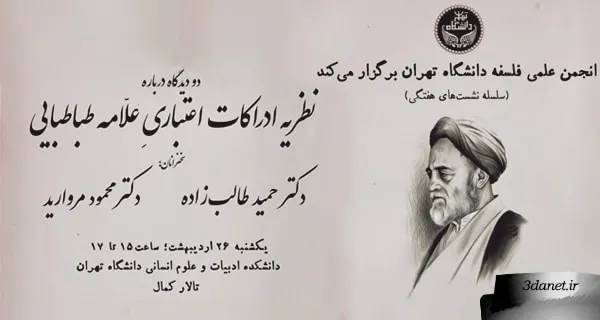


Discussion0 comments
No comments yet; let yours be the first voice.