Religion
Qoli Khan Was No Khan: A Critique of Naimeh Pourmohammadi's Cognitive Science of Religion
The book Cognitive Science of Religion by Naeimeh Pourmohammadi, rather than being an original work, is the product of translation and copying from English sources. Researchers describe it as 'book-making' and 'wholesale plagiarism,' with negligible authorial contribution and misleading citations.
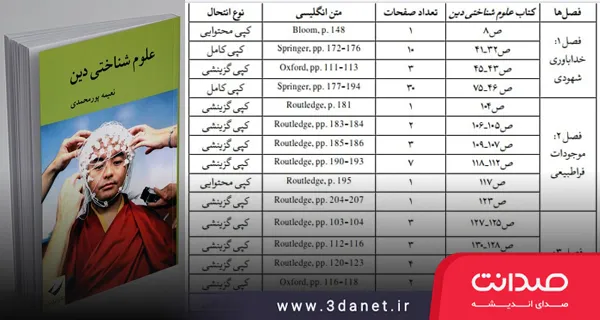
On the Tale of the Book Cognitive Science of Religion by Naimeh Pourmohammadi
Authors:
Mohammad Souri (Faculty Member at the Islamic Sciences and Culture Academy and Head of the Department of Philosophy and Theology)
Meisam Fasihi Ramandi (PhD Candidate in Philosophy of Religion, University of Tehran, Farabi Campus)
Ayeneh-ye Pazhuhesh, Issue 207, Year 35, No. 3, Mordad and Shahrivar 1403, pp. 261-328.
Research on any subject means that the researcher presents the results of their investigations to the audience, and their contribution to the writing is clearly distinguishable from the contributions of previous research, such that readers clearly understand which parts of the writing are the result of the researcher's own investigations and which parts are the results of others' research. Critiquing writings that have not observed this necessary condition and exposing the copies and borrowings from others undoubtedly has an impact on improving the quality of research writings. In the present article, the book Cognitive Science of Religion, authored by Naimeh Pourmohammadi, is critiqued from this perspective. After comparing sections of well-known and credible sources written in English in the field of cognitive science of religion, the authors of the article have concluded that the major part of the book is translated or derived from those English sources and is not the result of the "author's" own research. To the extent that it is better to use the term "book-making" instead of "authorship," and "pseudo-author" instead of "author." Naimeh Pourmohammadi has constructed a book by using the material from a few limited sources and assembling them, and has published it under her own name as an "authored" work. The various parts of the book Cognitive Science of Religion have been compiled in three ways: (1) Parts that are verbatim, sometimes for dozens of consecutive pages, a complete and integrated translation from other sources; (2) Parts that are a scattered, arbitrary, and selective translation from other sources; (3) Parts that, although not a complete or selective translation, are a content copy from other sources, in such a way that the material appears to be from the compiler, but is in fact from others. The author's blind and misleading citations are such that the non-specialist reader does not realize at all what is happening and considers all the material to be the result of the author's research. In summary, it can be said that this book is a major plagiarism and a kind of book-making and clumsy copying in the world of research, and the "author" has almost no significant contribution to this book. Although, given the problem of lack of originality, the time has not come for a structural and content critique, the book Cognitive Science of Religion also contains serious and sometimes ludicrous flaws in this regard, which I have briefly mentioned in the second part of the article.
A Review of the Book "Cognitive Science of Religion" by Naeimeh Pourmohammadi By: Mohammed Soori & Meisam Fasihi Ramandi
Abstract: Research in any field requires that the researcher clearly distinguishes their contributions from previous work, so that readers can easily identify which parts of the text are the result of the researcher's own efforts and which parts are derived from others' research. Critiquing works that do not adhere to this essential requirement and identifying instances of copying and plagiarism undoubtedly contributes to improving the quality of research writing. This article critiques the book "Cognitive Science of Religion" authored by Naeimeh Pourmohammadi from this perspective. The authors of this article compared significant portions of the book with several well-known and reputable sources in the field of cognitive science of religion written in English. They concluded that a substantial portion of the book is translated or adapted from these English sources and is not the result of the "author's" own research, to the extent that it would be more appropriate to use the term "book fabrication" instead of "authorship" and "pseudo-author" instead of "author." Naeimeh Pourmohammadi assembled the book by using content from a few limited sources, assembling them, and publishing it under the guise of "authorship." The various sections of the "Cognitive Science of Religion" book are compiled in three ways: (1) sections that are complete and uninterrupted translations of other sources, sometimes spanning dozens of pages; (2) sections that are fragmented, selective, and arbitrary translations from other sources; (3) sections that, although not complete or selective translations, are content copies from other sources, making it appear as if the content is from the compiler, but in fact it is from others. The author's misleading and deceptive references are such that a non-specialist reader would not realize what is happening and would consider all content as the result of the author's research. In summary, this book represents a major act of plagiarism and a form of clumsy book fabrication and copying in the realm of research, with the "author" contributing almost nothing of value. Although the book's lack of originality is a primary issue, structural and content-related critiques are also unwarranted, as the book contains serious and sometimes ridiculous flaws, which are briefly addressed in the second part of the article.
Keywords: Naeimeh Pourmohammadi, Major Plagiarism, Plagiarism Due to Inadequate Referencing, Book Fabrication, Source Manipulation, Cognitive Science of Religion.
.
.
Click here to download the PDF file of this article
.
.





Discussion1 comments
با خواندن این مقاله توسط ناقد نماها حس شرم بهم دست داد به نظرم باید ب حال چنین جامعه ای خون گریست در سوگ اخلاق نقد....