اندیشهفلسفهخردگفتگوحکمتمعناپرسشفرهنگ
Political Science
Religious Freedom in Europe Was a Requirement of Statecraft, Not the Fruit of Freethinking
Religious freedom in the West was not merely the product of philosophers' ideas, but a consequence of the growing capacity of states to legislate. The rise of fiscal-military states made religious uniformity costly and turned toleration into a requirement of statecraft.
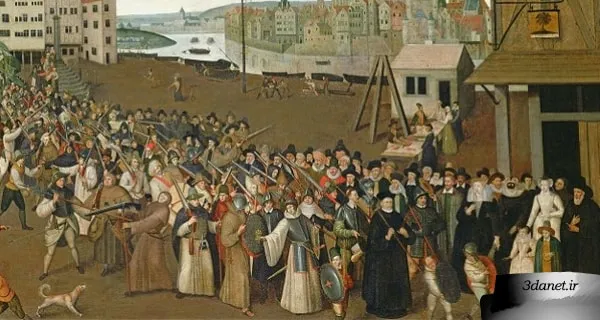
Mark Koyama, Ian — Religious freedom in the West has become a symbolic value. It is enshrined in constitutions, defended by politicians and thinkers across the entire political spectrum, and for many it is an absolute value beyond question. Yet many misconceptions remain about how and why it emerged.
According to the traditional narrative, religious freedom in the West emerged in the wake of devastating religious wars. And it was accelerated by the powerful arguments of thinkers such as John Locke, Baruch Spinoza, Pierre Bayle, and Voltaire. The reaction of these philosophers and political theorists to the savagery of the religious wars was to defend the radical concepts of toleration and religious freedom. Subsequently, the liberal ideals of these thinkers took root in the political institutions of the West following the French and American Revolutions.
In broad outline, this is the account accepted by most political philosophers and social scientists. But the evidence does not support such an emphasis on the power of ideas in shaping the emergence of religious freedom. The emphasis on ideas downplays the influential role that institutions played.
The ideas of the philosophers were indeed important. Bayle, in the Historical and Critical Dictionary1 (1697), pointed out that if a religion claims to be the only true faith, it implicitly possesses the right to harass other religions, and other faiths possess an equal right to make such a claim. By demonstrating the inherent instability for society of these claims—claims based on religious truth—Bayle argued that if people are mistaken about their religion, they can hardly be considered guilty if they are nonetheless striving in good faith to practice its principles.
Locke argued that true faith cannot be compelled. From this, he claimed, it follows that restricting the rights of religious minorities is permissible only for governmental reasons, not for doctrinal or otherworldly ones. Voltaire's approach was no less effective, as he relentlessly described and ridiculed instances of religious persecution. Time and again, he made bigots and the enforcers of religious bigotry a laughingstock. These are persuasive and important ideas, and they are worth studying and rereading continually.
But focusing on these ideas does not provide a complete explanation of how religious freedom came to the West. The intellectual importance of Bayle, Locke, and Voltaire does not mean that their ideas were key when religious freedom grew and ultimately found its way into real, social life.
Recently, together with my economist colleague Noel Johnson at George Mason University, we completed the book Persecution and Toleration (2018), in which we show that ideas were not sufficient for the realization of religious freedom. More important than them, political and institutional changes—particularly the growth and strengthening of the state's capacity to make and enforce laws—were needed for religious freedom to become possible and desirable in the West. The driving force behind the rise of state power was not the ideas of Bayle, Spinoza, and Locke, but the need to procure resources for statecraft and war. Clearly, for the emerging fiscal-military state, religious uniformity and persecution became too costly and inefficient.
One of the features of medieval Europe was the existence of multiple overlapping borders and political territories. These territories were not "states" in the modern sense of the word. Rulers were expected only to enforce existing "laws of the land," not to make new laws. Typically, no taxes were raised, and in normal times, rulers subsisted on the revenues from their own lands. Armies were not permanent but were assembled on an ad hoc basis when needed. Different territories and cities within a kingdom might have their own tariffs, regulations, and systems of weights and measures. Bureaucracy, as such, did not exist.
Laws varied at the local level, and their enforcement was generally dependent on a person's identity. The nobility were often exempt from taxation. The rights and duties of peasants differed from those of townspeople. Access to trade was controlled by guilds.
Different laws and regulations for different people are called identity rules, and these rules were the norm. Medieval political orders relied on identity rules because they were a low-cost form of governance. Medieval political orders lacked the power to enforce general laws, so reliance on identity rules was also logical from this perspective.
At a deeper level, identity rules were the mortar holding the political order together. By treating people differently depending on their legal status or religion, identity rules limited economic competition among groups and created economic rents that economic elites could sweep up. These rents, in turn, helped maintain the discriminatory political order.
Many of these discriminatory laws were based on religion. One example was Jewish usury. Canon law forbade Christians from lending money at interest, but Jews were not subject to canon law. By enforcing this prohibition, rulers could tax the monopoly profits of Jewish usurers. In return, they offered Jews protection from violence and the right to manage their own affairs.
Religion also offered a potentially powerful source of political legitimacy. Modern states derive their legitimacy from democratic institutions or by providing public goods or economic growth, whereas premodern states tended more to rely on religion.
For medieval states, it was logical to rely on religious institutions to perform governance functions and provide public goods on their behalf. Religious institutions such as churches and monasteries in Europe, and endowments and mosques in the Islamic world, provided education, poor relief, and other public goods. Compared to secular organizations, they were better at identifying and excluding free riders and attracting members' contributions.
A partnership between church and state formed, with important consequences for religious freedom in the premodern world. In exchange for granting political legitimacy to rulers, religious authorities could ask secular rulers to enforce religious uniformity. This trade-off was also attractive to secular rulers, because they believed that religious competition caused political instability.
Religious uniformity, and the resulting persecution of religious dissent, served as a safeguard of the political order. In such a world, religious freedom was unimaginable.
The nature of this political trade-off is evident in the evolution of Martin Luther's views on religious freedom. Initially, after breaking from Rome, Luther defended religious freedom. In his early works such as An Open Letter to the Christian Nobility2 (1520), he recognized the right of every believer to personal judgment and argued against the coercion of religious beliefs. But Luther's position changed. The Peasants' War of 1524-1525 is a likely reason for this shift. He opposed the religious freedom of the Anabaptists and then condemned the followers of Huldrych Zwingli, his fellow reformer in Switzerland. Luther's internal battles over religious freedom, and the freedoms of his other contemporaries, imply that powerful forces were at work that seemed to make religious coercion necessary. He ultimately came to believe that religious uniformity—for Lutheranism—must be mandatory.
There are also the examples of John Calvin and Michael Servetus. Servetus was a freethinker and, in the history of medicine, deserves attention for discovering the function of pulmonary circulation. Moreover, he denied the Trinity; this made him a common enemy of Catholics and Protestants. Calvin colluded with the Catholic inquisitors of Vienne to have Servetus prosecuted for heresy. When Servetus came to Geneva, Calvin pressed for his prosecution. Servetus was burned alive, while Protestant Europe cheered.
Sebastian Castellio, the French theologian, criticized Calvin for the unjust execution of Servetus and, in doing so, mounted a powerful intellectual argument in favor of religious toleration. Castellio’s argument for religious toleration predates Locke and Bayle by a century and a half. Yet his writings had no practical effect, and Castellio did not attain the honor in the struggle for religious freedom that he deserves.
In any case, religious freedom was simply indefensible in the first half of the sixteenth century. This was not merely a matter of bigotry. People in the eighteenth century were no more intelligent or capable of contemplating arguments for toleration than people in the sixteenth. What differed was the more prominent role of religion in sustaining political order in the sixteenth century.
So what changed? Why did religious freedom come to the West? Why did Locke and Voltaire become heroes of religious freedom while Castellio did not? The answer lies in the set of fundamental institutional changes that occurred within European states between 1500 and 1800.
The first change was a transformation in the scale of European states. In the late Middle Ages, medieval rulers began investing in building governing capacities and raising taxes more systematically; however, the most dramatic advances occurred after 1500, as a result of advances in military technology that historians call the Military Revolution. This arms race, initiated by the invention of gunpowder and engulfing the entire continent, compelled rulers to invest in greater fiscal and governing capacities.
To pay for larger armies, new taxes had to be raised and a permanent system of public borrowing established. Moreover, a shift occurred from feudal, decentralized, ad hoc tax systems toward standardization and centralization. Instead of relying on tax farmers, the Church, or merchant companies to raise taxes, rulers invested in sprawling bureaucracies to do it directly themselves. This was the only way to meet the cost of armies that were growing relentlessly.
The size of European armies provides a sense of the scale of this transformation. The armies that fought in the Hundred Years’ War between England and France generally numbered a few thousand men. On one occasion when the French assembled a force noticeably exceeding 10,000 men for the Battle of Agincourt, it was considered an unusual event, and in any case, this army was defeated by a much smaller one.
By the beginning of the eighteenth century, French and English commanders were leading field armies of up to 100,000 men. During the reign of Louis XIV, the total size of the French army in the field was 400,000 men.
Paying for these vast armies—and the equally expensive navies that early modern states built—required increased tax revenues. Between the Glorious Revolution in 1688 and the end of the Napoleonic Wars in 1815, the tax revenue collected by the British state increased fifteenfold. Since total GDP roughly tripled, this represented a fivefold increase in the relative size of the state. Other European states also succeeded in dramatically increasing the amount of tax revenue collected (though some, like France, failed to do so at the rate needed to keep pace with rising expenditures).
The dramatic institutional changes accompanying these shifts reveal the emergence of what is known as the fiscal-military state; the rise of these states set in motion large-scale, costly wars. The astonishing military and governing capacity of early modern states also meant that they had a greater ability than their medieval predecessors to persecute heretics more effectively. Rulers such as Philip II of the House of Habsburg in the Netherlands and Mary I in England burned hundreds of people for their beliefs.
Nevertheless, the long-term effect of these changes was to weaken the role of religion as an instrument of political legitimation and to replace the old reliance on identity-based ordinances with more general laws. The new modern states that emerged in Europe after 1600 subjugated all alternative sources of power—the nobility and the church—under absolute authority. Religious legitimacy became less important as a source of political legitimacy, and the grand transaction between church and state was weakened. As states relied less on religious authority, they consequently placed less value on enforcing religious uniformity.
The case of Cardinal Richelieu illustrates these developments. Richelieu destroyed the independent power of the nobility in France; greatly expanded the power of the monarchy; and, though a cardinal, placed the interests of France above those of the Catholic faith. A vital part of this achievement involved destroying the independent military power of the Huguenots, or French Protestants. Even as he crushed the Huguenot "state within a state," Richelieu also guaranteed their right to worship according to the Protestant faith. Religion was to be a private activity, rather than an alternative source of political power, but clearly greater religious freedom was obtained at the expense of religion's political power.
This process of centralization and bureaucratization had other important consequences. It meant that identity-based ordinances had to be set aside. In their place, states institutionalized more general regulations. Guilds lost their exclusive privileges. Legal systems became increasingly standardized; taxes became more regular. For states with bureaucracies and professional tax collectors, treating everyone equally simply cost less. Discriminatory laws against Catholics, Protestants, or Jews were either gradually deemed redundant or eventually abandoned. Although this process of equalization was gradual and uneven, it proved relentless and, in the long run, irreversible.
Some states attempted to strictly enforce religious uniformity. Habsburg Spain established the Inquisition and expelled its Jewish and Muslim populations. Louis XIV drove the Huguenots out of France. But these efforts to return to the medieval world of religious homogeneity proved to be costly mistakes and helped weaken the regimes that committed them.
The establishment of relatively powerful, "secular" states that no longer needed religious legitimacy shifted the political balance in favor of religious freedom and dismantled the old system of identity-based ordinances. Once this institutional change occurred, elite opinion shifted in favor of religious freedom.
The case of Jewish emancipation provides an important example of how, from a historical perspective, religious freedom actually came about. In 1782, Habsburg Emperor Joseph II issued one of the first edicts of toleration for Jews in continental Europe. This decree granted Jews specific civil rights on the condition that they integrate as active citizens with the rest of the population. The edict did not go so far as to offer full equality for Jews, but it represented a radical change in their treatment. The motivation for emancipation, more than a commitment to the principle of religious equality, stemmed from the recognition that maintaining the old reliance on identity-based ordinances imposed heavy economic and political costs. Joseph II had been persuaded by the writings of Christian Wilhelm von Dohm. Von Dohm argued that existing regulations marginalized the Jewish way of life and rendered Jewish people sterile as citizens and workers. He argued that freeing Jews from discriminatory laws would lead to strengthened economic capacity.
Joseph’s reforms were controversial. But revolutionary France adopted a similar policy and soon exported it to most of Europe. The results of this transformation were dramatic. Before this, Jews had been shut out of most industries and trades; they were barred from university, the legal profession, and guild membership. As a result, Jews were largely confined to occupations such as moneylending and peddling, and the majority of Central European Jews lived in ghettos, impoverished and destitute. After emancipation, this situation changed within a generation. Jews entered the higher levels of education, industry, and commerce on a massive scale.
This increase in religious freedoms also transformed Europe’s cultural and intellectual life. During the period between the Middle Ages and the modern era, Jewish intellectual culture, despite occasional exceptional geniuses like Spinoza or Moses Mendelssohn, had lagged far behind the intellectual culture of Christian Europe in many ways. The emancipation of Europe’s Jewish population led to a tremendous flowering of intellectual and artistic achievement among Jews, which greatly enriched European society.
Economic changes, chief among them the onset of modern economic growth, complemented the emergence of religious freedoms. Just as in the case of the Jews, greater freedom allowed minorities to flourish. The French Protestants whom Louis XIV had expelled brought advanced skills and industrial expertise with them to England, the Netherlands, and Prussia. During the British Industrial Revolution, Quakers and other religious dissenters constituted a large proportion of the merchants, entrepreneurs, and inventors.
The indirect consequences of the shift from identity-based rules to general rules were even more important. Identity-based rules had limited the scope of trade and the division of labor. When these identity-based rules were removed—when guilds lost their authority, and cities and lords lost the ability to impose internal tariffs—trade and commerce expanded.
The growth of trade, in turn, reinforced the tendency toward liberalism. Trade, as Enlightenment thinkers like Montesquieu had argued, encouraged individuals to view the world through the positive-sum lens of mutually beneficial interaction rather than the zero-sum lens of confrontation. The resemblance of religious freedom to a recipe for social disorder and civil war became less and less, and to a win-win proposition more and more.
What implications does our discussion have for the world today? Most importantly, perhaps, is the need to recognize that liberal ideas were not necessarily responsible for the emergence of liberal societies. Instead, the rise of a new type of political organization, the modern state, led rulers, for reasons of their own, to implement general rules of conduct that were incompatible with religious discrimination.
Protestants often view the Reformation as the origin of religious freedom. But the example of Calvin and Castellio shows that Protestantism in itself did not lead to religious freedom. American national mythology often attributes the origin of religious freedom to the Puritans who fled persecution in England and settled in New England. But the Puritans’ belief in religious freedom was only for Puritans; they were stricter enforcers of religious conformity than many European states. The genuine adoption of a meaningful practice of religious freedom arose neither in the wake of philosophers’ arguments nor was it related to the nature of Protestant belief, but rather came about because of the political impossibility of achieving conformity after 1600, as Protestants became increasingly sectarian.
Ultimately, the history of the establishment of religious freedom is a reminder that a commitment to liberal values alone is not sufficient for liberalism to flourish. It requires the appropriate political and economic foundation. As the German experience of the 1930s shows, religious persecution can swiftly re-emerge. We cannot simply rely on liberal ideas to work. If religious freedom and other achievements of liberalism are valuable to us, we must turn our attention to their institutional foundations.
.
.
Bibliographic Information:
Koyama, Mark, and Noel Johnson. Persecution and Toleration: The Long Road to Religious Freedom. forthcoming, 2018
.
.
Endnotes:
• This piece was published on August 28, 2017, under the title “Ideas were not enough” on the Aeon website and was first translated and published under the title “Religious Freedom in Europe Was a Requirement of Statecraft, Not the Fruit of Freethinking” in the fifth issue of the Tarjomaan-e Olum-e Ensani quarterly. The website Tarjomaan published it on January 22, 2018, with the same title and translated by Ali Amiri. •• Mark Koyama is an associate professor of economics at George Mason University and a senior fellow at the Mercatus Center. Along with Noel Johnson, he authored Persecution and Toleration: The Long Road to Religious Freedom (forthcoming, 2018).
[۱] Dictionnaire Historique et Critique [۲] Open Letter to the Christian Nobility
.
.



Discussion1 comments
دکتر محمدرحیم شایگان نیز معتقد است علّت اصلی مدارای مذهبیِ کورش و داریوش هخامنشی همین "اقتضای دولتداری" و "همچون ابزاری برای نشان دادن مشروعیت" بوده است. (مجلهی بخارا شماره ۱۱۹ صفحه ۱۳۵)