Religion
Rereading the Article “The Fundamental Principles of Islamic Government” by Ayatollah Makarem Shirazi
In response to claims that Islamic government is an unknown concept, Ayatollah Makarem Shirazi identifies three foundational principles: popular participation, consultation with experts, and the supervision of a jurist. Its defining features include freedoms, an interest-free economic system, and the rejection of despotism.
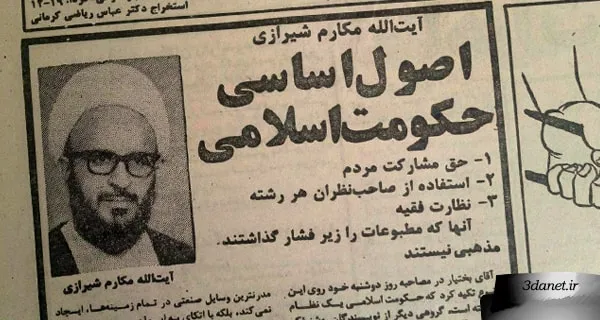
What you read in this note is the full text of the article by Ayatollah Makarem Shirazi, which was written on the eve of Imam Khomeini's (may God have mercy on him) return to Iran and the victory of the revolution, in response to Bakhtiar's criticisms and attacks on the Islamic government, where he had said, "Islamic government is an unknown system." It was published in Kayhan newspaper on 11 Bahman 1357.
In this article, His Eminence enumerates the three principles of "1- The right of popular participation, 2- Utilizing experts in every field, 3- The supervision of the jurist" as the fundamental principles of the Islamic government and outlines some of the characteristics and goals of this system, including the state of freedoms, the economic system, foreign policy, and intended development activities, as well as the course of the fight against corruption:
Full text of the article:
The Fundamental Principles of Islamic Government
1- The right of popular participation
2- Utilizing experts in every field
3- The supervision of the jurist
In his Monday interview, Mr. Bakhtiar emphasized the point that Islamic government is an unknown system. A group of other intellectual writers also repeat this point. But I do not know whether, to resolve the ambiguity of an issue, we should sit on our hands and wait for revelation and heartfelt inspiration? Or should we put our finger on every dark point that exists in an issue and ask for clarification from those who are proponents and experts on that issue? If the explanations are convincing, we accept them, and if not, we continue again until we have sufficient reason to negate or affirm that subject.
All systems that have been implemented in the world so far, whether constitutional, republican, or any other school of thought, were previously unknown and unprecedented, yet neither of these two descriptions has prevented their implementation.
Allow me to clarify the outlines of the Islamic government in a few short sentences:
Negation of Despotism
The Islamic government is not a dictatorial or despotic system and negates any form of despotism. In terms of the structure of government, it bears a close resemblance to a "republic," but you are free and at liberty in naming it.
Three Fundamental Principles of Islamic Government
The political system of this government rests on three principles: "the right of popular participation, utilizing experts and knowledgeable individuals in every sector, and the supervision of the jurist regarding conformity with Islamic standards."
According to the first principle,
that is, the right of popular participation, which is derived from the ruling of consultation (Shura) in the Quran, all people can participate in choosing their desired individuals—as representatives—for consultation on all political, social, and economic issues. Men and women, literate and illiterate, are not differentiated in this; it is sufficient that they be mature and sane.
According to the second principle,
in the categorization of political and social organizations—especially for the head, representative, and main officials of the government—competence, merit, and expertise, in addition to purity, integrity, and faith, are conditions.
According to the third principle,
an individual or a council of just jurists—experts in Islamic matters who are pure and aware of the issues of the time—must supervise two things: first, the enactments of the consultative assembly (parliament), and second, the implementation of laws, so that no violation of the principles of Islamic laws occurs.
Election of the Head of Government
In selecting the head of government as well, the three aforementioned principles—namely, the participation of the people, whether directly or indirectly, competence and expertise, and the supervision and solicitation of the jurist's opinion within the general, overarching domain of Islamic laws—are conditions. And the claim made by some respected writers that in an Islamic government, the jurist is a superior being and the rest of the people are like minors in need of a guardian is categorically false.
Liberties
In this system, all democratic freedoms are provided for: freedom of speech, freedom of the press, freedom of thought, and every other kind of freedom. The sole condition for this freedom is that it not be detrimental to society or contrary to Islamic laws. Even followers of other schools and religions will not be placed under any pressure whatsoever to change their beliefs.
I explicitly declare that those who place the press under pressure in mentioning matters and, as you say, have created a "religious SAVAK," are certainly not from among us. SAVAK was specific to despotic regimes, not a democratic regime like Islam. However, the press, which has a news and public dimension, also has a duty to be a reflection of events—with correct quantity and quality—and the desires of the general public, not for the particular inclinations of their writers to give a specific shape and color to events.
Likewise, those who resort to violence, creating terror and intimidation, and threats to impose their ideas are not from among us, for we know well that the overwhelming majority of the country's people desire an Islamic democracy. In the presence of such a remarkable majority, violence is not only illogical but also harmful, because majorities are always subject to accusations of dictatorship. For this very reason, they must avoid any action that gives an excuse to the enemy.
Islamic laws are so progressive, vast, flexible, and comprehensive that not only do they create no obstacle whatsoever to freedoms, education at all stages and for all, and the use of the most modern industrial tools in all fields, but, by relying on faith and spiritual backing, they generate movement and fresh blood in the veins of society.
The concept of an Islamic government does not mean that non-Muslims have no place in it; this is a great mistake. Rather, its concept is that the laws of Islam, which have a completely humane aspect, cast their shadow over it, and even non-Muslims are utilized when necessary.
In the system of this government, any form of abuse, corruption, bribery, theft from the public treasury, and hoarding is condemned, and the severest punishments are considered for these groups. Fundamentally, by transforming the one-dimensional education of the West into a multi-dimensional Islamic education, the roots of many of these abuses will be eradicated.
The Economic System
In the economic system of this government, the capitalist system of the West, full of oppression, exploitation, and extravagance, is condemned; just as the Marxist economic system, which is itself considered a form of capitalism plus the deprivation of human freedoms, has no place. The economic system of Islam is founded upon the negation of any form of human exploitation and the negation of a bipolar society (rich and poor), and all economic organizations must operate with this spirit, while at the same time, the principle of freedom is not sacrificed along this path. For example, today's banking system, which is built upon usury to the benefit of the wealthy, will be transformed into a system serving the interests of the people, and banks will grant loans without any interest—under reliable regulations, of course—and the salaries of bank employees will be secured through a limited commission (exactly equivalent to the sum of their salaries) collected from the people. The only privilege a bank offers in return for savings, current accounts, and attracting people's capital is the secure safekeeping of assets and facilitation of financial payments. In particular, maximum use will be made of the people's religious beliefs in this regard, and this matter has been experienced with brilliant results in the interest-free loan and Islamic cooperative funds that have been established in almost all parts of the country.
Women's Freedom
Regarding women's freedom and their rights, contrary to what some have imagined, Islam places no restrictions whatsoever on their education or choice of profession, provided that it prevents woman from being used as a tool for advertising goods, or as a decoration for the office of a director general, or any work that damages the personality, status, and chastity of woman and leads her down the path of corruption.
Foreign Policy
In the realm of foreign policy, the Islamic government, while maintaining relations with all the world's governments, will not allow the Islamic country to fall within the sphere of domination and influence of other powers and become the guardian of their interests, or a military dependent, or an economic parasite, or an agent executing their designs — of course, it will have no relations with usurper states such as Israel and will support liberation movements such as the Black movement in Africa.
Development Activities
In the field of development activities and humanitarian services, self-help, which originates from the constitutional principle of enjoining good, is a great facilitator, and the country can be developed swiftly and the people roused from indifference; just as we see its examples in all fields today. When it is announced in a mosque that your brothers have been injured and need blood, so many volunteers come forward that the blood centers turn them away!
Fighting Corruption
In the matter of fighting corruption, this self-help also rushes to the aid of society in the form of forbidding evil, and through the use of religious belief, all people will become guides and guardians for one another.
Mr. Bakhtiar, what dark or ambiguous point is there in the brief list mentioned above?
I must also say this: you repeatedly state that you have fulfilled many of the people's demands. We ask: by using which authorities? You say: I am the Prime Minister! But does this claim not have a clear contradiction with your statement that a dictatorship has cast its shadow over everything in this country for 25 years — and naturally, its Rastakhiz legislative assembly is the complete manifestation of this dictatorship?!

Discussion0 comments
No comments yet; let yours be the first voice.