Philosophy
Second Series of Ofogh-e Goftogu Sessions: The Transformation of Greek Philosophy in the Islamic and Christian Worlds
Greek philosophy was transformed in both Islam and Christianity; Christianity reached modernity by enlisting philosophy, whereas Islamic philosophy became mystical. A Horizon of Dialogue session with Dr. Ahmad Asgari, Dr. Milad Nouri, and Dr. Amirhossein Saket examined this divergence.
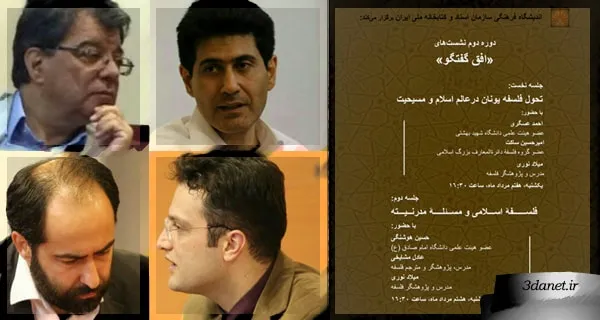
The first session of the second series of Ofogh-e Goftogu sessions, titled The Transformation of Greek Philosophy in the Islamic and Christian Worlds
Speakers: Dr. Ahmad Asgari, Dr. Milad Nouri, and Dr. Amirhossein Saket
With the presence of: Dr. Mohammad Ilkhani
Milad Nouri: Although the wellspring of the philosophical tradition in the Islamic and Christian worlds is Greek philosophy, it is clear that Greek philosophy underwent transformation and change in the Islamic and Christian worlds and acquired a new structure. The process of the transformation and metamorphosis of Greek philosophy and what befell it in these two different traditions plays a significant role in understanding subsequent philosophical events in the Islamic and Christian worlds. What is the nature of Greek philosophy? How was Greek philosophy transmitted and transformed in the Islamic world? How was Greek philosophy transmitted and transformed in the Christian world? What are the commonalities and differences between the philosophical tradition in the Islamic world and the Christian world? Questions such as these, though not all, are part of the path that must be traversed to confront modern thought and contemporary thinking within the philosophy of the Islamic world. The four centuries of silence in Islamic philosophy might be broken by examining the historical identity shaped by the course of its history; but this examination is only possible by looking at the trajectory of Greek philosophy's metamorphosis in the Christian world. From the perspective of someone in the contemporary era thinking about rethinking Islamic philosophy, the only way to understand the contemporary philosophical problem is to understand the metamorphosis of fundamental themes in the process of historical growth and development. The Christian thinker, emphasizing the concept of divine salvation through faith, placed Greek philosophy in the service of justifying concepts such as the Trinity and resurrection, and on this basis, introduced philosophy not as a criterion for happiness, but as a handmaiden that occasionally suffers humiliation and deficiency before faith, whereas Muslim philosophers, like the Greeks, believed from the beginning in the theory of happiness through philosophizing. Nevertheless, it is ultimately Islamic philosophy that tends towards a kind of resurrection-oriented mysticism, while faith-based Christianity, which considered nature a prison and the place of man's fall, ultimately, by turning towards nature and human cognitive faculties, treads the new path of the Renaissance and modernity. And the question remains as to what the philosophical and historical root of such an occurrence is. Even if this formulation of the problem is subject to discussion and critique, its necessity cannot be ignored. The examination conducted with the collaboration of Dr. Ahmad Asgari and Dr. Amirhossein Saket, and in the presence of Dr. Mohammad Ilkhani at the Cultural Think Tank of the National Library, although it could not examine all dimensions of the problem, can be considered as a statement of the problem, so that those interested in the updating of Islamic philosophy might, through this passage, cultivate new ideas.


.
.
Second Series of Ofogh-e Goftogu Sessions: The Transformation of Greek Philosophy in the Islamic and Christian Worlds
Full audio of this session
.
.
Related Content:
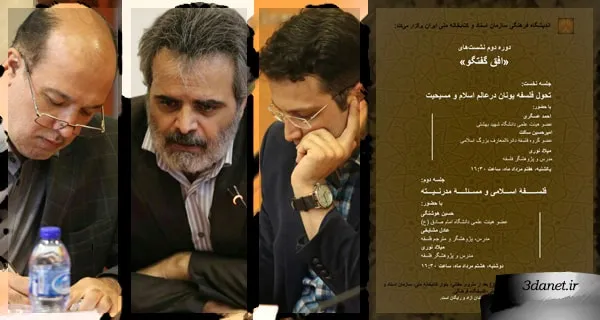
The Second Session of the Second Series of Ofogh-e Goftogu Sessions
.
.



Discussion1 comments
لطفا تدبیری بیندیشید که کیفیت فایلهای صوتی کمی بهتر باشه، واقعا موقع گوش دادن آدم اذیت میشه!