Philosophy
Sharif University of Technology Summer School on Evolution, August–September 2018
The Sharif University of Technology's summer school on evolution explored the biological, humanistic, and philosophical dimensions of evolutionary theory. Over three days, leading academics covered topics ranging from natural selection to the relationship between the Islamic philosophical tradition and evolution.
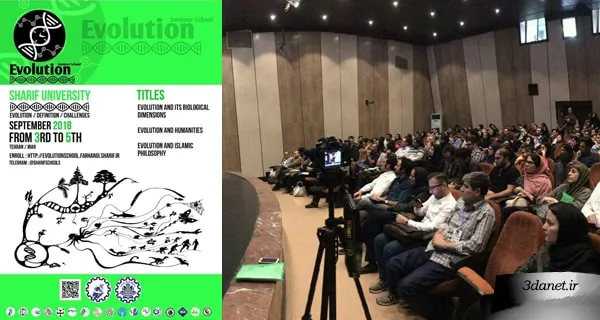
In recent decades, evolution has taken on vast dimensions. These dimensions have crossed the boundaries of biology and transformed the humanities, the natural sciences, and philosophy alike. The scope of these influences prompted the organization of a summer school, bringing together a group of distinguished scholars from this land as well as several international academics, to examine some of these dimensions. The Summer School on Evolution was held over three days, from 3 to 5 September 2018, at Sharif University of Technology.
The first day was devoted to biological evolution, with invited professors discussing certain of its aspects. The nature of evolution and its mechanism were the central concerns of the first day. On this day, the achievements of evolutionary theory were defended.
The first speaker of the first day was Dr. Naderlou, who elaborated on the foundations of evolution. The characteristics of living organisms and the difference between the world of biology and the laws of physics and chemistry, the features of Darwin's theory of evolution, the major challenges facing the theory of natural selection, and various theories of heredity were among the topics he presented.
Next, Dr. Karbasizadeh delivered his lecture on the subject of natural selection and mental faculties. He began by offering explanations concerning the citing of evolutionary causes for events in primitive societies, using the example of infanticide, and then proceeded to a more detailed examination of the perspective of evolutionary psychology.
In the third lecture, Dr. Ata Kalirad, a member of the Institute for Research in Fundamental Sciences, spoke on the topic of new evidence for the theory of evolution. He divided evolutionary evidence into two categories: retrospective and prospective. In the retrospective section, his talk focused on molecular studies of proteins and genes, and in the prospective area, on experimental evolution.
The fourth speaker of the first day was Dr. Zohreh Anvari. She began her discussion on the geological time scale, periods of climate change, and the emergence of primates in the Cenozoic era. She then addressed the historical succession from primates to early humans and also comparatively introduced the various species of the genus Homo.
The second day addressed the impact of evolution on the humanities, including psychology and sociology.
Dr. Abdolrahim Najl Rahim, a neurologist and Iranian researcher at the University of Sheffield, London, presented the topic of the relationship between natural evolution and cultural evolution in the first lecture. At the beginning of his talk, he raised the importance of emotion and feelings and their relationship with socialization and culture. He went on to state that every living being, as an agent of life, advances itself and chooses its living environment; in other words, every living being determines the meaning of its life within itself and its body; such that the nervous system's connection with other internal organs is far more complex than its external connection with the environment.
After that, Dr. Samadi, Director of Research at the Faculty of Theology and Philosophy of the Tehran Science and Research Branch, delivered his lecture on the subject of evolutionary explanations in the humanities. Pointing to the many disagreements within evolutionary theory, he outlined six fundamental approaches—the rooting of complex human behavior in the behavior of simpler organisms, human behavioral ecology, gene-centrism, the co-evolution of genes and culture, evolutionary psychology, and finally, the rejection of the mind-body dualism view—and briefly explained each one. He concluded his discussion on color vision and color constancy.
In the third lecture, Mr. Solhirad presented the topic of the crisis in sociology and the need for evolution in the subject. Emphasizing the connection of many disciplines with evolution and, despite this, sociology's resistance to accepting Darwinism, he stated that sociology is always relative, but unlike
Darwinism, it possesses the ability to predict the future. He then, by introducing schools of thought such as Marxism and feminism, outlined their goals, which were based on eliminating differences and classes in societies, and critiqued them.
The fourth presentation of the second day of the Evolution Summer School was Mr. Sadegh Mirzaei's talk entitled "Universal Acid." He introduced "Universal Acid" as the very evolution which, from the perspective of philosophers, is like an acid that devours everything. In the continuation of the presentation, he addressed Dennett's view, who believes this acid does not destroy morality and, on the contrary, moral foundations can be built upon it.
The necessity of understanding the relationship between the Islamic philosophical tradition and evolution was the program for the third day of this school. We tried to put this subject to the test by benefiting from the presence of scholars from the seminary and the university.
The first speaker was Dr. Parsania, and his talk began with a discussion of transcendence and evolution in the history of Islamic thought. In his speech, he raised the relationship between evolution and motion, stating that evolution is provable through the concept of motion. In fact, Islamic thought merely has a different interpretation of the theory of evolution compared to materialist interpretations, but according to traditions, interpretations, and existing evidence, it accepts the principle of evolution. What is debatable from his perspective are the philosophical aspects of the subject of motion. Since evolution is a kind of motion, the characteristics we deem philosophically necessary for motion must be considered at the biological level.
Dr. Seyed Hassan Hosseini, PhD in Islamic Philosophy and Theology, delivered his lecture on the subject of the book On the Origin of Species and theism. While introducing Darwin's On the Origin of Species, he pointed to the influential events in his life. According to Dr. Hosseini's lecture, this book encompasses five main concepts: the instability of species, the existence of a common ancestor, the gradualism of evolution, the diversity of species, and natural selection. Although Darwin used words like "creature" and "creation" in the early editions of this book—which was mainly due to his wife's religious thinking—he did not believe in the superiority of humans over other species; it should be noted, of course, that he corrected these instances in later editions. He concluded by stating that the idea of natural selection, in which no consciousness is involved, is a thought that can be attributed to this book, and this thought is fundamentally incompatible with belief in God, because God, even in His most minimal form, possesses a kind of consciousness. He rejected the separation of the discussion of evolution into biological and philosophical levels.
In the third lecture of the third day, Dr. Hassan Miandari, a member of the Iranian Institute of Philosophy, spoke about the role of ethics in social life and individual selection or group selection. He also analyzed the relationship between religion, God, and self-interested individuals in populations and compared these conditions in modern and past societies.
Dr. Amir-Mohammad Gamini, a professor in the Department of History of Science at the University of Tehran, delivered the final lecture of the school on the subject of the first encounters with the theory of evolution in Iran and Islamic lands. He briefly described the historical course of the introduction of the theory of evolution to the Arab world and subsequently to Iran. In addition, he expressed the various views of Iranian Muslim scholars. Continuing, by introducing the book Naychiriyya, written by Seyyed Jamal al-Din Asadabadi, and the book Critique of Darwin's Philosophy by Mohammad Reza Najafi Esfahani, he examined the views of both. According to his lecture, Esfahani tried to find the most accurate account of Darwin's theory using available sources.
.
.
Audio Recordings from the First Day of the Evolution Summer School
.
Report on the First Day of the Sharif Evolution Summer School
.
Dr. Azadegan - Opening Ceremony
.
Mr. Solhirad – Opening Ceremony
.
⭐⭐⭐ Dr. Naderloo – Foundations of Evolution
.
⭐⭐ Dr. Karbasizadeh – Natural Selection and Mental Faculties
.
⭐⭐⭐ Dr. Kalirad – Evolution in Light of New Evidence
.
⭐ Dr. Anvari – Phylogenetics of Hominins
.
.
Audio Recordings from Day Two of the Evolution Summer School
.
Report on Day Two of the Sharif Evolution Summer School
.
⭐ Dr. Najl Rahim – The Relationship between Natural Evolution and Cultural Evolution
.
⭐⭐⭐ Dr. Samadi – Lessons from the Explanation of Color Vision
.
Mr. Solhirad – Crisis in Sociology; The Need for Evolution in the Subject
.
Mr. Mirzaei – A guide to using the acid that erases everything
.
.
Audio Recordings from Day Three of the Evolution Summer School
.
Report on Day Three of the Sharif Evolution Summer School
.
⭐⭐️Dr. Parsania – Transcendence and Evolution in the History of Islamic Thought
.
⭐⭐⭐️Dr. Hosseini – The Origin of Species and Theism: Compatibility or Incompatibility?
.
⭐️Dr. Miandari – An Evolutionary Critique of the Biological Foundations of Moral Philosophy
.
⭐⭐️Dr. Gamini – The Introduction of Evolution to Iran and Islamic Lands
.
.
Sharif University of Technology Evolution Summer School, September 2018
Sharif Interdisciplinary Schools Telegram Channel
.
.


Discussion0 comments
No comments yet; let yours be the first voice.