Political Science
Stalin's Library: What Did the Secret Murderer of at Least 1,500 Writers Read?
Stalin, who had fifteen hundred writers killed, was a voracious reader who could read up to five hundred pages a day. His library of twenty thousand books, filled with marginalia, opens a window into the dictator's worldview—from his admiration for Ivan the Terrible to his hatred of Trotsky.
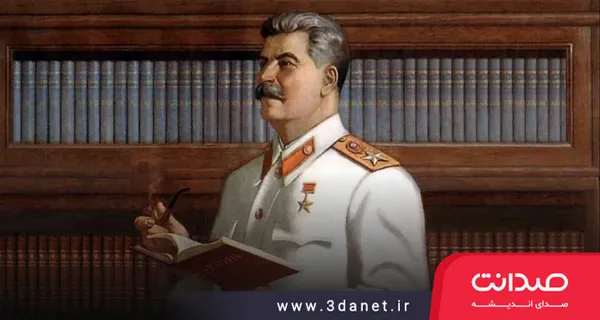
Stalin's Library: What Did the Secret Murderer of at Least 1,500 Writers Read?
Author: Amelia Gentleman
Translator: Nadia Karimi
English source: theguardian
Translation first published: Vinesh
Joseph Stalin, the communist politician and the person chiefly responsible for the massacre of millions across the Soviet Union, also has a hidden side! Stalin's library, with around 20,000 volumes, is that hidden side of the dictator. Do you think examining the books in this library could reveal other aspects of Stalin's life? In the following article, Amelia Gentleman, a writer for the Guardian, explores this subject.
As the evidence suggests, Joseph Stalin was an avid and persistent reader. He even set a daily reading quota for himself! It is said that he read between 300 and 500 pages a day. Stalin's death in 1953, from a heart attack, also occurred in his library. Stalin's library was filled with books that had been studied and meticulously annotated.
While reading, Stalin would write notes in the margins of his books with red, blue, and green pencils. He would even underline parts of the book he found interesting and number important points. Sometimes, when he was distracted (!), he would content himself with writing phrases like "Yes! Yes!", "I agree", "It's rubbish", "Garbage", "It's obvious", and "Futile". Of course, whenever he encountered grammatical or spelling errors, he would become extremely angry and correct the mistakes with a red pencil.
Joseph Stalin amassed a personal library over the course of his life. Researchers estimate that Stalin's library contained more than 20,000 volumes. In addition to this, he would also delve into the personal archives of his friends (!) and read their favorite books. The matter went so far that Demyan Bedny, one of the Soviet poets, complained about Stalin! Because he had left greasy fingerprints on one of his books!
After the events of 1956 and Khrushchev's denunciation of Stalin, plans to preserve Stalin's library were also suspended. Thus, Stalin's personal books were scattered. It is interesting to note that they ranged from child psychology to sports, religion, health, hypnotism, and even the works of Dostoevsky. Geoffrey Roberts (a British historian and author of the book Stalin's Library) says that many academics strove greatly to find the remnants of Stalin's library books, hoping to find the key to the personality of this monster who ruled the Soviet Union. Roberts adds: By carefully examining Stalin's books, we can see the world through his eyes. We may not be able to look into his soul, but at least we will be able to wear his worldview glasses for a few moments!
Stalin admired writers. At the Soviet Writers' Congress in 1934, he said: To build socialism, we need civil engineers. But this country also needs engineers of the human soul, that is, writers. He tried to ensure that his family members were just as good at reading as he was. For example, he gave his stepson a copy of Robinson Crusoe. On it, he wrote: I hope that when you grow up, you will become a fearless, steadfast, and knowledgeable Bolshevik.
Stalin also gifted his daughter a volume of the History of the Communist Party. Of course, it is necessary to mention that this gift was accompanied by a strict order to study it. Sergo Beria, the son of Lavrentiy Beria (Stalin's security commissar), later claimed that whenever Stalin visited someone, he would also drop by their library. During this visit, he would randomly open some books and look for signs that proved the book had been read.
An important part of the vast collection housed in Stalin's library, namely the classic works of Russian and international literature (by Pushkin, Gogol, Tolstoy, Chekhov, Hugo, and Shakespeare), went missing after his death. Therefore, it is impossible to truly understand what his opinion of these works was. But as an example, according to those close to him, Stalin believed that Dostoevsky's works had a bad influence on Soviet youth.
By studying and scrutinizing the remnants of Stalin's library, one can see that he had a great interest in history. Stalin was intensely eager to read works related to the Tsarist era. He can be counted among the devotees of the reigns of Ivan the Terrible, Peter the Great, and Catherine the Great. Moreover, Stalin can also be introduced as a diligent and genuinely enthusiastic reader of Lenin's works! But as for Trotsky! In one of his marginal notes, he sufficed with writing the word "idiot"!
Stalin never thought to write a daily diary and did not try memoir-writing. This is why these marginal notes around the books in his library are so important. Geoffrey Roberts says: Stalin drew a thick line under one of the sentences attributed to Genghis Khan. That sentence is: "The death of the defeated is necessary for the peace of mind of the victors." The word 'teacher,' in Stalin's handwriting on the cover of a play about Ivan the Terrible, also tells us that Stalin considered this despotic ruler as a role model.
According to Vitaly Shentalinsky, author of a book on the KGB's literary archive, approximately 1,500 writers were murdered during Stalin's reign of terror. Of course, this book is not very focused on the details of these writers' activities. Nevertheless, Geoffrey Roberts still judges Stalin with astonishing generosity and forbearance. In his book Stalin's Library, he says: Considering the volume of Stalin's misdeeds (!) as the ruler of the Soviet Union, it is natural if we imagine him as a monster. Or remember him as a man who, in ultimate rage, condemned all opponents. But Stalin was also a dedicated idealist! He was not a psychopath, but also an intelligent, emotional, and sensitive intellectual!
.
.
Stalin was a voracious reader, who set himself a daily quota of between 300 and 500 pages. When he died of a stroke in his library in 1953, the desk and tables that surrounded him were piled high with books, many of them heavily marked with his handwriting in the margins.
As he read, he made notes in red, blue and green pencils, underlining sections that interested him or numbering points that he felt were important. Sometimes he was effusive, noting: “yes-yes”, “agreed”, ‘“good”, “spot on”, “that’s right”. Sometimes he expressed disdain, scribbling: “ha ha”, “gibberish”, ‘“nonsense”, “rubbish”, “scumbag”, “scoundrels” and “piss off”. He became extremely irritated whenever he came across grammatical or spelling mistakes, and would correct errors with his red pencil.
During his life he amassed a personal library estimated at about 20,000 books, but he also read widely from the collections of friends. The Soviet poet Demyan Bedny complained that Stalin left greasy fingermarks on the books he borrowed.
After Khrushchev’s denunciation of Stalin in 1956, plans to preserve the library in his dacha were abandoned and his books (which included volumes on child psychology, sport, religion, syphilis and hypnosis as well as works by Turgenev and Dostoevsky) were dispersed, so it has become challenging to make an exhaustive study of what he enjoyed reading. Geoffrey Roberts acknowledges that many academics before him have scoured the remnants of his collection, hoping to glimpse Stalin’s true nature or find the “key to the character that made his rule so monstrous”.
Roberts finds no smoking guns, but suggests: “By following the way Stalin read books, we can glimpse the world through his eyes. We may not get to peer into his soul, but we do get to wear his spectacles.”
In the abstract, Stalin admired writers, telling the Soviet writers’ congress in 1934 that while civil engineers were needed to build socialism, the country also required “engineers of the human soul, writer engineers, building the human spirit”. He insisted that his family and colleagues should be equally well read. He gave his adopted son a copy of Robinson Crusoe, inscribing it with “the wish that he grows up to be a conscious, steadfast and fearless Bolshevik”. He gave his daughter a Short Course History of the Communist Party, commanding her to read it. Svetlana said she never bothered because “It bored me so.” (She later defected to the west). Sergo Beria, the son of Stalin’s security commissar Lavrenty Beria, claimed that when Stalin visited someone from his inner circle he would go into their library and start opening the books, to check for signs that they had actually been read.
But he wrote frustratingly little about his views on literature. His huge collection of Russian and international classics – Pushkin, Gogol, Tolstoy, Chekhov, Hugo, Shakespeare – was lost after his death. So his thoughts on Dostoevsky, for example, can only be surmised from casual comments to friends who remember Stalin concluding he was a bad influence on Soviet youth rather than from incisive notes made during his reading.
From the works that remain, we discover that he was very interested in history, preoccupied with the lessons of tsarist rule in Russia, ominously obsessed by the reigns of Ivan the Terrible and Peter and Catherine the Great. Most of the surviving annotated works relate to Marxist thought. Perhaps the biggest insight his book collection offers is that he was a diligent, reverential and genuinely enthusiastic reader of works by Lenin. Failing that, he settled for books written by his rivals. When Trotsky’s conclusions annoyed him, he wrote “Fool!” in the margins.
Stalin kept no diary and wrote no memoirs, so these scribblings in the margins become invested with greater significance than perhaps they deserve. Roberts warns against reading too much into Stalin’s decision to underline a line attributed to Genghis Khan, “The death of the defeated is necessary for the peace of mind of the victors”, or assuming that the doodled word “Teacher” on the cover of a play about Ivan the Terrible means that Stalin viewed this tyrant as a role model.
Roberts is startlingly forgiving towards Stalin, noting: “Given the scale of his misdeeds as Soviet ruler, it is natural to imagine him as a monster, to see him in the mind’s eye furiously denouncing opponents.” Instead he concludes that Stalin was “a dedicated idealist”, “no psychopath but an emotionally intelligent and feeling intellectual”.
According to Vitaly Shentalinsky, in his book The KGB’s Literary Archive, approximately 1,500 writers perished during Stalin’s Terror. There is surprisingly little focus on their struggle in this book. Fascinating in parts, its promised insight into Stalin’s true feelings remains elusive.
.
.


Discussion4 comments
استالین دیکتاتوری بود که لیاقتش را در حفظ قدرت می دانست، واز این رهگذر کشتن میلیون ها نفر را روا میدید.
خواندنی بود. سپاس از مترجم و صدانت
این که جامعه دانشمند و تحصیلکرده در دنیا نگاه حاکم بر اندیشه را قبول دارد، استالین را مستبد میداند، دانشگاه را بری از ارزشها و نهاد علمی میشمارد، تاریخ علم رسمی را باور دارد و توجهی به روابط قدرت و چگونگی تشکیل جامعه علمی انگلوساکسونی ندارد، ازصحت و سقم توصیف و تبیینهای ارائه شده بوسیله employeeهای the Establishment قدرتمند جهانی مطمئن هست و نهایتا سؤالی در باره صدق ادعاها و سلامت گزاره های institution مسئول شناخت جهان پیرامونی ما در ذهنش شکل نمیگیرد. اتالین مستبد بود، هیتلر خونریز بود، روزولت پیشنهاد league of Nations (نهاد پیشین قبل از سازمان ملل) را داد، علم آینه واقعیت است و یک سری افراد مخالف علمند و قس علی هذا.
یادش گرامی مرد بزرگی بود