Political Science
Introduction and Review of the Book “The Idea of Progress and New Developments in Iranian Society” with Hadi Khaniki (Author)
In his book The Idea of Progress and New Developments in Iranian Society, Hadi Khaniki reviewed Majid Tehranian's thought on national development—a multidimensional development encompassing both material and spiritual capacity. By integrating science and culture, Tehranian saw Iran differently.
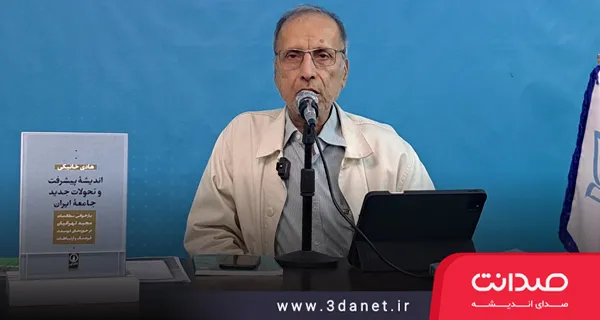
The Ettehad-e Mellat Party, Fars Branch, in its series of talks and thought sessions, has introduced and reviewed the book “The Idea of Progress and New Developments in Iranian Society.” In this session, held on May 8 in Shiraz, Hadi Khaniki, the book’s author and a professor of communications at Allameh University, gave a brief overview of the thoughts and research of Majid Tehranian, which are referenced in this book, and his views on the country’s development. A summary follows, and the video and audio of the lecture along with the Q&A are available for download at the end of the post.
In this short time, I will try, with a brief narrative of this book, to delve more into the issues that are most afflicting us today, namely the issue of “national development” and the foundations and obstacles that stand before it. The main text of the book, which is based on “What is the problem of Iran from Majid Tehranian’s perspective?”, goes back to an important historical context and an important historical approach.
Dr. Majid Tehranian has several characteristics that, in my opinion, help one better understand the problem of Iran. His first characteristic is that he is deeply committed to Iran and tries to see and understand Iran as it is. He is someone who studied, went to Harvard University, and graduated in political economy from that university, and naturally understood the issue of development scientifically at its highest level.
But alongside this, he has characteristics that are very important for understanding the problems of societies like ours, and that is: in which world did he live, and what was, in fact, his base and origin? Dr. Tehranian arose from Khorasan, and his family were those who published the first and perhaps the longest-running Persian-language newspaper that is still published, namely the Khorasan newspaper, and his cousin was the founder of the Khorasan newspaper, and he himself was a relative of Malek al-Sho’ara Bahar. Someone who fought all his life says that Iran needs peace.
His second characteristic was that this individual, within this context, possessed a linguistic competence and a competence of understanding; as you can see in his works. During the time he came to Iran to teach in the doctoral program at Imam Sadiq University, we spoke very sympathetically and with shared views. I clearly saw in him that someone who had spent a significant part of his life abroad spoke in poetic language. He never struggled to find a Persian word. His third characteristic was that he had the courage to enter politics.
The Duality of Politics and Science
There have always been, and still are, specific dualities in Iran, and one of these dualities is that if you want to become a prominent scientist and thinker, you say you have nothing to do with politics, or you become a scientist when you have distanced yourself from politics, or conversely, when you enter politics. Because it seeks quick understanding and quick solutions to problems, it also sees scientific work as contradictory to its political action. Alongside these two avoidances, there is a third avoidance, and that is working within society. When you reach politics, where should you position yourself?
You must take a post, take responsibility, and be placed in high positions, not at lower levels, and believe that unless you are placed there, you cannot do political work. Tehranian was not like this, and a period of his political life was involved with the Confederation of Iranian Students Abroad, which was an anti-Shah regime organization and was active, and they were also leftists. Let’s go back to the 1970s and keep in mind that if you are a leftist, you are placed in the religious-Marxist dichotomy. You are either a Marxist who is anti-religion, or religious and distanced from Marxists. But one of Tehranian’s closest friends when he was in the Confederation was Dr. Chamran; such that when he spoke to me, he referred to him by the name Mostafa, and I had to ask who he meant.
A leftist who was a secretary of the Confederation, and a Chamran who was a mystic-minded fighter. These traits—being concerned, or in other words, being Iranian, being well-read and masterful in knowledge, and also having the capacity to confront problems—made him someone different from the common thinkers, politicians, or scholars of that decade. So much so that Tehranian is one of the few prominent communication theorists in the world and a well-known name. Yet this same prominent theorist in the world everywhere speaks of himself as a traveler from the West and someone in search of Rumi and Ferdowsi.
In my view, these different traits helped him to see the problem of Iran's development and underdevelopment in the 1970s in a way largely different from others. Why different? I will now explain this difference, which is also in this very book. Different in the sense that the 1970s marked the beginning of Iran's high revenues due to high oil sales. The Shah's slogans in the 1970s were "Onward to the gates of the great civilization." That is, to put it very simply: if you have money, you can develop. The study of Iran and Japan, because historically Iran and Japan were always posed as rivals in the development process—after all, when Amir Kabir's reforms began in Iran, the Meiji Restoration in Japan followed 16 years later. The Tokyo Polytechnic University was established later than Dar ul-Funun in Iran.
Or sending students abroad began earlier in Iran than in Japan. You can find many such examples where Iran is ahead of Japan in the first step, and then you see that Japan has pulled ahead. During Reza Shah's authoritarian modernization, modernity was also defined from above and due to the authority of the government; again, one model was Iran, and now that Iran has high oil revenues, the Shah's invitation to research centers is also—and of course, the answer is clear—what should we do to become the Japan of West Asia.
Among the first people to conduct this study in Iran is Dr. Tehranian, one chapter of which I have included in this book, and it is a translation of the research he conducted for UNESCO. He begins studies of this kind, and the concept of development he arrives at clearly states that development is not a purely economic matter.
Development is a multifaceted and multidimensional matter
Development is a multidimensional and complex matter where economic, social, political, and cultural factors exist alongside one another. This understanding of development is very common today. At that time, Tehranian, contrary to theoretical and policy-making conventions, sought this out and proposed that development is a multifaceted and multidimensional matter. Pay attention to this very neat definition that Tehranian proposes, a statement made in the mid-1970s, not in the year 1400 or the 21st century. He says development means the increase of the material and spiritual capacities of the national system and reaching new levels of complexity, order, and innovation. Spiritual capacities mean: does that society enjoy tolerance or not? Can it engage in dialogue or not? Are its elites mutually accepting and participatory, or anti-participation and pessimistic? Does it define everything based on polarized and antagonistic mentalities? And when he speaks of the beliefs and hopes that exist for development, even in Iran, he also emphasizes the spiritual dimension of development. Such as the ethics of development, the psychology of development, the politics of development, the dialogue of development, all of which are important.
In addition to these two foundations, he determines three levels where both the material capacities and the spiritual capacities of development must reach new levels in these new layers; become more complex, more systematic, and more innovative. These statements are not only about the material resources of development. Becoming more complex means, for instance, not exporting crude oil but having petrochemicals emerge alongside it and other industries take shape. It is not only and merely this; a society whose ethics also become more complex compared to the past. What does more complex ethics mean? In simple ethics and traditional ethics, it is very clear. We say do not lie, do not slander. But modern ethics asks: is the media and communication system of that society based on lies or not? Is it based on slander or not?
In 1976, Mr. Tehranian assumed responsibility for the communications committee of the Sixth Development Plan. With the participation of virtually all experts in the field of communications—from those versed in theater, music, and cinema to media specialists and the like—he came and accomplished a monumental task. To illustrate how pioneering it was, I point to the term "information society," which appeared in the report of the Sixth Development Plan committee in '76, defining Iran's problem system in terms of communications as moving from a society based on oral and face-to-face communication toward multimedia.
A conference titled the Shiraz Conference was held in this very city of Shiraz. At this conference, he argued that National Iranian Radio and Television was losing its position to small media—such as those transmitting the Imam's messages via cassette tapes; leaflets, statements, mosques, religious gatherings, get-togethers, coffeehouses, and programs held among students—a collection of these media were prevailing over radio and television.
An emphasis that, of course, went unheeded was his point that instead of expanding its technology, National Iranian Radio and Television should ensure that society's reference groups were seen there. It is someone with this approach, this background, and this encounter who defines the problem of Iran's development. I have presented this issue in 8 chapters of this book; various places where he discusses the role of media in national development, compares Iran and Japan, and raises the requirements inherent in the idea of progress.
A Value Transformation Occurring Beyond Generational Change
The issue that Dr. Tehranian raises is a very broad one. He first proposes three transitions encompassing political transformations, economic transformations, and communications transformations, and then sees that this is insufficient, and in his latest research, he also considers six transitions. That is, he also studies social transition, cultural transition, and psychological transition in society.
The central signifier of all these studies is that Iranian society has changed rapidly. We are speaking of a society where everything underneath has changed. We are faced with a diverse and pluralistic society. In this diverse and pluralistic society, civil institutions have not grown in proportion to this diversity and plurality. From political institutions, such as parties and political organizations, to trade and professional bodies—that is, we are faced with a mass-like society and a fluid society. I demonstrated this in the final chapter, meaning I summarized what these changes essentially are.
I should also mention that we were supposed to conduct this research in 1996 when Dr. Tehranian came to Tehran, and he followed up several times afterward and came to Tehran; but because Kayhan newspaper published an article about him, labeling him a CIA spy, he never came to Iran again and later passed away. In 2022, amidst all this and in parallel with undergoing treatment in both Shiraz and Tehran, I began this work; simultaneously, because the 2021 presidential election took shape under different conditions and the reformists did not hold a unified position—some participated in the election and some did not—Mr. Khatami also asked me for such a study on the reasons behind people's decisions and their changes.
Among these changes was the fact that, although it requires much explanation, the common notion—whereby we hastily simplify interpretations of changes, speaking of Generation Z and Alpha and the like, and talking about the inability of dialogue between older and newer generations or vice versa—my argument and the conclusion of that research was that a value transformation has occurred beyond generational change, meaning we ourselves have also changed. If we are 60 or 70 years old, when we look back at our past and our previous ways of confronting issues, we too have changed, and indeed, in some respects, this change is such that we have been unable to engage in dialogue even with our own past. That is, it is not merely that we cannot speak with the other, but we cannot speak even with ourselves.
Components of Hard and Soft Change
In the ninth chapter of this book, where I presented these discussions in a very condensed form, I said that there are three important events based on which we must now redefine the question of Iran. At the first level, we must recognize and understand the components of change in Iranian society. These components of change include both hard and soft components. A society that has become more urbanized and whose literacy level has increased, a society in which the level of women's participation has risen, or whose style of religiosity has changed, and whose style of media use has changed; ultimately, this very field of communication, which we refer to as the communication revolution, but new communication theorists say that the communication revolution itself contains three types of revolution within it. The internet revolution, which has altered access.
The device or technology revolution, which is the smartphones in our hands, and you see that it contains a stadium, a cinema hall, a library, a classroom, a marketplace for selling goods, receiving goods, and all of these. The third revolution, which receives less attention, is the intertwining of these two. That is, the internet and mobile phones and social networks. Meaning, social networks do not belong only to the present time and have existed since ancient times. From old times, we saw that when the residents of a region came to a larger city, if they were laborers, they would gather in a coffeehouse, and if they were people of rituals and ceremonies, they had monthly gatherings, and so on. This has undergone its own changes, which we must first understand as the components of today's changes in society.
The second level is the technological transformations themselves and the discussion around them. Look at the phenomenon of artificial intelligence now and what can be done with it. Now, in light of these technologies, our traditional institutions and our conventional institutions, which are not even traditional, it is not clear whether they can perform their roles well; for example, Mr. Castells, who came to Iran in 2007, said that he had come to the Middle East three times in the past year, once at the invitation of an academic institution and twice at the invitation of companies working in the United Arab Emirates. That is, companies sought out Mr. Castells, and such changes are not few.
Horizon-opening towards the future is very low
In any case, these technological transformations, which have accelerated and shortened distances, and the neighborhood that has occurred in a multicultural world, we have inevitably been forced to confront these. The third level, which is both my lived experience and something I pursue intellectually, is the issue of dialogue. Today, I reduce the question of Iran, with all its complexities that you can start with water, land subsidence, soil erosion, the environment, and so on, to ethnicities, religions, gender, and all of these, to the fact that our society is in dire need of dialogue. Society is severely suffering from the erosion of social capital, and the level of hope for the future and horizon-opening towards the future has become very low.
In all the recent surveys conducted, including the famous survey of Iranian values and attitudes, it is evident that when its statistical population across Iran is asked how they predict Iran's situation in the next 5 years, they predict it will be worse at almost all levels. More important than the question of which direction Iran's situation is heading is this perception or feeling that exists in Iranian society that the situation is getting worse, and the distrust towards others, and the growth of individualism and the growth of material values in society, which is rapidly increasing, forces us to open up society. We should not think that only society lacks this proper understanding. We must also accept that we ourselves do not understand. To understand what we must do, we need to develop the capacity for dialogue.
No level of politics offers a solution for our problems
The third part of this final chapter of the book is, in my opinion, very important for understanding today's problem, where I presented both the problem and the solution under the title of dialogue. The multitude of issues and the density of problems in Iran show that no political force and no level of politics can single-handedly provide a solution for our complex economic, cultural, social, and historical problems. Because problems have accumulated, the country's political and executive system at its various levels, with whomever it consults, with any political force, and in any meeting with any theorist, and any search it conducts in artificial intelligence to find the future's problem like a Hafez fortune-telling, goes to see what Iran's problems are, and ultimately there is a kind of bewilderment and confusion.
By dialogue, I do not at all mean pseudo-dialogue or masks of dialogue where we think a television program on Channel 4, for example, where a few people sit and address an issue, is dialogue. What I mean is that understanding the problem precedes the solution, and executive bodies or the governance system, due to the accumulation of its problems, seeks quick solutions.
Whenever any executive body asks us "what is to be done?" and seeks help, its first question is what solution you have for the problem right now. For instance, what is your solution now for the problem of electricity imbalance? What solution do you have for opening new horizons in our international relations? With that continuous study, one side of which was Dr. Tehranian, another side myself, and another side the urgency that illness imposed to organize it sooner, my view is that we need dialogue while we are incapable of dialogue and also lack the necessary skills for engaging in dialogue.
In other words, we interpret dialogue within our previous experiential and intellectual framework. I think there are five obstacles to dialogue that we can consider as an issue of national development in Iran. The first issue is that dialogue is a matter of thought. That is, it must first create an intellectual capacity and power, and this elevation of intellectual power is not achieved through elimination, coercion, self-centeredness, and the like. Dialogues in the realm of thought have two characteristics. One is that they have lineage. It is not a fashion of thought that we can say should be easily rendered obsolete and discarded every day.
The second characteristic is that it requires critical power and critical revision. Critical revision does not mean negation. Nor does it mean absorption. That is, you must see everything in its own era. So the issue is how we deal with and react to different worlds of thought and to those who think differently from us. This is the very weakness in dialogue that exists.
The second issue is our way of confronting complex problems. We usually deal with complex problems in a simplistic way. We deal with multifaceted problems in a one-dimensional way. We think all problems have only a political solution, and the political solution is only a radical one. Look at Iran's economic problem today, for example. The problem is economic, but it has a political solution.
The third issue is the problem of describing and explaining perceptions. It is often correctly said that we do not understand the problems of today's society and country. What does it mean that we do not understand? Do we lack data and information, or do we lack the context that is supposed to interpret our information? In my opinion, it is more in that context which explains this information and data. Here, the issue of language is very important.
When David Bohm, as a physicist-philosopher, wants to define dialogue, he says, "Dialogue is learning to play with one another, not against one another." The fourth issue is the field, space, and possibility for dialogues, both in general and in specific terms. In our society today, this space and possibility is very limited. I know these very constraints where a significant part of our political forces have no space to speak seriously; this is a very important issue, that we must also think about the space and possibility for dialogue.
Our mentality is largely based on suspicion
The fifth issue is that of presuppositions and stereotypes, which is a historical problem. Our mentality is largely one based on suspicion and understanding rooted in mistrust. This is, of course, a historical issue. Social psychologists and researchers both inside and outside Iran have examined this and asked why, fundamentally, elites in Iran are more pessimistic toward one another than anyone else. For their pessimism, it makes no difference whether they are in a political party, a university, an economic firm, or an administrative organization. This issue of presuppositions is also a significant obstacle to dialogue.
It is for this reason that I pointed out that the book The Idea of Progress must be read in this sense. Alongside it, of course, other new discussions about development have also begun. The work that Dr. Renani has organized under the title The Intellectual Dynamic of Development, in which he has so far presented more than ten narratives of development. There are other narratives that have taken shape in the virtual space; I also invite you to study the views of Dr. Goodarzi and Dr. Kazemipour under the title “What Happened,” which is about the decline of social solidarity in Iran and the shrinking and diminishment of the societal side in the face of the sides of power and wealth; although I myself am among the hopeful who say that solidarity in Iran is manifesting its new forms.
.
.
Watch the video of Hadi Khaniki's lecture on YouTube | Aparat
Audio of Hadi Khaniki's lecture
Audio of Q&A with Hadi Khaniki
.
.
Subject: Introduction and Review of the Book “The Idea of Progress and New Developments in Iranian Society”
With: Dr. Hadi Khaniki (Author)
Time and Place: Shiraz, 8 Ordibehesht 1404 | Ettehad-e Mellat Party, Fars Branch
Series of Goftar va Andisheh Meetings – Meeting No. 83
Shiraz, Moallem Square, Hemmat (Iman) Jonubi Street, Alley 17, Corner of 17/2 Branch
.
.

Discussion0 comments
No comments yet; let yours be the first voice.