Political Science
Ten Critiques of Abazari's Remarks on Neoliberalism and Fascism
A valuable lecture by Abazari on fascism and neoliberalism nonetheless contained claims inconsistent with the evidence. While acknowledging governments' neglect of the poor, the author argues that labelling Iran's economy as neoliberal and the market-versus-institutionalist dichotomy are both false.
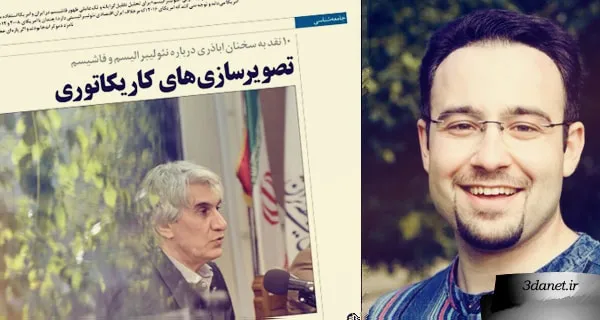
The recent lecture by my dear and learned professor, Dr. Yousef Abazari, on Fascism and Neoliberalism in Iran and America, sparked fruitful discussions in Iran's public sphere. This critical lecture by the professor, like several of his previous talks, contained valuable and important warnings, wake-up calls, and insights, while at the same time some of its central claims were inconsistent with empirical data and evidence, and a certain sloppiness and lack of precision in judgment and the use of concepts and data could be observed in it. Given the necessity of taking Abazari's warnings seriously, in addition to points that other critics have raised and published, which I will not repeat, I will proceed to mention a few critiques or points.
The Necessity of Reformists and Moderates Paying Greater Attention to the Poor
Before presenting a few critiques, I must emphasize that I fully agree with Abazari's central claim that post-war governments have not fulfilled their duty of attention to the poor and the issues of the most vulnerable and lowest strata of Iranians. For example, none of the post-war governments have taken Iran's three to five million addicts seriously or provided efficient and substantial services to reduce their numbers and suffering. Reformists, moderates, and developmentalist political forces in Iran have not paid sufficient attention to the fact that the majority of Iranians who voted for Ahmadinejad are grappling with "real issues," and these real issues must be better understood, taken seriously, and planned for more earnestly.
The economically lower classes in Iran have a right to be dissatisfied with post-war governments. An efficient social welfare system is not at their service (for example, even the Imam Khomeini Relief Foundation does not assist poor alcoholics in Iran), they have no money, they cannot find work, and even if their children study, they do not see a promising prospect ahead. Iran's reformists and moderates must act in such a way that the lower classes (who often voted for Ahmadinejad) themselves feel that Iran's developmentalists have taken their issues seriously, understand their economic demands, and have a plan to address them. But to date, Iran's developmentalists have not been able to represent this segment of the population and have had little success in expanding "participatory development." It is essential that Iran's reform-seekers somehow give this part of society hope in the prospect of trends and the future, and create conditions in which they believe that through effort, they can find more jobs and greater economic success through predictable pathways.
The high unemployment rate and accumulated social harms have also brought significant non-economic consequences and could lead to costly, unpredictable outcomes. It is worrying that the majority of Iran's vast army of unemployed feel that this economic system no longer works for them, and even with effort and education, they see no promising prospect for themselves. This despair and distrust in the mechanism of the economic system is a kind of fire under the ashes that could have devastating costs. Ahmadinejad's two presidential terms were one of these costs of the reformists' neglect. Iran's first-place ranking in addiction in the world is among these results. The Arab Spring was also partly due to this feeling among the youth of those societies. In the 1400 elections as well, the candidate who will likely win is one whom society believes is anti-corruption and whose concern is reducing the suffering and poverty of the lower classes. If reformists want to have such a candidate, they must now correct the direction of their attention, policies, and discourse. While emphasizing the importance of Abazari's attention to this issue, I will proceed to present a few critiques of his remarks:
1- Iran's Economy: Mixed, Not Neoliberal
The claim by Abazari and some leftist critics of the government’s economic policies that Iran’s economic system is a neoliberal one is a strange and indefensible assertion. Iran’s economy is still a hybrid, heavily oil-based and state-run system that also has an underdeveloped, opaque, and not very competitive market, in which the three post-revolution governments have implemented some neoliberal policies and reduced state ownership in a few limited areas. One can see evidence of neoliberal processes and market strengthening in Iran and rightly criticize some of these policies, but we do not have a suitable, established overall label for Iran’s peculiar, hybrid economy, and by no measure can it be called “neoliberal” given this level of state ownership, monopoly, state educational and health services, and subsidy payments. One can criticize some neoliberal policies in Iran’s economy while also criticizing the insulting and imprecise use of the neoliberal label. It is fundamentally indefensible to deem all policies of reducing state ownership or all policies of state intervention as universally desirable or condemnable. To expand development and economic justice in Iran, in some areas we actually need neoliberal policies and a smaller state, while in other areas efficient state intervention and ownership is a better choice. A blanket prescription cannot be written. Nor can Iran’s economy be called neoliberal or socialist-statist as a whole, just as Iran’s government cannot be considered a fully democratic or authoritarian state. In Iran, certain neoliberal policies (such as deregulation and privatization of industries) and socialist ones (such as expanding health insurance coverage and universal education) have advanced simultaneously. Critics like Abazari see only half of this picture, and in describing that more neoliberal half, they focus solely on its costs and ignore its achievements.
2. The False Dichotomy of Free-Market Economics and Institutional Economics
The portrayal in Iranian media of an economic battle line between proponents of free-market economics on one side and leftist institutionalists on the other is based on a mistaken premise. Fundamentally, institutionalism is a current within economics, not an alternative to the capitalist economy. In Iran, we do not know of any representative within the academic tradition of this current who has received top-tier training and produced significant scholarly output, and much of the posturing and criticism on both sides has an ideological basis. “Free-market ideology” versus “anti-free-market ideology.” The valid criticisms of certain policies from the Sharif University Economics Department and Niavaran Institute circle do not negate the fact that at least some figures in this current are connected to mainstream contemporary economics. In contrast, unfortunately, most figures in Iran’s more left-leaning economic current are not well-equipped with modern economics and have been incapable of offering possible alternative and positive proposals. Parties with social-democratic and center-left developmentalist leanings (such as the Ettehad-e Mellat Party, the Mojahedin of the Islamic Revolution Organization, and part of the national-religious forces) and activists and policymakers concerned with expanding economic and social justice are also deprived in Iran of consultation with economists doing top-tier work in the mainstream of contemporary economics, and the voice of this tendency is weak in the public sphere and policy circles.
With the return of more economics graduates from the world’s top universities (both left-leaning and right-leaning) and their employment in economic decision-making, this false dichotomy—free-market economics and institutional economics—which has mostly ideological proponents, can break down, allowing modern economics to take center stage and be used more effectively in policymaking to serve development and justice.
3- The Scholarly Weakness of Leftist Economists in Iran Governing institutions and many leftist critics such as Yousef Abazari do not emphasize the necessity that improving economic policymaking in Iran to reduce pressure on the underprivileged requires strengthening economic policy think tanks and taking the professions of “economics” and “policymaking” seriously in Iran. The efficient and fruitful activity of economics researchers and these think tanks is also fundamentally impossible without extensive and regular contact with similar scientific and policymaking institutions in developed countries. The Niavaran economic circle and Sharif University in Iran, which are severely criticized by Abazari, happen to be the only circles connected to contemporary economics in Iran. Sooner or later, Iran’s rulers, conservatives, and security institutions must accept, like the rulers of countries such as Turkey, that economics and social policymaking are also professions requiring global connections, and just as security institutions, for example, create no obstacle for the scientific communications and conferences of Iranian physicians with the presence of prominent non-Iranian specialists and professors (even if the speakers are tie-wearing atheists), they should also create no obstacle for the travel and scientific exchanges with economists from the world’s top universities and economic policymakers (from both leftist and rightist leanings). Just as they have understood today that it is necessary to permit learning and scientific exchange for employing the latest cardiac procedures (so that they or their loved ones do not die from surgical methods from two years ago), they must also realize the importance and necessity of using up-to-date knowledge of economic policymaking and, without conspiracy thinking, provide the opportunity for Iran to connect to the global network of the economics profession and science. Justice-seeking intellectuals and politicians must also, instead of merely offering general critiques and discrediting the Niavaran and Sharif University school, place greater emphasis on the necessity of elevating the status of the economics profession and the connection of Iranian economists with leading global scientific institutions, if they sincerely want their demands to be translated into justice-seeking and effective economic programs.
The fact that in recent years, intelligent and studious Iranian students in the field of economics at the world’s top universities and in Iran have increased (in both rightist and leftist leanings) can help the more serious formation of the economics profession and a network of up-to-date and strong economists in Iran. But these young economists who have studied well, if they do not maintain their contact with scientific institutions outside Iran and developments in economic knowledge, will see their scholarly vitality drained after a few years. Unfortunately, there appears to be a ludicrous law that new faculty members in Iran, before formal employment, are not permitted a multi-month/one-year research trip to universities outside Iran, whereas the necessity of these trips and publishing articles before becoming official is actually greater, and the seven-year wait until the first trip after their doctorate largely burns them out. Reducing the general weakness of the more applied fields of “social and economic policymaking” and “political management” and the programs of parties and governments in Iran also requires a larger number of talented Iranian students to study in this area at the world’s leading universities and to return and gain practical experience in Iran.
4- The Usefulness of Monetizing Subsidies for the Underprivileged In part of his remarks, Yousef Abazari reads the monetization of subsidies during the Ahmadinejad era as an instance of neoliberal policies and to the detriment of the underprivileged. This claim is also a matter of dispute, and for example, Dr. Javad Salehi-Isfahani, Professor of Economics at Virginia Tech, holds a different view. Salehi-Isfahani is one of the few Iranian economists who has managed to combine top-tier scientific activity in the field of economics with regular trips to Iran, maintaining contact and field knowledge, and relying on first-hand data that he personally collects during trips and from Iranian governmental and private institutions. Attention to the social consequences of economic policies and the issues of the lower deciles is also among his strengths. In a series of his articles and notes (which are available on his website), relying on official statistics from the Statistical Center, he has shown that the implementation of targeted subsidies by Ahmadinejad led to a reduction in inequality in Iran, and although there are criticisms of the manner of its implementation, the principle of this step is worthy of defense and helped improve the lives and reduce the poverty of the underprivileged.
In countries with a high percentage of non-tax revenue, given Iran’s demographic scale and less-than-stellar governance, empirical studies show that citizens themselves can spend subsidies better than the government, and paying cash subsidies to them is a more fruitful choice for the country’s economy and economic justice. For this reason, this method of distributing a portion of national income among citizens has gained popularity in recent years among influential economists at top-tier universities worldwide. Due to the lack of an advanced tax system, precise information on citizens’ economic status, and the absence of a broad class of professional accountants whose credibility and profit lie in avoiding assistance with tax evasion, in Iran this cash subsidy, until further notice, is better paid to the entire population (and not just the lower deciles). Salehi-Isfahani believes that under the Rouhani administration or any subsequent government, it would be better to distribute about ten percent of oil revenue as cash subsidies among all Iranians.
One of the arguments put forward by right-wing opponents of converting subsidies to cash is that this leads to a reduction in motivation and hours of productive economic work and an increase in voluntary unemployment and addiction. This notion is completely baseless, and as comparative, controlled studies between those who receive subsidies and those who do not show, this is by no means the case. The needs and expenses of Iran’s lower and middle classes are far too great for receiving a few hundred thousand tomans to cause them to work less. On the other hand, left-wing critics of price increases also pay little attention to the fact that instead of the enormous volume of money the government spends on hidden subsidies (such as the price of gasoline), more effective services can be provided to the deprived (for example, by investing in educational infrastructure, more precisely identifying vulnerable groups, and providing more effective financial and institutional support to them). 5- The Necessity of Fairness in Describing the Ahmadinejad Era Ahmadinejad’s governance was deeply damaging and his economic policies were often highly erroneous, and during his tenure a large portion of national income was “squandered” or “wasted.” But even in criticizing the Ahmadinejad era, the judgment of Abazari and some leftist intellectuals, reformists, and moderates is exaggerated and inconsistent with reliable data and evidence. For instance, the constant claim that the $800 billion in oil revenue during Ahmadinejad’s era exceeds the total oil revenue of all previous governments is inaccurate and misleading. Ahmadinejad’s oil revenue was very high, and its expenditure management was disastrous. No jobs were created, and the economy reached negative growth, but none of this justifies the exaggerated claim being made, because both the value of the dollar has changed significantly over the past 100 years and Iran’s population has increased. As Javad Salehi-Isfahani has shown, the oil revenue during Ahmadinejad’s era was $639 billion (not $800 billion), and the total oil revenue of all governments since the 1960s was $582 billion. However, if we factor in changes in the dollar’s value, Iran’s highest oil revenue belongs to the last 8 years of the Pahlavi government (and not the Ahmadinejad era), and the oil revenue of the Khatami administration amounts to 38 percent of the Ahmadinejad administration’s oil revenue. If we also bring population size into the picture, the revenue of the last 8 years of the Pahlavi government becomes more than three times that of the Ahmadinejad administration. Abazari and most reformists and intellectuals also overlook this “fact” that credible economic reports and studies show that during the Ahmadinejad era, although Iran’s economy and the middle class suffered severe blows, the condition of Iran’s poor improved and economic inequality decreased (which, of course, was largely due to the rise in oil prices and the distribution of cash subsidies).
6- Disregard for the Necessity of the Globalization of Iran’s Economy
Abazari overlooks the fact that the achievement of the JCPOA, the reduction of sanctions, and Iran's greater integration into the global economy (which benefits all economic classes in Iran) would not have been possible without the reformists' support for the moderates and the Rouhani government, and maintaining this coalition remains necessary for the foreseeable future. Prominent Iranian economists unanimously agree that to solve the unemployment problem and achieve economic prosperity in Iran, we have no choice but to globalize by attracting foreign investment, acquiring modern technology, and making Iranian products competitive for international markets, while simultaneously preventing the majority of Iranian citizens from becoming losers in this globalization. Any political current in a position to lead Iran's establishment and government that sincerely seeks to strengthen Iran's economy and reduce poverty and unemployment has no alternative but to submit to the globalization of Iran's economy. Unfortunately, the main policymaking currents in Iran are either indifferent to the unavoidable necessity of globalizing Iran's economy or lack sufficient plans to prevent a large segment of Iran's population from losing out in this more globalized economy and to support more vulnerable Iranians in this process.
7. An Incomplete and Caricatured Picture of Iran's Situation Many of the economic policies Abazari objects to are worthy of criticism, but the picture he presents of the totality of post-war governments' policies is caricatured and selective. One can, for example, criticize the commodification and monetization of university education and the state's insufficient attention to workers and the bottom three deciles of Iranian society, while simultaneously offering a fairer overall picture of the general state of Iran's economy. In Iran and many peer countries, some policies of reducing state ownership have been implemented, but at the same time, the level of public and state service coverage in the areas of education, health, and urban infrastructure has also expanded.
Abazari fails to notice that the very state he labels neoliberal is, relative to its population, one of the largest states in the world, and its level of coverage for electricity and water supply, literacy, rural schools, health services and medical insurance, and free school and university education is higher than all countries in the region (including Turkey and Egypt). Abazari rightly criticizes the uncritical implementation of some International Monetary Fund and World Bank recommendations in Iran, but he himself, without regard to empirical evidence, assumes that the prevailing economic policies in Iran have produced results similar to neoliberal economies (including the United States). He does not notice, for instance, that unlike the United States and many countries governed by neoliberal policies, the income of the bottom 40 percent of Iran's population has, on the whole, been protected throughout the governance of all governments over the past four decades. This protection, under conditions where average economic growth in the post-revolution years has been low and the revolution, war, and the era of "Mahmoudian tribulation" have imposed heavy costs on Iran's economy, is no small achievement. Despite major, episodic shocks, the income gap has generally been declining in the post-revolution years. Abazari overlooks that over the past four decades, while economic growth has been negative overall for the upper deciles of society, it has been positive overall for the economically weaker deciles. The level of coverage and services provided by governmental institutions such as the Construction Jihad, the Imam Khomeini Relief Committee, and rural health houses, and the degree of social mobility through education at public universities, are also unrivaled in the Middle East. Iran has been one of the few societies where greater economic growth and deeper integration into the global economy have coincided with a reduction in class disparities, and the enlargement of the national economy has benefited all economic classes.
The state's support policies have by no means been efficient or sufficient, and the situation of the more deprived deciles could have been better with more judicious policymaking, but an exaggerated and one-sided description of the state and direction of Iran's economy is also unjustified. The Rouhani government has also had considerable success in restoring relative stability and calm to Iran's economy and reducing inflation (both of which also benefit the lower classes). In the first two years of the Rouhani government, poverty and inequality decreased, although in the third year (2015-2016), the levels of poverty and inequality rose again due to the drop in oil prices.
It is not out of place here to draw a comparison between what happened in the Iranian economy in 2012 and 2015. Oil revenues in 2012 (during Ahmadinejad’s second term) fell by about 40 percent compared to 2011. In such a situation, and given the sanctions, exports dropped to one million barrels per day or less, inflation rose sharply, and the foreign exchange market experienced strange turbulence. That great turmoil of 2012 in the economy occurred with oil revenues of $68 billion, which was nearly three times the oil revenues of 2015. In contrast, in 2015 (during Rouhani’s term), Iran’s economy faced a 55 percent drop in oil revenues, which was greater than the 40 percent decline of 2012; yet none of that turmoil occurred. This containment of further damage to Iran’s economy and the underprivileged was, as it happens, the product of the policymaking of the very Niavaran circle that Abazari sharply attacks. Perhaps this is why, despite worsening economic conditions, the moderates achieved considerable success in the 2016 parliamentary elections. The success of the JCPOA and the fact that most people, unlike Abazari, realize that the government’s hands are not very free in reducing poverty and unemployment and that some of the important obstacles to development lie outside Rouhani’s cabinet were also influential (although, contrary to the First Vice President’s assertion, the worst year for Iran’s economy after the revolution was not 2015, but the final year of the Iran-Iraq War).
8. Insufficient Signs for the Emergence of Fascism in Iran Abazari has so far mentioned two instances and signs of fascist tendencies in Iranian society: 1) the mourning gathering for Pashaei, and 2) the anti-Arab slogans at the Cyrus Day gathering in Pasargadae. I critiqued the first instance last year in the note “9 Experience-Based Critiques of Abazari’s Remarks” (goo.gl/HfpWTI). The second instance also seems insufficient for Abazari’s claim. Some manifestations of “collective narcissism,” including extreme nationalism and the humiliation of Arabs, Afghans, and Turks among a segment of Iranians, are worthy of critique, but the claim of the emergence of nationalist fascism based on the evidence Abazari cites does not seem defensible. At the gathering Abazari refers to, which has been held for years (and explaining the reasons for its formation and flourishing is not possible in this space), fewer than fifty thousand people participated this year. According to numerous eyewitness accounts, out of these tens of thousands, only about fifty people chanted the slogan “We are Aryans, we do not worship Arabs.” At the same gathering, the majority of the crowd’s slogans lacked anti-Arab elements, and even a number of Iranian Arabs had participated. As it happens, this year the extremist and anti-Arab slogans at this gathering were noticeably fewer than in previous years. In a society where two to three million people travel to Iraq to participate in the Arbaeen pilgrimage and march, four million people go to Mashhad on foot and by vehicle on the martyrdom anniversary of the eighth Shia Imam, more than a hundred thousand gather in the stadium for Tehran derbies, and at a time when, for example, more than fifty thousand people attend concerts by rock music stars, a gathering of fewer than fifty thousand people at the quasi-ritualistic, Iranophilic, and entertaining commemoration of a national and historical figure—Cyrus—in Pasargadae is not so strange and is not necessarily a sign of the emergence of fascism.
9- An Exaggerated and One-Sided Analysis of Trump's Rise Abazari uses the magical key-concept of “neoliberalism” for a reductionist and single-factor analysis of the emergence of fascism in Iran and America. In part of his remarks, he considers Trump's victory to be the product of neoliberal policies in America, and does not note that the America of 2016 (which, unlike Iran, has a neoliberal economy) is not much different from the America of 2008 and 2012 that elected Obama. If this year Obama, Sanders, Joe Biden, or Elizabeth Warren had been the Democratic nominee, and if it were not for certain campaign management errors by the Democrats, Trump's victory in this same America would have been avoidable (in the note “Four Major Mistakes of the Democratic Campaign” I have pointed to several of these errors). Certain neoliberal policies and the neglect of the most vulnerable Americans by the leaders of both major U.S. parties over the past two decades also played a role in Hillary's defeat, but one could argue that the America of 2016 has, as it happens, become slightly more socialist than the America of 2008: Obama's health insurance has covered twenty million lower-class Americans, gas for heating the homes of the disadvantaged has become cheaper, the income gap between women and men has narrowed, the U.S. government has grown larger, the very globalization of the American economy and policies that led to the discontent of low-income, low-education whites in the Midwestern and Northern states have created jobs for another 14 million Americans and carried America through the pass of the most significant economic crisis in recent decades, the situation of people of color, women, and religious and gender minorities has slightly improved, and as it happens, Obama's more progressive economic, cultural, and social policies were among the factors behind the discontent and backlash of low-education white Americans.
10- Abazari's Wrong Address
Apart from the fact that Abazari, in his remarks, shows little concern for the precise use of concepts or reliance on empirical evidence, he has found no easier target than the reformist and moderate governments, and makes not the slightest reference to the role of sectors outside the Iranian government in the economy and the widespread monopoly and corruption they foster. A responsible intellectual strives, while offering a frank and effective (even if angry) critique of the parts of the government in need of reform, not to weaken and destroy other parts of the government and the political forces that make such reform possible (today, a segment of the reformists and moderates). Abazari, however, while rightly speaking of the desirability of greater politicization and participation by a larger percentage of Iranian citizens, does not explain how increasing distrust of all political currents (from moderate principlists to moderates and reformists), disregarding their internal pluralities, and tarring them all with the brush of "supporters of anti-justice, fascism-nurturing neoliberal policies" increases this political participation? On which effective and actually existing political force can one rely to pursue justice-seeking policies? Among Iran's effective political forces today, which deep-rooted current has been more justice-seeking than a segment of the reformists and has striven to reduce poverty and increase welfare? Reducing poverty and unemployment and drying up the grounds for the emergence of fascism requires, among other things, critiquing and strengthening the more justice-minded wing of the reformists and the Obamas, Sanderses, and Corbyns within the governing system, not suppressing and destroying them and clearing the field for the emergence of second Trumps and Ahmadinejads. To improve the situation of the deprived in Iran, we need a more transparent, healthier, and more competitive "market," as well as a "plan" and efficient, intelligent supportive and interventionist policies by the government (especially in the areas of healthcare and education), and also greater "civic participation" by responsible citizens. The continued, more effective presence of justice-seekers and developmentalists, and the coalition of reformists and moderates in the government, helps strengthen all three of the above forces to reduce poverty and unemployment. Abazari, however, offers no constructive proposal for reforming and improving the grounds for any of these three forces to play a role, and instead of paying attention to the main obstacles to the expansion of development and justice in Iran, he points in the wrong direction. "Fairness" in analysis, "precision" in the use of concepts, the "courage" to address the root causes, and "sensitivity" to empirical evidence and the practical effects and consequences of critical discourses are characteristics of responsible intellectualism, and we need the justice-seeking wake-up calls of such intellectuals. It is not only right-wing populism that can pave the way for the emergence of fascism and should be a cause for concern. Left-wing populism, too, by attacking structural rationality, extreme anti-statism, and spreading distrust of all reform-seeking political forces and structures, can inadvertently pave the way for the strengthening of fascism.
.
.
Ten Critiques of Abazari's Remarks on Neoliberalism and Fascism
Mohammad Reza Jalaeipour
(Published in Etemad Newspaper – Saturday – 27 Aban 1396)
.
.


Discussion1 comments
حیرت آور است که جلایی پورهای پدر و پسر کل مسئله ترامپ را به اشتباهات کمپین انتخاباتی دموکرات ها تقلیل می دهند. ظهور پدیده ای مثل ترامپ را به «اگر پارهای خطاهای مدیریت کمپین دموکراتها نبود، پیروزی ترامپ در همین آمریکا قابل اجتناب بود» ساده کردن کوتاه بینی خاصی لازم دارد که ظاهرا خصیصه بخشی از اصلاح طلبان وطنی ست. ممکن است حرف های اباذری راجع به اقتصاد ایران اشتباه باشد، اما اصل حرف او در مورد ترامپ را باید در مورد پدیده ترامپ فهمید و نه صرفا یک پیروزی انتخاباتی.