Philosophy
The Ambition of Separation: A Conversation with Hassan Eslami Ardakani
Opposition to philosophy is as old as philosophy itself, often driven by the perceived self-sufficiency of religion and a fear of weakening the faith of the masses. The School of Tafkik (Separation) has advanced this opposition by claiming a fundamental distinction between philosophy and religion, and Hassan Eslami Ardakani examines the roots of this current within Shiism.
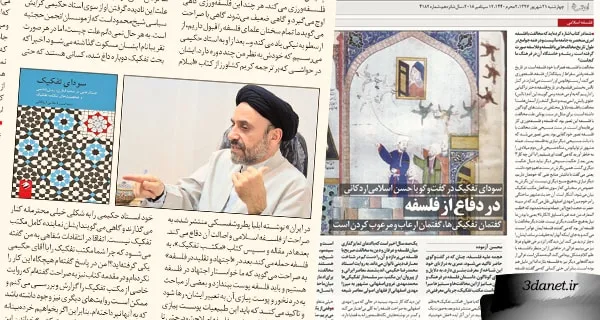
Mohsen Azmoudeh: The assault on philosophy, as emphasized in the present conversation, is as old as this branch of human knowledge itself, arising for various reasons and in various forms. The story of philosophy in our culture and civilization has not been exempt from these oppositions and conflicts either. The School of Separation (Maktab-e Tafkik) is an intellectual current of the last hundred years that, claiming to distinguish between philosophy, mysticism, and religion, explicitly opposes philosophy and considers it incapable, at least in understanding religious knowledge. According to the account of Master Mohammad-Reza Hakimi, a contemporary Iranian thinker and follower of this school, the founder of the Separationists is Mohammad-Mahdi Gharavi Esfahani, known as Mirza Mahdi Esfahani, a contemporary Shiite jurist of the Usuli school, and names such as Sheikh Mojtaba Qazvini, Seyyed Mousa Zarabadi, Mirza Javad Tehrani, Sheikh Mahmoud Halabi, and others are followers of this school. What do the Separationists say? What is the reason for their opposition to philosophy? What arguments do they offer for their claim? Are they still present among us today? What is the relationship between the new Separationists and the previous generations? Seyyed Hassan Eslami Ardakani, full professor of philosophy and head of the Department of Ethics at the University of Religions and Denominations, has been engaged in critiquing and confronting Separationist ideas for many years, and recently a collection of his articles and talks on this subject has been published in a book titled The Ambition of Separation by Kargadan Publishing. On this occasion, we tried to discuss the above questions with him.
In your book, you have pointed out that opposition to philosophy is not unique to our society and that throughout history, in all societies, there has been opposition to philosophy and philosophers. Where do the roots and origins of this lie in our culture?
Opposition to philosophy is coeval with philosophy itself. In the history of philosophy, when Socrates, one of the founders of philosophy, practiced philosophy, Aristophanes mocked him. Alongside Thales, the first philosopher in the history of philosophy, we have the Thracian maidservant who laughs at him and says this man (Thales) does not see what is in front of his feet and is seeking to discover the secret of the heavens! Opposition to philosophy has had various reasons in different traditions. For example, in the Greek tradition, the reason for opposing philosophy was the notion that philosophy and philosophizing are useless endeavors. In the Christian tradition, the reason for opposing philosophy was the idea of self-sufficiency. That is, it was thought that with the Christian religion, there was no longer any need for philosophy. Recall the famous saying of Tertullian, the Christian theologian of the second century AD, who said: What has Jerusalem to do with Athens?! Meaning, after Christian wisdom, one should no longer seek any other wisdom. This same attitude existed in our tradition as well. That is, they said that having the rich sources we ourselves possess, there is no need for any other source. This attitude is particularly evident in the statements made by the defenders of the School of Separation. The late Mirza Mahdi Esfahani narrates that famous fabricated hadith that on the chest of His Holiness the Hujjat (may God hasten his reappearance) it was written: "Seeking knowledge from anyone other than us is tantamount to denying us," meaning, with us present, there is no need for any other wisdom. Another reason for opposing philosophy was that they said philosophy weakens the faith of the common people and, instead of leading them to the truth, plunges them into doubt. We see this view among some jurists and mystics as well. Ghazali, in some places, finds fault with philosophy or theology (Kalam) from this perspective. Of course, Ghazali may attack philosophy from other perspectives too, but this was also one of his reasons. Therefore, even those who said philosophy is good, said that only certain individuals should study philosophy and that studying philosophy is not for everyone. It was as if the necessity of paying attention to elitism in the reading of philosophy and the necessity of having aptitude were important.
The reasons you mentioned for opposing philosophy are mostly internal and epistemological, but is the opposition to philosophy solely for epistemological reasons, or has it also had political and social reasons? That is, have issues such as social status and political power also played a role in opposing philosophy? Because, after all, the philosopher, like the gadfly of society (the Socratic metaphor for the philosopher), explicitly criticizes power.
You raised an important point. Of course, because I am not a specialist in history, I have not addressed this topic in my books and articles. Coincidentally, I recently saw that Dr. Hassan Ansari touched upon this very aspect in a note. Historically, there is ample evidence that opposition to philosophy came from Hanbali jurists and the Ahl al-Hadith. Dr. Ansari's view is that it is Shi'ism that has protected and supported philosophy, because it has been more rationalist. If we follow this trajectory, it seems to be a point worth pondering. Especially since Mr. Ahmad Amin, in a discussion about Sayyid Jamal al-Din al-Afghani, says that Sayyid Jamal popularized philosophy by coming to Egypt, because Iranians have a better and greater affinity with philosophy. The late Martyr Motahhari, of course, emphasizes that this is not due to their being Iranian, but due to their being Shi'a. In any case, Shi'i thought throughout history has shown greater sympathy with philosophy, because it has not had anxiety about the ruling power.
You mentioned the rationalist characteristic of Shi'i thought. But the question is, what happens in the modern period that from within the Shi'i tradition, a school called the School of Separation (Maktab-e Tafkik) emerges? After all, the proponents of Tafkik are Shi'a, and a figure like Mirza Mahdi Esfahani had fundamentally studied philosophy.
A direct and complete answer to this question is difficult, because it requires extensive historical and social studies. But in my opinion, as an enthusiast and someone who pays attention to this discussion, several points must be considered: First, Islamic philosophy did not fulfill the expectations that its proponents and enthusiasts had. Over recent decades and even centuries, Islamic philosophy lost its strength and efficacy, to the extent that some of the devout who engage with Islamic philosophy, instead of solving their everyday problems, have become entangled in highly abstract philosophical issues that have the least direct connection to people's daily lives. For example, the discussion of the difference between the philosophical secondary intelligible and the logical secondary intelligible is, of course, an interesting discussion in philosophy, but from the viewpoint of the opponents of philosophy, what pain does this discussion cure in people's lives? On the other hand, in the words of figures like the late Mehdi Haeri Yazdi, the adherents of Tafkik became disillusioned with philosophy because they could not solve philosophical dilemmas and look at issues from a philosophical perspective, and they reacted in this way. Also, if you consider these discussions in relation to the atmosphere of the Islamic world, you see this purism and refinement elsewhere as well. That is, groups feel that the Islamic tradition is under such pressure from various studies, research, and tendencies that the essence and core of Islam and pure revealed teachings have been forgotten, and an effort is made to reconstruct it. This attitude has always been present to a greater or lesser extent throughout history, and therefore it should not be called a new tendency. A current that has emphasized a kind of pruning and purification. Of course, among Sunnis, this interpretation is famous that 'every hundred years, a renewer appears and revives the religion.' Therefore, the Tafkik movement should be examined under a revisionist or revivalist project.
If you were to formulate the point of contention, what would you say about the main claim or claims of the School of Separation?
The main point of the adherents of the School of Separation can be taken from the first article published under the title 'Maktab-e Tafkik' (The School of Separation) by Professor Mohammad-Reza Hakimi, which was later published as a book. In these works, the idea of 'autonomous religious reason' was proposed, which can be explained around two axes. First, a negative axis, in their own terms, and another, a positive axis. The negative axis says there are three paths to reach the truth, and we must separate these three paths from each other, and the title 'Separation' (Tafkik) arises from this very point. These three paths are: 1- the path of mysticism; 2- the path of philosophy; and 3- the path of religion, or in other terms, unveiling, reason, and revelation. According to the adherents of the School of Separation, throughout history these three paths have been mixed together, and they must be separated from one another. The second claim, which is the positive aspect of their assertion, says that after separation, we strive to present the pure revealed teachings as they were, without any adulteration or distortion. These are the terms that the proponents of Tafkik use, and these two axes are the core of their claim.
The positive aspect leads to the idea of 'autonomous religious reason,' correct?
Yes.
As you mentioned, this precise and specific formulation was set out in the writings of Master Mohammad-Reza Hakimi. But we know that the history of the School of Separation goes back decades before that, and the founder of this school, Mirza Mahdi Isfahani (1303–1363 AH), is one of the contemporary Shi‘a usuli jurists, and after him figures such as Sheikh Mojtaba Qazvini, Seyyed Musa Zarabadi, Mirza Javad Tehrani, Sheikh Mahmoud Halabi, and others are followers of this school. Was the School of Separation articulated with the same clarity and distinctness among these figures that Master Hakimi speaks of?
You have raised a good point. No, it was not. For this reason, in my discussions I try to distinguish between the first generation of the School of Separation and its later generations, and especially a new generation for which a name cannot yet be chosen, but they have gone so far as to set aside Mr. Hakimi. I am witnessing a current that does not yet reflect its views in written and official form, but when they converse in virtual spaces, they explicitly say that Mr. Hakimi is not the “typical” representative of the School of Separation. This is a curious point. If this claim is taken seriously, we should expect a new metamorphosis in the School of Separation. You see, the thought of the late Mirza Mahdi Isfahani rests on two axes: first, that all human sciences are entirely darkness, obscurity, and gloom.
Does he say this about the modern sciences or about all sciences?
No, he says this about all human sciences. The very title of his book is: “On the Fact that Human Sciences Are Darkness by Nature.” The second axis is that one must return to revelation. Hence, he opposes philosophy, logic, and other sciences. He explicitly states the mutual exclusivity between religion and philosophy and mysticism. But later, when we come to Master Hakimi, firstly, he presents a unique formulation and his work is an innovation and something new, and secondly, he reduces this total mutual exclusivity to a very, very partial mutual exclusivity and explicitly says we do not accept total mutual exclusivity, meaning he rather moderates it. While Mirza Mahdi Isfahani explicitly invalidates all of philosophy, Master Hakimi calls for research and independent reasoning within philosophy.
In your talk, you referred to the generations of the School of Separation and the evolution that has occurred in their orientation toward philosophy. If possible, please elaborate on these periods from your own perspective.
What I am saying is provisional and summary, and work needs to be done on this view. You see, while Mirza Mahdi Isfahani explicitly invalidates philosophy entirely and in his writings rarely takes a philosophizing view of matters, when we come to Sheikh Mojtaba Qazvini, we see that in his book “Bayan al-Forqan” he rejects philosophy, but he argues philosophically. An argument that resembles the argument of Allameh Tabatabai in the book “The Principles of Philosophy and the Method of Realism.” Then, with Mirza Javad Tehrani, we see that he fully enters the game of philosophy. In his numerous works, he explicitly says that the primacy of existence is wrong and the primacy of quiddity is correct. That is, he takes a position within philosophy and places himself in the ranks of the proponents of the primacy of quiddity. Meaning he seems to oppose a specific philosophical position, not all of philosophy. This is a great distancing from the late Mirza Mahdi Isfahani.
In one of the articles in the book about Mirza Javad Tehrani, you argue that he is not a Separationist at all?
Yes, that is exactly the case. I would say that if being a Tafkiki means what I initially described, then he is no longer a Tafkiki. Because he himself has not explicitly stated that he is a Tafkiki. Nor has he made such a claim in his writings. Some have made this claim, but that does not make it so. In reality, he engages in philosophizing, although this philosophizing sometimes reaches a peak and sometimes weakens. At times he explicitly says we accept all the statements of the scholars of philosophy, he speaks well of Aristotle, and so on... After him, we come to Master Hakimi, who, in my opinion, has several periods himself. In the marginalia he published on Karim Keshavarz's translation of the book 'Islam in Iran' by Ilya Petrushevsky, he explicitly defends Islamic philosophy and its originality. Later, in an article and then the book 'The School of Tafkik,' he attacks philosophy. Then in 'Ijtihad and Taqlid in Philosophy,' he explicitly says that we demand ijtihad in philosophy and that philosophy must shed its skin, and some of its useless discussions and, in his words, its 'onion-skin layers' must be abandoned, and he emphasizes that this 'polytheistic onion-skin natural philosophy' must be set aside and philosophy reformed. He even goes so far as to refer to Seyyed Jamal al-Din Asadabadi as the 'Philosopher of the East,' calls the late Mohammad-Taqi Shariati the 'Socrates of Khorasan,' and names the late Abdoljavad Falaturi a Tafkiki philosopher. As we approach the recent period, especially in the book 'Divine Theology and Human Theology,' we witness explicit insults directed at philosophy and philosophers, and in it, he speaks of the 'nonsense of the philosophers' and the 'drivel and rubbish of philosophy.' That is, one feels that he does not have a coherent position regarding philosophy and has many ups and downs.
What can be said about the other figure of the Tafkik School, Ayatollah Seyyedan? Does he also have such fluctuating positions regarding philosophy?
In my opinion, as far as I have studied, his view of philosophy is much more coherent, moderate, and respectful, and we do not see these ups and downs. He explicitly says that we accept human rationality and reasoning, and his speech is very different from Master Hakimi's.
When we speak of an intellectual current like the Tafkik School, it specifically has certain figures who, even if they are not friends, intellectually refer to one another in their works, quote each other, and have students and followers. Can the same be said of the proponents of the Tafkik School?
This is one of the difficulties. They have claimed that we are the Tafkik School. Mr. Hakimi, who initiated this discourse, created a lineage in which the names you mentioned were present: the late Mirza Mahdi Esfahani, then Sheikh Mojtaba Qazvini, and then Seyyed Musa Zarabadi. After that, no one else is referenced. Most of Mr. Hakimi's references are also to Mirza Mahdi Esfahani. But we also have others who are very close to the Tafkikis, yet their names are not in Mr. Hakimi's book (the book 'The School of Tafkik'). For example, Sheikh Mahmoud Halabi, who was a student of Mirza Mahdi Esfahani and compiled his lecture notes. As far as I have searched, there is no mention of Sheikh Mahmoud's name in any of Master Hakimi's works, and he is completely ignored, even though he was both a prominent orator and one of the main students of the late Mirza Mahdi Esfahani. Perhaps the reason for this disregard by Master Hakimi is Sheikh Mahmoud's political leaning, as he is one of the founders of the Hojjatieh Society. In any case, I do not know the reason, but his name is almost passed over in silence. Recently, as the discussion of Tafkik has heated up again, there are those who even set aside Master Hakimi himself in a very respectful manner and sometimes say he is not the complete representative of the Tafkik School. Incidentally, in oral criticisms, I am told, 'Why have you equated the Tafkik School with Mr. Hakimi?!' In response, I have said I have never done this, and in the introduction to the book, I have explicitly stated that I am reporting and examining a specific narrative of the Tafkik School, and there may be other narratives that I have not addressed. Therefore, if we want to look at the matter meticulously, one might perhaps doubt calling this current a 'School.'
In one of the conversations in the book, you claim that Professor Hakimi’s Al-Hayah is a prime example of the dominance of leftist thought in Iran. Interestingly, the School of Separation, as their name suggests, places great emphasis on this “separation.” How can we demonstrate that contemporary currents of thought, particularly the leftist current which has greatly influenced contemporary Iranian thought, have also influenced the School of Separation?
Imagining this is very difficult, but I will mention two examples. First, Professor Hakimi, in a famous interview published in the Sharq Yearbook (2011) titled “The Narrator of Traditions of Light,” says that Amir Parviz Pouyan was his student. Mr. Pouyan was one of the key members of the Organization of Iranian People's Fedai Guerrillas who was killed in the clashes. Professor Hakimi says that once Mr. Pouyan was reading an article in his presence that contained Marxist ideas. His exact words are: “Pouyan read his article, and after he finished, I said that we wanted to say the same things, except we also add a God to it. He does not harm these matters and emphasizes them.” How can this statement be interpreted? Anyone with an analytical mind can see that an Islamic or Christian theological system—that is, a theological system that believes in the primacy of consciousness over matter—is incompatible with Marxism. The dispute over the last 50 years has been the conflict between these two perspectives. There was a time when if someone spoke of a socialist economy, they were called a Marxist and rejected. Now he (Mr. Hakimi) explicitly says that what you say, we say too. But more importantly, he claims that we are traditionists, and I doubt this claim. Someone who considers themselves an Akhbari and a traditionist must, as a first step, ascertain that the statement they have accepted as a hadith and made a guide for their action is indeed a hadith. In two or three places, Professor Hakimi quotes a sentence and says the Prophet (PBUH) stated in a reliable hadith: “Sharru ummati al-aqwiya,” meaning “The worst of my people are the rich.” He then references the book Jami‘ al-Sa‘adat (by Mirza Mahdi Naraqi), which was written in the 12th century AH. This hadith he cites does not appear in any of our traditional sources, and the late Muzaffar, who was himself a renowned jurist from Najaf and edited the book Jami‘ al-Sa‘adat, emphasizes in the introduction that the book has flaws, one being that the late Naraqi was not careful and there are many fabricated hadiths in his book. What does it mean to ignore all the authentic hadiths from the Prophet (PBUH) about the goodness of and in defense of wealth, and to cling to a sentence found in a non-traditional source, highlight it, and design an ideology based on it?
Do you view this influence of leftist thought on the Separationist current as a negative aspect of their work, or was your aim simply to show that the Separationists themselves were also influenced by other currents?
I never said that this influence is bad, and I have always said that the concern for justice is sacred, and no one has yet been able to reconcile the discussion of freedom and the discussion of justice. Democrats pursue freedom, and socialists pursue justice. But my point is that Mr. Hakimi and the School of Separation, with their logic of separation, say we only seek the [religious] sciences and have no lenses, presuppositions, etc., before our eyes. My point was that you also have presuppositions. If mystics approach the Quran with a mystical perspective, you approach the Quran with an economic perspective.
You have outlined the methodological characteristics of the School of Separation. If you were to briefly formulate the core of the Separationists’ arguments, what would you say?
The adherents of the Separation school have an epistemological argument, a historical argument, and a sociological argument. These formulations are, of course, my own, and I have tried to derive them by reading their works. In their system of religious knowledge, the question is posed: Is the word of Imam al-Sadiq (peace be upon him) more authoritative, or the word of the polytheist Aristotle? It is obvious that the word of Imam al-Sadiq (peace be upon him) is correct. But my question is: Where did Imam al-Sadiq (peace be upon him) say such a thing? Our problem is not with revelation; our problem is with the report that has been given of revelation. This is a point that our jurists have also noted. The late Akhund Khurasani, in his Kifayah, when speaking of the Sunnah of the Prophet (peace be upon him), emphasizes that what we have is not the Sunnah of the Prophet (peace be upon him) itself, but an account of the Sunnah. That is, it comes from people who witnessed this Sunnah and reported it. The reports of these people are subject to scrutiny. In his History of Philosophy, Russell refers to Xenophon's Socratic memoirs, in which a different image of Socrates is presented—that is, an ethical Socrates is portrayed. Russell does not much like Xenophon and says that because he lacked a strong philosophical understanding, he could not comprehend Socrates, and he says, 'I would rather have my own thoughts reported by an intelligent person who disagrees with me than by a zealous disciple who is somewhat dull.' This is a reality; consider Hegel, for example. His thoughts were reported by his students. The Sunnah of the Prophet (peace be upon him) was also reported by disciples who themselves had disagreements with one another. Thus, Shaykh Tusi, in the fifth century AH, says in al-Uddah fi al-Usul that the disagreements among Shi'a jurists on individual issues are greater than the disagreements that exist between Malik ibn Anas and Ahmad ibn Hanbal. Even now, there are disagreements among the members of the Separation school themselves. I have demonstrated this. Mirza Mahdi says that philosophy is entirely invalid, whereas Mirza Javad Aqa Tehrani says that the philosophy of the primacy of existence is invalid and accepts the philosophy of the primacy of quiddity.
You have extensively criticized the views of the Separation school. Have they given you a worthy response? How has their reaction to your critiques been?
To this day, no published written text in the form of a book has been released in response to my critiques, except that a book by one of the adherents of the Separation school, titled The Problem of Analogy: An Analysis of the Use of Analogy in the Principles and Branches of Religion, written by Mr. Alireza Rahimian, was published, and I criticized it in an article titled "Is Jurisprudential Analogy the Same as Logical Analogy?". They responded to this critique of mine in defense of the book, and I then criticized that response. In my view, our problem is that the defenders of the Separation school, when examining critics' objections, usually do not say whether your statement is wrong or right; instead, they say that you yourself are wrong! They do not say your statement is incorrect; they say you and your very existence are incorrect!
So they engage in character assassination?
Yes, this character assassination occurs on three levels. The first is on the physical level. That is, they say the critic's very appearance is problematic! For instance, Mr. Ashtiani recounts that he went to the school and saw Shaykh Mahmoud Halabi criticizing Mulla Hadi Sabzavari. He wrote: "He had set upon the late researcher Sabzavari and was constantly referring to that late scholar as 'Chaqaleh Hakim' [a derogatory term]"! The son of Mr. Seyyed Ali Qazi, who was a renowned mystic, says that he spent an entire month of Ramadan in Mashhad attending the sermons of Mirza Hadi Esfahani, "He would go to the pulpit and become very angry, cursing my father. He explicitly said, 'That Seyyed in Najaf, his beard is red and he is short!'" This account appears in the memorial volume for the great mystic, Seyyed Ali Qazi. Moving beyond this level, the most common and predominant response given by the adherents of the Separation school is to declare the critic scientifically unqualified, addressing them as 'this student,' 'this beginner,' and so on, and saying that this person has no scholarly competence whatsoever. Moving beyond this level, we reach another level where they tell the critic, 'You have no moral competence at all! You are a lover of status and wealth, or you have a problem,' and in their own words, 'you lack the spiritual substance for divine knowledge' and do not understand what we are saying at all! This is the entire structure of their perspective, and the discourse of the Separation school is a discourse of intimidation, terrorizing, and crushing, not of convincing. In recent years, many people have criticized the Separation school, and I have not seen a single one of these critiques receive a response, or be told that half of a certain sentence of yours was 25 percent correct.
But today we are in a situation that is the age of communication, and there is no room for such responses. That is, public opinion can recognize that with such responses, character assassination actually takes place.
Unfortunately, I still see this form of response. Right now, I am constantly receiving text messages and messages that have been published on social networks against this book, and all of them are in this vein. My only response is: put your criticisms in writing and publish them. Scientific dialogue means written dialogue, which unfortunately has not yet taken place in this regard.
Perhaps it would have been better to ask this at the beginning: a new generation of the Tafkiki school is now emerging. What was your motivation for compiling your collection of articles and talks about the Tafkik school? Did you simply want to collect your works, or do you feel a necessity in this area?
As I have said in the book's introduction, I entered the discussion unwillingly. I simply wanted to collect my works in the field of critiquing the Tafkik school and publish them in a refined form. But the echoes of this book, even to this oral extent, are so alarming that it seems I might feel a necessity and want to continue this work. Of course, I personally have no desire to continue this discussion and believe others should carry it on.
Have you received any positive reactions to the book?
Some people have been deeply offended and angered, and this shows that the book has had an effect. But no one has passed by this book with indifference, and that is positive. Of course, this book can also have a positive impact, in the sense that claims must be clarified. Many did not imagine that the Tafkikis would respond in this way and expected them to at least be faithful in conveying viewpoints. But this book shows that this is not the case. In any case, what I have said may be wrong or right. I have always said that the Tafkik school is an intra-religious and respectable current, and as worthy of consideration as all Islamic currents, and it is very good that we can present our religious thoughts in a more refined and correct manner. But we must ethically arrive at norms under which we can engage in scholarly discussion with one another. The nature of scholarship is the nature of criticism: "Indeed, the life of knowledge is through critique and refutation." This is my personal belief.
.
.
The Ambition of Separation: A Conversation with Hassan Eslami Ardakani
In Defense of Philosophy
The Discourse of the Tafkikis is a Discourse of Intimidation and Terrorizing
Interviewer: Mohsen Azmoudeh
Published on the Thought Page of Etemad Newspaper, Wednesday, Shahrivar 21, 1397
.
.


Discussion2 comments
ممنون بابت مصاحبه و این نقد خوب وبلاگ نوشتهجات که گذاشتید
نقد و معرفی کتاب سودای تفکیک : https://zoheirnoaparast.blogspot.com/2018/09/blog-post_14.html?m=1