اندیشهفلسفهخردگفتگوحکمتمعناپرسشفرهنگ
Political Science
The American Resurrection: A New Nation Emerges
Post-revolution American celebrations of national unity were challenged by the uprising of indebted Massachusetts farmers, Shays' Rebellion. The unrest prompted Madison to replace the Articles of Confederation with a Constitution providing for a central government.
The American Resurrection
A New Nation Emerges
Compilers:
Tara Strauch, Editor
Marco Basile, Managing Editor
Editors: Joseph Locke and Ben Wright
Stanford University Press, California, 2018
Translator: Ramin Khajehpour
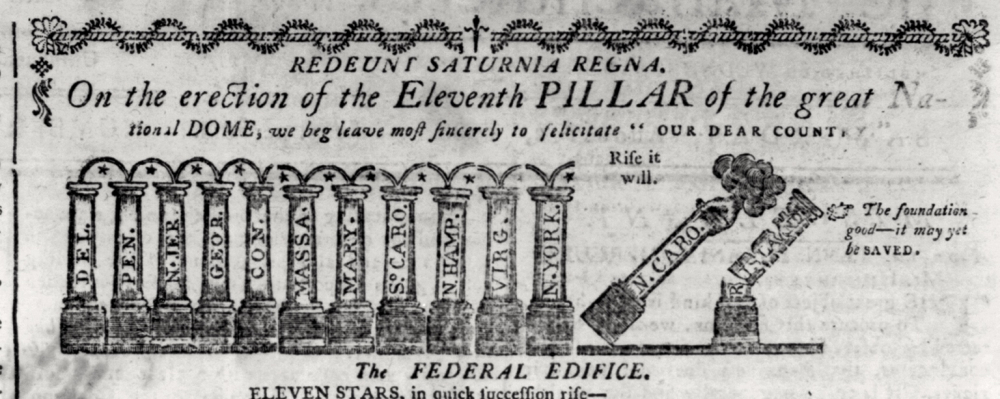
On July 4, 1788, the people of Philadelphia emerged from their homes to celebrate the "Grand Federal Procession" and honor the new national constitution. Workers from every trade and craft paraded through the city streets. Blacksmiths had placed a forge on a cart, where they symbolically beat heated swords into agricultural tools. Potters proudly held aloft a sign recalling a phrase from the Bible: "The potter hath power over his clay," thereby linking the people's sovereignty over their country to divine power. Christian clergymen marched hand in hand with Jewish rabbis. The grand parade seemed to embody the hopes and aspirations of many Americans for their nation's future: a diverse yet unified and prosperous nation.[1]
The following year, Americans went even further, celebrating more patriotic holidays. In April 1789, for instance, thousands gathered in New York to witness George Washington's presidential oath of office. In November of that same year, George Washington asked his fellow citizens to observe a particular day as a day of thanksgiving, especially because they had established a government in a "peaceable and rational manner."[2]
But this new nation was never as unified as its champions desired. Although federal government officials and its supporters placed great emphasis on unity and cooperation, the country was often anything but cohesive. The Constitution itself was a controversial document, adopted only to empower the government and enable it to withstand internal conflicts. Despite the celebrations, this nascent nation viewed its future with uncertainty, for two years before the national festivities of 1788 and 1789, the United States had faced the danger of collapse.
Shays' Rebellion
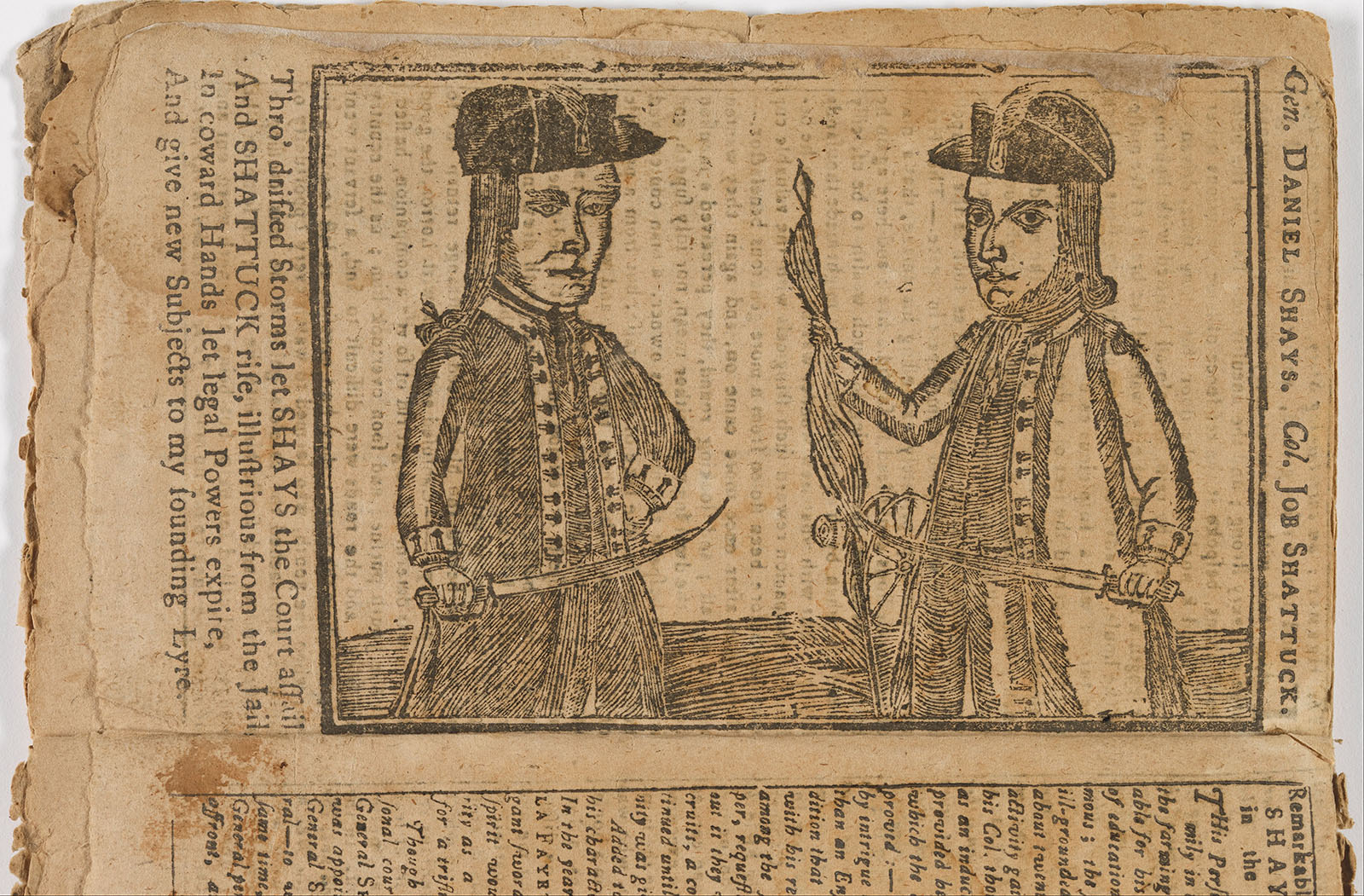
In 1786 and 1787, a few years after the Revolution ended, thousands of farmers in western Massachusetts were struggling under a heavy burden of debt. Their problems were compounded daily by the weakness of the national and local economy. Many political leaders saw both the debt and the economic struggle as stemming from the Articles of Confederation, which provided no means for raising federal revenue. The Articles did little to forge a unified nation out of the diverse states. The farmers demanded that the Massachusetts government protect them from their creditors, but the government sided with the lenders. When lenders threatened to seize the farmers' property, many farmers, including Revolutionary War veterans, took up arms.
These armed men, led by their former comrade-in-arms Daniel Shays, became known as Shaysites and employed the tactics of the pre-Revolutionary Patriots. They surrounded courthouses to prevent judges from issuing orders to confiscate their property. The protesters saw their motivation and methods as an extension of the "meaning of the Revolution of 1776"; they were protecting their rights and demanding redress for popular grievances.
But Governor James Bowdoin viewed the Shaysites as rebels seeking to dominate the government through mob violence. He called up thousands of militiamen to disperse them. These government troops were led by a former Revolutionary general, Benjamin Lincoln, who insisted that "anarchy, confusion, and slavery" must be prevented in the state of Massachusetts.[3] In June 1787, Lincoln's army arrested over a thousand Shaysites and reopened the courts.
Daniel Shays and other leaders of the uprising were convicted of treason, and several others were sentenced to death, but ultimately Shays and many of his followers were pardoned. Their protest, which became known as Shays' Rebellion, sparked intense debate. While some Americans, like Thomas Jefferson, believed that "a little rebellion now and then" helped preserve the nation's liberty, others feared the nation was sliding toward anarchy and argued that the states were incapable of maintaining order on their own. For nationalists like James Madison of Virginia, Shays' Rebellion was a clear example of why the country needed a strong central government. Madison warned, "Liberty may be endangered by the abuses of liberty as well as the abuses of power."[4]
The Constitutional Convention
The uprising in Massachusetts prompted leaders across the country to consider taking action. After years of urging by James Madison and other nationalists, delegates from twelve of the thirteen states finally gathered in the Pennsylvania State House in Philadelphia in the summer of 1787. The only state that refused to send a delegate was Rhode Island. The delegates came to this convention with instructions to revise the Articles of Confederation.
The biggest issue the convention needed to resolve was the federal government's inability to levy taxes. This weakness meant that the burden of repaying Revolutionary War debts fell on the states. The states, in turn, found themselves indebted to wealthy individuals who had, in effect, loaned money to the states by purchasing bonds during the war. This was part of the reason why, for example, Massachusetts officials were forced to support the wealthy bondholders rather than the poor western farmers.[5]
The uprising in Massachusetts prompted leaders across the country to consider taking action. After years of urging by James Madison and other nationalists, delegates from twelve of the thirteen states finally gathered in the Pennsylvania State House in Philadelphia in the summer of 1787. The only state that refused to send a delegate was Rhode Island. The delegates came to this convention with instructions to revise the Articles of Confederation.
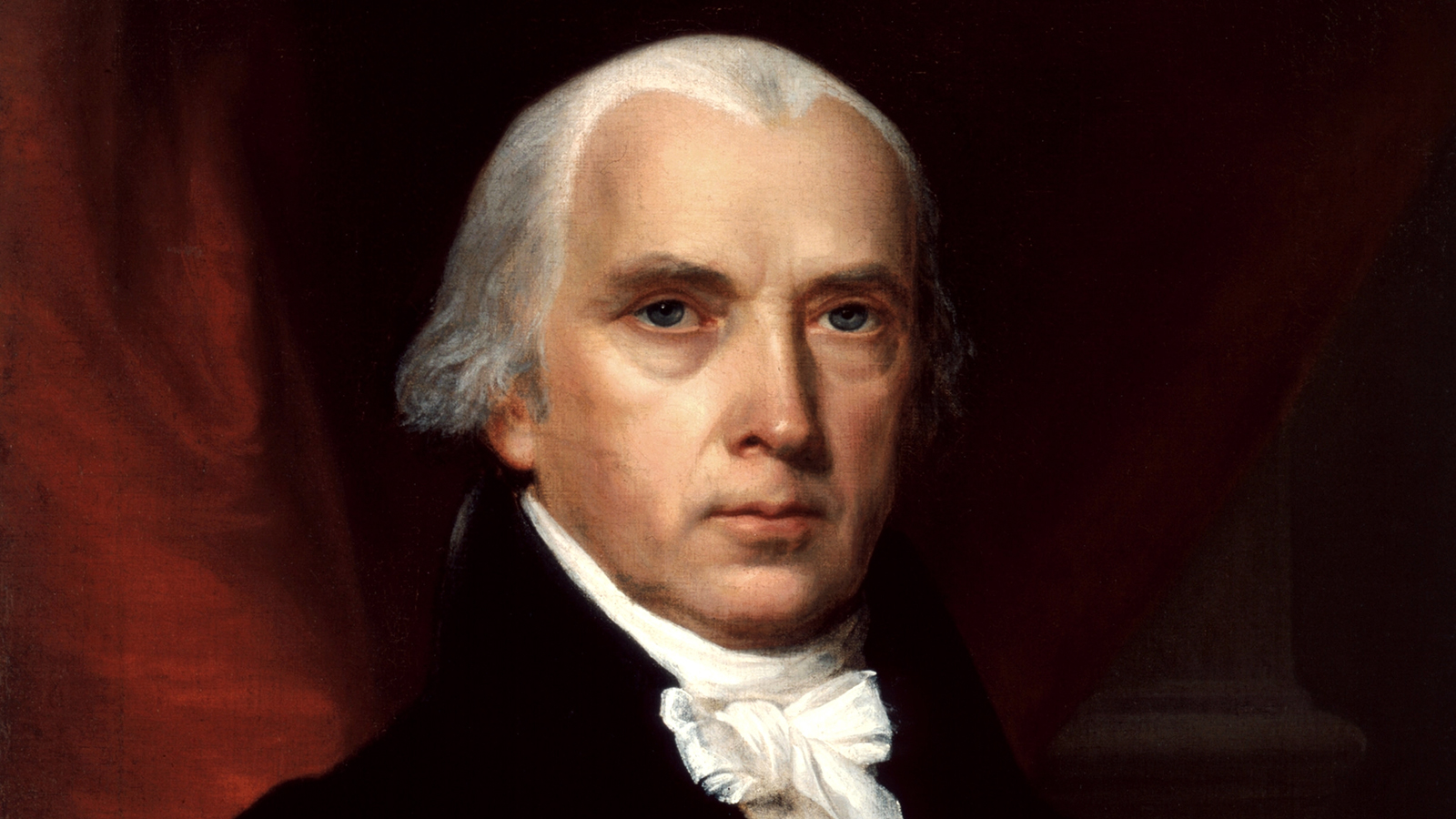
But James Madison had no intention of rewriting the "Articles of Confederation." He intended to create an entirely new constitution. In the past year, he had completed two extensive research projects—one on the history of government in the United States, the other on the history of republics throughout the world. He used this research as the basis for a proposal he brought with him to Philadelphia. That proposal was called the "Virginia Plan," because Virginia was James Madison's home state.[6]
The "Virginia Plan" was audacious. Classical teachings held that to build a republic, a small and homogeneous territory was needed: for example, the ancient Roman Republic, or a small country like Denmark. It seemed that inhabitants who were too far-flung or too diverse could not govern themselves well. The general opinion was that the United States needed a very weak central government, a central government that would only represent the states in certain matters common among them. In other words, power should remain at the state or local level. But Madison's research had led him down a different path. He believed that establishing "an extended republic," encompassing diverse peoples, climates, and traditions, was possible.
Therefore, the "Virginia Plan" proposed that the United States should have a strong federal government. This government was to have three branches—legislative, executive, and judicial—as well as the power to act and intervene in national matters. In this plan, the legislative branch, or Congress, had two houses, in which each state had representatives based on its population and tax base. Furthermore, the national legislators had the power to veto state laws.[7]
The other delegates at the convention generally agreed with Madison on the failure of the "Articles of Confederation." But they did not agree on what kind of government should replace it, especially on which method of representation in Congress was best. Representation was a crucial issue that influenced a host of other decisions, including how the executive branch of government should function, what specific powers this federal government should have, and even what to do about the divisive issue of slavery.
For more than a decade, in the Continental Congress, each state had one vote. Small states like New Jersey and Delaware wanted the situation to remain the same. Moreover, Connecticut delegate Roger Sherman believed that members of Congress should be appointed by state legislatures. Sherman said ordinary voters lacked sufficient information, were constantly prone to being misled, and should be entrusted with as little as possible regarding the most national matters.[8] But the large states preferred the "Virginia Plan," because this plan gave their citizens much more power and influence over the legislative branch. James Wilson of Pennsylvania believed that since the Virginia Plan broadly increased the power of the national or federal government, representatives should be elected as directly as possible by the people at large. He warned: "Government without the confidence of the people cannot long endure."[9]
In the end, Roger Sherman proposed a compromise. This proposal stipulated that there would be a lower house, the Congress or House of Representatives, and each state would appoint representatives to this house based on its population. In contrast, there would also be an upper house, the Senate, in which each state would have only one vote. This proposal, after months of debate and with slight modification, was accepted as the Great Compromise: it was decided that each state would have two senators, both of whom could vote independently. In addition to establishing two types of legislatures, this compromise also stipulated that for the purposes of taxation and representation, each slave would be counted as three-fifths of a citizen.
However, regarding the structure of the executive branch of government, it actually took the delegates considerably longer to reach a decision. Should executive power remain in the hands of a committee or a single individual? How should government officials be selected? On the first of July, James Wilson declared that the national executive power should be vested in a single person. Only four years after the American Revolution, this proposal was highly controversial, as it evoked the specter of an elective monarchy. [10] The delegates were also concerned about how to protect the executive branch from corruption or excessive dominance. They debated these questions endlessly, and in early September concluded that the president should be chosen by a special electoral college.
In the end, the legislative convention proposed a government unlike any other. A government composed of elements copied from ancient republics and the English political tradition, but with limited, democratic innovations—all while striving to maintain a delicate balance between national sovereignty and state sovereignty. It was a complex and intensely controversial plan.
Ratification of the Constitution
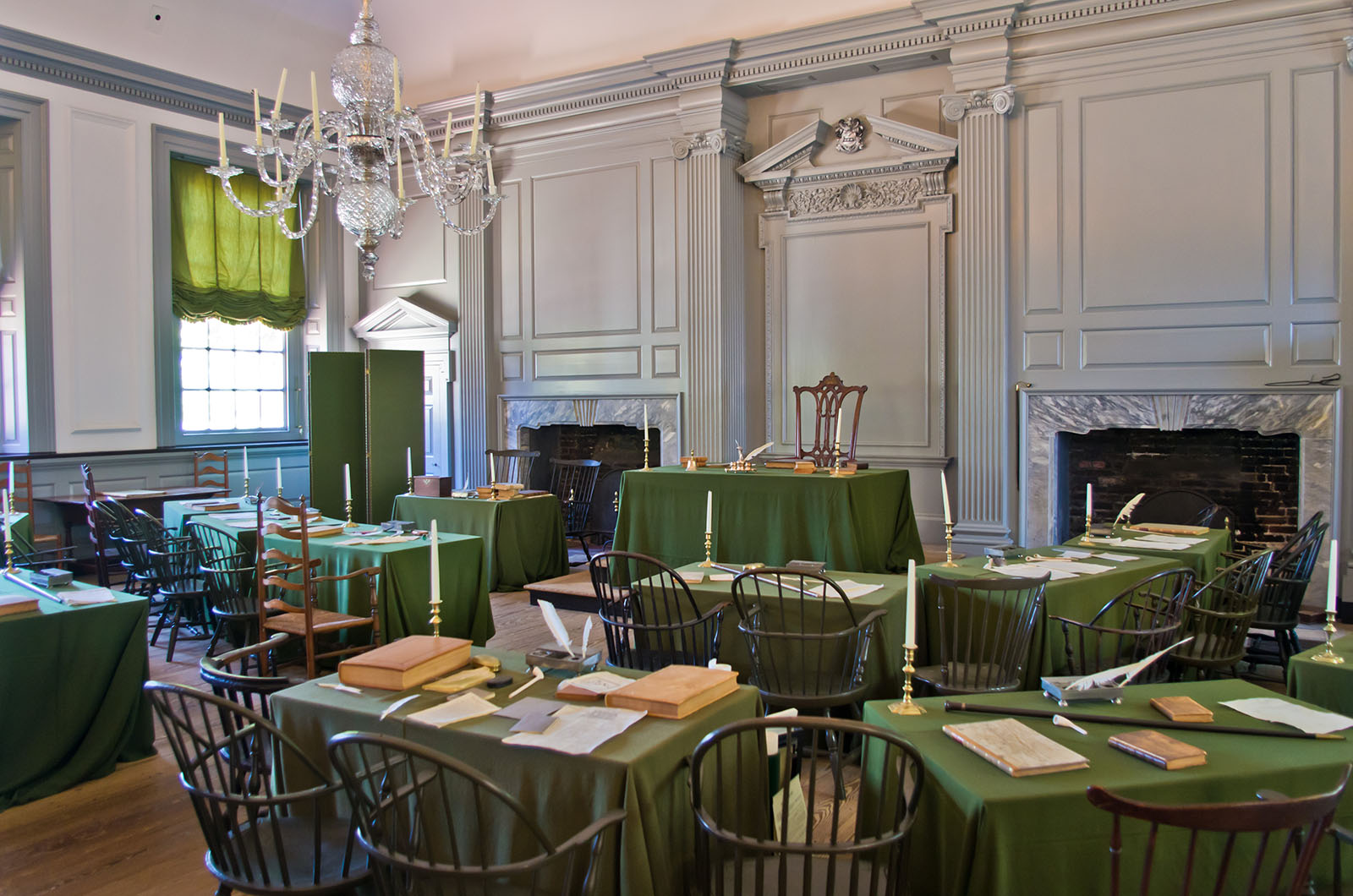
The convention resolved that the proposed constitution be sent to the Congress, which was convening in New York. A letter from George Washington accompanied this constitution. However, the adoption of the new Constitution required not only the approval of the Congress in New York but also ratification by a separate convention convened in each state. During the ratification process, critics of the new document set to work urging voters in each state to oppose it.
Most importantly, the legislative convention rejected the declaration of states' rights presented by George Mason of Virginia and voted in favor of a national bill of rights. This omission gave new life to opponents of the new document. Many Anti-Federalists argued that without such a guarantee of specific states' rights, American citizens risked losing their personal liberties to a powerful federal government. On the other hand, Federalists in favor of the new document argued that adding a bill of rights was not only unnecessary but dangerous, as such a bill could prevent future citizens from adding new rights.[11]
Citizens debated the merits of the Constitution in newspapers, letters, ceremonies, and coffee-house arguments across America. Some of the most famous and important arguments were made by Alexander Hamilton, John Jay, and James Madison in the Federalist Papers, which were published in various New York newspapers in 1787 and 1788.[12]
The first crucial vote was cast in Massachusetts in early 1788. At first, Massachusetts Anti-Federalists held a near majority in the ratifying convention, but after weeks of debate, a number of delegates changed their votes to approve the Constitution by a narrow margin. However, they also agreed to a number of proposed amendments, which were to be submitted to the first Congress. This pattern—ratifying the Constitution but appending proposed amendments—was followed by other state conventions.
In June 1788, the most important convention was held in Richmond, Virginia, where Federalists like Madison, Edmund Randolph, and John Marshall prepared to contend with Anti-Federalists of equal stature, such as Patrick Henry and George Mason. Virginia was the most populous state in America and had produced some of the nation's most prominent leaders; the success of the new government depended on cooperation with the state of Virginia. After nearly a month of debate, Virginia ratified the new Constitution by a vote of 89 to 79.[13]
On July 2, 1788, Congress declared that a majority of the states had ratified the Constitution and that the document was in effect. But the debates were not yet over; North Carolina, New York, and Rhode Island had not completed their ratifying conventions, and Anti-Federalists still argued that the Constitution would lead to tyranny. The New York convention ratified the Constitution by a margin of only three votes, and Rhode Island finally ratified it by two votes—a full year after George Washington was formally inaugurated as president.
Compromises and Legal Rights
Although the debates continued, the election of George Washington as president solidified the Constitution's authority. From 1793 onward, the term Anti-Federalist was essentially meaningless. However, the debates this group conducted gave rise to a part of the law that today seems irreplaceable. In 1791, ten amendments were added. Together, these amendments formed the Bill of Rights. Contrary to his original wishes, James Madison supported these amendments as a necessary measure and political compromise. Madison won election to the House of Representatives only by promising a list of legal rights to Virginia voters.
But many issues were not covered by the Bill of Rights. It offered no specific protections for women and did not guarantee them representation in government. Many states allowed only men with a certain amount of property to vote, and slavery not only still existed but was accepted and protected by the Constitution.
Of all the compromises that shaped the Constitution, none was probably more important than the compromise over the slave trade. Americans generally believed that the Atlantic slave trade was more violent and immoral than slavery itself. Many Northerners morally opposed the slave trade. But they also knew that if they allowed Southerners to import more African slaves, the political power of the South would increase. The Constitution counted each slave as three-fifths of a citizen for purposes of representation, so in areas with many slaves, white voters had greater influence. On the other hand, the states of the Upper South also supported a ban on the Atlantic slave trade, because they already had a surplus of slaves. A ban on slave imports meant that Virginia and Maryland could demand higher prices for selling their slaves to states like South Carolina and Georgia, which depended on the continuation of the slave trade.
The New Englanders and the Lower South compromised at the Constitutional Convention of 1787 on what was called the "dirty bargain." The New Englanders agreed to include a legal clause that protected the foreign slave trade for twenty years, in exchange for which the delegates from South Carolina and Georgia agreed to support a legal article that made commercial legislation easier for Congress. As a result, the Atlantic slave trade continued until 1808, when it was outlawed for three reasons. First, Britain was also in the process of outlawing the slave trade in 1807, and the United States did not want to cede any moral high ground to its rival. Second, the Haitian Revolution (1791–1807), a successful slave revolt against French colonial rule in the West Indies, had changed the terms of the debate. The specter of thousands of armed Black revolutionaries terrified white Americans. Third, the Haitian Revolution had ended French plans to expand its presence in America, so in 1803 the United States purchased the Louisiana Territory from France for a pittance. This vast new territory, which doubled the size of America, placed the issue of slavery's expansion at the top of the national agenda. Many white people, including President Thomas Jefferson, thought that ending the foreign slave trade and dispersing the domestic slave population could keep the United States a white republic and perhaps even lead to the decline of slavery.
But the prohibition of the slave trade lacked effective enforcement power and funding. Moreover, instead of freeing illegally imported Africans, the measure left their fate to the individual states, and many of those states simply auctioned off and sold the detained slaves. As a result, the slave trade ban protected the logic of capital owners rather than humanity. The newly established federal government supported slavery just as much as it supported the democratic rights and privileges of white people.[14]
Hamilton's Financial Mechanism
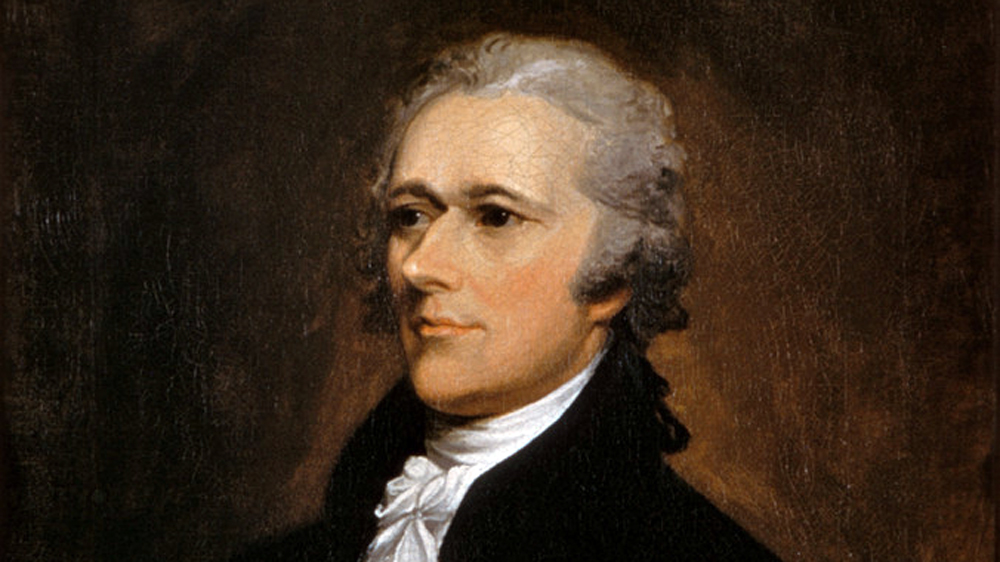
The cabinet George Washington chose reflected the political tensions over the size and power of the federal government. Washington selected Alexander Hamilton for the Treasury Department, and John Adams was vice president. These two men wanted an active government that would bring about prosperity by supporting American industries. But Washington chose Thomas Jefferson for the State Department, and Jefferson was committed to limiting federal power and supporting an agriculture-based economy. Almost from the very beginning, George Washington tried to reconcile the Federalists and Republicans under his leadership.[15]
Alexander Hamilton believed that self-interest was the most powerful motive for human actions. Self-interest drives people to accumulate property, and the pursuit of property accumulation creates commerce and industry. In Hamilton's view, government played a crucial role in this process. First, the government had to protect private property so it would not be stolen. Second, Hamilton believed the government should harness people's "avarice" (for acquiring property) and employ it "in the service of the public good."[16] In other words, a wise government should channel its citizens' passion for acquiring property so that both individuals and the state would benefit.
Like many statesmen of his era, Hamilton did not believe that government should guarantee an equal distribution of property. Inequality was recognized as the greatest and most fundamental distinction in society, and Hamilton saw no reason to alter it. Instead, Hamilton wanted to bind the economic interest of wealthy Americans—the moneyed class—to the financial capacity of the federal government. If the wealthy needed the government, then they would have to direct their financial resources in a way that empowered the government.[17]
Hamilton therefore believed that the federal government should be "the repository of the rights of the wealthy."[18] To achieve this goal, Hamilton, as the first Secretary of the Treasury, proposed an ambitious financial program.
The first part of Hamilton's program was the federal assumption of state debts. These debts were largely left over from the Revolutionary War, and the federal government was to take responsibility for the unpaid debts of the states, totaling 25 million dollars. Second, Hamilton asked Congress to establish a bank—the Bank of the United States.
The aim of this proposal was to tie federal power to the economic survival of the country. Under this proposed commitment, state creditors (those holding state bonds and promissory notes) were to surrender their old certificates to the Treasury and receive new federal bonds of the same face value. Hamilton predicted that the circulation of these bonds would be like money, acting as an engine of commerce and an instrument of industry and trade.[19] But this part of his program was controversial for two reasons.
First, many taxpayers opposed paying the full face value for old bonds that had depreciated in market value. Many bondholders had purchased them from the original lenders for a pittance (less than the face value of the certificates). Paying them the full face value meant rewarding these speculators at the taxpayers' expense. In response, Hamilton declared that the public debt must be fully honored, or citizens would lose all confidence in the government. Second, many Southerners declared that they had already paid off their outstanding state debts, so the federal government assuming the debts of others meant that Southerners would be forced to pay the debts of New Englanders again. Nevertheless, President Washington and Congress accepted Hamilton's argument. By the end of 1794, 98 percent of the country's domestic debt had been converted into federal bonds.[20]
Hamilton's plan for the Bank of the United States similarly gained congressional approval, despite strong opposition. Thomas Jefferson and other Republicans argued that the plan was unconstitutional; the Constitution did not grant Congress the authority to establish a bank. But Hamilton argued that the bank was not only legal but also vital to the nation's prosperity. The Bank of the United States fulfilled many needs. It served as a convenient depository for federal funds. It could issue banknotes backed by gold or silver. Its agents could periodically collect the notes of state banks and demand specie in return, controlling inflation, as well as by limiting the notes printed by state banks. Furthermore, it could grant the wealthy a guaranteed interest based on the assets of the federal government. The government could control only twenty percent of the bank's stock, with the remaining eighty percent held by private investors. As a result, the initial connection between the government and the wealthy benefited both parties, and this connection would invigorate American commerce.
Therefore, in 1791, Congress adopted a twenty-year charter for the Bank of the United States. Bank stock, together with federal bonds, using this new financial instrument, created more than seventy million dollars in assets. This led to the formation of secure markets that allowed the federal government to borrow more money and committed to the rapid expansion of state-chartered banks and other private commercial corporations in the 1790s. For the Federalists, this was one of the chief goals of the federal government. For opponents who wanted a more limited role for industry, or those living on the margins who lacked access to the center, Hamilton's mechanism solidified class divisions and gave the wealthy unlimited power over the federal government.
Beyond this issue, Hamilton's program had another highly controversial element. To pay its debts based on the new bonds, the federal government needed a reliable source of tax revenue. In 1791, Hamilton proposed an excise tax on the production, sale, and consumption of a number of goods, including whiskey.
The Whiskey Rebellion and the Jay Treaty
For most American farmers, grain was the most important product that could be quickly turned into cash. In the West, selling grain to a distillery to produce alcohol was usually more economical than shipping it to eastern markets. Consequently, Hamilton's tax plan once again placed a burden on western farmers. This seemed to divide the new republic into two camps—geographically into East and West, economically into merchants and farmers, and culturally into cities and countryside.
In 1791, in a Pennsylvania town, sixteen men dressed in women's clothing attacked a tax collector named Robert Johnson. They tarred and feathered Johnson. When the local marshal sought justice, these men did the same to the marshal's representative. They kidnapped him, beat him severely, then tarred and feathered him and left him for dead in a humiliating state. The rebel farmers imitated the methods of the revolutionaries and the insurgents of Shays' Rebellion, wrote local petitions, and raised liberty poles. Over the next two years, tax collection dwindled.
In July 1794, groups of armed farmers attacked the federal marshal and tax collectors, burning down the homes of at least two tax collectors. By the end of the month, an armed force of about a thousand men, led by a radical lawyer named David Bradford, robbed the United States mail and captured about eight miles from Pittsburgh; but President Washington reacted swiftly.
Washington initially dispatched a group of Pennsylvania elders to meet with the rebels and seek a peaceful solution; simultaneously, he assembled an army of thirteen thousand militiamen in Carlisle, Pennsylvania. On September nineteenth, Washington became the only president to lead a military force in the field while in office, though he soon handed command of the army over to Henry Lee, a revolutionary hero and the sitting governor of Virginia.
As soon as the federal army moved west, the farmers dispersed. Alexander Hamilton, hoping for a passionate display of federal power, oversaw the arrest and trial of a number of rebels. Many were released for lack of evidence, and many of those who remained, including two men sentenced to death for treason, were promptly pardoned by the president. The Whiskey Rebellion demonstrated that the federal government was capable of quelling domestic unrest. But it also showed that some citizens, especially poor westerners, viewed the government as their enemy.[21]
Simultaneously, another national issue provoked intense protests. Hamilton not only ambitiously intended to build a powerful financial mechanism, but he also wanted a nation engaged and occupied with foreign commerce. To this end, Hamilton sought a friendly relationship with another nation, one nation in particular: Great Britain.
From the end of the Revolution, relations between America and Britain had been tense, a situation stemming in part from the war between Britain and France. The British navy posed a threat to American shipping; Britain would seize American sailors and send them to fight against France as soldiers, a practice that terrified American seamen. Trade was dangerous and costly for America, and British impressment of American forces frightened the families of mariners. Nevertheless, President Washington was aware of America's weakness and was determined to remain neutral in the war between France and England. In April 1793, he formally declared that the United States would remain neutral.[22] Fortunately for Hamilton, his political ally John Jay, who was then serving as Chief Justice of the Supreme Court, sailed to London to negotiate a new treaty, one that would satisfy both the United States and Britain.
Jefferson and Madison were vehemently opposed to these negotiations. They were deeply suspicious of Britain and viewed the treaty as a form of favoritism by the American government toward Britain over France. The French had recently overthrown their monarchy, and American Republicans believed the United States should be pleased to have friendly relations with a new revolutionary government. They also feared that a treaty with Britain would favor merchants and industrial manufacturers over Southern farmers.
In November 1794, despite Republican misgivings, John Jay signed the "Treaty of Amity, Commerce, and Navigation" with Britain. The Jay Treaty, as it became known, required Britain to evacuate its military posts in the Northwest Territory (specifically at Detroit, Fort Mackinac, and Fort Niagara) by 1796. Britain also agreed to compensate American merchants for their losses. In return, the United States agreed to treat Britain as its most valuable trading partner, which meant tactically supporting Britain against France. Unfortunately, Jay was unable to resolve the issue of impressment.[23]
For the Federalists, this treaty was a significant achievement. The Jay Treaty gave the United States the limited ability to officially remain neutral in European wars and to serve American prosperity by protecting its commerce. But for Jeffersonian Republicans, the treaty was proof of Federalist malfeasance. The Federalists had sided with a monarchy against a republic; they had acknowledged British influence over American affairs without even ending the practice of impressment. The debates over the treaty in Congress transformed Republicans and Federalists from temporary factions into two distinct political parties (though they were not yet coherently organized).
The French Revolution and the Limits of Liberty
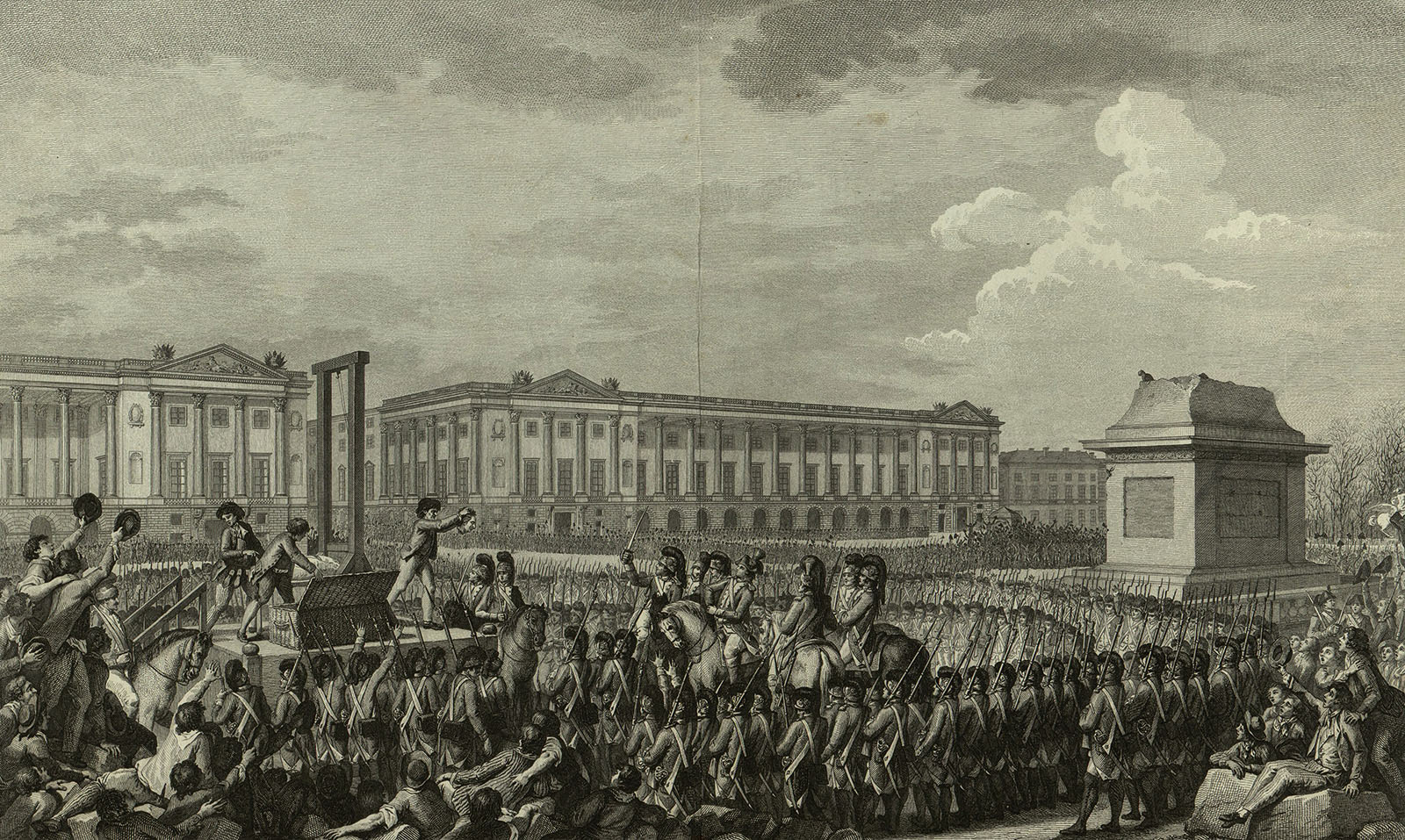
Federalists feared radical democratic doctrines, and this fear had, in part, inclined them toward Britain. In the wake of Shays' Rebellion, the Whiskey Rebellion, and other domestic protests, Federalists sought to preserve social stability. The course of the French Revolution seemed to justify their concerns.
In 1789, news reached America that the French had risen up against their king. Most Americans imagined that the heroes of the French Revolution who had fought in the American Revolutionary War and returned to France were now spreading liberty from America to Europe.
At first, nearly all Americans were delighted by the French Revolution. On July 14, to commemorate the French Revolution, cities across the country hosted speeches and parades for the occasion. Women wore neoclassical dresses in honor of republican principles, and men pinned revolutionary cockades to their hats. John Randolph, a Virginia planter, named two of his favorite horses Jacobin and Sans-Culotte, after the factions of the French Revolution.[24]
In April 1793, the new French ambassador, "Citizen" Edmond Charles Genêt, arrived in the United States; he traveled to numerous cities, and Americans eagerly turned out to greet him. Citizen Genêt encouraged Americans to take action against Spain, which was allied with Britain, and suggested that Americans attack the Spanish colonies in Florida and Louisiana. When President Washington rejected the proposal, Genêt threatened to appeal directly to the American people. In response, Washington asked France to recall its diplomat from American soil. In the meantime, however, Genêt's faction in France fell from power. Knowing that returning home might cost him his head, Genêt decided to remain in America.
Citizen Genêt's guess was correct. A radical coalition of revolutionaries had seized power. They had launched a bloody purge; the Terror reigned in France. Genêt's improper conduct and the guillotines in France soured Americans on the French Revolution.
Part of the American populace, fearing that the French Revolution was spiraling out of control, turned to the Federalists, while another part, still hopeful about the French Revolution, gravitated toward the Republicans. Thomas Jefferson did not recoil from the violence of the French Revolution; he preferred that the French Revolution succeed, even at the cost of depopulating half the earth. Jefferson said, "If there were a land where liberty reigned, even if only Adam and Eve were left there, it would still be better than the situation we have now."[25] The Federalists, however, wanted closer ties with Britain.
Despite the political rancor, in late 1796, a sign of hope suddenly appeared: the United States peacefully elected a new president. When George Washington stepped down from power and executive authority changed hands, the nation's leaders worried about popular unrest, but the transition went smoothly and the country did not descend into chaos.
Now John Adams, George Washington's former vice president, was president. Adams was less popular than the old general and led a nation that was deeply divided. Foreign crises also put him to a severe test.
In response to the Jay Treaty, the French government allowed its ships to attack American seamen. To resolve the dispute, President Adams sent envoys to France in 1797, but the French mistreated these diplomats. Some American officials, code-named "X, Y, Z," indicated in their correspondence that negotiations would only begin if America offered France a bribe. When the bribery story was exposed, Americans were outraged. People from many cities wrote to President Adams, declaring their support for him against France. Many seemed eager for war. South Carolina Representative Robert Harper vehemently declared, "Millions for defense, but not one cent for tribute."[26]
In 1798, the people of Charleston gazed anxiously at the ocean horizon, fearing that the French navy might arrive at any moment. They feared that the very French ships that had aided America during the Revolutionary War would now land invading forces on their shores. Some Southerners were convinced that an army composed of Black troops from the French colonies in the Caribbean would attack the Southern states and incite a slave uprising there. Many Americans believed that the French had concealed their agents within America. In the streets of Charleston, groups of armed young men hunted for French agitators. Even small children, sticks in hand, were ready for conflict and combat.[27]
During this crisis, New Englanders were among the most outspoken opponents of France. In 1798, they found a new reason for Francophobia. An influential Massachusetts minister named Jedidiah Morse announced to his congregation that the French Revolution had been brought about by a conspiracy led by a mysterious anti-Christian organization called the Illuminati. The whole story was a hoax, but rumors of Illuminati infiltration spread rapidly throughout New England, adding new dimensions to the foreign threats.[28]
Against this backdrop of fear, the so-called Quasi-War with France took place in the Atlantic Ocean, a conflict primarily between French warships and American merchant vessels. But during this crisis, anxiety over foreign agents escalated, and members of Congress took steps to prevent domestic subversion. The most controversial of these steps were the Alien and Sedition Acts. These two laws, passed in 1798, were intended to prevent French agents and sympathizers from jeopardizing American resistance, but they also attacked those who criticized the President and the Federalist Party.
The Alien Act allowed the federal government to deport individuals of foreign nationality, or even aliens who appeared to pose a threat to national security. The Sedition Act was even worse; it allowed the government to prosecute anyone found to be publishing false, scandalous, and malicious writings against the government.[29]
These laws were not enacted solely due to the excitement of war. They reflected conceptions about the nature of the American Revolution and the limits of freedom. Indeed, most supporters of the Constitution and the First Amendment agreed that freedom of speech meant only the absence of prior censorship or restraint, not a guarantee against punishment. According to this logic, "licentiousness," or unbridled speech, was not a sign of liberty but rather diminished the freedom of society. James Wilson, one of the principal architects of the Constitution, argued that "every author is responsible when he attacks the security or welfare of the government."[30]
In 1798, most Federalists agreed with these laws. Under the Sedition Act, they indicted and prosecuted many Republican printers—and even a Republican member of Congress who had criticized President Adams. During this period, although the Adams administration never enforced the Alien Act, its passage was enough to convince some foreigners to leave the country. For the President and most Federalists, the Sedition and Alien Acts represented a continuation of a kind of conservatism rather than the radicalism of the American Revolution.
But the Sedition and Alien Acts provoked two kinds of intense reactions. In the first reaction, opponents who were shocked by these laws clearly declared that freedom had a broad vista. For example, New York lawyer Tunis Wortman called for "pure independence" in the newspapers.[31] Furthermore, Virginia judge George Hay called for the exemption of all publications, even criminal ones, from legal punishment.[32] Many Americans argued that freedom of speech meant the freedom to say almost anything without fear of prosecution.
The second reaction was that James Madison and Thomas Jefferson helped state governments organize opponents of these laws in various states. The ironic point of the matter was that both men had, in those same years, supported the rules underpinning the Sedition Act. For example, in 1789 Jefferson had written to Madison that the government should punish citizens for uttering “false facts” that wounded the country.[33] In any case, both opposed the Alien and Sedition Acts on legal grounds. In 1798, Jefferson, borrowing from the Kentucky legislature, found a solution to this problem. After that, the Virginia legislature also adopted a similar document written by Madison.
The argument of the Kentucky and Virginia legislatures was that the powers of the national government are limited to the authority expressly granted by the United States Constitution. More importantly, they claimed that states could declare federal laws unconstitutional. At the time, these resolutions were merely a sign of defiance. But in the following decades, their bold claims had significant effects.
In just a few years, the sentiments of many Americans toward France changed dramatically. Instead of rejoicing “in the light of liberty,” Americans now feared the spread of the French style of liberty. The debates over the French Revolution in the 1790s gave Americans an opportunity to understand clearly, for the first time, the meaning of being American. Did the American national character mean a radical and universalist attitude toward human liberty? Or was America to be a traditional, pious offshoot of Great Britain? Americans did not agree; and it was upon this fragile foundation that many of the conflicts of the nineteenth century were laid.
Religious Liberty
One of the reasons the debates surrounding the French Revolution became heated was Americans’ concern for their own religious future. The fear of the Illuminati organization in 1798 was only one symptom of this fear. Slow but fundamental changes in attitudes toward religion and government had begun throughout the United States.
In 1776, none of the American state governments observed a separation between church and state. On the contrary, all thirteen states had either established official, tax-supported churches, or at least required government officials to profess a specific religion. Most officials believed this was essential for the preservation of morality and social order. But after six decades, this attitude changed. In 1833, the last American state, Massachusetts, stopped supporting official religious denominations. Historians call this gradual process “disestablishment.”
In many states, the process of disestablishment had begun before the creation of the Constitution. For example, South Carolina was ostensibly Anglican before the Revolution, but this ended with the restrictions on denominationalism in the laws of 1778. Instead, any church with at least fifteen members, including adult males, was now allowed to be officially registered or recognized as a state-supported church for tax purposes. Churches only had to agree to a set of fundamental principles of Christianity, and these principles were so vague that most denominations could support them.[34]
South Carolina tried to balance religious liberty with the religious practice deemed necessary for social order. Government officials were still expected to be Christian, their oaths amounted to an acknowledgment of God, they were compelled to tell the truth based on their religious beliefs, and they were asked to live according to the Bible. These principles defined what the minimum essentials of Christianity were in many states. As new Christian denominations proliferated between 1780 and 1840, more Christians fell outside these principles.
South Carolina continued its general establishment law until 1790, when a revision of the law eliminated the clause concerning religious establishments and the religious restriction on public officials. However, many other states continued to support established churches into the nineteenth century. Federal law did not prevent this. During these decades, the religious freedom clause in the Bill of Rights restricted the federal government, but not the state governments. In 1833 a Supreme Court justice ended Massachusetts's support for the Congregational Church.
Many political leaders, including Thomas Jefferson and James Madison, favored disestablishment because they saw the relationship between state and church as an instrument of oppression. Jefferson proposed a statute for religious freedom in the 1779 assembly, but his bill failed in the stubbornly Anglican legislature. Madison reintroduced the proposal in 1785 and managed to defeat a rival bill that called for equal revenue for all Protestant churches. In response, the state of Virginia also ceased using public money to support religion. Jefferson wrote, "the religion of every man must be left to the conviction and conscience of every man; and it is the right of every man to exercise it as these may dictate."[35]
At the federal level, the delegates at the 1787 Constitutional Convention readily agreed that the national government should not have an official religion. This rule guaranteed religious freedom until 1791, when the First Amendment was ratified. But the limits of federal disestablishment required debate. For example, the federal government supported Native American missionaries and official chaplains. In the nineteenth century, debate continued over whether the postal service should operate on Sundays, or whether non-Christians could serve as witnesses in federal court. Americans continued to struggle to understand what it would mean if Congress did not establish a religion.
The Election of 1800
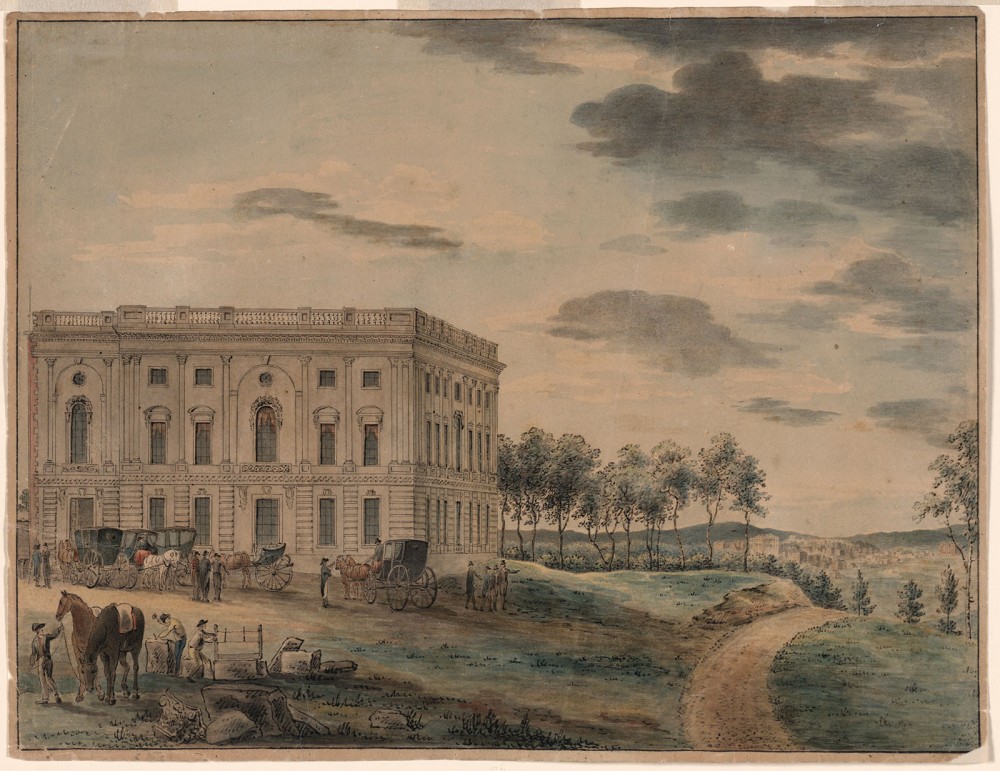
Meanwhile, the Alien and Sedition Acts were nullified in 1800 and 1801. They had been relatively useless in suppressing opposition. Contrary to expectation, these laws provoked strong reactions that were very significant. These laws helped many Americans decide what they did not want from the national government.
Thus, in 1800, President Adams lost the trust of many Americans. They communicated this to Adams in various ways. For instance, in 1798 Adams issued a national Thanksgiving proclamation. But instead of enjoying a day of celebration and gratitude, rioters pressured Adams and his family to leave the capital (Philadelphia) and not return until the end of the day. On the other hand, Adams's independence also brought him into a quarrel with Alexander Hamilton, who was the party leader and offered Adams little support. After four years in office, Adams found himself exposed to abuse from all sides.
Thus, in the election of 1800, the Republicans defeated Adams in a bitter and complex presidential contest. During the election, an article in a Federalist newspaper predicted that a Republican victory would drown America in theft, crime, rape, and illicit relations.[36] On the other hand, a Republican newspaper began mudslinging against the president, declaring that Adams had "neither the force and fortitude of a man, nor the gentleness and sensitivity of a woman." Both sides predicted catastrophe and war if the other side won.[37]
In the end, the contest resulted in a tie between two Republicans, Thomas Jefferson of Virginia and Aaron Burr of New York, who each had seventy-three electoral votes. (Adams had sixty-five votes.) Aaron Burr was meant to be the vice-presidential candidate, not the presidential one, but according to the original rules of the Constitution, a runoff vote had to be held in the House of Representatives. This House was controlled by Federalists who were furious with Jefferson. The members of the House voted dozens of times without resolving the issue. On the thirty-sixth ballot, Thomas Jefferson prevailed.
The Republicans believed they had saved the United States from certain peril. A Republican gathering in New York called the election a "bloodless revolution." They thought of their victory partly as a revolution because the Constitution (and eighteenth-century political theory) made no provision for political parties. Republicans thought they were fighting to liberate the country from an office-holding aristocracy, not merely participating in a normal legal process.
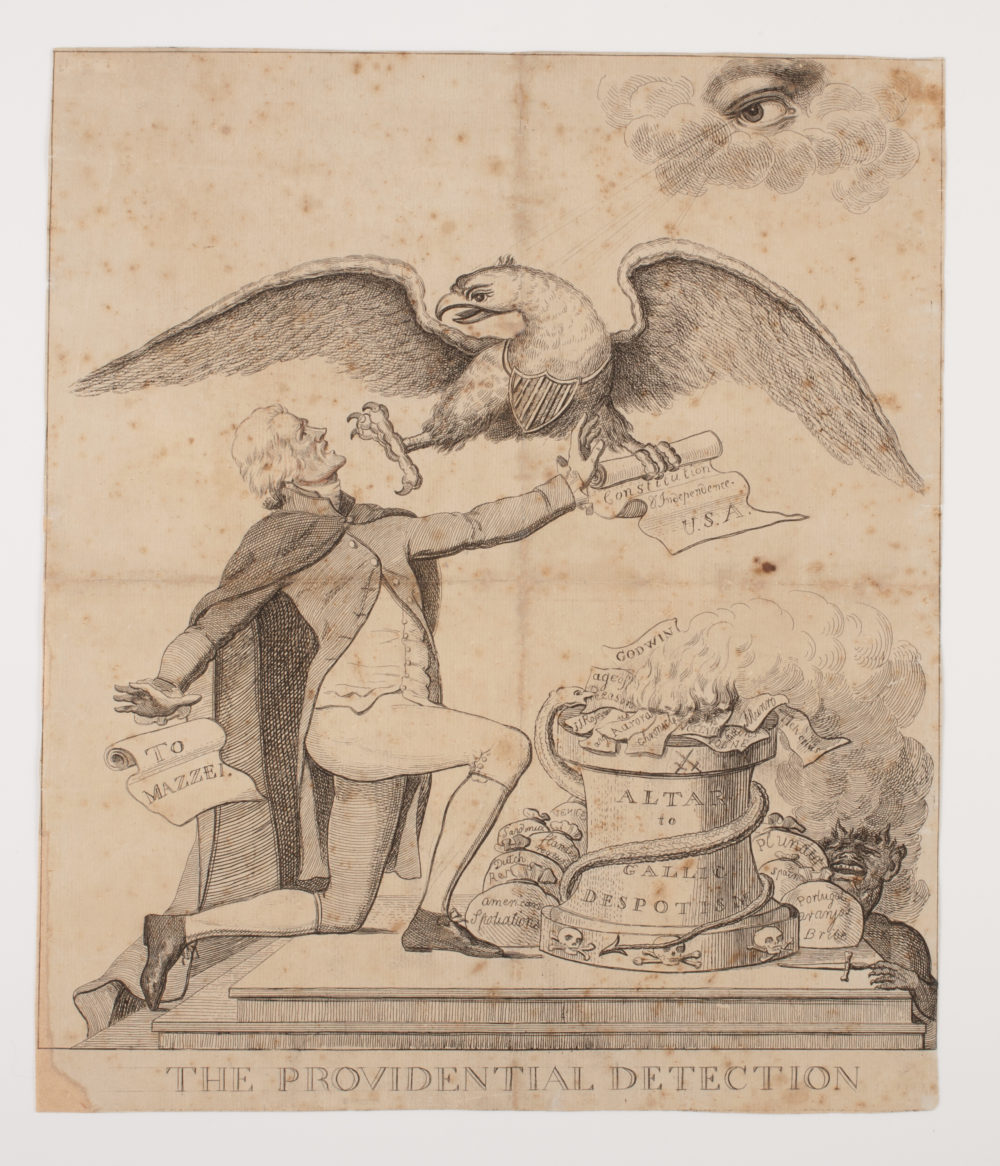
But in his first inaugural address, Thomas Jefferson offered an olive branch to the Federalists. He promised to pursue the will of the majority of Americans, who he believed were mostly Republicans, and added that he would also respect the rights of the Federalist minority. His election established an important tradition. Adams accepted his electoral defeat and peacefully left the White House. Jefferson wrote years later that the Revolution of 1800 did for American laws what the Revolution of 1776 had done for its structure. He added that the revolution was now complete, not by the sword but by "the rational and peaceable instrument of reform";[38] "the suffrage of the people." But 38 years later, the Twelfth Amendment changed the rules for presidential elections to prevent deadlocks; it was designed to accommodate the ways and methods of party actions.
Despite the efforts of Jefferson and Adams to tame political parties, the tension between federal power and the liberty of states and individuals persisted into the nineteenth century. When Jefferson's administration tried to reduce federal influence, Chief Justice John Marshall, an Adams appointee, sought to expand the authority of the Supreme Court. The most famous clash of these rival plans occurred in 1803 in the case of Marbury v. Madison, where Justice Marshall used the opportunity to establish a great tradition.
Initially, the Marbury case seemed insignificant. The night before he left office, Adams appointed several men to serve as justices of the peace in Washington, D.C.; by making these "midnight appointments," Adams wanted to place his Federalist partisans in vacant offices at the last minute. But as soon as they took over the government, Jefferson and his Secretary of State James Madison refused to deliver these federal commissions to Adams's appointed men. Several of the appointees, including William Marbury, sued the government, and the matter was argued before the Supreme Court.
Marshall used the Marbury case to exercise a shrewd form of governance. On the matter of the commissions, the Supreme Court ruled in favor of Jefferson's administration. But Chief Justice Marshall went beyond this decision; he ruled that the Supreme Court reserved for itself the right to decide on Congress's violations of the law. In other words, the Court assumed the power of judicial review. This was a major (and lasting) blow to the Republicans' plans, especially after 1810, when the Supreme Court extended judicial review to state laws as well. Jefferson, particularly frustrated by this decision, argued that the power of judicial review "makes the judiciary a despotic branch [of government]."[39]
Conclusion
A great debate over political power swept over the young United States. The Constitution guaranteed a strong federal government that could tax, wage war, and enforce laws, but this guarantee could never resolve many of the conflicts among the voters of this nascent nation. The Whiskey Rebellion proved that the government could silence domestic opposition but also revealed a new threat to liberty. Hamilton's banking system provided credit for the nation, but it also squeezed frontier farmers. The Constitution's guarantee of religious freedom clashed with many popular prerogatives. Disagreement only deepened, and as the 1790s progressed, Americans were unfortunately divided into two camps over political parties and foreign wars.
During the debates over the ratification of the Constitution, Alexander Hamilton had written of the wonders of the Constitution. He wrote, "A nation without a national government is, in my view, an awful spectacle." But he added, "The establishment of a Constitution, in time of profound peace, by the voluntary consent of a whole people, is a prodigy." A miracle that must be preserved with "trembling anxiety." The Anti-Federalists had deep concerns about the Constitution, but even they celebrated the idea of national union. By 1795, even the most steadfast critics reluctantly accepted Hamilton's views on the Constitution. Though these individuals could still find the necessary warnings in Washington's 1796 Farewell Address. Washington wrote, "The common and continual mischiefs of the spirit of party are sufficient to make it the interest and duty of a wise people to discourage and restrain it." What Washington said was probably true, but he continued, "In a republic, a minimal degree of partisanship is not dangerous, but extreme partisanship is." Washington warned, "It is a fire not to be quenched, it demands a uniform vigilance to prevent its bursting into a flame, lest, instead of warming, it should consume."[41]
For every parade, thanksgiving proclamation, or grand demonstration in honor of the nation's union, there were also political bickerings to remind American citizens just how fragile their union was; and as partisan differences and regional disputes tested the federal government, the new nation also increasingly explored the limits of its democracy.
.
.
Notes
[1] . Francis Hopkinson, An Account of the Grand Federal Procession, Philadelphia, July 4, 1788 (Philadelphia: Carey, 1788).
[2] . George Washington, Thanksgiving Proclamation, October, 3, 1789; Fed. Reg., Presidential Proclamations, 1791–1991 .
[3] . Hampshire Gazette (CT), September 13, 1786 .
[4] . James Madison, The Federalist Papers, (New York: Signet Classics, 2003), no. 63 .
[5] . Woody Holton, Unruly Americans and the Origins of the Constitution (New York: Hill and Wang, 2007), 8–9 .
[6] . Madison took an active role during the convention. He also did more than anyone else to shape historians’ understandings of the convention by taking meticulous notes. Many of the quotes included here come from Madison’s notes. To learn more about this important document, read Mary Sarah Bilder, Madison’s Hand: Revising the Constitutional Convention (Cambridge, MA: Harvard University Press, 2015).
[7] . Virginia (Randolph) Plan as Amended (National Archives Microfilm Publication M866, 1 roll); The Official Records of the Constitutional Convention; Records of the Continental and Confederation Congresses and the Constitutional Convention, 1774–1789, Record Group 360; National Archives.
[8] . Richard Beeman, Plain, Honest Men: The Making of the American Constitution (New York: Random House, 2009), 114 .
[9] . Herbert J. Storing, What the Anti-Federalists Were For: The Political Thought of the Opponents of the Constitution (Chicago: University of Chicago Press, 1981), 16 .
[10] . Ray Raphael, Mr. President: How and Why the Founders Created a Chief Executive (New York: Knopf, 2012), 50. See also Kathleen Bartoloni-Tuazon, For Fear of an Elected King: George Washington and the Presidential Title Controversy of 1789 (Ithaca, NY: Cornell University Press, 2014).
[11] . David J. Siemers, Ratifying the Republic: Antifederalists and Federalists in Constitutional Time (Stanford, CA: Stanford University Press, 2002).
[12] . Alexander Hamilton, James Madison, and John Jay, The Federalist Papers, ed. Ian Shapiro (New Haven, CT: Yale University Press, 2009).
[13] . Pauline Maier, Ratification: The People Debate the Constitution, 1787–1788 (New York: Simon and Schuster, 2010), 225–237 .
[14] . David Waldstreicher, Slavery’s Constitution: From Revolution to Ratification (New York: Hill and Wang, 2009).
[15] . Carson Holloway, Hamilton Versus Jefferson in the Washington Administration: Completing the Founding or Betraying the Founding? (New York: Cambridge University Press, 2015).
[16] . Alexander Hamilton, The Works of Alexander Hamilton, Volume 1, ed. Henry Cabot Lodge, ed. (New York: Putnam, 1904), 70, 408 .
[17] . Alexander Hamilton, Report on Manufactures (New York: Childs and Swaine, 1791).
[18] . James H. Hutson, ed., Supplement to Max Farrand’s the Records of the Federal Convention of 1787 (New Haven, CT: Yale University Press, 1987), 119 .
[19] . Hamilton, Report on Manufactures).
[20] . Richard Sylla, “National Foundations: Public Credit, the National Bank, and Securities Markets,” in Founding Choices: American Economic Policy in the 1790s, ed. Douglas A. Irwin and Richard Sylla (Chicago: University of Chicago Press, 2011), 68 .
[21] . Thomas P. Slaughter, The Whiskey Rebellion: Frontier Epilogue to the American Revolution (New York: Oxford University Press, 1986).
[22] . “Proclamation of Neutrality, 1793,” in A Compilation of the Messages and Papers of the Presidents Prepared Under the Direction of the Joint Committee on printing, of the House and Senate Pursuant to an Act of the Fifty-Second Congress of the United States (New York: Bureau of National Literature, 1897).
[23] . United States, Treaty of Amity, Commerce, and Navigation, signed at London November 19, 1794, Submitted to the Senate June 8, Resolution of Advice and Consent, on condition, June 24, 1795. Ratified by the United States August 14, 1795. Ratified by Great Britain October 28, 1795. Ratifications exchanged at London October 28, 1795. Proclaimed February 29, 1796 .
[24] . Elizabeth Fox-Genovese and Eugene D. Genovese, The Mind of the Master Class: History and Faith in the Southern Slaveholders Worldview (New York: Cambridge University Press, 2005), 18 .
[25] . From Thomas Jefferson to William Short, 3 January 1793,” Founders Online, National Archives. http://founders.archives.gov/documents/Jefferson/01-25-02-0016, last modified June 29, 2015; The Papers of Thomas Jefferson, vol. 25, 1 January–10 May 1793, ed. John Catanzariti (Princeton, NJ: Princeton University Press, 1992), 14–17 .
[26] . Robert Goodloe Harper, June 18, 1798, quoted in American Daily Advertiser (Philadelphia), June 20, 1798 .
[27] . Robert J. Alderson Jr., This Bright Era of Happy Revolutions: French Consul Michel-Ange-Bernard Mangourit and International Republicanism in Charleston, 1792–1794 (Columbia: University of South Carolina Press, 2008).
[28] . Rachel Hope Cleves, The Reign of Terror in America: Visions of Violence from Anti-Jacobinism to Antislavery (New York: Cambridge University Press, 2012), 47 .
[29] . Alien Act, July 6, 1798, and An Act in Addition to the Act, Entitled “An Act for the Punishment of Certain Crimes Against the United States,” July 14, 1798; Fifth Congress; Enrolled Acts and Resolutions; General Records of the United States Government; Record Group 11; National Archives.
[30] . James Wilson, Congressional Debate, December 1, 1787, in Jonathan Elliot, ed., The Debates in the Several State Conventions on the Adoption of the Federal Constitution as Recommended by the General Convention at Philadelphia in 1787, Vol. 2 (New York: s.n., 1888) 448–450 .
[31] . Tunis Wortman, A Treatise Concerning Political Enquiry, and the Liberty of the Press (New York: Forman, 1800), 181 .
[32] . George Hay, An Essay on the Liberty of the Press (Philadelphia: s.n., 1799), 43 .
[33] . Thomas Jefferson to James Madison, August 28, 1789, from The Works of Thomas Jefferson in Twelve Volumes, Federal Edition, ed. Paul Leicester Ford. http://www.loc.gov/resource/mtj1.011_0853_0861
[34] . Francis Newton Thorpe, ed., The Federal and State Constitutions, Colonial Charters, and Other Organic Laws of the States, Territories, and Colonies Now or Heretofore Forming the United States of America Compiled and Edited Under the Act of Congress of June 30, 1906 (Washington, DC: U.S. Government Printing Office, 1909).
[35] . Thomas Jefferson, An Act for Establishing Religious Freedom, 16 January 1786, Manuscript, Records of the General Assembly, Enrolled Bills, Record Group 78, Library of Virginia.
[36] . Catherine Allgor, Parlor Politics: In Which the Ladies of Washington Help Build a City and a Government (Charlottesville: University of Virginia Press, 2000), 14 .
[37] . James T. Callender, The Prospect Before Us (Richmond: s.n., 1800).
[38] . Letter from Thomas Jefferson to Spencer Roane, September 6, 1819, in The Writings of Thomas Jefferson, 20 vols., ed. Albert Ellery Bergh (Washington, DC: Thomas Jefferson Memorial Association of the United States, 1903), 142 .
[39] . Harold H. Bruff, Untrodden Ground: How Presidents Interpret the Constitution (Chicago: University of Chicago Press, 2015), 65 .
[40] . Alexander Hamilton, The Federalist Papers (New York: Signet Classics, 2003), no. 85 .
[41] . George Washington, Farewell Address, Annals of Congress, 4th Congress, 2869–2870 .
.
.





Discussion2 comments
تصویری که در ایران از تاریخ آمریکا بوسیله انتشارات یهودی و تحصیلات developeشده بوسیله خود حاکمان صاحب قدرت و دارایی جا انداخته شده با آن چه در خود ایلات متحده جامعه آکادمیک می داند متفاوت است. کتابی به نام The Untold History Of the USدر کتابخانه ها موجود است و در اینترنت قابل دانلود کردن و شنیدم در کشور شما ترجمه شده. اما این ذره ای از واقعیات نیست. برای جوان اهل تحقیق دنبال کردن سخنان زندان رفته ها، شکنجه شده ها، تجاوز شده ها، مردم معتاد بی خانمان trump , svanenger سخنان بومی ها ، سیهپوستان محروم ، قشر متوسط فقیر شده و غیر آن به شکل هوشمند انه و با زیرکی و با کمک قشر دانشگاهی غیر صادق با رشوه جاه و مقام و پول و شهرت علمی بعنوان servieروشنفکری shout down میشود. این صدای خفه شده miserables آمریکایی است و شما به آن دسترسی ندارید. سخنرانی The ballot or the bullet، Malcolm X را بشنوید.
بومی از میان قبیله چروکی: جمعی مجرم و نظامی با ما چپق صلح می کشیدند و پس از استقرار زن و بچه ما را قتل عام کردند. مقاومت ما در فیلمهای آمریکایی به شکل وحشیگیری و خونریزی به تصویر کشیده شد تا زمانی که با حذف منبع غذایی ما و کشتار دسته جمعی آمریکایی ها(اروپایی ها سفید پوست caucasian) انقدر کشتند تا بر ما غلبه پیدا کردند. سپس بروی نقشه آمریکا مناطقی بنام Reservationنگاشته شد که محل کانسنتریشن بومی های صاحب این سرزمین بود. همان کاری که ملت غربی بر سر فلسطین آوردند بر ما رفت. این R ها هم مانند سرزمین فلسطن آب رفت . ما اکنون بیسواد فقیر و مجرم social dregsجامعه در کنار برده های آفریقایی که بزور بروی کشتی های اروپایی های معتقد به اندیشه نو به این سرزمین آورده شدند حقارت را تحمل میکنیم.وقتی در کتب فلسفه حقوق بشر، لیبرالیسم، آزادی و اندیشه ورزی را می بینم به یاد کشتار بومی ها صاحبان سرزمین و تصاحب عدوانی مجرمانه چشم آبی ها میافتم. اما من در دانشگاه ، در اسوشیدپرس صدایی ندارم. وقتی راکفلر propertyسازمان ملل را به این سازمان هدیه داد فهمیدم که حقوق ملل و Human Rights Charter که آن ها مینویسند مانند لبخند ژنرال کاستر افتادم که در ابتدا چپق صلح می کشید و در یک قلم قتل عام چند ده زن و بچه را به قتل رساند. اندرو جکسون که در کتب شما بعنوان رئیس جمهور آمریکا و نظام آزادی و حقوق بشر قرار می گیرد فرمان Indian Removal سرخپوست زدایی را صادر کرد. وقتی از افردی که بر وی جسد و استخوان های شکسته بومی های صاحب سرزمین آمریکا خانه و کشتزار خود را بر پا کردند بعنوان یک ملت ! نام میبرید یا ناآگاهید یا منافع شما در تغافل و تحمیق مخاطبین است.