Religion
The Crime of Apostasy in Hadith
The legislator has not prescribed a specific punishment for apostasy, and this silence indicates a reluctance to criminalize it. The conduct of the Ahl al-Bayt and Imami jurists points to tolerance toward apostates, with execution reserved for those who openly profess unbelief and actively propagate against Islam.
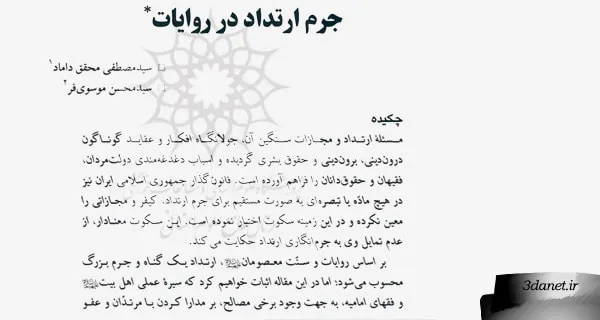
The Crime of Apostasy in Hadith: The issue of apostasy and its severe punishment has become a battleground for various intra-religious, extra-religious, and human rights ideas and opinions, and has caused concern for statesmen, jurists, and legal scholars. The legislator of the Islamic Republic of Iran has also not directly specified a penalty or punishment for the crime of apostasy in any article or clause, and has remained silent on this matter. This meaningful silence indicates his reluctance to criminalize apostasy. Based on the hadiths and the tradition of the Infallibles, apostasy is considered a major sin and crime; however, in this article we will prove that the practical conduct of the Ahl al-Bayt and Imami jurists, due to certain expediencies, was to tolerate and pardon apostates, which itself indicates that the punishment for apostasy has been abandoned. Furthermore, we will state that the unqualified application of hadiths that consider the subject of apostasy to be merely changing one's religion is restricted by the condition of being accompanied by denial and rejection. We will also show that the acceptance of repentance is not exclusive to a national apostate, but rather the repentance of a fitri apostate is also accepted and the effects of repentance apply to it.
Conclusion
It seems that a fitri apostate is someone who is born upon the fitra of Islam, at least one of whose parents is a conscious Muslim, and who professes Islam after reaching puberty, then turns away from the religion out of obstinacy and stubbornness. The Islamic legislator has not directly specified a punishment for the crime of apostasy in any article or clause and has deliberately remained silent about this crime. This meaningful silence of the legislator indicates his reluctance to criminalize apostasy. On the other hand, the subject of some hadiths on apostasy is merely changing one's religion, while the subject of other such hadiths is changing one's religion accompanied by denial and rejection. According to usuli rules, unqualified hadiths must be interpreted in light of qualified ones. One verse and two hadiths were also presented as evidence for this reconciliation. The practical tradition of the Messenger of God and the Commander of the Faithful, Ali (AS), in early Islam also involved pardoning fitri apostates, and there is much historical evidence in this regard; just as Imam Khomeini also refrained from punishing fitri apostates on numerous occasions. If a fitri apostate returns to the fold of religion, their repentance is accepted and they are spared the death penalty. Moreover, the death penalty is specific to those fitri apostates who, in addition to stubbornness and obstinacy, openly display their disbelief and propagate against the true religion of Islam. Finally, it seems that considering the extraordinary power of global media and the propaganda campaigns of the enemies of religion, and also in observance of the rule of "tanfir" (causing aversion), the implementation of the death sentence should be refrained from, and another appropriate punishment should be considered for the apostate, just as instead of the term "irtidad" (apostasy), the expressions "turning one's back on religion," "turning away from religion," and "religious intolerance" can be used to carry a less negative connotation.
.
.
PDF file of the article The Crime of Apostasy in Hadith
.
.
Authors: Seyed Mostafa Mohaghegh Damad, Seyed Mohsen Mousavi Far
Source (Journal): The Teachings of Criminal Law, New Series, Fall and Winter 2014, No. 8
.
.






Discussion0 comments
No comments yet; let yours be the first voice.