Political Science
The Devotees of Ignorance, by Reza Khojasteh-Rahimi
The Siahkal incident was less a tragedy than a comic tale: Amir Parviz Pouyan and his comrades, modelling themselves on Che Guevara and rejecting expertise, sanctified ignorance and even accused Shariati of leading the youth astray.
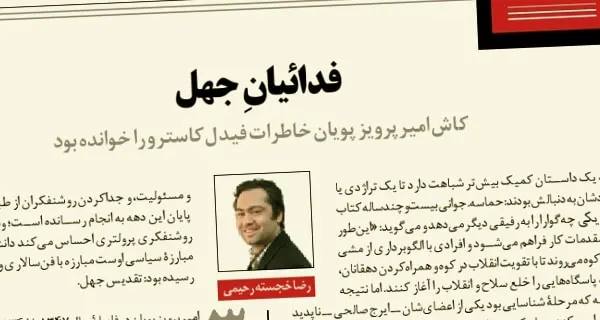
The account of the affair resembles a comic story more than a tragedy or what they themselves were seeking: an epic. A young man in his twenties hands Che Guevara’s Guerrilla Warfare to another comrade and says, “This is how one must serve”…
.
The Devotees of Ignorance
If Only Amir Parviz Pouyan Had Read Fidel Castro’s Memoirs
1 The account of the affair resembles a comic story more than a tragedy or what they themselves were seeking: an epic. A young man in his twenties hands Che Guevara’s Guerrilla Warfare to another comrade and says, “This is how one must serve.” Preparations are made, and individuals, modeling themselves on the approach of Che Guevara and Castro, head to the mountains to strengthen the revolution there, rally the peasants, attack the city, disarm outposts, and launch the revolution. But the result is this: in the first stage, the reconnaissance stage, one of their members—Iraj Salehi—disappears; in truth, he flees. As he later wrote in SAVAK interrogations: “The evident satisfaction of the villagers with the government caught my attention. It made the thought of separating from that group enter my mind.” At the appointed time, before the attack on the Siahkal outpost, the first shot is also mistakenly fired by one comrade at another. During the escape, it is the turn of their Ford, which they had stolen from a villager, to commit a counter-revolutionary act by not starting, forcing the guerrillas to push-start the car. In the following days, while three exhausted and frostbitten guerrillas separate from their comrades and take refuge in a rural peasant’s home, they are handed over to the gendarmes bound hand and foot. Another of the comrades flees, leaving the tired and dejected comrades alone. The remaining guerrillas, guided by the “locals” who were supposed to be the engine of the revolution, are targeted by the gendarmes’ fire and fall to the ground. It is said that at this time, Amir Parviz Pouyan, one of the theoreticians of armed struggle who had a hand in these events from afar, had psychologically developed a fear of firearms; because of a bullet that had apparently been discharged while cleaning a gun and had torn through his back. Pouyan was convalescing, although he had already provided the theory of armed struggle and, at the end of the 1340s, had declared that it was no longer enough to speak of the vanguard merely with enthusiasm. In defense of armed struggle and in rejecting the theory of survival, he had written that it was time for enthusiasm and desire to turn into familiarity and action. The model for young militants had thus shifted from Jalal and Shariati to Régis Debray and Castro. So much had been written and said in Iran’s intellectual sphere by the likes of Jalal and Shariati in praise of Sartre and his views on committed literature and the responsibility of the intellectual that when Sartre called a mediocre but rebellious man, Fidel Castro, who had taken up arms, the intellectual of the age, young militants like Pouyan were drawn to Castro’s charisma and approach. With the unfolding of the Siahkal tragicomedy and the arrest of the young guerrillas, solutions also occurred to the desperate comrades; among them, kidnapping for ransom to save their revolutionary and militant comrades—for instance, the abduction of the German ambassador in Tehran—and it was after this that the banner of armed struggle under the title “People’s Fadai Guerrillas,” centered on young people like Pouyan who had now become proletarian theoreticians, was raised for the first time.
۲ As has been recounted, during his time as a sociology student at the University of Tehran, Amir-Parviz Pouyan was grappling with a spiritual torment over whether to continue or abandon his studies. Aversion to the university, to coursework, and to specialization was, of course, not alien to the general atmosphere and spirit of that decade. Jalal contemptuously called the technocrats “specialization-mongers,” and Ali-Asghar Haj-Seyyed-Javadi thundered that technocrats “attach more importance to statistical figures and economic, financial, and technical calculations than to the spiritual and moral needs of human beings.” And Ali Shariati, in defining the intellectual, said that “an intellectual is someone who thinks in a new way. If he is unlettered, so be it; if he does not know philosophy, so be it; if he is not a jurist, so be it. He is not a physicist, a chemist, a historian, or a man of letters—so be it. But he must sense his time and understand the people.” It was probably on the basis of such precepts that Amir-Parviz Pouyan contemplated leaving the university and told a friend: “I want to drop out and have come to seek advice on the matter—holding a degree, for an intellectual who wishes to engage deeply with social issues, can become an inhibiting and troublesome factor; in the sense that with a degree one is usually absorbed into government jobs and, gradually advancing within the state apparatus, falls short of his social missions, and I, in order to forestall such a possibility in the future, want to set my mind at ease by leaving the university.” That Pouyan had arrived at such a simplistic conclusion about science and education showed that prioritizing struggle and responsibility, and separating intellectuals from the educated class, had done its work by the end of this decade; when Pouyan, on the path to becoming a proletarian intellectual, feels that the university is a diversionary station on his path of political struggle, the battle against technocracy and specializationism had reached its zenith. The sanctification of ignorance.
۳ Amirparviz Pouyan wrote two letters between 1968 and 1969; one was a sealed letter addressed to Ali Shariati and the other, semi-clandestine and at the group level, concerned the mourners of Jalal’s death. Both letters were written with the intent of enlightenment and to move beyond the revolutionary comrades of the two exemplars of the intellectualism of the 1340s and 1350s. In the first letter, a 22-year-old youth accused the man who would later be dubbed the Teacher of the Revolution of confusing the youth and squandering their protest potential. Shariati stood condemned for occupying students and the young generation with abstract subjects and leading them astray. Pouyan had, of course, earlier mocked that orator from his hometown for translating Massignon’s Salman the Pure, saying, “Instead of translating Capital, this is the souvenir you brought back from Europe?” and had received the stubborn reply, “This is nothing; from now on I want to work on pilgrimage texts.” In the autumn of 1968, however, Pouyan, in a critical letter to Ali Shariati that was probably a final ultimatum, warned that the Teacher of the Revolution, instead of struggling, was seeking to divert the youth with dry and intangible discussions; he even taunted him for attending a séance in the dormitory of Ferdowsi University of Mashhad! The text of this letter is not available. But the second, semi-clandestine letter or article about Jalal is, of course, extant: “Angry at Imperialism and Afraid of Revolution”—as if describing Jalal’s state. Pouyan, a 23-year-old youth, wrote this article on the occasion of Jalal’s death, with an intensely caustic tone and pen, and for the purpose of exposure to his party comrades. Reading it today, more than revealing anything about Jalal, exposes the excessive and pathological self-confidence of its young author. His letter to Ali Shariati must certainly have had such a caustic tone and pen that, after reading it, Shariati told the bearer of the letter: “See how today’s chicks want to teach yesterday’s chicks a lesson.” It was contrary to custom for someone, especially a young person, to rise to speak ill of Jalal’s corpse. In the absence of that intellectual myth, as if it were an opportunity to drag him down, he took up his pen and wrote that he was an advocate of “a half-baked socialism” that “moderated class exploitation” and was a “defender of liberalism,” and although he did not possess the “self-serving opportunism of Ali-Asghar Haj-Seyed-Javadi,” at the time of his death he was ultimately a “progressive, moderate petty bourgeois” who also feared the “leftist petty bourgeois.” The article finally concluded with this merciless judgment: “I consider his timely death, although sorrowful in one respect, a success for him. Although the folklore legend made a martyr of Takhti and Samad Behrangi, they are indifferent regarding his death. But in any case, this was better than them making a traitor of him in the future. Saying that he would have joined the ranks of the revolutionaries is far easier than saying that he would have found a place among the revolutionaries, and this is the most realistic consolation I can offer his petty-bourgeois supporters.” Pouyan’s writing in rejection and vilification of Jalal at the end of the 1340s was as explicit, wrathful, and volcanic as Jalal’s own writings about his opponents and enemies throughout that decade. A decade that had passed with the prioritization of action and courage had borne fruit: the spread of verbal violence aimed at pushing aside any manifestations and expressions of non-revolutionary action. Pouyan’s insolence was strange but not novel. A decade that had begun with Jalal Al-e-Ahmad’s dominance and his sharp critiques of every opponent, and had reached the negation and disparagement of uncommitted poets and writers with words like “warbling canary,” had to end, at its close, with the vanguard of youths who wanted to transform the revolutionary “opinion” of the likes of Jalal into revolutionary “action.” Nor had they gone far astray.
4 With the unfolding of the tragicomedy of Siahkal, led by Pouyan and other comrades, statements were distributed among the people; among them one titled “Siahkal, Iran’s Moncada.” A comparison referring to the barracks in Cuba where Fidel and his brother Raúl had begun their struggle. Shortly thereafter, Amir-Parviz Pouyan gave his life on the path he had chosen. He was exposed and, during an assault to arrest him, killed himself. The young man who had declared Jalal’s death useful and timely, and wrote that Jalal died before he could be known as a traitor, lived a short life. He did not survive to read Castro’s memoirs from the era of struggle and power, to at least compare, through the memoirs of that very myth, the record of that intellectual and revolutionary myth with their socialist utopia. (These memoirs were published in 2010.) Their hero was perhaps not—or perhaps was—that narcissistic Castro who, in the narrative of his memoirs, wrote without a stammer: “The Cuban Revolution would have had no external existence without me.” And of Che Guevara he said: “It is hard for you to accept that for all these years you have prostrated yourselves at the altar of a man whose memory is kept alive only for propaganda reasons—[Che Guevara’s] iron will had nothing to do with true convictions, mental strength, and iron will. Rather, it was related to his asthma; the constant feeling of suffocation and especially the continuous reaction to this feeling and the regular, abundant secretion of adrenaline by the body’s involuntary system makes such patients fear nothing.” The model of struggle for Pouyan and his comrades was perhaps not—or perhaps was—that Castro whose first action after the revolution was to build a heroic image of himself: “I thought of making myself a hero.” And for this purpose, he erected statues and monuments of himself throughout Cuba; every place where he had fought or every place where he had been imprisoned had to be rebuilt in the desired form. Without anyone noticing. Pouyan and his comrades, who had forbidden love between the girls and boys in the group according to communist theories (so much so that Manaf Falaki and Ruqayyah Daneshgari preferred to keep their relationship hidden); what did they know that their beloved Fidel was the same militant intellectual who, upon liberation, sent many of his former comrades to “five-star dungeons.” And many others to firing squads: “There have been [those] who, despite pleas for help, entreaties, tears, and requests for mercy on account of their youth, were still executed.” Fidel and Batista were not so different from one another, and Fidel himself had realized this, writing: “Batista and I were very similar. We have never been more alike.” He estimated that on the first day he would execute five hundred people and had also banned the presence of photographers at execution scenes. He had become such a dictator that, alongside courts from which, in his own words, “almost no one has come out alive,” he could “persuade tough men” to “sign their own death warrants before their own firing squads.” His brother Raúl, according to our revolutionary intellectual’s account, “when he spoke of killing someone, it was as if he were speaking of turning off a light switch,” to the point that Fidel once told him: “Raúl, you don’t want the palace. You are only interested in a mass grave, and that is exactly what will happen.” With such a background and record, the beloved intellectual who had pushed aside Batista established a lifelong, unelected dictatorship. It was as if the people had elected him once, and that was enough. It can be called a dictatorship or guided democracy; something that was supposed to be an alternative to Western democracy. Western democracy was a vice that our native intellectuals, from Cuba to any other Third World country, used as a cudgel against democracy. So much so that Sartre, enamored of these young militants, traveled to Cuba with de Beauvoir to hang the medal of intellectualism around their necks, to praise rebellion, and to write: “What preserves the Cuban Revolution today, and perhaps for a long time to come, is that the revolution is in the hands of rebels.” The revolution of rebels was a new model of the free human being; a manifestation of “soldier-militants” against “clockwork puppets” and an alternative to democracy which, according to native intellectuals, “gave Westerners no right beyond dropping a ballot into a box.”
5 On the eve of the Pouyan and Ahmadzadeh group joining the Jungle Group, the Tabriz branch of the group carried out an armed operation. The result was the killing of two policemen, the seizure of a machine gun, and the emergence of two cut-off and remorseful guerrillas. One of those two cut-off guerrillas, named Mark (the alias of Jafar Ardabilchi), had said, “I got scared and said goodbye.” Masoud Ahmadzadeh wrote this some time later in his interrogations and added, “Unfortunately, we did not deal decisively with this backing out and did not inflict upon them the punishment they deserved, even death.” Later, when Pouyan was no longer around, this mistake was not repeated. Pancho (Uranus Pourhassan), because he showed weakness and fear in going to the mountains, was declared a traitor deserving of execution by the verdict of Miftahi and Hamid Ashraf; although he managed to escape and avoid the revolutionary execution. Numerous ordinary people and conscript soldiers were killed in the guerrillas’ militant objectives; among them a bank manager who had been slow in opening the safe, or a conscript soldier who, after being disarmed during their attack on the bank, had attempted to flee (one of the conscript soldiers killed by Hamid Ashraf’s bullet). A letter from Hamid Ashraf reveals that in the following months, the young gangsters executed at least three of their comrades who had succumbed to petty-bourgeois traits and intended to leave the incident; on charges of “weakness, slackness, and a tendency to surrender.” The era of the Fadai guerrillas came to an end right at the dawn of the ’79 revolution, and if we are to judge them in the same language that Amir Parviz Pouyan wrote about Jalal, we must say that “their removal from power was better than for posterity to make a traitor out of them; they were revolutionaries. But saying that they would join the ranks of freedom-seekers is far easier than saying they would be placed among freedom-seekers.” The militant intellectualism that, by rejecting the theory of survival, had stepped into the fray of armed struggle, was not destined to follow a path much different from that of the outlaws of Siramastra and their legendary leader, who committed the first murder of his life at the age of nineteen, and after the guerrilla revolution, killing people had become so indifferent to him that he would write: “Killing the first person is hard. After that, everything becomes normal. You just have to kill one person. On subsequent occasions, even the victim’s face will not attract your attention. In later stages, groups of victims will replace that first victim. In the end, it does not matter how many people you have killed. [If you ever fall into the hands of your opponents in exchange for these killings] you will only be hanged once.”
.
.
Images of the article The Devotees of Ignorance in Andisheh Pouya Magazine
First Page | Second Page
.
.
Article Title: The Devotees of Ignorance
Author: Reza Khojasteh Rahimi
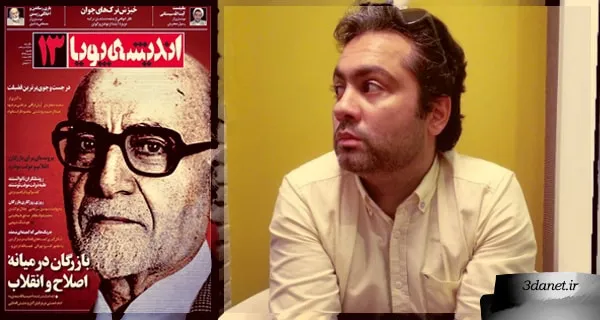
Source: Andisheh Pouya Magazine | Issue 12
.
.


Discussion10 comments
من نیز فریب خورده گمراهان بودم واگر آب بود شناوری چون کاسترو وپویان
دیروز فضای حاکم آن بود. چرا فکر می کنید امروز از گمراهان نیستید. الان حاکمیت رسانه و تحصیلات بر اذهان افراد مدرن تر و شدید تر از چگوارا و کاسترو است. اون وقت به نظر خودتان فریب خوردید ،الان فریبی دیگر البته با زیبایی و فریبندی امروزی تر. از فضای حاکم بیرون بیاییم و آن را بشناسیم
روشنفکران برشیپور افسانه عوام می دمند و در پرده تبلیغات انقلاب را زنده می خواهند و مهار انقلاب رابه یاغیان می سپارند
ای کاش همه ما یک بار زندگینامه فیلدل کارتزو رو بخونیم
مدتهاست که دیگر طشت رسوایی مارکسیسم از بام فروافتاده خصوصا زمان فروپاشی اتحاد جماهیر سوسیالیستی شوروی معبود توده ای ها و مارکسیسیتهای وطنی.از عجایب روزگار انکه تتمه مارسیست های داخلی در دامن کشورهای امپریالیستی غنوده اند همان کشورهایی که روزی علیه انان مبارزه می کردن. اری عجب مدار از این روزگار غدار..
فاشیسم لیبرالیسم را بشناسیم. اگر کسی اندیشه شما را نداشت کمونیست نیست. ضمنا افراد محترم و بزرگوار معتقد به لیبرالیسم گرایش چپ را مانند فحش و اتهام بکار می برند. وحشت می خوان ایجاد کنن تا حتی نام گرایش چپ برده نشود. این شدت وحشت را من در هیچ جا سراغ ندارم. اگر واقعا به شعارشان باور داشتند پس این هیاهو و ترس از چپ برای چیست.؟
کتاب نوربرتو فوئنتس به هيچوجه ظنز نيست. برای اثبات حرفه بخشی از نقدی را که خسرو ناقد بر اين کتاب در بی.بی.سی نوشته است، در زير می آورم. لينک اصلی نوشتۀ ناقد در بی.بی.سی: http://www.bbc.com/persian/arts/story/2008/02/080219_shr-kn-castro-book.shtml «نوربرتو فوئنتس که روزگاری در مقام سفیر کوبا انجام وظیفه میکرد، زندگینامهای دو هزار صفحه ای به زبان اسپانیایی از زبان فیدل نوشته است. فوئنتس عنوان "زندگینامه خودنوشت فیدل کاسترو" را برای کتاب خود برگزیده است؛ با آنکه کاسترو در نگارش کتاب نقشی نداشته است. فوئنتس اما معتقد است اگر فیدل کاسترو خود زندگینامه و شرح رویدادهای تاریخی انقلاب کوبا را می نوشت، نمیتوانست گستردهتر و دقیقتر از آنچه او نوشته است بنویسد. از اینرو عنوان "زندگینامه خودنوشت فیدل کاسترو" را برای کتابش برگزیده است. گرچه خود اذعان دارد که "داستان واقعی زندگی فیدل کاسترو در محدودهای پنهان است که کسی را راهی بدان نیست و در جایی تحت محافظت و کنترل کامل قرار دارد: در مغز فیدل".»
یک نکته کوچولو: این کتاب، کتاب خاطرات اصلی آقای کاسترو نیست. در واقع یک زندگینامه طنز است که توسط یک روزنامهنگار و به صورت تخیلی نوشته شده و از صدر تا ذیل آن با نگاه طنز نوشته شده است. به شکل عجیبی کتاب توسط مترجم و ناشر آن (انتشارات اطلاعات) به شکل یک کتاب جدی منتشر شده است! توضیحات بیشتر در مورد اصل کتاب انگلیسی را در ویکیپدیا و سایت آمازون میتوانید بررسی کنید.
بازیِ جدیدی نیست البته خجسته رحیمی وقاحت را خوب بلد است
الان نقد و بحث و بررسی مبارزه مسلحانه یا منش فداییان خلق چه ضرورتی دارد که ژورنالیستهای به اصطلاح لیبرال به آن می پردازند؟ به نظرم به جای اینکه وارد زمینی که امثال خجسته رحیمی چیده اند، بشویم باید از یک موقعیت پرسش کنندگان پرسید.اصلاحاتچی های مسلمان لیبرال طرفدار فقه آیت الله خوئی، دنبال چه هستند؟ هر کس انصاف و عقل به قدر کفایت داشته باشد می فهمد که این مقاله چیزی جز ژورنالیسم زرد نیست.وقتی نهایت استدلال نویسنده ای است که طرف سنش 22 سال بوده پس نباید جلال را نقد کند!