Sociology
Andisheh Pouya Monthly; article “The Disobedient Citizen and Future Possibilities” by Mohsen Goudarzi
Drawing on quantitative research, Mohsen Goudarzi analyzes the phenomenon of the 'disobedient citizen' in the aftermath of the 2017–18 Iranian protests. Mehdi Soleimanieh considers it the most prominent sociological analysis, addressing social rupture and disillusionment with institutions.
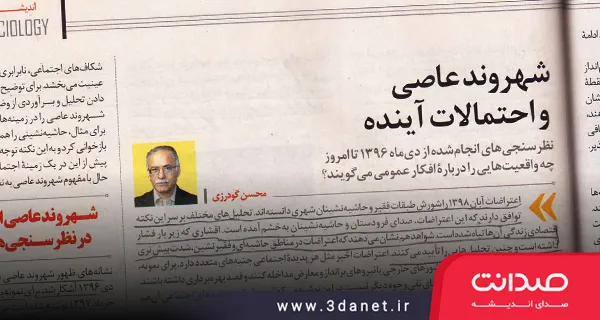
Notes and excerpts by Mehdi Soleimanieh on the article “The Disobedient Citizen and Future Possibilities” by Mohsen Goudarzi, published in Andisheh Pouya Monthly:
Introduction: Why is Mohsen Goudarzi’s text “very important”?
Let me get straight to the point: as a sociology student, I have read numerous texts by Iranian sociologists for over 16 years. Based on this 16-year familiarity, I believe the text “The Disobedient Citizen and Future Possibilities,” which Mohsen Goudarzi recently published in issue 63 of Andisheh Pouya on the occasion of this year’s November protests, may be the most important sociological-scientific text that Iranian sociology has produced in explaining the current overall state of society. Why do I make such a claim? I have three arguments for this claim:
What is one of the most important characteristics of sociology? Thinking about the problem of the here and now. This thinking about the problem, and one step before that, the very finding of our here-and-now problem, is one of the most significant weaknesses of many of our social science researches and analyses. Either the problem is not exactly a problem arising from our conditions and, at best, corresponds to only a part of our society’s problem (such as Yousef Abazari’s framing of the problem and his foregrounding of “neoliberalism” as the main problem of Iranian society in recent years), or it does not correspond to our current situation at all. Goudarzi’s analysis is a thoroughly here-and-now analysis: an analysis that, although built upon global sociological knowledge, draws its roots from our real sufferings and our specific situation. A kind of indigenous conceptualization.
What is the second important feature of this text? To understand our problems and to think about solutions, we need a “general view.” A description and analysis that sees not just one specific, small part, but all the components together. There is no shortage of sociological descriptions or analyses that have well described or analyzed one or several corners of the intertwined reality of our complex problems. But our society and our sociology need meso- and macro-level analyses: an understanding of the totality and from above. An understanding that puts various, seemingly unrelated problems and micro-descriptions together and shows us a larger descriptive or analytical picture. This has been the characteristic of influential sociological theories: a larger analytical frame. This characteristic is not easily attained. Goudarzi’s description and analysis in this text has such a capacity.
The third feature of Goudarzi’s recent text is its basis in an interconnected set of quantitative researches. In this text, Goudarzi stands on the shoulders of numerous studies, each of which has been an opportunity for Iranian sociology. An opportunity that is rarely obtained. Not through mere speculation or documentary studies, but based on a series of consecutive researches over the past decade, he has arrived at a macro analytical framework and precise conceptualization. Those who know Iranian sociology are aware that we are faced with either a crisis in the production of real numbers or a crisis in rich and correct analysis. Goudarzi, for various reasons, is capable in both areas. This is how he has given social meaning to numbers. Now, by listening to the logic of numbers painstakingly obtained with a thousand scruples, he is articulating a pattern that we have rarely heard for a long time.
With this introduction and considering the great importance of this analysis, I quote excerpts from his text and finally share the original text here for study. If we are thinking about the pains of our people, this text must be taken seriously.
Excerpts from the text “The Disobedient Citizen and Future Possibilities”:
“The November 2019 protests have been considered a revolt of the poor classes and urban margin-dwellers. Various analyses agree on this point that these protests are the enraged voice of the subaltern and margin-dwellers. Strata whose lives have been ruined under the pressure of the economy. Evidence also shows that the protests were more intense in marginal and poor areas, confirming such analyses.”
“Social protests are not confined to the social margins; rather, broad social classes are dissatisfied with the state of society and endure the pressures of inequality, discrimination, and the negation of their identities. In the case of the deprived classes, protests have been accompanied by a widespread wave of destruction of public and private property, and for this reason, their form and type differ from the protest that exists among the higher classes and groups of society. It seems that anger exists in most social strata, but the form and intensity of its expression vary among different groups.”
“After Dey 96 [January 2018], changes occurred in the collective mentality, and signs of the emergence of a phenomenon that can be called the ‘disobedient citizen’ gradually became apparent.
“At the beginning of the year 1398 [March 2019], more than half of the respondents to a survey said they have no hope that the situation will improve in the future. There is also no hope regarding the fight against corruption. At the beginning of 1398, more than half of the respondents thought that administrative and economic corruption would increase (...) In Esfand 1397 [March 2019], in another survey, 84 percent said they think their worries will increase in the future.”
“Numerous other results also confirm that after Dey 96, public opinion has lost hope for the improvement of conditions and has no hope in the efficacy of official institutions and policies.”
“With the emergence of the disobedient citizen, a new actor or agent has appeared in the political and social space, operating within a social context that can be called ‘social rupture’ or the decline of social solidarity.”
“The disobedient citizen brings social rupture from the level of a concept into the arena of ordinary, everyday life, reveals it, and gives it language. This phenomenon articulates social rupture, manifests it, and brings it from an abstract state to the level of the streets and the city.”
“Signs of the emergence of the disobedient citizen became apparent in surveys after Dey 96. For example, I will quote part of a text written in Khordad 1397 [June 2018]: A radical transformation has occurred in public opinion. The findings of this survey provide signs of the formation of a new situation in public opinion. Dissatisfaction with the country’s conditions is increasing and can quickly lead to collective protests. Given the breadth of the grounds for dissatisfaction, it is possible that a protest in one part of the country will lead to a protest in another part and spread like a domino.”
“Alongside widespread and growing dissatisfaction, official institutions and organizations, as well as the policies adopted, have lost their credibility more than ever, and their capacity for influence and control is also diminishing.”
“The gap between the will of the majority of the people and official policies is continuously widening, and as a result, dissatisfaction is directed at various spheres and fundamental values. The widespread despair of the people regarding the country’s future indicates a severe decline in trust in the efficiency and capability of responsible institutions. Even critical political figures and currents have lost their influence and effectiveness in persuading protesting and angry citizens.”
“In this inflamed context, the smallest and simplest issues have the potential to become a factor for social tension and the incitement of public opinion. The intensification of tensions, anger, and collective fear and panic makes the environment conducive to unpredictable, emotional, and uncontrollable ‘collective behaviors.’”
“The people see the country as futureless and ‘exhausted’ in the face of problems. They have no hope for the future. Creating hope through preaching and advice is not possible. Rather, it will only be feasible through demonstrating a serious will for fundamental change in the way the country is run.”
Who is the disobedient citizen and what was their slogan in the Aban protests?
“The disobedient citizen is a citizen who is weary of their living conditions, dissatisfied with the way the country and society are run, and sees no prospects for their life. The situation is neither tolerable for them, nor do they have the power to change their living conditions, nor any hope that official institutions and policies can do anything to improve their situation. The disobedient citizen negates the existing conditions and knows that they do not want such conditions. When the protesting crowd chants slogans like: ‘Death to high prices’ or ‘Death to corruption,’ they are angrily negating the conditions in which they are trapped.”
“The disobedient citizen is fed up with the state of society and their own conditions. While enduring a hard life, the daily news published about grand corruption makes them angrier about their situation and more disillusioned with social conditions. They see the gap between their own life and the life of ‘others.’ The disobedient citizen sees that a specific group or stratum enjoys the best life opportunities, such as jobs, income, and social status. Not only do they see the boastful and ostentatious display of wealth on city streets, but this aristocratic lifestyle is also flaunted on websites. This display provokes anger and hatred in them.”
“The values upon which official institutions are organized have become distant from their aspirations and interests. Hence, the disobedient citizen finds this mode of social organization alienating. The disobedient citizen experiences a combination of helplessness and despair. They see neither official institutions and organizations as effective in solving problems, nor can they untangle any of their own difficulties. They find no refuge in institutions and have no power to solve problems. Thus, the mental and emotional space of the disobedient citizen can be described as a combination of disillusionment, exasperation, and anger. (...) In one of these very Aban 2019 protests, a crowd was chanting: We are exhausted! This is the state of the disobedient citizen, expressed in the form of such a slogan.”
What has made citizens disobedient?
“1- The pervasiveness of problems and their remaining unsolved: Various aspects of people’s lives have become problematized or issue-ridden. That is, life affairs have been disrupted or face great difficulty and numerous obstacles. The social system, at various levels, is faced with dysfunction and malfunction, and therefore, life proceeds with hardship. In the words people themselves use, ‘Life has become hard.’
2- Growing dissatisfaction and the search for a better life elsewhere: The reflection of dissatisfaction with the situation can be seen in the tendency to emigrate. (...) According to a survey conducted in Tehran, in 2003 about 19 percent, in 2010 about 38 percent, and [in the latest survey in 2019], 53 percent of respondents spoke of their desire to emigrate.
“3- The decline in the credibility of institutions and the accumulation of despair: Due to corruption, the credibility of official institutions is declining. The inefficiency of institutions in organizing life and solving problems increases despair towards them. According to surveys, a large part of society believes that the economic, moral, social, and religious situation will worsen in the future.
“This anger is directed not only at officials but also at fundamental institutions. In the months of Ramadan in 2018 and 2019, the number of people who explicitly stated in surveys that they do not fast increased significantly. Most of these individuals are those who are dissatisfied with the existing conditions. This anger and dissatisfaction have gradually spread to other institutions and values. It should be noted that since 1975, when survey results have been available, fasting has always had the highest level of observance among religious behaviors. Its figure has averaged over seventy percent, whereas this time it had fallen below fifty percent.”
«4- The Decline in the Credibility of Political Forces and a Sense of Helplessness: Political factions and figures have also lost their credibility. Even critical political currents and figures no longer enjoy the credibility they once had. (...) In a survey last year, more than half of the respondents said they do not recognize any of the country's political factions.»
«5- Concern over the Fragility of Life: The results of a survey in September 2018 show that 68 percent of respondents find their income insufficient to meet their needs. The balance between income and the cost of living has been disrupted, and the majority are worried that with this trend, their standard of living will decline even further.»
«A survey conducted in Tehran in October 2018 shows a significant difference in outlook on the future between poor and wealthy neighborhoods. For example, in District 1 of Tehran, the number of pessimists is 4.8 times that of optimists. This ratio for District 19, which is considered a poor neighborhood of Tehran, is 22 times. It is expected that the fragility of life is greater for poorer groups.»
«6- Sudden Policies: Living in Tension: On the other hand, we are faced with a low level of political cohesion, or in other words, high levels of intra-government disputes and weak 'policy cohesion,' meaning contradictory, ad hoc, transient, and unstable policies. Unstable, inefficient, unpredictable, and sudden policies are perhaps the most important features of policymaking in recent years.»
What can be said about the future? «Considering these factors, what can be said about the future? It seems that, given the protests that followed the gasoline price hike, the government, out of concern for unintended consequences, will be unable to make any serious decisions regarding fundamental problems for a long time. It has already shown that it has no inclination to adopt fundamental policies. The atmosphere of distrust will also intensify indecision. As a result, the situation will continue as it is, and the problems will persist. On the other hand, the capacity for protest remains high because the living conditions for a large part of the population are dire. The conditions mentioned above, such as the fragility of life, the intensification of increasing problems, etc., require fundamental and serious decisions and policies, which there is currently no high probability of being adopted. The weakness of political cohesion further reduces the possibility of serious decision-making.»
.
.
PDF file of the article "The Disobedient Citizen and Future Possibilities"
.
.
The article "The Disobedient Citizen and Future Possibilities" by Mohsen Goudarzi, published in Andisheh Pouya Magazine
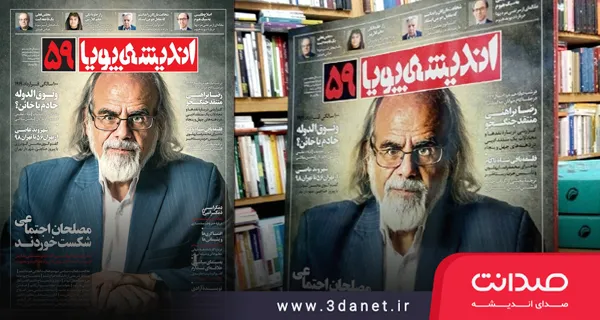
Andisheh Pouya Monthly - Issue 63, Azar and Dey 1398, pp. 47 to 50
.
.

Discussion1 comments
توصیف وضع موجود است . دانش انتزاعی در تراز روزآمد جهانی زمانی این جا ـ اکنون مفید است که از وصف آن چه روزانه می بینیم ، فراتر رود و گزینه های پیش رو را نشان دهد تا با توجه به پیامدهای محتمل هر یک ، امکان برون رفت از تنگنا فراهم شود .