Philosophy
Chronicle of an Intellectual Life: Andisheh Pouya Monthly in Conversation with Mostafa Malekian
In a conversation with Andisheh Pouya, Mostafa Malekian reflects on the influence of his parents: a father who instilled a disregard for power and wealth and a love of knowledge, and a hardworking, humble mother. A portrait of the philosopher's intellectual life within a religious family.
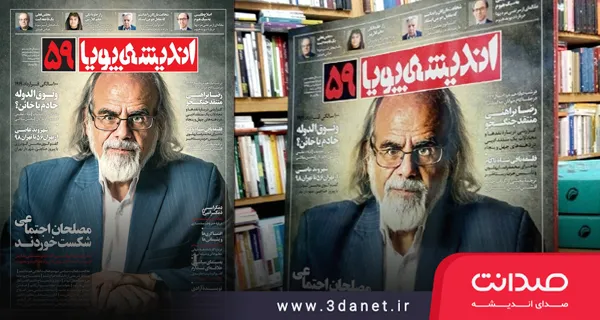
Chronicle of an Intellectual Life: A Conversation with Mostafa Malekian
Interviewers: Reza Khojasteh Rahimi and Javad Heydari
Andisheh Pouya . No. 59 . Khordad and Tir 1398
You were born in 1956 in Shahreza, into a religious family; and as we know, your father, Abdolrahim Malekian, known as Naseh Qomsheh’i, was one of the city’s well-known clerics. To begin, tell us a little about your parents and the cultural and familial atmosphere of your childhood.
I was born in 1956 in Shahreza, but my father lived in Qom almost until 1963. Until after the events of the 15th of Khordad and Mr. Khomeini’s exile, due to the affection he had for him, he became embittered and returned to Shahreza. It was as if he did not find Qom pleasant without Mr. Khomeini’s presence. When he came to Shahreza, he established a platform there for teaching religious sciences and propagating and promoting religion through the pulpit, the mosque, and the mihrab. However, his father was a bazaar merchant from a wealthy family. My grandfather’s great-grandfather was one of the renowned wealthy men of his time in Shahreza. Nevertheless, our life at home was modest, and my grandfather and my father did not favor a life above average. We did not live in poverty, but we absolutely did not live in affluence and luxury either. Before me, my parents had a daughter who, I don’t know exactly at how many months old, passed away, and in a sense, I was considered the eldest child of the family. But I was born in Shahreza during the period of my father’s residence in Qom. My father, in terms of his learning, his practical spiritual wayfaring, his manner of dealing with people, and his outlook on life and existence, was loved and respected by the people. The general public perhaps heard of his scholarly standing indirectly and from others, but they saw his practical standing in his conduct. Therefore, in the environment where I grew up, because of my father, we received great respect from the people. These conditions later caused me to become sensitive and thin-skinned, and it harmed me. Because I had not heard unpleasant or bitter words in familiar gatherings, in unfamiliar environments where no one knew my father and family, I would become very thin-skinned. My childhood was very uneventful, such that I have nothing worth telling from that period. I can only say that my father encouraged us toward indifference to the pursuit of wealth and power. I heard him say time and again that he could conceive of all worldly pleasures, but he could not conceive of the pleasure of leadership; what pleasure is there in a person taking on the burden and responsibility of several thousand or several million other human beings and being happy about it as well. He demonstrated this way of life in practice, too. For example, despite the affection he had for Mr. Khomeini and the legitimacy of the Islamic Republic, and his support for the Islamic Republic, he did not accept the slightest position after the revolution. He did not even accept the Friday Imamate of our small town. My uncle was the Friday Imam of the town from the beginning of the revolution for over two decades. My father detested power.
We have heard you say many times that a person’s character is formed by the age of 12. Up to this age, what traits did you inherit from your parents that influenced your practical behavior?
I think that from my father, more than anything else, I inherited an indifference to social competition and social comparison—that we should not compete with others in wealth, power, fame, and the like, nor be in a state of comparison. I do not mean that I have truly become like my father, but I believe he planted the seeds of this outlook in me as well. My father was genuinely indifferent to status and wealth. I heard him say many times, “Wealth and money are no different to me than straw.” In practice, he had neither any greed or craving for acquiring wealth, nor any stinginess or reluctance in spending it. Secondly, my father always loved knowledge for its own sake and absolutely did not want to gain respect, prestige, popularity, or climb the social ladder through learning something. He always told us, learn so that you have learned, not so that you can say, “I know this.” As long as his eyes could see, that is, until two years before his passing, whenever we saw him at home, he was engaged in study. I never saw my father sitting without a book in his hand; even when we were around him, a book was certainly open in front of him. This was the second characteristic of my father, which was a practical encouragement for us in the love of reading and study. My father always told me: Mostafa, consider your sustenance guaranteed by God, but know that you must acquire faith and righteous deeds drop by drop, particle by particle, and grain by grain. This was another of his lessons in life, though of course, I set my mind at ease and in my life considered both guaranteed and did nothing for them. My mother also possessed a diligence and seriousness in life that was astonishing. On average, she never slept more than four hours in a day and night and was always working. I found this diligence only to some extent in study, not in any other direction. Another astonishing characteristic of my mother was her humility; she considered everyone in the world better than herself. I heard her say many times, “Whoever I look at, I see they are better than me.” There was no arrogance, haughtiness, or pride in her. The third characteristic of my mother, which perhaps reached us genetically or through upbringing, was her obsessive-compulsiveness. She had a pathological obsession with cleanliness and hygiene, with ritual purity and impurity in the religious sense, and with order. I have had obsessions since childhood and still do. Of course, my obsessions have manifested in different forms at different times: at times as ritual purity and impurity, at times as cleanliness, and at times, for instance, in the use of words—how to write, where to place or not place a comma, and the like.
You mentioned that your father was a supporter of Mr. Khomeini and was affected by his exile on Khordad 15, 1342. Was he a political cleric?
My father was not much of a political cleric, but he held great esteem for Mr. Khomeini’s personality and character. His affection was of the kind one human being has for another. My uncle, however, was always a revolutionary and even became the Friday prayer leader of Shahreza for a time after the revolution. But my father was not a revolutionary, not in the sense of being anti-revolution.
Did he not have any revolutionary activities before the revolution?
If he did, they were very faint. He was summoned to the police station once or twice, but he was not in a situation where he would be subjected to any aggression there. I could say, figuratively, that his heart was with the revolution, and his tongue was to some extent with the revolution, but he took no practical action. I do not know what he had in mind or in what form he approved of opposition to the Shah, but he detested armed activities against the Shah’s regime. While he was strongly opposed to the Shah’s rule, he did not approve of armed struggle or any resort to violence at all.
It seems your family has a genealogy indicating your descent from the Prophet. But “Seyyed” is not registered in your family name. Is that correct?
Yes. Although I have not mentioned this anywhere until now. Our main ancestor was from the Sadat of Bahrain, who migrated to settle in Mashhad during the Afsharid era to escape the pressure being exerted on the Sadat in Bahrain. Haj Malek, from whom we inherited the name Malekian, set out for Iran to reside in Mashhad, traveling from the south, from the direction of Shiraz, towards Mashhad. But while passing through Isfahan, he apparently took a liking to Shahreza and its very pleasant climate at the time and settled there. Haj Malek was a pious man, and in Shahreza, he added to his wealth mostly through trade, to some extent agriculture, and to a lesser degree animal husbandry. It seems that before migrating to Iran, Haj Malek had destroyed his family tree in Bahrain out of fear. In Shahreza, he also did not make his status as a Sayyid public, to avoid the illusion that he intended to make a living through his lineage in a strange city. Nevertheless, in our family, it was passed down from father to child that we are Sayyids, and only the family itself knew. For this reason, none of the family members registered with the title 'Sayyid' on their birth certificates. My father and uncle, who were clerics, also never wore a black turban.
When the revolution happened, you were 22 years old. Tell us about your intellectual and mental atmosphere at that time. Were you interested in political activity?
I was never interested in political activity. Intellectually and theoretically, I opposed the Shah's regime; I also held a series of political views and opinions, but it was not such that I would engage in political activity or, in the parlance of the time, revolutionary activity. I shied away from practical political work. I remember giving Dr. Shariati's works to friends to study, but I do not recall ever distributing or reproducing even a single leaflet by Mr. Khomeini, apart from Dr. Shariati's works.
You went to the University of Tabriz in 1973 to study mechanical engineering. You mentioned you were interested in Shariati's works. Up to that point, in terms of studies, besides Shariati's works, what else had you read, and what direction did your interests take?
I studied Dr. Shariati's works with great interest, but his works constituted only a small part of my studies. I was interested in Shariati because, in my view, he was the first religious person who spoke new words. It was after Shariati that I became acquainted with Bazargan. I liked Shariati for the immense humility he showed towards any kind of young person, whether from Tehran or the provinces, knowledgeable or less knowledgeable, and because, beyond his own interests, he felt a social mission and concern for others. I read his works with ever-increasing enthusiasm until I entered university. But when I myself entered philosophy and reread these books, while my affection for his character remained intact, I felt day by day that I could no longer accept them. Before that, I would read anything by Shariati that came into my hands with passion, sometimes reading it three or four times. But my studies were not limited to him. I read books on Western philosophy with interest and paid attention to and was interested in ethics, both theoretical and practical. Alongside these, since childhood, I had an interest in literature books, especially the genres of poetry and the novel. I was greatly influenced by reading the works of Victor Hugo, especially Les Misérables and, to some extent, The Hunchback of Notre-Dame. Among French authors, I liked the works of André Gide. At that time, André Gide's works were mostly published in translations by the late Hassan Honarmandi, which I believe were good translations. Among French authors, I had also read Balzac's novels, each several times.
In your religious family, was there not a negative view towards heretical books or the religious yet modernist works that, for example, Shariati was in a sense promoting?
In our family, if someone spoke of religion, they were not treated very strictly about it. Therefore, Dr. Shariati's books faced no prohibition in our home. My father considered any book related to the Islamic religion permissible, and it made no difference to him whether they were the writings of Muhammad Qutb, Sayyid Qutb, or Mohammad-Taqi and Ali Shariati. However, regarding the study of Western philosophy or Western theology, and even novels, there was great strictness in our house from my father and my uncle. For years, we lived in the same house with my uncle, and therefore, due to his sensitivities, I read many books secretly, away from the eyes of my father and uncle.
Why, despite these interests, did you begin your university studies in mechanical engineering?
The mistake that fathers and mothers still make today existed back then too; namely, if your child's IQ is high, they must study engineering or medicine. In high school, I had studied mathematics. When I took the university entrance exam, everyone expected me to be admitted to the University of Tehran or Sharif University of Technology. But I fell ill, and suddenly, contrary to everyone's expectations in the family, I was admitted to the University of Tabriz. However, from the moment I entered university, I saw that my heart was constantly fluttering for humanities books. In the student dormitory, I was perpetually reading humanities books. It seemed to me that it was not right for there to be a gap between the field I was studying and the field my heart was attached to. Therefore, I abandoned mechanical engineering in the fourth semester, took the entrance exam again, and entered the University of Tehran in the field of Islamic philosophy.
It seems you were expelled from the university in 1978. What was the story behind this expulsion, considering you were not engaged in political activity?
Yes, they expelled me because of a series of activities that the gentlemen assumed I was carrying out. I used to take Dr. Shariati's writings with me to the university, and once, opposite the Marmar Palace, I was arrested. I was released a few hours later, but they informed the university, and while I had only a few credits left in my studies, I was expelled. If I had not been expelled, I would have graduated before the revolution. After the revolution, when the universities reopened on the first of Esfand 1357, I was able to return to university, complete my final semester, and in Tir 1358, I was among the first to graduate after the revolution.
What was your takeaway from the period of studying Islamic philosophy at the University of Tehran? Which professors gave direction and horizons to your thinking?
In the field of Islamic philosophy, Motahhari was a unique professor, although in those years he taught very little. In the understanding and teaching of Islamic philosophy, he was very different from other professors. Dr. Amir-Hassan Yazdgerdi was also our professor of Persian language and literature, and until 1979, I constantly visited his home and was his assistant in his scholarly research. I also attended the classes of Mehrdad Bahar and Abdolhossein Zarrinkoub as an unregistered listener and was interested in and fascinated by them. But overall, in those years, the Faculty of Theology and Islamic Studies faced a dearth of professors, and for this reason, I do not have very pleasant memories of that time. When I graduated from the Faculty of Theology, I was vacillating between Islamic philosophy and Western philosophy, and my inclination toward Western philosophy was growing day by day. Sometimes I accused myself that perhaps I had not understood Islamic philosophy well, and it was partly for this reason that almost immediately after obtaining my bachelor's degree, I went to Qom to see what Islamic philosophy and mysticism had to say. But, why hide it from you, the more time passed, the more I gravitated toward Western philosophy and the further I distanced myself from what is termed Islamic philosophy.
So your goal in entering the seminary was to remedy the possible weaknesses in your religious thinking?
Exactly. I never had a particular interest in learning Islamic jurisprudence. Of course, I was interested in many topics of the principles of jurisprudence, but I had no interest in jurisprudence itself and never intended to specialize in the field of jurisprudence. However, I intended to specialize in the philosophy and mysticism to which the adjective Islamic is also conventionally attached.
You also attended classes at the Dar Rah-e Haqq Institute in Qom, which was managed by Mr. Mesbah Yazdi. Why did you go to the Dar Rah-e Haqq Institute?
I initially began the conventional courses of the Qom seminary. However, since I had already learned Arabic language and literature beforehand, in Qom I entered the study of principles of jurisprudence (usul al-fiqh), jurisprudence (fiqh), philosophy, and mysticism. In parallel with that, right in the first year I entered Qom, it was announced that the Dar Rah-e Haqq Institute, whose academic section was supervised by Mr. Mesbah Yazdi, was accepting a second cohort of seminarians. This institute, on the margins of the seminary courses, taught what the clerics termed modern sciences. My younger brother and I took the institute's written and oral exams and were accepted. But after attending for one term, I saw that none of these courses held any value for me, because I knew all of them far better than our instructors. I had previously learned English, Western philosophy, and economics at a higher level than what was being taught in that program. In economics, they were teaching the economic discussions of Mohammad Baqir al-Sadr, which I had already read myself. Therefore, after one term, despite Mr. Mesbah's considerable insistence that I stay, saying the courses would gradually become beneficial to me, I left. Then, alongside the conventional seminary courses, I seriously began a self-directed study of Western philosophy.
During the period you were at the Dar Rah-e Haqq Institute, did Mr. Mesbah himself teach?
Mr. Mesbah only taught one course per week during that period, Nihayat al-Hikmah.
Was his class not appealing to you either?
Mr. Mesbah's teaching method was not a time-wasting method. There was no padding or superfluity in his teaching. He would go straight to the heart of the matter and explain it. Of course, his elucidations were never like those of Morteza Motahhari, but he did not engage in verbosity and did not waste the seminarians' time. On the whole, his teaching seemed to me to be a desirable form of teaching. What somewhat drew me to Mr. Mesbah was that he was the only philosophy instructor who also seriously critiqued the material. For example, when he expounded the words of the late Allameh Tabatabai in Nihayat al-Hikmah or Bidayat al-Hikmah, he would also critique them. Whereas critique is very rare at the introductory level of the seminary.
What was your relationship with Mr. Mesbah like?
My relationship with him was a close one from before 1979, when I entered Qom. Two of my brothers, both of whom were seminarians, had a close relationship with Mr. Mesbah. Additionally, Mr. Mesbah was a friend and acquaintance of my father. Before I entered Qom, I would sometimes go from Tehran to Qom on Thursdays and Fridays and occasionally attend Mr. Mesbah's class. But from the time I left the courses at the Dar Rah-e Haqq Institute, I became close to Mr. Mesbah for another reason. He entrusted me with teaching courses that I was capable of handling and that were outside the conventional seminary system. For example, I taught English for a while.
After the revolution, divisions emerged among the political clerics. Were you not involved in such demarcations or such debates, for instance, around Mr. Mesbah?
I would hear the debates, and many times I witnessed these discussions in the atmosphere of Qom, but Mr. Mesbah's political views were of no importance to me at all until they explicitly came into conflict with my own views. At that time, I was only sensitive if someone criticized the character of Ayatollah Khomeini, to whom I was attached, especially if the criticism was harsh in tone, and I was not sensitive about other matters; because I simply had no political concerns. Therefore, in addition to teaching at the Dar Rah-e Haqq Institute during Mr. Mesbah's first program, I also taught during the second and third programs.
You also collaborated with Mr. Mesbah in editing his lectures and compiling them into book form.
Yes, in those years Mr. Mesbah taught courses outside the seminary system and would ask me to turn them into books. His lessons on any given subject would run, for instance, from seven to twenty sessions. He wanted me not only to organize his material but also to expand upon it. This was because I was the only student who was familiar with Western philosophy and knew English, a task beyond the ability of the other students. If you look at those books, you will notice they are full of references to the works of Western thinkers. For example, he would defend individualism against collectivism, and in expanding his remarks, I would bring in the views of individualists, even though Mr. Mesbah himself had not mentioned these views. Mr. Mesbah did not even know the names of Western collectivists and individualists, but in elaborating his ideas, I would introduce arguments for one side and against the other. Over several years, I prepared roughly seven books in this manner, and during this time I grew very close to Mr. Mesbah. But this connection had absolutely no political dimension and had nothing to do with his political views. Three things about Mr. Mesbah attracted me. First, he was the only cleric I saw who seriously wanted students to become acquainted with the modern world, albeit in order to oppose it. Western studies for the sake of anti-Westernism was Mr. Mesbah's project, but it was the Western studies aspect that interested me. Second, as I mentioned earlier, the critical dimension in Mr. Mesbah's teaching was very strong. Otherwise, even then I realized that his breadth of research and depth of thought never reached the level of Mr. Javadi Amoli or Mr. Hasanzadeh Amoli. He had absolutely no expertise in Islamic mysticism, and in Islamic philosophy he never measured up to those two. But those two spoke solely and exclusively within the framework of religious law and in defense of it, whereas Mr. Mesbah displayed a freedom and liberty in engaging with Western philosophy that drew me in. Third, he had verbal discipline, spoke measured words, and never talked without reflection. For these three reasons, I was close to him. But I was never close to his political views. Neither at the time when I myself was a revolutionary and he was not very conciliatory toward the revolution, nor later when I was no longer conciliatory toward my former views and he became a defender of the revolution.
What about philosophically? Did you have no disagreements with his views?
I found his critique of Islamic philosophy interesting, and it attracted me. Some of his other views, even if presented in a raw form, were also appealing to me. For instance, he took a strong stance against collectivism and defended individualism. I had a great deal of sympathy for individualism, and this was important to me. Or, for example, he had a strong sense of disciplinary boundaries, insisting that you should not use mysticism or poetry and literature in philosophy, and I never saw this boundary-consciousness in others. But my interest in his views really did not extend much beyond this.
Regarding the approach you took in transcribing and expanding his works, did he not have any critical comments?
No; except for that one incident which caused the beginning of my separation from him. It was only that; otherwise, he never rejected my writings. He would read the text and send it straight to print.
What was that incident?
When I was preparing the book Society and History based on his lectures, I had used some of Dr. Soroush's works in expanding upon his points, and I had also provided references in the footnotes indicating that he had made a particular point in such-and-such a book. Work on this book was nearing completion when, if I am not mistaken, the first article of “The Theoretical Contraction and Expansion of the Sharia” was published in Kayhan-e Farhangi in Ordibehesht of 1367. Mr. Mesbah became extremely agitated. I consider it unlikely that he had read “Contraction and Expansion,” because he could recognize from a distance what he considered to be misleading and heretical, and saw no need to read it. He would not spend any time at all reading something he had identified as misleading. Probably some individuals he trusted had read the article and told him what Soroush had said in it. Mr. Mesbah was very upset; he sent word for me to come to him, and I went. He said that every quotation from Mr. Soroush must be removed. His phrasing was that he did not want to be indebted to this gentleman. I said there was no problem at all, and it was agreed they would be removed. He said he would remove them himself. Summer came, and I went to my hometown. When I returned, it was early Mehr. I saw that the book had been published, but Dr. Soroush's material had not been removed from the text of the book; only the footnote citations had been deleted. Around that time, in Kayhan-e Farhangi magazine, one of Mr. Soroush's friends and admirers wrote an article criticizing this book, and among other things wrote that you have mentioned statements by Mr. Soroush without citing the source or reference. In those same days, Mr. Mohsen Gharavian, who was one of Mr. Mesbah's zealous followers, wrote a response to that critique, which was also published. In that response, he had said that these unattributed quotations are the responsibility of Malekian, not Mr. Mesbah. He placed the blame on me. Many friends approached me and said, write an article and say that this was not my doing, and if a mistake was made, it was something Mr. Mesbah himself did. But out of the respect I held for Mr. Mesbah, I did not do this. I reasoned to myself that if I lose my reputation, I am not an important person, but if Mr. Mesbah loses his reputation, the scholarly community suffers a loss. This was the beginning of my departure from the circle of Mr. Mesbah's friends, and my taking a different angle and distancing myself from him. Of course, it was only the beginning of taking a different angle, because I remained in contact with that circle for years afterward, although my contact grew fainter day by day.
Did you not raise the matter with Mr. Mesbah himself?
Not for a long time afterward, no.
You would see Mr. Mesbah, but there was no discussion about this?
No, there was no discussion at all. Until a long time later, Mr. Gharavian and I were both teaching somewhere. One day, the driver who was supposed to take me home from there said that Mr. Gharavian was also teaching in another class and had said he wanted to see me, and if possible, could I wait a little until his lesson was also finished. I sat in the car with the driver who took me back and forth until Mr. Gharavian's lesson ended and he came. He got into the car and told me, let's go to your house. He came to my place and apologized. I think it was perhaps two years after the date he had written that article. He said, at that time, without investigation, I had attributed something to you, and later I understood it was false. He apologized to me, asked for my forgiveness, and said: I had been told so.
Meaning Mr. Mesbah himself had told him?
No, he said, “I had been told.” He still strongly supported Mr. Mesbah at that time. In short, he asked for my forgiveness, and the matter passed. Until some time after that, Mr. Ali Shirvani Harandi, who was a friend of mine and is now one of the scholars of the Qom seminary, told me that Mr. Mesbah had said Malekian is more dangerous than Soroush. You know, in religious contexts, what consequences it can have when they say someone is more dangerous than so-and-so.
Up to this point, no works of yours had been published that would lead to such a judgment?
I was teaching in Qom and had my own positions in the classes. In short, I poked around here and there until it became clear that Mr. Shirvani Harandi had also quoted this from Mr. Gharavian. I went to Mr. Gharavian and said, such a thing has been quoted from you; is it true or not? He said yes. I said, who told you this? He said, Mr. Mesbah himself. Then I requested a meeting with Mr. Mesbah. I said I wanted to have a meeting with you. I also invited a number of his close associates to that meeting as witnesses, including Mr. Gharavian himself.
Up to this point, was your disagreement limited to these two quotations?
From 1989 onwards, it seemed to me that Mr. Mesbah held positions completely different from Mr. Khomeini's time. This was also there, and it gradually began to bother me. I understand a change of position, but only when it is honest. One of the signs of honesty in changing positions is not denying previous positions. Of course, keep in mind that, on the other hand, with each passing year, I too was moving further away from my own former positions. This also made our stances toward each other more divergent.
To what year does your request for a meeting and visit with Mr. Mesbah date back?
I don't remember exactly, but I think it was around Ordibehesht of 1993. In addition to Mr. Gharavian, I invited Mr. Gholamreza Fayyazi, Mr. Qasem Ravanbakhsh, Mr. Qotbi, who was his office director, and one or two others whom I don't recall, to attend that meeting. There, I said to Mr. Mesbah, you have said that Malekian is more dangerous than Soroush, and this is a compound claim; it is three claims. One, that Soroush is dangerous. Two, that Malekian is dangerous. Three, that Malekian's danger is greater than Soroush's danger. I said I have come here for you to prove these three claims. He said, I did not say that. I said, why, Haj Agha, you did say it; again he said, I did not say it. For the third time I said it, and he denied it. When he denied it three times, I said, Mr. Gharavian has quoted it from you. Mr. Gharavian also said, you yourself told me. Mr. Mesbah then said, so I must have quoted it and said that they say Malekian is more dangerous than Soroush. When it reached this point, the truth became clear to me. I did not continue further. After this, I turned to other issues, and it was a long meeting. I think it lasted more than two hours.
What other issues did you address?
For example, I said, tell me the criticisms you have directly. He replied that if he had any serious criticism of me, he wouldn't have let me teach at his institute. I said, nonetheless, there have been things you've conveyed from others expressing dissatisfaction with me. He said, I will mention two things: one, when you raise a doubt, you should also answer it, but often in your classes you raise a doubt and don't answer it, and the doubt occupies the students' minds. The other is that your teaching style seems to convey a disparaging and somewhat negative view of Islamic philosophy while making Western philosophy appear grand. I replied that, of course, if a doubt has an answer, the requirement of truth-seeking is that I raise it. To cut it short, toward the end of this meeting, I said something to Mr. Mesbah that I later saw Mr. Gharavian had misquoted in several places; and again, I didn't react. At the end of that meeting, I said, Mr. Mesbah, let's suppose you have a supermarket containing all the sciences and knowledge, and suppose I am hunched under a staircase, having set out four cans from which I sell herbal remedies. I said, I will never close this stall of mine under the staircase because of your supermarket, since there's always a chance someone might want something that isn't in your supermarket but is in my stall; so don't expect me to close this under-the-staircase shop because of your supermarket. Mr. Gharavian later recounted this in a way that was truly worlds apart from what I had said. They said that Malekian had told Mesbah, you have a supermarket and let me have a stall of my own, you have your shop, let me open my shop too. As if I wanted to open a shop and there was some rivalry, and I was asking the other party's permission to let me enter the field of competition. Whereas it wasn't like that. I was actually declaring, don't think I will close my stall because of your supermarket.
Was this meeting the end of your relationship?
Yes.
What was Mr. Mesbah's final stance toward you?
He didn't say anything, he offered a blessing. He also sent his regards to my father, and the meeting ended gently, but I had understood that the possibility of continuing cooperation was gone.
When Mr. Gharavian left Mr. Mesbah's circle, he made a claim that anyone who wanted to leave that circle would be placed in isolation under certain conditions for a while. Was there really such treatment of those who wanted to leave?
What Mr. Gharavian has said relates to the years after my departure for Tehran, and I know nothing about its truth or falsehood. I left Qom entirely in 1998 and settled in Tehran.
You also continued your post-revolution studies in a Master's program in Islamic Philosophy, but apparently you abandoned it in the final year and didn't get your Master's degree. Why?
After my Bachelor's, I had no interest in continuing my studies. The late Mofatteh was the dean of the Faculty of Theology and was very kind to me. He sent word that I should take the Master's entrance exams. He insisted a lot, but I didn't accept. Until I was informed that he had written my name among the registrants. So I took the entrance exam and was accepted. After one or two semesters, the Cultural Revolution happened, but I continued after the university reopened. Until a very regrettable incident caused me to withdraw from continuing my studies.
What was that incident?
Alongside my studies, I also taught at the faculty. I had a student whose master’s thesis was a translation of one of Frithjof Schuon’s works entitled The Pearl and the Shell of Islamic Mysticism. That student had a supervisor, an advisor, and an examiner, and I was merely assisting him. At the thesis defense session, the thesis supervisor, Dr. Ahmad Beheshti, began cursing and using foul language, and made indecent remarks about mystics. At that time, that professor was the head of the department. The other professors showed no reaction to him whatsoever. None of them said, if this book is so unjust, why did you, as a professor, agree to supervise it? Although I ostensibly had no official role in that session, I stood up to that professor and reacted explicitly. The argument escalated, and the session was brought to an end at the recommendation of two other professors. Despite having said he would not sign off on the student’s grade, the professor signed it two days later, and the matter passed. But word was sent to me: “Tell so-and-so that I’ll get even with him.” Because, in addition to teaching in the philosophy department, I was also a student. I went to him and said, since someone like you is the head of the philosophy department, from this moment on, because I do not want to owe you anything, I am abandoning my studies in this field. That professor also wanted to take away my teaching position, but the students resisted strongly. As a result, I only continued teaching and withdrew from my studies.
In your own division of your intellectual periods, you have referred to five Malekians. Malekian I, according to your account, believed in fundamentalist Islam until 1982, albeit without violence. Where was the turning point in your transition from Malekian I to Malekian II, who, by your own account, believed in traditionalist Islam?
By 1982, I had realized that fundamentalist positions were not supported by reason. They were neither supported by extra-religious, extra-sectarian, rational reasons, nor even by religious texts. By late 1982, it was established for me beyond doubt that there was neither rational argumentation nor scriptural argumentation in favor of the fundamentalists’ statements. These became completely certain for me, and therefore I moved beyond Malekian I; otherwise, there was absolutely no incident that upset me emotionally or sentimentally and led to this transition.
What was your entry point into traditionalist Islam, within whose framework, again by your own account, you thought from 1982 to 1986?
I understood fundamentalist Islam to mean that society must be governed by precisely the same rules that were in effect at the dawn of Islam. From the moment I set aside this view, since I was religious, I sought to find whether another narrative existed. The first accessible narrative, which seemed very powerful to me, was the one offered by European traditionalist Muslims. At that time, the book The Reign of Quantity and the Signs of the Times by the famous French traditionalist René Guénon appeared immensely significant to me. Before the revolution, I had read his book The Crisis of the Modern World in a translation by the late Seyyed Ziaoddin Dehshiri, but that translation was so erroneous and obscure that I could not grasp anything. When I read The Reign of Quantity and the Signs of the Times in the fluent translation by the late Dr. Ali-Mohammad Kardan, this book seemed tremendously significant to me. Thus, from the beginning of 1983, I began reading all of René Guénon’s works in English. After René Guénon, I moved on to other thinkers, such as Frithjof Schuon, Titus Burckhardt, Martin Lings, and of course, Seyyed Hossein Nasr. I even read the works of those who, though not traditionalists in the strict sense, had sympathies with the traditionalists, such as William Chittick, Henry Corbin, and Toshihiko Izutsu. I truly devoured these books. Their critique of the West seemed far more serious to me. Their criticisms were made with a comprehensive knowledge of the West, not out of ignorance of it.
So you still held an anti-Western view.
Yes, absolutely. Of course, “anti-Western” is not an inaccurate term, because the criticisms these gentlemen leveled at the West seemed very valid to me. Back then, at the university, I also encouraged students to translate and annotate the works of these traditionalists, even as their master’s theses, and translations of some of those works were published at that time.
Didn’t the traditionalists also resemble the fundamentalists in their belief in implementing the laws of the age of tradition?
No, the traditionalists said that the spirit of the teachings must not be tampered with, but they also said that the outward form of the teachings must not be tampered with either.
During the period when you were interested in traditionalist Islam, did you also embark on the path of mystical wayfaring?
No. Due to the educational environment of my childhood, I was very interested in mystical wayfaring, and I still am. But in practice I never succeeded in this, and at no stage of my life did I ever follow such a path.
What was the turning point in your separation from traditionalist views, and the transition to Malekian Three in 1986?
I discovered three things about the traditionalists, all three of which were truly devastating for me. One was that I saw their critiques of modern Western culture had also been presented in the works of modern thinkers themselves, but the traditionalists presented those critiques as something of their own invention. A very good example is an article I wrote refuting Schuon’s view. Schuon claims that our point is that sin affects cognition, whereas modern philosophy does not at all believe that sin affects cognition, and philosophers full of transgression and error philosophize without knowing that their sinfulness distorts their philosophizing. But I saw that, according to Merold Westphal in his article “Taking St. Paul Seriously: Sin as an Epistemological Category,” 48 modern philosophers had all emphasized, to varying degrees, the effect of sin on cognition, because moral error affects the cognition of the one who errs. Secondly, I saw that the traditionalists attributed things to the West that absolutely do not exist in the West, for example, the claim that Western rationality is sensuality in disguise. That is, Western rationality is the lustfulness of Westerners in a transformed guise. But Western rationality is not like this. Thirdly, we saw that their interpretations of world religions, in order to prove the transcendent unity of religions and the perennial religion, were interpretations that the followers of those religions and denominations themselves do not accept. Just like the interpretations Marxists made of historical periods, and in order to fit Iran into their interpretation, they distorted all the historical realities of Iran; these people did the same thing with religions. These three aspects made me realize that there is no reasoning in favor of the traditionalists’ claims.
You have also sometimes pointed to non-epistemic reasons, such as the traditionalists’ excessive pride.
Yes, but we see this trait more or less in others as well, and I cannot say it was the reason for my departure from this current.
Were you also aware of certain points raised about the cult-building and personal conduct of people like Schuon?
At that time, I had absolutely no knowledge, not even an iota, of what is attributed to Schuon’s personal life and, by extension, to the personal lives of some of his very close followers like Burckhardt and others.
You mean the reports that Mark Sedgwick provided in his 2004 book, Against the Modern World: Traditionalism and the Secret Intellectual History of the Twentieth Century, about the Maryamiyya order and the personal and moral lives of Frithjof Schuon, Seyyed Hossein Nasr, and other traditionalists?
Of course, I had learned of these matters before Sedgwick’s book, but in those years when I was giving my account, I had no knowledge of these affairs. You know that Sedgwick’s book also did not tell the whole truth about the lives of these traditionalists, and the reality is broader and deeper than what he reported. But when I was criticizing Schuon, I was not aware of his personality and character, and I criticized him solely based on what appeared in Schuon’s writings.
After this, you inclined toward the views that fell within the religious intellectualism movement; that is, a kind of religious modernism.
Yes, I think that from 1987 onward I really had no attachment to traditionalism. The few things that were published by me after that year were all critiques of traditionalism.
During this same period, you continued your intellectual efforts with the publication of the journal Naqd va Nazar. The style and approach of this journal differed from the main line of religious intellectualism in Kiyan and Kayhan-e Farhangi. Kiyan was a journal with an analytic philosophy outlook, centered around Mr. Soroush's views, but Naqd va Nazar even leaned somewhat toward continental philosophy. Traditionalists also had a serious presence in this journal. Thus, the atmosphere of Naqd va Nazar was not like that of Kiyan.
My collaboration with Naqd va Nazar began in 1992, but the Traditionalists had absolutely no influence in the journal. I was the senior advisor to the journal, and only once did I suggest that we address the Traditionalist current in a special issue. Despite the fact that I had truly broken away from that current, I always believed in polyphony and liked for all intellectual currents to be introduced. In any case, the Traditionalist current was doing its own work in our country, although Traditionalists, due to this current's attribution to Seyyed Hossein Nasr, who was still a negative figure in our political system, denied the presence of this current in Iran. Therefore, addressing them was the right thing to do. But as you also pointed out, Kiyan magazine was completely different from Naqd va Nazar, and these two cannot be equated with one another within religious modernism. During the years I collaborated with Naqd va Nazar, I did not collaborate with Kiyan at all. My collaboration with Kiyan magazine began later. The reason was that, while I held respect for Mr. Soroush, I refrained from being considered part of his circle or coterie. In those days, Mr. Tehrani, Shams al-Vaezin, and Jalaeipour repeatedly told me to do some work for Kiyan magazine, but I refrained from being counted among Mr. Soroush's supporters and aides or his circle. Fundamentally, I did not like being attributed to any current or group.
Did you perceive that entering that space meant entering a circle?
Yes, in those years, Kiyan magazine was truly, from the perspective of outside observers, Mr. Soroush's magazine. Whether this perception was mistaken or correct, it was completely widespread, and I saw no one who did not hold this perception. Later, Mr. Kadivar told me that they had a weekly meeting in Tehran with Mr. Soroush present, and that I should come too. At that time, I also told him that I would not come to these meetings. Despite the fact that Mr. Soroush and I taught simultaneously at the Faculty of Theology and had a friendly relationship with no problems between us, I did not want to be attributed to him.
But for a period, you worked alongside Mr. Mesbah and did not have such a reservation.
But no one in that era considered me one of the Mesbahis. They would say he collaborates with Mr. Mesbah on scholarly work, but absolutely no one at that time said that Malekian was also one of the Mesbahis. It was not the case that I was in his circle or had subservience to him, and this very fact bothered the members of Mr. Mesbah's circle.
In Naqd va Nazar, alongside Legenhausen, Seyyed Javad Tabatabai and Mousa Ghaninejad also had articles. What was this journal's relationship to the project of religious intellectualism?
I pursued two goals in managing Naqd va Nazar. First, I wanted to acquaint the seminary with the modern world, which I think was not without effect. Second, I wanted cultural polyphony to be reflected in the journal. As you said, at that time we published articles from liberal individuals like Ghaninejad, and in contrast, we also published pieces from some very traditional clerics and those who believed in Traditionalist Islam. I placed great value on diversity. In those years, I myself believed in religious intellectualism, but it was not the case that the journal was confined within religious modernism. Opponents of religious intellectualism, like Dr. Mahmoud Bina-ye Motlaq, who considered religious modernism something close to disbelief, also wrote in the journal. But since any new idea, from the seminary's perspective, is considered religious intellectualism, everyone in the seminary thought our journal was a journal of religious intellectuals. The orientation of Naqd va Nazar can be considered religious new-thinking, not religious intellectualism.
You finally bid farewell to the thought and project of religious intellectualism around 1997, at the start of the reform era, and moved from religious intellectualism toward existentialist views and later toward the synthesis of rationality and spirituality. What made you move beyond religious intellectualism as well?
I was reading the works of religious intellectuals, whether our own, Arabic-speaking ones, or English-speaking ones from the Islamic world—from Indonesia, Malaysia, Kashmir, Bangladesh, to India. As I read these works, I noticed two things. I saw that both the process and the product of religious intellectualism are indefensible. What does that mean? It means that in its process, religious intellectualism ultimately cannot claim to be intellectual while abandoning rationality, whereas for every sentence in the sacred text, it has no rational reason and accepts many things out of dogmatic adherence. It seemed to me that the process of dogmatic adherence was incompatible with the process of rationality, and I still insist on this. As for the product, what religious intellectuals provided could not be extracted from the texts using correct interpretive methods. Therefore, it was faithful neither to modernity and modernism, nor to the Book and the Tradition. For example, the justice that religious intellectuals speak of in the sacred texts is by no means the social justice discussed in modernity. The freedom that religion grants is not at all modern freedom. What moderns say about being masters of one's own destiny is never what is said in Islam under the phrase "everyone is responsible for what they do." I saw that both modern concepts and religious concepts were being distorted to conform to each other, or at least to come closer together. This is what made me grow cold toward religious intellectualism. Of course, I believed that the works of religious intellectuals are useful insofar as they contain a kind of critique of traditional Islam and fundamentalist Islam, but I found their project unsuccessful.
You moved from religious intellectualism to the existentialist approach, and from that approach to the project of rationality and spirituality, thus changing your intellectual project five times in twenty years. Doesn't five transitions in twenty years indicate a somewhat high speed on your part?
Yes. Of course, this trajectory has been complementary. Initially, I believed that the outward aspects could be fully adhered to. Then, in the second period, when I inclined toward traditionalism, I came to believe that the inner aspects could be fully adhered to. Subsequently, in the period when I inclined toward religious intellectualism, I believed that changes must be made to the outward aspects for religion to be acceptable. After that, I reached the conviction that religion cannot answer social issues, and therefore we must direct and confine religion to individual matters, and the only school among Western schools whose concern is the "individual" is existentialism. Thus, I gravitated toward Islamic existentialism. In this period, I particularly wanted to extract from Islam what Kierkegaard, and to some extent Jaspers and Marcel, intended to extract from Christianity. When I realized that even individual problems cannot be solved by adhering to historical and institutionalized religion, I gravitated toward the synthesis of rationality and spirituality. One might think that these are leaps whose preceding and succeeding stages have no connection to each other, but the reality is that these leaps are also in continuity. If you look closely, I have moved from the broadest expectations of religion to the most minimal expectations of religion. This has been my intellectual trajectory, but something from each period has remained with me. For instance, from the period of religious existentialism, the focus on the individual and paying less attention to society has completely stayed with me, and I still adhere to it and believe that our audience must be the individual. From the first and second stages, what has remained with me is that we are not, in any case, without need of religion, but not historical and institutionalized religion. I still say we cannot turn our backs on religion, but I mean the universal religion and spirituality that I speak of, not historical and institutionalized religion.
Did this inclination of yours toward individualism and disillusionment with the project of religious intellectualism have anything to do with the inefficacy and inability of the reformists to bring about change after the 2nd of Khordad, 1997?
If you mean their unsuccessful political activism, no. My issue was their unsuccessful theoretical activism.
You experienced five shifts over the 20 years from 1978 to 1997. But since 1997, which again spans about twenty years, you have stood in one place. What is the reason for this stasis?
You might say this stasis is due to old age and a lack of intellectual dynamism. But I think there is no reason that the pace of a person's passage should be the same at every stage. Truly, if it were to become clear even now that what I mean by rationality and spirituality cannot be reconciled, I would turn back from this as well.
In the twenty years since you proposed the project of rationality and spirituality, there is still no citable text that we can say explicates this project of yours. You introduced the idea in a lecture, and ten years later you gave another lecture on its tenth anniversary. That is all. We expect that, now that you have been stationary in one thought for twenty years, you would have at least acted to develop this thought. But this idea has not yet even become a book, so we cannot trace how Malekian Five's ideas have deepened over these twenty years. We have witnessed the longitudinal expansion of your thought across various fields over these twenty years, but we cannot understand what internal changes and transformations the project of rationality and spirituality has undergone in these two decades; because you are an oral lecturer and thinker, and there is simply no text for us to refer to.
This objection is entirely valid. But if you are patient, I suspect that in less than two years from the publication of this conversation in your magazine, you will find what you want, or at least what I am able to say. I have many preoccupations, which is of course no excuse, but I have not had the opportunity to attend to what, in your view and indeed in my own, is more important than all other preoccupations. Consequently, this criticism is completely valid.
Now imagine that Malekian One is loyal to one political system, and Malekian Two to another political system, and Malekian Three to yet another political system, and the same for Malekian Four and Five. Can you conceive of a political system in which the five Malekians could live together peacefully?
No, I don't think so. The requirement of each of these is a different system. The requirement of rationality and spirituality is a minimal state whose presence emerges only and solely where my freedom disrupts the freedom of another citizen, and which is absent in all other affairs. But this is absolutely incompatible with religious fundamentalism. It is even incompatible with religious traditionalism.
But fundamentalists and traditionalists live alongside the rest of the people in a model that resembles Rawlsian political liberalism.
They live that way because they are compelled to. If one day they find themselves in the majority in terms of numbers and resources, they will overturn the entire arrangement. If fundamentalism is submissive, humble, and tame somewhere, know that it still considers itself weak in its assessment of power.
Malekian’s Project of Rationality and Spirituality has, in recent years, taken on dimensions that have also been subject to critique and commentary. In this project, you emphasize the reform of the individual and the primacy of culture. Previously, in our own magazine, you even had a debate with Mr. Hajjarian on this very issue. Your project of Rationality and Spirituality, and your ethical orientation, has ultimately led to this advice: “Forget about reforming society. We have been cast out of paradise. I think if this expulsion from paradise has one good meaning, it is this: that we will no longer be a paradise in this world. We have left paradise and have fallen. We must descend and lower our expectations.” Or elsewhere you have said, “If society is to be reformed, its individuals must be reformed one by one. Do not pin your hopes on the changes that are today referred to as institutional changes, thinking that if a series of external decrees, rules, regulations, establishments, and arrangements are changed, society will see righteousness. No, all corruptions arise from within the human individual, and naturally, all righteousnesses also arise from within the human individual.” Your words, in the sense that you say one should not seek a promised paradise on earth, are an invitation to a kind of realism that stands against voluntaristic and revolutionary perspectives, and resembles a kind of reformist view. But when you emphatically say that social reform must be forgotten or that one should not pin hopes on institutional reforms, it seems you are moving toward a kind of Stoicism in politics. One might be a Stoic in one’s personal life, but Stoicism in politics means passivity. Many have leveled this critique that Malekian’s ethical orientation means the suspension of social reforms and nation-building, and its result will be a kind of passivity.
When I say forget about social reform, I am rejecting the argument of those who, on a global level, advocate for the proposal of social reform; those who bypass the individual and go straight to institutions. When I say forget about social reform, I mean forget the idea that social reformers promote. The discourse of social reformers is that institutions must first be set right, and I say forget this preoccupation. I never say forget society and its pains and sufferings. My difference with other intellectual friends is that I say social reform should be the result of our work, whereas they say it should be the goal of our work. I say the goal of every human being’s work should be the reform of oneself, not the reform of society. And if we succeed in this goal, the result will be the reform of society. My entire distinction from other intellectual friends lies in the distinction between goal and result. I say the goal must be my own self-reform, and if I do not succeed in this goal, then nothing comes of it, but if I do succeed, to the very extent that I succeed, I have also reformed society. When I succeed, I will be a person of justice, fairness, and compassion toward human beings, and I will keep my promises, and in this way, as a result, society will also be reformed.
By taking the view of social reformers to an extreme, you claim they ignore the individual. When we turn a view into an extreme, it also becomes easier to attack.
Are social reformers not reformers who begin their activity with institutions? If they do not start with institutions and say we start with the individual and institutions, or even say they consider changing the individual prior to institutions, we will have no problem and will be on the same path. But when the term social reformer is used, what comes to mind? What comes to mind from a social reformer is someone who, before saying you must not have egoism, goes to society. I oppose this social reformer.
This social reformer publishes the journal Naqd va Nazar to transform the mentality of the clergy. This social reformer establishes a political party to strengthen and institutionalize party behavior in the country and among the people. What is wrong with that?
All social reformers, in your terms, provide cultural growth and intellectual growth. But if egoism exists within those very people who form a party, they will make the situation worse day by day. Strengthening individuals' thinking is different from them heading in a good direction. As a thief who comes with a lamp, he will carry off goods more selectively. Previously he could not advance his work because his thinking was weak, and now that his thinking has become strong, he can.
You emphasize the individual's egoism. Fardid also used the concept of egoism and the commanding self. We have seen that this Fardidian thought, instead of being constructive, is always critical.
I have nothing to do with Fardid, but my own point is that as long as moral vices have not been eradicated in me, the more learned I become, the larger my party becomes, and the more power my party gains, the worse the situation will become.
Nagel has an article titled "What Makes a Political Theory Utopian". In this article, he says that throughout the history of political thought, two types of theories have been proposed. One is transformation, which speaks of change and evolution, and the other is a mode of thinking that seeks institutional design. He says those who pursue transformation and change and evolution want to eliminate egoism among individuals, and in fact, they are saying the same thing as you. Nagel says that from Plato until the late Middle Ages, this way of thinking persisted, but in the modern era, especially from Hobbes onward, institutional design became important. According to him, each of these two has its strengths and weaknesses. Those who speak of transformation and inner change and evolution want to take egoism away from us in order to build a better world. But the first weakness of this approach is that it leads us to utopianism. Because any political theory must have both a persuasive aspect and be compatible with human psychology, and a justificatory aspect and be compatible with morality. Eliminating egoism is compatible with morality, but according to Nagel, it is not compatible with human psychology. As the failure of Marxism showed, this egoism is not eradicable. If we do not pay attention to this feasibility, we will be drawn to utopianism.
Nagel here is classifying political theories, but I have never considered my theory political. My theory is solely and exclusively confined to the individual. I have said many times: O individual, do you want, in conditions where society is either healthy, unhealthy, or semi-healthy, to emerge with your own hide intact? If you do, the way is the combination of rationality and spirituality; and if you succeed, to that same extent, you will make an unhealthy society healthier. This theory is not political at all. A political theory has political implications.
But do you accept that the political implications of your moralistic theory might lead to utopianism?
Utopianism is when, after I say let us eliminate egoism within ourselves, I claim that this egoism is absolutely eradicable within us. But if I say let us strive to eliminate egoism, in the sense that at whatever stage of egoism we are at, we think that we can still reduce it further, this is not utopianism; it is a roadmap.
Can you say when this desired state will occur?
Not at all. I have absolutely no predictions about the future. My point is this: O individual, in this very seventy-year lifespan of yours, not in the future—for no future is conceivable for you—I want to do something so that whether in a healthy or semi-healthy society, you can have a flourishing life. Only this. And if you succeed in having a flourishing life, you will have consequences for your contemporary society and will have improved it to your own extent.
Nagel says that a flourishing life cannot be realized without attention to the institutions in which we live. Moreover, in that article, he says that forgetting the self and disregarding oneself, doing one's duty to the best of one's ability, and obeying instructions without exercising personal judgment can lead to a tendency toward obedience and keep the most horrific regimes in power. According to Nagel, this moralism, while it prevents people from taking bribes, can also turn them into compliant participants in official policies of segregation, deportation, and fully organized genocide. Thus, becoming moral does not necessarily lead to a flourishing life.
In explaining the theory of rationality and spirituality, I have repeatedly said that the first component of spirituality is living morally. How does living morally invite me to complicity in genocide? How does it invite me to take the path of obedience to perpetrators of genocide? This is absolutely not the case. If the first condition for the step of spirituality is our being moral, being moral means having honesty and being a person of justice and fairness.
Why do you think Nagel warns of this danger?
Because Nagel's conception of spirituality is not the conception I have of spirituality. He thinks that when spirituality is spoken of, what is meant are monks and nuns who, when slaughter takes place in the cities, are sitting on the mountainsides meditating. They remain silent and are not people of struggle. Like the Catholics who remained silent throughout all the crimes of the twentieth century and before, and some even collaborated. He has such a conception. But I have a different conception. I say the spiritual person is a moral person, and a moral person is just, compassionate, faithful to their promises, trustworthy, and sympathetic to the plight of others.
We made a comparison between this moral person and the new model of human being in Marxist theories. In contrast, the Hobbesian human is one who is not inherently altruistic and is a wolf to other humans. Wouldn't it be more realistic to base our theory on the Hobbesian human?
No, right now in our own society and in all societies of the world, there are those who have neither collaborated with oppression, nor supported a tyrannical regime, nor believed that the pain and suffering of humans is none of our business. Did Albert Schweitzer or Thomas Merton, who are spiritual figures, collaborate with any tyrannical regime in the slightest? The existence of a thing is proof of its possibility.
So should Albert Schweitzer or Thomas Merton be considered the average members of society?
I am not concerned with everyone. Your problem is that you interpret my words in a collectivist way. I am saying, O you who live in a healthy, unhealthy, or semi-healthy society, do you want to flourish or not? The way is to have rationality and spirituality. I am not at all concerned with making society healthier. I have said time and again that my goal is not the reform of society. My goal is solely the reform of the individual.
Why don't you place individual reform and social reform alongside each other? Why don't you place them in a sequential relationship? Social reform and institutional reform can be alongside individual reform. Why affirm one and reject the other?
Anyone can undertake social reform. I have not commanded or forbidden anyone.
But when you say forget about social reform, it means you consider it mistaken and are not sympathetic to it. It means your project has no affinity with the project of social reformers.
Yes, in my view, the solutions that social reformers implement and claim will make society better do not yield results. I say your project is unsuccessful. You can do it, no one is stopping you, but you will not achieve results.
Why do you say with such certainty that they will not achieve results? They could also say that they do not forbid Malekian's moralism and that you can do your work, but you will not achieve results.
Is it not the case that even now, in this very unhealthy society, there are individuals who live prosperously, have peace of mind, are happy, cause no one any pain or suffering, and, to the extent of their own capacity, reduce the pain and suffering of others?
In this same article, Nagel says that if we accept that slavery is a radical and pervasive evil, the theory of transformation and change could not eliminate slavery throughout history. At most, it could tell the slaves, "I can tell you what you can do within slavery to live a good life." But because he believed slavery was so evil that no good life could be imagined under its conditions, he turned his attention to institutional reform and the abolition of slavery. Abraham Lincoln, even through bribery and enticement, which are apparently immoral, abolished this law and saved millions of people from this pervasive evil.
I do not accept this interpretation. If you had put someone else in Abraham Lincoln's place as president or commander of the U.S. Army, they could not have done this. It is because this person is Abraham Lincoln, and he has eliminated egotism within himself, that he was able to do this. If you believe in institutional reform, it means that if you remove Abraham Lincoln and put someone else in his place, they should still do the same thing. Other individuals were also commanders of the Northern forces, but they did not do what Lincoln did. You have overlooked the fact that if the institution is the institution, and to be honest, it means individuals play no role. But it is still individuals who play the main role.
Perhaps Lincoln, with a consequentialist view, was seeking a desirable outcome, and this does not necessarily have anything to do with egotism.
Why didn't Lincoln, with the power he had as commander of the Northern forces, pursue his own interests? Did the institution tell him not to be that way?
But even if you put the best individual in an unhealthy institution, they cannot necessarily be a source of effect.
If I were saying that I want to reform institutions with this project, your objection would be valid. But I am not saying that at all. I do not want to save society with the project of rationality and spirituality. I want to save the individual.
Why shouldn't we strive to design a good institution in the economy, in politics, so that as a result, fairer conditions for ethical living are provided?
Who designs the institution? The individual. And if the individual prioritizes their own interests, they will create a crooked design. You want to change the economic institution of the country. But what does changing the economic institution mean? One is to change the economic laws, and another is to bring in executors who will definitely implement those laws. Can you imagine any other meaning? But those who have not been morally developed, in whichever of these two positions they are placed, will yield no result for us. Someone who steals says, "To hell with society, wherever it wants to go, I will put my wealth in foreign banks and use it with my wife and children." Someone who enters society is looking out for their own interests. You think that when someone enters society, they become a refined individual. It is absolutely not like that. Someone who enters the marketplace of society, if they have not morally developed themselves, is looking out for their own interests and benefits.
Hobbes spoke of individual self-interest and collective interest, and he says the Leviathan comes, sets up a game, and says, "Pursue your individual self-interest, but in a way that also includes the collective interest".
But how can this very Leviathan be created? Your problem is that you have removed the individual, replaced them with a being I do not recognize, and say that this being does the work. Who does this work and changes this institution? Can anyone other than you and me change these institutions? In the Middle Ages, they said God alters destinies. You have removed that, but now, in your view, what alters destinies and transforms an institution into a good one, such that people within it think of collective interests? Is there any force other than us 8 billion people that does these things, or must we ourselves do it?
If the economic or political system in Afghanistan and Germany is different, does that mean the moral standing of the people of Afghanistan is lower than that of the people of Germany?
It certainly is. That is, there were human beings who gradually emerged from their egoism, and the result was a situation that, for instance, has become established in Germany.
Three hundred years of development in Germany, for example, has nothing to do with striving to move away from egoism. The formation of a strong army and an efficient government is the result of three hundred years of institution-building.
Do you call a strong army reform? Or do you say reform means people enjoying more justice, more welfare, more security? Do not think I do not call the growth of science, technology, or industry reform, but I hold to the saying of Jesus that the Sabbath was made for man, not man for the Sabbath. After all this growth in science, technology, industry, technique, and so on and so forth, are human beings today happier, more well-off? So what do you say about those who claim that the wage-slavery of capitalism is more lethal than the slavery of ancient Greece and Rome?
Do you hold this view?
Of course I do. Because I understand that a person who has spent their entire life and that of their spouse just to obtain necessities and manage their life is not happier or more well-off. I absolutely do not believe that progress in science, technique, technology, and industry has improved people's condition. I do not subscribe to this at all, not in the slightest.
Isn't this view of yours very utopian and unrealistic?
No, it is not utopian at all. On the contrary, I want to say: return to the realities. Return to this reality that as long as human beings are human and possess egoism, the situation is this.
So you believe a wall has been drawn between North Korea and South Korea. On this side, immoral people, and on that side, moral people? The moral ones built South Korea and the immoral ones built North Korea?
Not at all, not in the slightest. I am only saying that in South Korea, some people were forcibly attached to the achievements of the West, and in North Korea, some people were forcibly attached to the achievements of the East. Had there been no American intervention in South Korea and no Soviet intervention in North Korea, and had the people of these two Koreas been left to themselves, they would have created a regime suited to their disposition, that is, suited to themselves.
But, in comparing these two countries, one is closer to freedom, security, welfare, and justice; the other is not.
I know, but did its own people create this? So you want to say we should create it by force? Then go ahead and create it, and do not condemn the colonialism of the 17th, 18th, and 19th centuries. Yes, when England colonized India, it left India a sound judicial system. If you are looking at it consequentially, then say,
Be fair. Was it like that in North Korea and South Korea? Or did two forces come, one making people worse in some respects, the other making people better in some respects? Make no mistake, it was force. South Korea is just as subject to force as North Korea.
We have just wars and unjust wars. A moral philosopher like Walzer searches with a magnifying glass for the conditions of a just war, and to distinguish unjust wars. One cannot make blanket statements on this matter.
If you are committed to these things, then you should not oppose American intervention. You should say that if America intervenes, the necessities of life for you and me will become better than they are now. I say intervention is wrong everywhere. If we are truly humanitarian, we must ask what human beings want. Intervention and force, in my view, are indefensible everywhere.
Here you are judging in the realm of law and politics with a moral, non-functionalist view. But on the other hand, you say that a distinction must be made between morality and law. Many moral philosophers try to align their legal judgments with their moral judgments in order to have a unified moral theory. And if necessary, for example, they link their moral deontology with consequentialist moral theories in some places so they can still have a unified moral theory.
Law and morality have two different functions and two different goals, and I still insist on this separation.
The separation of law and morality leads us to positivism and legal positivism. Herbert Hart, who was an advocate of legal positivism and its separation from morality, believed in a kind of separation of ethics and morality. Ethics asks what I owe to myself. When you say I owe myself a good and happy life, you are speaking in the domain of ethics. But morality asks what I owe to others. Ronald Dworkin, who was a critic of Herbert Hart, says that what I owe to myself are two things: self-respect and an authentic life, but what I owe to others are also two things: the equal importance of all human beings and my responsibility towards others, which falls within the domain of morality, and ethics without morality can be destructive. It is possible to have your self-respect but not care about the equality of others. His point is that ethics without morality, and morality without ethics, neither can succeed. Law and economics need a movement from ethics towards morality. But if you believe in the separation of law from morality, like Hart, then you can no longer make law more moral.
A: I do not disagree with any of these issues you raised, but the question is, when you want to make law more moral, do you use a supernatural force or do you use these same people? If this person whom you want to entrust with this task has egoism, can they formulate laws for you or enforce laws for you that are moral? Everything that he defines under the titles of morality and ethics, I place in one circle and call it ethics. I say that, ethically speaking, a human being has duties both towards themselves and towards others. Ethics is what I owe to myself and what I owe to others. Now you want to make law moral? That is excellent. But when you want to make law moral, do you pray? What do you mean by this institution you speak of? Where is this institution? Where can I see it and grab it by the collar?
It is something we have constructed.
You say there is something called an institution apart from us human beings. I ask, where is this institution? What characteristics does it have? Is it a substance? Is it a relation? Is it a property? Is it an event? It must have a metaphysical category, meaning an ontological, existential category. What is this institution?
It is a reality that we humans construct, and once we have constructed it, it becomes independent of us and its implications flow into our lives.
That's fine. But who validates a good institution?
Perhaps a person who is not necessarily moral can create a state institution that serves the public good; like the formation of the central government in the era of Reza Shah.
On what basis do you say that the institution he created has led to good?
The evaluation of institutions rests on two things: their impartiality and their consequences. When Fukuyama says that the British Westminster system is better than the American electoral system and that if we do not reform this system institutionally, our democracy will decay, what do you think he is discussing? People of average morality enter the British Parliament or the American Congress. The issue is that to the extent this institution differs, its efficiency and provision of the public good also change.
I cannot accept that a bad person can create an institution that is impartial. I ask, is it possible for people to pursue their own personal interests yet pass and enforce laws in which complete impartiality is observed? Can you imagine such a thing? What guarantee is there that members of parliament, merely by understanding that something is more just, will immediately vote for it, and as soon as they realize something is unjust, will immediately vote against it? What kind of members of parliament does this task require? How do you guarantee that a parliament with 270 people sitting in it will think of the interests of humanity and not their own interests?
Rawls always emphasizes that in politics, you must consider human beings as they are, and laws as they ought to be. He says this path is far more successful than reversing it and saying, consider human beings as they ought to be and the law as it is.
I also accept that ethics must consider the capacities of human beings. Rawls's point is no more than this.
Therefore, you firmly believe in the separation of ethics and law, and you have no concern that this view might lead to legal positivism or a kind of anarchism and indifference to law.
It is like saying there must be a single theory for both food and clothing. Eating has one purpose, clothing has another. Ethics has one purpose, law has another. Why do you see two things that have two different purposes and two different functions as one?
Ultimately, law also wants to serve ethics and the collective good.
No, both ethics and law are in the service of humanity. Law should not be in the service of ethics. Ethics should not be in the service of law either. Ethics and law are two things that must be in the service of humanity. Ethics does one thing for humanity, law does another. Law gives us a society with security, welfare, order, justice, and freedom, and ethics gives us a kind of spiritual elevation; both are for the benefit of humanity.
The process of legal reform, that is, the process of a country becoming a country, and developing and securing the public good within development. But by emphasizing individual ethics, you deny the importance and necessity of the development project and process.
Yes, everything you say has been realized in the best possible way in the West, in America. Make no mistake. But sometimes you see the glitter and the lights and the lamps, and sometimes you see the people. I accept the glitter; I accept that airplanes travel at 1100 kilometers per hour and that artificial satellites exist, I accept all of this, but your mistake is that you think people are now living well.
With this view, you render differences unimportant. You render the differences between Germany, America, and North Korea unimportant; and this is the Stoicism in politics we referred to earlier.
Your mistake, too, is thinking that once the necessities of life are secured in a place, people will want nothing else. Then you want to provide these necessities of life at any cost. Does an employee who, along with their spouse, must work from morning to evening for 35 years, unable to take a single day off, just to finally secure their life's necessities, have a sense of authenticity and freedom? Do they have self-esteem? Does a person who could be sent to accounting at any moment, or told, 'Because a better worker than you has been found, a better engineer than you has been found, you are fired,' have self-esteem?
Are you saying that, economically, an employer should never lay off a worker under any circumstances, even if this situation leads to the firm's inefficiency?
This means I must lay them off because I am only thinking of myself.
No, because I am thinking of an institution that serves the public good, and if this institution collapses, far more than that one employee will become unemployed.
When you say the company will collapse, it means you are thinking of yourself. Are you making that decision for the sake of the 20 other people working there? What I want to say is that the people who created a system with so much glitter, but in which human beings end up in this situation, were not ethical. This system, where when you get sick and cannot go to work, it is as if your stomach should also stop working, is not a system created by ethical people. Why should a system be created where, the moment people have an accident, it is as if neither they nor their wife and children need food, clothing, or shelter anymore? Lincoln abolished slavery, but this is also a system in which a slavery worse than that slavery has come to rule.
Do you truly believe this statement?
This slavery is far worse than that slavery.
Aren't you speaking in slogans? Aren't you exaggerating? Is slavery truly the same as the capitalist system?
In terms of the fact that in both, the slaves ate their food so they could work, they are alike. Of course, this new slave has freedoms compared to that old slave. But on the other hand, in the old slavery system, when my slave was incompetent, I would sell them at a lower price to another slave owner. Now, if my slave becomes incompetent, I release them. I ask you, which is better? You think that because in this new slavery, people's food is provided, they are no longer slaves. I say people are slaves just as they were back then. It is as if you have become a materialist.
No, the issue is that we should not engage in revolutionary critique, but offer reformist solutions. We should say what better model can be created that yields more collective benefit and good. This slave you say is released is supported by the social security system, is a citizen, and votes.
A human being is not in service of the ballot box. The ballot box should be in service of the human being. Has the fact that Americans can vote made their lives better? You still have not understood Jesus's saying that these things must be in service of the human being, not the human being in service of these things. Are you pleased that they vote? Well, they vote, so what? We want votes to ultimately be in service of human beings, not for human beings to be servants of the vote.
So you would prefer to live in the old slavery system rather than the current system.
In the respect I mentioned, I prefer the old slavery system.
We live in Iran, and the reformist solution we propose must be proportionate to the context we are in. But even if you were in France, Germany, or Afghanistan, your reformist view would not change. They say a key that fits every lock is made of air. Isn't this key of yours, which fits every lock, made of air? Our main problem in Iran is a kind of exceptionalism that must be overcome; the idea that we are an exception and must have rules, laws, and rights different from other countries; this exceptionalist view makes us feel we have no need for the institutional experiences of other countries. But you say the problem is individual morality; this diagnosis of the problem bears no relation to our specific conditions.
To overcome the very exceptionalism you speak of, one must also appeal to individuals. The point is to be able, in Rawls's terms, to cast the veil of ignorance over yourself and say, I want the good of humanity, and I will walk this path. Of course, I do not believe that all societal changes are pursued through morality, but good changes do pass through morality. Positive changes are those whose agents think of humanity. The people who enact just laws and the people who implement justly enacted laws must be moral; otherwise, with every change and transformation, you are merely taking benefits from one group and giving them to another.
Hayek says that on the ladder of politics, the higher you go, the baser you become, and good people do not reach the top of the ladder. You must design a model for these conditions.
That is the very root of our misfortune. I say that a healthy person, to the extent they live healthily, makes the world better, and an unhealthy person will not make life better, even at the top of that ladder.
Let us move on from this discussion a little. Malekian Five is known for the project of Rationality and Spirituality and for the emphasis on moralism within his project. Among the three schools of virtue ethics, deontology, and consequentialism, you believe in the first school. Has Malekian Five's ethical view also undergone change and transformation?
Until roughly the year 2005, I was inclined toward ethical consequentialism, and it seemed to me that the arguments in favor of ethical consequentialism, though not without problems, were stronger than the arguments in favor of its two alternative theories, namely deontology and virtue ethics. In 2005, for the first time, in a speech at the Participation Front, I explicitly stated that consequentialism is indefensible.
What, in your view, were the main problems with consequentialism in ethics?
In my view, consequentialism had three fundamental problems, and I still believe it has these three problems. The first major flaw of ethical consequentialism is: up to what point in time, up to what place, and up to what state of affairs must I consider the consequence? That is the first one. Consequentialism says to do that which yields the greatest possible benefit for the greatest number of people. Calculating this greatest benefit for the greatest number is only within the power of Almighty God. Why? Because an action we take now has certain benefits by tomorrow, and by two months from now, and by five years from now, its benefits become less or more. Up to when must I calculate, up to what spatial range, and up to what circumstances? I might say something whose consequence is to offend you; the consequentialist says I should not say it so as not to offend you. But your being offended might cause you to become a first-rate moral philosopher; in that case, the benefit of my action would outweigh its harm. Then you might become a moral philosopher and put forth moral views that endorse a tyrannical political regime; in that case, the harm of my action would outweigh its benefit. So the first flaw is: up to what place, up to what time, and up to what state of affairs must we consider the consequence? The second flaw is that consequentialism contradicts our intuitions. Ethical consequentialism dictates that if I am standing above a bridge and a train is coming and will collide with another train, and I can drop a fat man between the two trains so that one person is killed instead of a hundred, I should do it. But this act contradicts my intuition. My intuition cannot accept that I should throw an innocent fat man down so that a hundred people on the trains are not destroyed. The consequentialist ruling contradicts my intuition, and I cannot accept it.
So our intuition says the two trains should collide and all the people should die?
I am not morally responsible for the collision of the two trains. If I could do something, yes, but since I cannot do anything, it is none of my concern. Morality is within the bounds of human capabilities. Morality should not demand that a person do something they cannot do. By the dictates of consequentialism, one could say that the end justifies the means. All the atrocities in the world have arisen from this very point, that they have said the end justifies the means. In the school of deontology, the end never justifies the means. In the school of virtue ethics, the end never justifies the means. It is only in consequentialist ethics that they say, kill this person, it is in service of the goal you have. To say that the end justifies the means contradicts our intuition.
But this misuse can also be made of virtue ethics and deontological ethics.
No, my discussion is not about misuse. My point is that "the end justifies the means" is contrary to our intuition. That the world's tyrants also misused "the end justifies the means" and instigated genocide is a misuse; there is no argument there. But my point is that "the end justifies the means" is contrary to our intuition. Our intuition does not say that when you have a goal, any means that gets you to that goal is permissible.
So our intuition says that in no place, does no end ever justify any means? For example, is no kind of punishment acceptable for a goal?
I did not say that; I am saying that one cannot claim that when you have chosen a goal rationally, any means that gets you there is ethical. Some means are ethical, some means are not. Otherwise, cutting off my child's hand to save them from death, even if it causes them pain and suffering, is in line with a goal that justifies the means. But according to the school of consequentialism, the end justifies any means, and this contradicts human intuition. Ethics must systematize our moral intuitions. Something cannot contradict my intuition and become a moral rule. That was the second objection I had to consequentialist ethics. The third objection I have to consequentialist ethics is that if it says the greatest benefit for the greatest number, it seems to view all individuals as equal, whereas I can never consider my own father equal to my neighbor. That is, if I can save one of two sinking boats, and in one boat are my father and mother and in the other boat are three strangers, since the algebraic sum of individuals in that boat is three, can I abandon my parents and save those three? A human being, by virtue of being human, cannot make such an ethical choice. Therefore, the third objection is that these emotional attachments are ignored in consequentialist ethics.
Given these three objections you have to consequentialist ethics, how do you side with consequentialism in law?
Because law has a different task than ethics. The task of law is to create a society with order, security, welfare, freedom, and justice. I discussed this with Mr. Hajjarian in your magazine, that I can neither say the realm of politics has no ethics, nor can I say the realm of politics has a different ethics. The realm of politics has ethics, and its ethics is not different either. But consequentialism in the realm of politics is not related to consequentialism in ethics.
This realm of politics, which you say has ethics and its ethics is not different, what is its ethics?
Suppose you are a baker. The function of a baker is to bake bread. A baker can bake bread ethically, or can bake bread unethically, but they must bake bread. In the realm of politics, the politician must provide order, security, welfare, freedom, and justice, but they can provide these ethically, or they can provide them unethically. If we want to see whether they are a successful or unsuccessful politician, we must look at the result of what they have done.
When, for example, Walzer says that a politician who has dirtied their hands, if they want to remain faithful to their deontological ethics, what actions must they take, it implies that separating law from ethics is not such an easy task.
I do not know exactly what Walzer's view on ethics in politics is, but I say that the politician is like the baker. If the baker bakes bread, they are a baker; otherwise, they are not a baker. The politician, too, is a politician if they deliver the results we expect of them. Just as the baker is a baker by virtue of the result of their work, so the politician is a politician by virtue of the result of their work. So we must be consequentialist in the realm of politics. That is it. But now, another point is that this baker can bake bread, in an ethical way and in an unethical way, and in both cases, bread has been baked. The politician, too, can fulfill the desired goals in an ethical manner and in an unethical manner. Now, this politician, in confronting their own ethicality, can accept the school of consequentialism, or the school of virtue ethics, or the school of deontology. So my point is that all occupations and professions are consequentialist, and politics is also an occupation.
Your use of the term consequentialism here is misleading; perhaps you could say functionalist, it would be better.
Say function, that’s fine. So here we look at function. If someone does not fulfill this function, they are not a politician at all, but this function can be achieved through ethical methods or unethical methods. And its ethical methods, depending on whether I am a virtue-oriented, consequence-oriented, or duty-oriented politician, can be ethical or unethical. Therefore, I can be ethically virtue-oriented, but as to whether I am a successful politician or not, you must look at the results of my work.
If we accept that in politics we must be function-oriented, which of the three ethical schools can best fulfill the functions of politics?
In my view, there is no preference in this regard. The one who is effective in the institution of politics is the individual. Since I believe in ethical virtue ethics, I say it is closer to prudence to entrust politics to a virtue-oriented individual. But it is only closer to prudence, because a virtue-oriented person pays attention to their inner motivations and does not look only outward, and a person who attends to their inner motivations is usually more cautious in their decisions. That is all. Nothing more. Otherwise, one can be a politician with all three ethical perspectives.
Until 2005, when by your own account you were a consequentialist, you also believed in a kind of ethical consequentialism in politics and did not make this separation between ethics and politics. You said that since “what makes actions ethically good or bad is their effects and consequences, and by effects and consequences is meant the benefit or harm of actions, and by benefit and harm is meant the reduction or increase of pain and suffering,” in politics too, ethically speaking, “reformism is a kind of recourse to hedonism.” This is your exact phrase from the lecture “Theoretical Foundations of Reformism,” which appears in the book Our Destiny, Our Prudence: “Reformism, ethically speaking, is ultimately consequentialist, and within consequentialism it is utilitarian, and within utilitarianism it is ultimately hedonistic.” Here you speak within the frameworks of moral philosophy in politics, but when you moved from ethical consequentialism to ethical virtue ethics, because applying this virtue ethics to law and politics was not easy, you drew a clear line between these two worlds. As long as you believed in consequentialist ethics, you did not have such a separation between law and ethics.
If I said the sentence you quoted, there is certainly an error in it. This sentence is definitely, in my view now, an error of errors. I have no doubt.
In your classification of the three ethical schools, you say that virtue ethics is an ethics of decision-making, whereas consequentialist ethics and duty ethics are ethics of judgment. So if we are to judge a politician, we cannot make any ethical judgment about a politician who believes in virtue ethics.
Whether the baker believes in virtue ethics or consequentialist ethics, their bread must be judged based on whether it is doughy, burnt, or toasted. There is no need for ethical judgment. Judge their bread based on whether it is burnt or not. When you see the results of the baker’s or the politician’s actions, you must say, legally speaking, you have failed or succeeded, but ethically you must go to the person themselves and see whether they acted ethically or not.
So one cannot make an ethical judgment about them?
You are in a hurry to refute me and are not paying attention to my main point. Judge the politician based on whether their bread is burnt or not; that’s it. Now, can we also make an ethical judgment? Virtue ethics says you cannot make an ethical judgment; the other two schools say you can also make an ethical judgment. Why? Because in duty ethics and consequentialist ethics, we have external criteria for ethical judgment, but in virtue ethics we are only dealing with the individual’s inner encounter, and therefore we have no possibility of judgment.
Your entire argument is that law is separate from morality. But many legal philosophers believe that legal reasoning is, in fact, moral reasoning. That is, you cannot engage in legal reasoning without starting from moral reasoning. Legal reasoning independent of morality leads to Nazism. The problem with the positivist school of law lies precisely here. The task of the moral philosopher, like that of the legal philosopher, should be to help align legal reasoning and moral reasoning. This is what moral philosophers do, for instance, in debates over the morality or immorality of taxation and distributive justice.
That which seeks to reform me is one thing; that which seeks to make social relations orderly, secure, and so on, is another. This is abundantly clear. You say my argument has corrupting consequences, but that is not so. Any political regime that delivers freedom, justice, welfare, security, and order is successful. Did fascism deliver freedom, welfare, and justice? Fascism is rejectable because it did not lead to these functions. The flaw of Nazism is just this, and this has nothing to do with legal reasoning independent of morality.
Malekian's views stand in opposition to those that believe in reforming institutions. Because you define your project as a moral project, and believe that morality is an individual matter unrelated to law and politics, you are not very optimistic about legal and political reforms. For example, while the project of some transformative forces is political reform, and some political forces emphasize policy reform—that is, the reform of policies and institutions—you, in a way, say these efforts are futile and should be abandoned. Why isn't your project a little more humble in the face of these projects? Someone who believes in policy reform could say that it is very good that Mostafa Malekian also has a concern for individual and moral reform alongside our project. These projects could converge at some point. But you, in a way, reject and do not accept all other efforts.
I am saying that before reforming policies and institutions, if you have not undertaken that moral reform, you will not improve the state of society one iota. That is all. I am not saying whether you should or should not undertake policy and institutional reform. I am saying that you, the reformist, if you truly want to improve society, must first eliminate this egoism within yourself. If you eliminate egoism, the result of your work will, of course, benefit humanity. Therefore, I do not command or forbid anyone. I do not say do this or don't do that. I only say that, judging by the outcome of your effort, I can predict that if you have not built yourself and are not moral, you will bring about an order exactly like the current order.
Stoicism in politics begins right here. Individuals can say, why should I form a party? The result is that we sit and engage in personal meditation or preach to people to be moral, and shut down party politics and political and institutional reform.
No, attention to party politics is different from attention to morality. I, as a moral person, might, based on the sixth normative source, conclude that I must be pragmatic and form a party. If you achieve those moral goals through a party, then achieve them through a party. Not all of our oughts and ought-nots are moral. I, as a moral person who wants to reduce people's pain and suffering, might reason that to reduce people's pain and suffering, it is pragmatic to form a party.
When you say that sentence, "Forget about reforming society," it means you are not thinking about such pragmatisms.
I say that reforming society as a goal must be forgotten. I still say the same thing. I say the goal is your own moral reform. But for your moral purposes, you must see through which means you can best reduce the pain and suffering of others. My whole point is that your goal should not be the reform of society, otherwise you will not succeed. Your goal should be your own reform, and its result will be the reform of society. When you have reformed yourself, that is, when you have become moral, your first concern, or perhaps your second concern, will be reducing the pain and suffering of others. Reducing the pain and suffering of others is possible through a thousand ways. I must exercise prudence and choose the path; you might say forming a party is the best way, I might say founding a university is the best way, another might say organizing dialogue gatherings is the best way. Whatever it may be, this prudence has nothing to do with morality.
This advice of yours to "reform the self" is advice that can be given at any time and place and is not historicized. Such a sermon could have been given a hundred years ago as well, and...
Yes, just as Buddha said 2,800 years ago that as long as you have egotism, nothing will improve, all these 2,800 years indicate that to the extent people have reduced a particle of their egotism, their situation has improved. And I believe that although one cannot deduce the future from the past, the future will be the same way.
Is this holism, whose result is issuing a judgment for 2,800 years ago until an indefinite future, beneficial?
Go and read the book The Moral History of the Twentieth Century. Jonathan Glover says that in the twentieth century, the most meticulous ethical scrutiny took place, yet moral decline was greater than in any century in human history. That is, if a person has egotism, even if their thinking advances, they only find better means to satisfy their own egotism. I do not have the power to command or forbid, and in my view, no one has the right to command or forbid others, and everyone may go whatever way they wish; but I say that I predict political reforms without moral reform will lead nowhere. One goes, another takes his place.
Your moral project, under the rubric of rationality and spirituality, is not immune to certain harms that afflict mystical perspectives. Somewhere, someone wrote in criticism of you that just as so-and-so is obsessive about refraining from praising people, he should be concerned about himself becoming the subject of praise. Someone wrote somewhere that a person feels a deep sense of embarrassment from the excess of veneration for Malekian. These dispositions you have can form a kind of master-disciple relationship that has its own consequences.
If you are saying that I commit immoral acts that cause me to become an idol for some, meaning I myself actively work in the direction of becoming an idol, then I have certainly committed one of the worst moral vices. In my view, reducing the pain and suffering of people is the first, and perhaps the second, duty of every moral human being; I say perhaps the second, because the first duty of every moral human being, in my opinion, is the elimination of self-conceit. But if they say that someone lives so morally that people praise him without cause, I say, firstly, I do not live at all at that moral level, and secondly, I have always said that one must not practice idol worship. I have always repeated Nietzsche's saying that my follower is someone who goes their own way, because I have gone my own way. Master-disciple games are reprehensible and, of course, are not limited to mystical circles. There are intellectuals who have not uttered a single word about mysticism in their lives, nor have they spoken of spirituality and morality, yet they have still become idols for their followers. I am not only a critic of intellectuals becoming idols, but I say that the first duty of the intellectual is the articulation of truth, and wherever we find a truth but, for the sake of caressing and flattering people's tastes and sensibilities, we conceal that truth or speak against it, we have fallen into the abyss of populism. Concealing or denying the truth in order to remain esteemed by the people or beloved by the people is demagoguery. The intellectual must neither give free rein to master-disciple games, nor seek to be esteemed by the people and fall into demagoguery.
Among contemporary intellectuals, you have particularly praised Mostafa Rahimi and Mohammad-Ali Eslami Nodooshan, and have said that you have not seen the moralism of these two intellectuals in any other Iranian intellectual from the dawn of the Constitutional Revolution until now. Have these two intellectuals truly held such a distinguished position in the history of Iranian thought?
I made this judgment from the perspective of being ethical and moralism. The project of Rahimi and Nodooshan was to reform society through moral reform. Do not think for a moment that I said no intellectual has lived as ethically as they have; no, what I meant was that in the core of their project, no intellectual has placed moralism as centrally as these two. They believed that we must bring about a moral transformation so that the reform of other matters occurs as a corollary to that moral transformation.
Your project becomes so specific that the intellectual models you present also become limited. Not to mention that there were also figures like Mahmoud Sana'i, for instance, who placed special emphasis on education, psychology, and the ethics of the people.
I consider Mahmoud Sana'i an academic, not an intellectual. The measure of an academic's success or failure is one thing, and the measure of an intellectual's success is another. An academic must advance a field of research one step further. But an intellectual does not advance any field of research; rather, they communicate the latest research findings to the people in order to reduce their pain and suffering. Mostafa Rahimi and Mohammad-Ali Eslami Nodooshan, incidentally, published books in their own field of work that are almost rare. The books Didgah-ha (Perspectives) and Nim-Negah (A Glance) by Mostafa Rahimi, and Iran ra az Yad Nabarim (Let Us Not Forget Iran) by Mohammad-Ali Eslami Nodooshan are noteworthy in this regard.
Why shouldn't Engineer Bazargan, who delivered so many moral sermons and religious speeches and, alongside that, built institutions, organizations, and a party, and also engaged in political activity, be placed alongside Rahimi and Nodooshan?
Mr. Rahimi did not consider any endeavor successful except through ethics and the development of moral culture. But Engineer Bazargan was an engineer who also wanted to proceed in the field of social issues with those same engineering inclinations. He himself was an ethical person, but his project was not an ethical project—not that his project was anti-ethical. There are people like the late Dr. Engineer Bazargan who want to change institutions so that society is reformed. They are called institutionalist intellectuals. But a moralist intellectual like Mohammad-Ali Eslami Nodooshan and Mostafa Rahimi never created any social institution and did not want to create one; their discussion was about how much more or less ethical individuals are.
So, in your view, Nodooshan and Rahimi are more successful intellectuals than Bazargan and Soroush.
Precisely. These two intellectuals were unsuccessful in terms of their goals, but they were also unsuccessful in terms of the outcome of their work, and both are strangers today. Yes, in my opinion, in terms of the results of their work, they have failed. But only that and nothing more. In my view, they became estranged, they failed, meaning they found no followers. That Soroush, Bazargan, or Shariati found more followers compared to Rahimi and Nodooshan is undeniable. But I think institutionalists fundamentally find more followers. Because the moralist intellectual first directs criticism at the individual, and the individual follower dislikes it, because no one wants to be told that they are bad. People fundamentally do not enjoy criticism of themselves but enjoy criticism of others. That is why all institutionalist projects are more successful, because they say you have no faults, it is others who have all the faults. Therefore, whoever is a moralist will certainly have fewer followers.
Your project's angle of vision, as you also explained in this conversation, is focused on moral reform; and you said that if you have anything to say in politics, it is from a prudential perspective and not from a moral one. This is while earlier, when you had consequentialist tendencies in your moralism, you also defended reformism in politics as a consequentialist ethical model. We want to know whether, in your view today, no type of political engagement is preferable, or whether, based on a prudential assessment, you still believe in political reformism, for example.
I do not believe in revolution at all, in any field, even in ethics. I believe we must become more ethical bit by bit, and no ethical revolution can occur. Nothing in the natural world comes into being except in the medium of time and through gradualness. Therefore, in politics too, I believe there is no defensible path other than reformism.
And, for example, do you still defend and are you satisfied with the vote you cast for Mr. Rouhani in 2013 and 2017?
When I voted for Mr. Rouhani, at the very time I was sending messages urging people to vote, I never said that Mr. Rouhani was a desirable president. I only said that Mr. Rouhani was far preferable to his electoral rival. I still say now that Mr. Rouhani is preferable. If those two rivals were to stand against each other a hundred more times under the same conditions, I would still vote for Rouhani; even though I know Mr. Rouhani was not successful in advancing society one iota. But someone being unsuccessful in "advancement" is different from someone being successful in "regression." He was absolutely unsuccessful in advancing reforms, but his rival could have been successful in regression, and therefore, the very fact that Mr. Rouhani became president is a cause for gratitude.
Earlier we referred to your statement that "Forget about reforming society." Among reformist political forces, there are also some who say that reformists have entangled themselves in a power without responsibility that yields nothing but disrepute and failure, and they recommend abandoning reform from above. It seems that your ethical project could be more aligned with these more radical views among reformists, yet you still defend voting and reform in that form. Isn't your ethical absolutism somewhat inconsistent with this political conservatism?
I think you may be right. Others have also told me, "After all our political activism, we have realized we must turn to the individual." Perhaps this criticism can be leveled at me: that you were telling everyone to turn to the individual, yet it seems you also pursue social reform. But this is not accurate. I have always believed that reform only occurs through the individual, but I understand that as long as individuals are not yet reformed, it is still better for Rouhani to be in power over them than for his rival to be in power. Ultimately, we must be reformed, but since we are not yet reformed, we cannot be insensitive to our external conditions. I believe one should participate in elections. Because every action must be weighed against its alternatives, and in my opinion, voting and elections are more successful compared to their alternatives.
So you are not speaking of voting in elections as a moral duty...
No, here we judge based on the criterion of expediency. Whether a person is moral or not, they must exercise expediency in their life. Going to the ballot box must be compared with its four or five other alternatives. If we want the condition of our society to improve, one path is revolution. One path is a coup d'état. One path is foreign intervention. One path is internal centrifugal movements. When I weigh voting and reformism committed to the ballot box against its alternatives, I see that it is more expedient than the other options. But if we continue to vote, will our situation get better? Our situation will get better in the sense that we will not fall prey to those alternatives. That is all, and nothing more. Let us also consider: before Mr. Rouhani came to power, did we precisely predict this current situation? We did not predict it, and there is no guarantee for the correctness of our predictions. We must decide at every moment at the threshold of our own awareness. Therefore, I still do not regret voting for Mr. Rouhani at all.
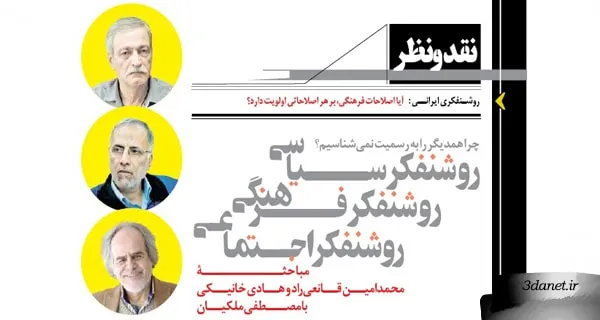
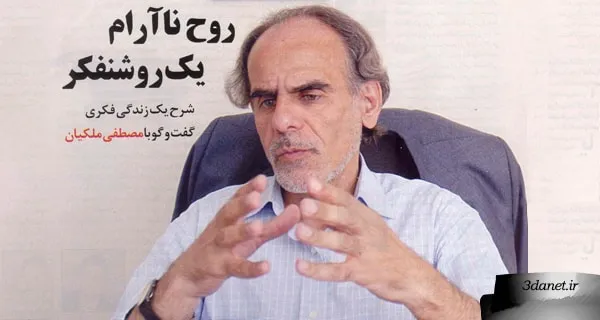
Discussion2 comments
به غیر از موضع گیری کلی آقای ملکیان ببینید که آیا از ابتدا تا آخر این متن بغیر از نقل قول و یا سئوال در مورد مواضع این و آن هیچ حاصل فکری هیچ حکم مبتنی بر داده ها که اوریجینال باشد یافت ی شود؟ چرا این گونه است؟ آیا این فعالیت واقعا فلسفه است یا نوعی مشاعره (فلسفی)؟
عجیب است که جامعه فلسفی غیر غربی با وجود این همه کشتار، غارت، تخریب، و ظلم از جامعه غربی ای که نمی شناسد بعنوان الگوی اخلاقی یاد می کند. اگر به جای تلاش برای کسب اعتبار نام این یا آن فرد برده نمی شد و رفتار جهانی ، میلیتاریسم و بی اعتنایی به حقوق جوامع غیر غربی توجه میشد چنین سئوال هایی که نشان از بی توجهی به حقوق مسلم جوامع در سیطره استبداد غرب تحت نام new world order از ابتدا تا انتهای یک مصاحبه نمی خواندیم. یعنی بغیر از هابز، رالز، و نیگل دیگر فکر در جهان وجود ندارد؟ یعنی شخص مصاحبه کننده برای فکر خود و وجدان خود هیچ self-esteemو جایگاهی قائل نیست؟ آیا این خود بی عدالتی و اوج repression نیست؟