Philosophy
The Restless Spirit of an Intellectual: An Account of an Intellectual Life in Conversation with Mostafa Malekian
Mostafa Malekian speaks of not fearing doubt and the unstoppability of thought. He rejects epistemological relativism and regards rational argumentation as a common scale for settling theoretical and practical disputes.
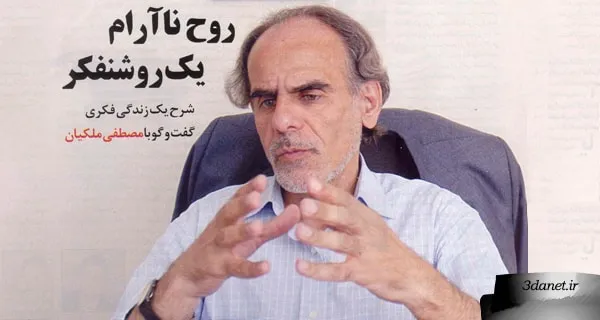
In the cold winter days that passed, days when Professor Mostafa Malekian's physical and mental state was still better than it is today, I sat down for a conversation with him. In those days, he was still well enough to visit the row of bookshops around Enghelab Square once a week, and if you happened to pass by there, you might suddenly see the professor, books in hand, standing and smiling as he chatted with a young or middle-aged person who had spotted him on the sidewalk of Enghelab Street, recognized him, and directed a flood of questions his way. The pretext for our conversation, however, was Mostafa Malekian himself and the course of his intellectual life. One must read this dialogue to realize that Mostafa Malekian is a man who, in his intellectual journey, has never stopped anywhere, has not feared doubt in his own thought, and has pressed forward. In this conversation, the professor speaks to us freely about his thoughts of yesterday and today.
.
The Restless Spirit of an Intellectual
An Account of an Intellectual Life
Samina Rastegari in Conversation with Mostafa Malekian
Question: Contrary to the status that rationality holds in your theory, some thinkers do not accept rationality as a scale that can resolve theoretical issues and solve practical problems; that is, they believe rationality is not an impartial scale. Every culture, society, and historical period has its own rationality. Rationality is only useful when it is a cognitive source upon which everyone agrees, but rationality is bound by time, place, culture, society, and so on.
Yes, this criticism is mostly raised by postmodernists, who do not grant reason a trans-temporal, trans-spatial, trans-situational, trans-cultural, trans-civilizational, trans-social, and trans-historical authority—a force or source within us that, in whatever time, place, situation, culture, civilization, society, and historical period we find ourselves, could unite us all and allow us to settle our disputes and disagreements with others by appealing to its arbitration and remedy. A scale that is impartial and a common ground for all of us human beings. This makes the judgment of reason or rationality dependent on, contingent upon, and conditioned by society, culture, and historical period, and thus leads to a kind of epistemological relativism. I have two responses to this belief: first, epistemological relativism is also one of the views and theories proposed in the realm of philosophy, and like any other view and theory, it has its proponents and opponents, and I myself am one of its opponents. The mere fact that someone holds a view and theory contrary to mine does not dissuade me from my own view and theory, unless they have a strong reason for their view and theory, and I have not seen such a strong reason in favor of epistemological relativism. The other response is that even if epistemological relativism were correct, it still would not make us abandon rationality, because what I mean by rationality is argumentation, and I can, within the society, culture, and historical period in which I inevitably find myself, engage argumentatively with other human beings.
Why do you believe that rationality has such efficacy?
The very fact that someone argues with me and seeks, with the help of reason, to demonstrate the relativity of reason and rationality and its dependence on culture and society indicates that, in their view, there are premises that are common between them and me, and they consider these common premises between me and themselves as materials they use to make their case. These very common premises can serve as the basis for both my and their argumentation.
And you call these common matters rationality?
I say that these very commonalities can make our rationalism fruitful and resolve our disputes in theoretical matters and practical problems. You noticed that I wanted to say that if an epistemological and cultural relativist asks us, without providing any reason, to believe in his relativism, then the choice or rejection of relativism becomes a matter of taste. One person, according to his taste, prefers relativism, and another person prefers absolutism, and neither has any epistemological preference over the other; and the absolutist can say to the relativist: Why should I submit to your taste? And why don't you submit to my taste? And if the relativist asks us, by virtue of a reason he provides, to commit to his relativism, then he must, in his reasoning, resort to premises that both he and we accept, and these common premises, at least at their own level, negate relativism.
On this basis, how do postmodernists exchange ideas with other schools of thought? Do they also consider reasoning to be a submission to a trans-temporal and trans-spatial rationality?
Of course, they too, as a rule, know that all those who belong to a single culture, society, and historical period have commonalities that are accepted by all of them, but they say that if we encountered people who are, for example, two thousand years distant from us and belong to another culture and society, we would have nothing to say. I say that even in that case, we would have plenty to say, but, more importantly, since we are not encountering those people now, and those we do encounter belong to our own culture, society, and historical period, why should we turn away from reasoning? Can I refrain from using a tool that is, in one respect, very useful for improving my life, on the pretext that if I had lived 500 years ago, I would not have had this tool, or if I were to live a thousand years from now, I would not have it?
Why do you think such a rationality exists, and that you, in one society, culture, and historical period, share a common rationality with an individual living in another society, culture, and historical period?
For two reasons: one a posteriori and empirical reason, and one a priori and rational reason. My a posteriori and empirical reason is that, so far, even by referring to the distant past, we have not found anyone who shares no common theoretical and doctrinal ground with us. Since we have not found them, why should we claim that such people exist and, therefore, that there is no common scale called rationality? If we found people with such a degree of theoretical and doctrinal distance from ourselves, we would have to think. Human cultures and civilizations, despite all the differences they have had and have, also possess common theoretical and doctrinal themes that cannot but be the material for all those who care for rationality and rationalism.
Could these common themes be the instinctive human characteristic for survival?
It could be, and it could not be. What matters for our current discussion is that we are not devoid of common doctrinal and theoretical matters; now, whether those common matters guarantee the survival of our species in the Darwinian struggle for existence and survival of the fittest or not, they still do not harm the core of our discussion.
Regarding spirituality, which is the second component of your theory, there are also questions. Among them, why do you use the word spirituality at all?
The referents of the concept of religion are all historical and institutionalized religions, such as Islam, Christianity, Judaism, Zoroastrianism, Hinduism, Buddhism, Daoism, Shinto, and Confucianism. What I have in mind is not historical religion and institutional religiosity—that is, I am not concerned, affirmatively or negatively, with the observance and adherence to the beliefs, rituals, and rites of a particular religious community. Rather, I am concerned with individual religion and spontaneous religiosity, that is, a religiosity that consists of walking one's own unique and singular path, as it has become known and revealed to the person themselves. Repeatedly and frequently, in my university lectures, interviews, dialogues, roundtables, speeches, and writings, I have strongly emphasized this point that collective religiosity is different from individual religiosity, and to clarify this difference, I have referred to the works of great psychologists of religion, such as William James, John Dewey, Erich Fromm, Walter Clark, Nock, Abraham Maslow, and Gordon Allport (for a brief reference to these views, one may consult my responses to the inquiry on religion and mental health). In this respect, I find the term 'spirituality' far more suitable for conveying my intent. On the other hand, the reality is that, whether we want it or not, and whether we like it or not, and for various reasons, the turn toward spirituality is increasing day by day. Regarding this phenomenon, one can, of course, have a positive value judgment and one can have a negative value judgment. To mention an example of each of these two value judgments, I can point to William James, the American psychologist and philosopher, who held a positive value judgment on this phenomenon, and to Charles Taylor, the great Canadian philosopher, who held a negative value judgment toward it.
Question: Why?
Because historical religions have metaphysical (not necessarily supernatural) and epistemological presuppositions whose digestion and assimilation are difficult and burdensome for the understanding of modern and contemporary human beings. The point is not that today's human being does not want to accept these presuppositions; even if they have the will to accept them, they do not find the acceptance within themselves. Even if they consider possessing them desirable, they find access to them impossible. We humans, just as we lack the bodily and physical capacity to perform certain tasks, also lack the mental and psychological capacity to perform certain other tasks. I emphasize that the discussion is not at all about whether these presuppositions are true or false and unsound. The discussion is about the fact that these presuppositions are such that the understanding and acceptance of at least some of them is not within the mental and psychological capacity of some human beings today. If the core message and the essence of the teachings of all religions can be liberated from reliance and foundation upon these presuppositions, a monumental task has been accomplished, and something has been provided whose understanding and acceptance pose no difficulty for the digestive system of the contemporary understanding.
Question: But a large number of human beings today still accept these presuppositions, and perhaps it is only the elites who fall under the scope of your statement.
It is true that a large number of human beings today also accept these presuppositions, but pay attention to this point: if you compare human beings from two thousand years ago, five hundred years ago, two hundred years ago, one hundred years ago, and today, you will see that the more modern and modernist human beings have become, the less their mental capacity has become for accepting these presuppositions. In other words, the intellectual developments of humanity have led it to conclusions that have been incompatible with these presuppositions, and this is regardless of whether those conclusions are true and these presuppositions false, or vice versa, or both sets are false.
Question: In effect, you reject the criticism that your theory is elitist.
Yes, my view is not at all elitist; rather, it is useful for all those who, day by day, are leaving the ranks of the acceptors of these presuppositions. Let alone the fact that a view being elitist is not a sign of its incorrectness, and let alone the fact that the most conventional, ordinary, and common views, when first expressed, were also accepted by only a small number of human beings and later, slowly and gradually, came to be accepted by all.
Question: What is the difference between the spirituality you speak of and materiality?
The spirituality I advocate holds that the God posited by historical and institutionalized religions and denominations is a personal and anthropomorphic God. That is, firstly: He is personal, meaning that every other existent is other than Him, and He is other than every existent, although an immense distance elevates Him above every other existent: He is the Necessary Being and the rest are contingent beings; He is the Cause of causes and the rest are His effects, whether mediated or unmediated; He is self-sufficient and the rest are in need of Him; He is infinite and the rest are more or less finite; and so on. Yet, in any case, He is anthropomorphic, meaning He possesses feelings, emotions, excitements, desires, speech, and actions similar (I say similar, not identical) to us humans: He has anger and pleasure, grace and wrath, love and hate, friendship and enmity; He defends, takes revenge, commands, prohibits, rewards, punishes, changes His decisions, threatens (with menace), entices (with promise), and so on.
In addition to this conception of God, that is, a personal, anthropomorphic God, other conceptions also exist: one can conceive of God as personal but non-anthropomorphic, and one can conceive of Him as fundamentally impersonal, akin to the pantheistic view held by many mystics of various religions and denominations. Therefore, if someone has a conception of God different from the masses' conception and does not consider Him a personal, anthropomorphic being, but, for example, considers Him impersonal, we are in no way permitted to consider that person a denier of God's existence. The difference between the spirituality I advocate and the materialist view is that, in the materialist view, every event is, in principle, explicable by recourse to the laws of the empirical natural sciences, namely physics, chemistry, and biology; that is, the laws governing existence are confined to the laws of physics, chemistry, and biology; whereas I see no reason for this exclusivity. On this basis, in the materialist view, the world lacks a moral order, meaning goodness and badness are ultimately lost; neither does goodness, finally and ultimately, receive reward, nor does badness, finally and ultimately, receive punishment, because physics, chemistry, and biology see no difference between, say, a true word and a false word, or between, for instance, sincerity and hypocrisy, deceit, and trickery. That is, for example, a true word and a false word do not differ from each other by a hair's breadth in terms of physical, chemical, and biological properties and relations. In other words, existence is blind and deaf to goodness and badness, rightness and wrongness, and consequently shows the same reaction to both, because it fundamentally sees no difference between them. I consider the system of existence to be moral and believe that not a hair's breadth of goodness is lost, nor a hair's breadth of badness.
Question: Isn't this very belief of yours an unproven presupposition? Have you accepted as a presupposition, or have you proven, that truth and falsehood are not the same, in your view?
On what basis does a lie detector operate? Why, when a lie is told, does the lie detector expose the liar? Is it not on this basis and for this reason that truth-telling and lying have different effects even on the human body and organism? Of course, biology does not understand truth and falsehood and cannot distinguish between them. The same goes for physics and chemistry. But in any case, whether my reason for my claim is strong or not is one matter, and whether my line of thought is separate from the materialists' line of thought is another matter. With this explanation, I have shown that my path and method are not a wholly materialist path, and I differ from a materialist. Whether my reason is stronger or the materialists' reason is, of course, another discussion. Some may find the materialists' reason stronger, and some may find my reason stronger. But this very fact shows that both sides recognize my path as separate from the materialists' path.
Question: Mr. Malekian, does this theory of rationality and spirituality of yours have any relevance at all to our society and politics? It seems you are speaking about a universal humanity and humankind. It makes no difference whether it is in Iran, America, or Africa; whether it is in present-day Iran or Iran two thousand years ago. Can solutions for this very society of ours be extracted from within your project, or not?
Why not? Yes, in my view, it can. Does the spiritual requirement that we not use any human being instrumentally have no implications for politics? Does the spiritual requirement that we only adopt beliefs through reasoning have no implications for education and politics? If spirituality requires that our interest in work not be solely for the sake of the income we earn through it, but that we be interested in the work itself, in and of itself, does this have no implications, effects, and consequences for the economy of the country and society? If the government announced today that this month, every government employee, whether they go to work or not, will receive their salary, in your opinion, what percentage of government employees would show up for work? A very small percentage. Why? Because all of us want work only for the sake of its income, and when the income is secured, we are no longer enamored with the work itself. The economic growth of a country does not depend only on its subterranean and surface natural resources, or only on the scholarly and precise planning of the country's economists, but, more than anything, depends on the country's human resources and the worldview of that human force. The natural resources of the Japanese are less than the natural resources of us Iranians, but their view of work is very different from our view of work, and as a result, their economy is far more flourishing than ours. I want to say that as long as we look upon work as a necessary evil, that is, something that is bad in itself but must be accepted as the only way to attain something good, namely income, our situation will remain roughly as it is, and considering work as an intrinsic good and desirable is a spiritual attitude. In any case, my claim is that a spiritual outlook on existence, the world, and humanity can be influential in all social institutions, including the family, the economy, education, politics, law, ethics, and religion.
Question: This point that a person must be passionate about their work is beautiful, correct, and oriented towards spirituality. But in society and in the real world, how should people become passionate about their work?
For every individual human being, there are always one or more tasks that they are truly and deeply passionate about. But why do they not pursue the work they are passionate about? Because the value judgments of others and the reward-punishment system of society matter to them. The solution is to not attach importance or significance, as much as possible, to the value judgments of others and the reward-punishment system of society. For instance, I have a genuine interest in psychology, or philosophy, or literature, or painting, but society values engineering and medicine, and in order to have social standing, I go into engineering or medicine, that is, towards a field I have no interest in. Now, if you ask what we should do so that the value judgments of others and the reward-punishment system of society become unimportant to us, I will give an answer, and that answer will bring another question to your mind, the answer to which will, in turn, raise yet another question, and so on...
Question: It seems most of your references are to Western thinkers. It appears you have inherited nothing from your own cultural tradition. Why?
I do not accept your view. I myself have said time and again that knowledge and understanding have neither time and history nor place and geography. Because they have no time and history, we cannot say that a thought or opinion is correct because it is ancient, or incorrect because it is ancient, or correct because it is new. And because they have no place and geography, we cannot say that a thought or opinion is correct because it is Eastern, or incorrect because it is Eastern, or incorrect because it is Western, or correct because it is Western. The ethics of belief requires that we pay absolutely no attention to the history or geography of a thought or opinion. If it is true and veracious, we must accept it, whether it is ancient or new, and whether it is Eastern or Western; and if it is false and untruthful, we must reject it, whether it is ancient or new, and whether it is Eastern or Western. On this basis, if I find the opinion of a Western thinker to be more correct than that of an Eastern thinker, I cannot follow and defend the opinion of the Eastern thinker. If, on a subject or issue, Hume has, in my view, said something more correct than what Avicenna, or Sheikh al-Ishraq, or Mulla Sadra Shirazi has said, I cannot say that because these figures are from my own soil and belong to my own culture, their words are more correct than Hume's. A true philosopher is fundamentally free from prejudice, dogmatism, rigidity, and bias, and therefore, if they have no religious bias, for example, they also have no anti-religious bias. From whomever they hear a word of truth, whose truth they discern by the scales of their own reason, they accept that word and incorporate it into their own system of thought. Prejudice, dogmatism, rigidity, and bias are fundamentally opposed to the requirements of the ethics of belief and are therefore reprehensible, and it makes no difference in whose favor or to whose detriment these prejudices, dogmatisms, rigidities, and biases are. If having an anti-Marx bias is bad, having an anti-Ali ibn Abi Talib bias is also bad.
Question: So, in proving your own theory, do you utilize both religious and non-religious sources?
Every philosophical person, every philosopher and person of rationality and reasoning must do so. I have said many times, and I say again, that the sacred texts of the world's religions and denominations are a significant and very important part of human culture, and one cannot, with anti-religious prejudices, dogmatisms, rigidities, and biases, disregard this immense treasure, which is part of our human cultural heritage. Can one ignore the treasures that the mystics, philosophers, scholars, poets, novelists, and ethicists of humanity have bequeathed to us? It is true that not everything in these treasures is true and correct, but one cannot conclude from this point that everything in them is false and incorrect and that one can and should neglect or deliberately ignore it. I repeat that the reference and recourse of a philosopher and person of rationality to religious and denominational sacred texts differs from the reference of someone who says: I accept a certain statement, even if I do not understand it, simply because it was issued from the tongue or pen of a certain person. A philosopher and person of rationality, firstly, does not accept or reject any statement until they have understood it, and secondly, even when they have understood a statement, they do not accept it based on the reason that a certain person said it, but rather tests it against the touchstone of their own reason.
Question: Mr. Malekian, why do you reduce every issue raised to you to psychology and ethics? For example, if a political issue is raised to you, you still analyze and answer it from the perspective of psychology and ethics?
Because I firmly believe that all our issues and problems have psychological and ethical roots. Even if our social institutions do not have the structure they should and must have, it is because the people involved in those institutions are, from a psychological or ethical standpoint, or both, unhealthy and have flaws and defects. The more I delve and explore, the more I see that there is no social issue or problem, including political ones, that does not, through one, two, three, or several intermediaries, lead back to a psychological or ethical issue or problem. In this respect, for me, the two subjects of mental health and moral perfection are of the utmost importance.
Question: Doesn't this very belief of yours cause your thinking to become individualistic and lack a social dimension? Because every social problem raised to you, you transform, through several intermediaries, into an individual problem?
You are right. My thinking is individualistic and I oppose collectivism. I see every human person as an individual possessing their own individuality, not as a member of a community and society where only their membership is of concern. In this respect, I trace my lineage to figures like Kierkegaard, not to those like Hegel and Marx. I want and see the human being as an individual, not a member. I do not see the human being as a cell of a very large body called society and community, such that I would be willing, if the interest of that whole—in my deluded opinion—required it, to sacrifice this part, with the pretext and excuse that for a body to remain healthy, sometimes there is no choice but to amputate a limb. The human being is not a part or a member to be sacrificed for a whole or a body and frame. The human being is an individual, and their individuality must flourish. The consequence is that I consider both individualism and the reduction of every issue and problem to psychological and moral issues and problems as requisites of my view, but I see neither of them as a flaw or defect in my view. They are consequences, but they are not corrupt consequences. They are the results of my view, but they are not bad results.
Question: Doesn't this individualistic view of yours limit you in offering solutions for social and macro-level problems?
Regarding social issues, I cannot and do not offer any superficial opinion, but why not a deep and root-oriented one? And of course, this root-oriented view is not my own invention or innovation; it is something I have learned from great psychologists, psychotherapists, and philosophers. Those who see the root of all pains and the source of all cures within the inner being of each and every one of us humans—that is, in our beliefs, feelings, emotions, desires, and needs.
Question: This answer is your re-emphasis that you are culture-oriented, not politics-oriented like liberals or economics-oriented like socialists. In fact, you consider the root cause of society's problems to be cultural. My question is, if this is the case and you are culture-oriented, and even consider political problems to be caused by cultural problems, why do you not always address the cause, which is culture, and sometimes go after the effect, which is politics? Why do you sometimes intervene in politics? Doesn't your commentary on political issues contradict your claim of being culture-oriented?
Let me be honest: I have never commented on political issues with heartfelt willingness, desire, and inner interest, and I have only done so when I have seen myself morally obliged to comment, and that is when a political matter has clear and obvious effects on the psyche and morality of the people. For instance, violence or blatant deceit clearly target the mental and moral health of citizens. But apart from violence, which is the most heinous form of violating human freedom, and deceit, which is the ugliest game played with the theoretical rationality of human beings, I leave everything else that transpires in the world of politics to its own people.
Question: Another discussion I want to raise is your view on religious intellectualism, and that you consider it contradictory and paradoxical.
I dislike repeating that the essence of intellectualism is rationality and the essence of religiosity is obedience, and that obedience and rationality are incompatible; consequently, religious intellectualism suffers from a kind of internal inconsistency. Rationality requires that if I claim "A is B" and someone asks me for a reason, I say "A is B because A is C, and C is B," but the requirement of obedience is that I say "A is B because so-and-so said A is B." It is clear that these two modes of reasoning do not accord with one another. You cannot be a follower of a religion unless you unquestioningly accept the words of the person or persons who are the founders or leaders of that religion. Can anyone claim to be a Buddhist but also not unquestioningly accept the words of the Buddha? Such a person, whatever they are, is not a Buddhist. In criticizing my words, some have said, what if we have a rational reason for our obedience? In that case, our obedience would not be incompatible with rationality, and I say in response, firstly: present your rational reason for obedience to a specific person, and secondly: if obedience is substantiated by a rational reason, then it will not be obedience at all, but rather a rational matter. In my opinion—and this opinion, like all my other opinions, may well be mistaken—religious intellectualism is faithful neither to intellectualism nor to religiosity, remains loyal neither to tradition nor to modernity, because it is neither full-fledged in its rationality nor in its obedience. It tries to have it both ways. And this, of course, in no way means denying or ignoring the immense services that those known as religious intellectuals have rendered to the culture of the country and society, and to other countries and societies.
Question: If you were to examine the emergence of the phenomenon called religious intellectualism from your favored perspective, namely psychology, what factors would you name as the causes of its emergence? Has being lost between tradition and modernity been the cause of the emergence of this type of intellectualism in Iran?
I think the emergence of religious intellectualism has several causes, all of which relate to social psychology. The first cause is that a Third World person, for example an Iranian, on the one hand needs the West to solve objective problems and needs religion to solve subjective problems. Therefore, they wish to combine both. When the discussion is about roads, cars, banks, airplanes, and healthcare, they need the West; when they seek peace, hope, inner satisfaction, and a meaningful life, they need religion because religion solves these inner, subjective problems. They want to have their cake and eat it too. Our religious intellectual, as a social reformer—a characteristic of which I have no doubt—says, when my audience's demand is this, my offering must also be this. The second point is that they themselves might believe in non-religious intellectualism but do not see it as expedient to completely neglect the religious dimension. Because they might come under immense pressure and do not want to pay such a high cost. A religious intellectual might, in their heart of hearts, truly be a secular or laic intellectual. But for reasons that usually come down to the person wanting to continue their life, it seems to them that if they want to neglect religion, they might be subjected to attacks by social groups, and as a result, they give a veneer of religion to their project. There is also a third form, which is that the religious intellectual might also have a political hue and aspect. Then they might also be in competition with the political current ruling their society; in the matter of politics, truth and falsehood are not important, success and failure are. Then they see that their rival has a weapon called religion in hand, so they say, I should not, by my own hand, deprive myself of this weapon. If the rival speaks of Ali (AS), I too will speak of Ali (AS), but with the interpretation that I myself prefer. I too will not lose this weapon. That is, they engage in a kind of political expediency and show themselves as a supporter of Hadith, the Quran, and the Prophet. So as not to be disarmed for no reason.
Question: In fact, here you agree with secular intellectuals as well as traditionalists who accuse religious intellectualism of a kind of duality.
I say it is one of these three cases. Of course, I do not want to accuse a specific religious intellectual of one of these three cases. These three causes may push religious intellectuals toward such a state and condition.
Question: Dr. Malekian, why has your intellectual project been presented in a scattered fashion through lectures, conversations, and roundtables, and why have you never presented it in a specific, unified, and criticizable written work?
The first point is that, unlike most people of culture, I see no difference between the written and the spoken word. You have seen that when people of culture are to write something, they pull themselves together considerably and are very calculating and meticulous. When you want to interview them but record what they say, they speak less carefully than when writing, but still in a polished manner. If you do not record their speech, they speak with far less care. This is because these three acts are different for them. But I am truly not like that; my scrupulousness is equal in all three. Therefore, if someone wants to critique me, and they critique my published spoken words as well, their critique is valid. I do not need to necessarily write something. So if someone critiques my spoken words, I will never say, "This is just something I said somewhere; why are you focusing on it? It is not my writing." No! I exercise the same care for my writing, my recorded speech, and my unrecorded speech. Thus, anyone who obtains the audio or written transcript of my interviews, conversations, lectures, roundtables, and talks and subjects them to critique, it is just like a critique of my writings. For me, there is no difference. The second reason is that my engagements are truly very numerous. The third reason is that I must honestly confess that I am not free from laziness and indolence. I do have laziness and indolence. I accept this too. I truly have a degree of laziness when it comes to writing. But I have no problem with anyone critiquing my spoken words.
Question: Before reaching your current position, you traversed a long path, meaning you came from the extreme end of the traditional camp to this side, and your background as a student of Ayatollah Mesbah and years of seminary study are very prominent in your record. Did a specific event cause this change in your path, or did you gradually realize that you were inclined in this direction?
When I was studying Islamic sciences in Qom, I had several teachers—in jurisprudence and the principles of jurisprudence, in philosophy and wisdom, and in mysticism—and I was not only a student of Mr. Mesbah. I was also a student of Mr. Javadi Amoli, Mr. Hasanzadeh Amoli, and Mr. Ansari Shirazi (I am only giving examples from the branch of philosophy and wisdom), and as it happens, my studies under Mr. Mesbah were less than under those three others I named. Of course, I do not deny having been his student. I read Mulla Sadra's Science of the Soul from the Asfar and part of Avicenna's Theology of the Shifa under Mr. Mesbah. Two other things should also have been mentioned. One is that I taught for years at the educational-research institute that Mr. Mesbah had founded. The other is that I prepared a considerable number of the works published by Mr. Mesbah for publication. Suppose Mr. Mesbah held nine sessions discussing a topic. These discussions were transcribed, and then I refined them, documented them, and found their references. Therefore, I was a collaborator in the publication of many of his works, and furthermore, I taught at his institute. Of course, I do not at all wish to deny that I was a student of Mr. Mesbah, but as for whether my passage through these stages was due to a specific event or not, I cannot say it was due to a specific event. That is, no shocking event occurred to me that suddenly changed my intellectual path. It happened very gradually. As it happens, it was not even a passage from traditional thought to modern thought. I have passed through several intellectual phases. The conception I had of religion in my adolescence was a conception that, looking back now, I can claim was a fundamentalist conception of religion. Albeit, in fairness, without the violence that exists in fundamentalism. Anyone familiar with my personality knows that I am simply incapable of being violent. After a while, I gravitated toward a traditionalist conception of religion, the conception of figures like René Guénon, Martin Lings, and so on... and Seyyed Hossein Nasr, who are mostly Muslim. It was during that time that I encouraged several of my students to translate the works of the traditionalists, and I myself was possibly the editor of these works. After a while, I gradually saw that religious traditionalism did not satisfy me at all either, and I turned toward what is called religious modernism. Which I interpret as religious new-thinking, and today they call it religious intellectualism. That is, I gravitated toward the thoughts of people like Dr. Ali Shariati, Dr. Abdolkarim Soroush, Dr. Mojtahed Shabestari, and other intellectuals of the Arabic-speaking Islamic world, the Turkish-speaking Islamic world, and the English-speaking Islamic world (Pakistan, Bangladesh, and Malaysia). It was during this period that I myself was considered a religious intellectual. But gradually, I saw that religious intellectualism did not satisfy me. It did not seem convincing to me. In fact, I turned toward a project that I myself call spiritual intellectualism.
Question: Does this new project of yours satisfy you now?
This project of Rationality and Spirituality satisfies me now, and I can say that from 1997 until now (the last 14 years) I have been engaged in reflection and contemplation on this very project. But at the same time, if you ask why this transition does not occur for many other people, if I want to answer honestly, I must say something that you and most of your audience might take as self-praise. I pursue whatever I consider to be the truth. As long as I consider X to be the truth, I am committed to X. When I later realize that X is not the truth and Y is the truth, I abandon X and cling to Y. I consider truth to be above every disposition, creed, and ism. This truth-seeking has always existed in me. I have always loved to be faithful to the truth and not to a particular school of thought. This issue meant that I could not "settle down." Even now that I am in this project, I may be mistaken, but since I have not yet realized its erroneousness, I currently believe in it. I always give this example for truth-seeking: Imagine a mother who is told that her son, who has been missing for 30 years, has been found and has disembarked from the plane at Tehran airport. Out of intense excitement and emotion, this mother might even disregard all social norms. She might run toward her child without shoes and without proper clothing. She might even kick two people and knock one down. Because that agitation arising from feeling, excitement, and emotion makes her forget even observing social norms. She runs into her child's embrace. Now, if at the very moment she is in her child's embrace, she becomes absolutely certain through some means that this man is not her child and has also strapped a bomb to himself, would she ever think to herself, 'I came with such excitement, it would be disgraceful now to separate myself from this man, and then everyone will say you ran without a chador, without shoes, and without a headscarf'? Would she say to herself, 'So if I want to separate, I should do it gradually'? It is not like that at all. With the same speed that she threw herself into that man's embrace, she distances herself from him with the same speed. Truth should be like this too. As long as we consider something to be the truth, we should embrace it completely. But as soon as we understand it is not the truth, we should distance ourselves from it and declare it with the same speed and the same candor. I have not tied my personality and character to a particular theory, and I am not so bound up with it that if I feel that theory has failed, it is as if my personality and character have been insulted; as soon as I realize my theory is unsuccessful, I immediately move toward the alternative theory that I think is closer to the truth. What should be important to us is the process of truth-seeking, not the product that we recognize as truth at any given moment. You must have the process of truth-seeking; at any moment, the product of this process may be a specific thing.
Question: But when we think we have attained the truth, we reach peace and stillness. Should we forgo this peace and stillness and always restlessly continue the process of truth-seeking?
In my opinion, yes. In my article on the tragic aspects of intellectual life, I have said that you must have two ideals: one is the articulation of truth, and the other is the reduction of suffering. You must communicate every truth you discover, as long as you consider it the truth, to all your fellow human beings. The other duty is to lessen the pain and suffering of others. We have these two duties.
Question: But these two are sometimes incompatible. That is, it is quite possible that I communicate a truth to people and their pain and suffering increase, and on the other hand, it is quite possible that I want to reduce their pain and suffering and am forced to conceal a truth. What is to be done?
In fact, no moral philosopher has been able to provide a definitive, convincing argument as to which one should be preferred over the other. I myself have no reason either. Personally, I consider the articulation of truth more important than the reduction of suffering. Unfortunately, most of us prefer sweet illusions and falsehoods to bitter truths, but I say a bitter truth is more valuable than sweet illusions.
Question: What is your greatest concern these days?
I honestly speak of the pain and suffering of the people. For this reason, I am often in a state of choked emotion and distress. I am a very emotional and tender-hearted person. In terms of psychological type, I am also an introvert. I also have a preoccupation with psychology and ethics. When these three come together in a person, they make life very bitter for them. My mental preoccupation with the pain and suffering of the people knows no bounds. I have no political presence and am glad I never have, but I am deeply concerned about the people.
Question: Your theory is very universal and is not specifically about the Iranian person. We also spoke about this in previous questions. The question I have is why have you stayed in Iran?
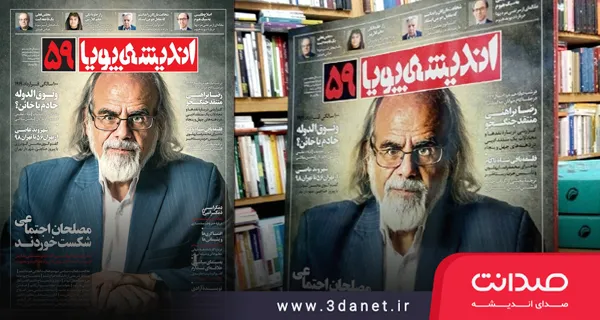
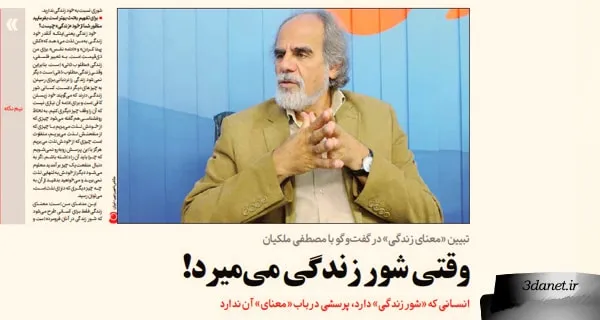
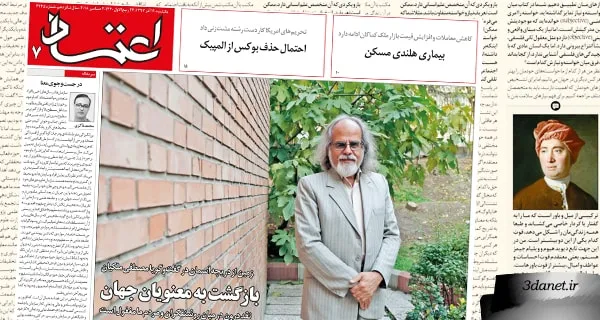
One problem I have is that as soon as I leave the country, I am so overcome by homesickness that whatever I went to do, I cannot attend to it. The moment I get off the plane, I want to return to Iran. A second reason is that I am more aware of my own flaws and shortcomings than anyone else, and I know better than anyone that I have a small personality tent. But at the same time, I know that in the eyes of people like some students and the public, I am a figure who, if not great, is not as small as I am in my own mind. Now, when those people know I am in Iran, they have a source of reassurance and hope. If they were to find out one day that Malekian has also left, they would feel as if their support has been pulled away; they would feel that certain people drew them into the public sphere, certain people opened their eyes, and now that their eyes have been opened and they have taken actions and reactions, as they are seeing the consequences of that eye-opening, those who opened their eyes are no longer there. Believe me, in these past few years, more than 100 times, while I was browsing in a bookstore across from the University of Tehran, someone has approached me and said,

.webp)
Discussion8 comments
نقد واستدلالی که اگر در پی بنیان ان بر اییم حتما به نقاط تضاد وحتی نفی ان خواهیم رسید ( مانند تعریف عقل واستدلال ویا روشنفکر دینی و..) اما از سویی دیگر برای ایحاد یک رنسانس فکری که در ایران نبوده است بسیار مفید خواهد بود وپیشنهاد میشود که اینگونه مصاحبه ها توسط فردی اگاه بر مسیله باشد تا مصاحبه شونده را به چالش علمی بکشاند تا وقت برای نقد توهم های تجربه شده تلف نشود
با سلام و تشكر از صدانت برداشت و نگاه بنده نسبت به دين تغييري نكرده است ، حدااق ١٠ سال است كه تغيير نداشته و البته كتابهايي كه فرموديد رو بنده نهج البلاغه را يك بار و قران را بيش از ده بار مطالعه كرده ام ، و دوباره از شما قضاوت بدون دليل ديدم ، دوست عزيز وقتي مطلبي را مي بينيم و قصد پاسخ داريم ، بايد به خود مطلب پاسخ دهيم و نبايد در مقام نصيحت سخناني را روانه شخصيت شخص گوينده كنيم، البته از اين سخنان پيداست كه قصد گفتگو وجود ندارد و بنده هم سخني ندارم، نميدانم شما از كجا متوجه شده ايد كه بنده چه اساتيدي را تجربه كرده ام با اين حال در پاسخ به سخن مصداقهاي عقلانيت از طرف شما ، دوست داشتم ارجاعاتي از قران بدهيد كه در آن مصداق عقلانيت امده است ، چون دوست دارم بيشتر اين مصداقها را بدانم و آيا شما مصداقهاي عقلانيت از ديدگاه فلسفه و منطق غربي را هم پيشنهاد مي دهيد يا خير ، بسيار ممنونم
بحث بنده در ارتباط با سخنان اقای" ملکیان "بود که در گفتگوی بالا امده است.
یک پیشنهاد سازنده : آیا بهتر نبود قبل از اینکه برداشت خود و نگاه خود نسبت به دین را تغییر دهید اساتید دیگری را هم تجربه می نمودید؟ آیا بهتر نبود اصل را قرآن و روایت های متواتر مانند غدیر ، منزلت ، ثقلین و... قرار می دادید؟ آیا بهتر نبود عبارت های نهج البلاغه بخصوص در موضوع توحید را بادقت مطالعه ودر آنها تحقیق می نمودید؟ آنگاه مصداقهای عقلانیت ، حجت ، و استدلال را مشاهده ، و حقیقت را در اسلام قرآن و عترت پیدا می کردید.
با عرض سلام با تشکر از پیاده کردن این مصاحبه ، فکر میکنم یک جمع بندی کلی به نظریات و رویکرد استاد ملکیان بود اگرچه من ایشون رو از سایر اندیشمندان و هم صنفان معاصرشون جلوتر ، کامل تر ، مستدل تر و فرهیخته تر میدانم ، اما نقد های زیادی به نظریات ایشان دارم ، یا شاید بهتر بگم پرسش های زیادی . ولی در حال حاضر قصد مطرح کردن تمام آنها رو ندارم فقط دو سوال دارم 01. اینکه آقای ملکیان واقعا معتقد به خدای متشخص و انسان وار هستند ؟ چون من در جاهای دیگری از ایشان باب های اندیشه ای مثبتی در تلقی خدای غیر متشخص شنیده بودم البته نگفته بودن که نظر خودشون هست ، اما در تبیین اینکه اگر خدا را غیر متشخص در نظر بگیریم و اورا مساوق و حتی مساوی با هستی و هستی بخش در ذات هر مخلوقی توامان در نظر بگیریم ، چقدر موجب افتتاح در ذهن در مورد معقوله خالق و خلق و ماهیت هستی میشود ، بسیار سخت گفته بودند بعد برام جالب بود که اینجا ذکر کرده اند در باب معنویات منظورشان خدای متشخص انسان وار هست حال میخوام بدونم من دچار اشتباه شدم ؟ یا ایشان واقعا خدا رو یک شخص انسانی قلمداد میکنند ؟؟ انقدر در سطح برداشت کردن مفاهیم کمی عجیب اومد برام از ایشون سوال دوم : ایشون خیلی مصرانه تاکید بر پذیرش هر حرفی مبتنی بر استدلال دارن آیا ما با اینمه اضداد در آرا و نظریه ها ، شیوه استدلالی واحدی داریم ؟ اگه بله ، اون چه شیوه ای است ؟ یعنی چطور بفهمیم داریم مستدل حرف میزنیم یا غیر مستدل ؟ البته ایشون گفته بودن که شروع صحبت بر مبنای تشابهات و اشتراکات ، خود مقدمه ای بر دیالکتیک مستدل هست اما من بیشتر میخوام بدونم شیوه ای در بحث یا دلیل آوری هست که اگر آنرا رعایت کنیم آگاه باشیم که در حال مستدل حرف زدن هستیم ؟ ممنون از زحمتی که میکشید استاد ملکیان واقعا ارزش این وقت و تلاش رو دارند ...
بنام خدا. این نقد فقط مربوط به یک بخش از موضوعاتی است که در مصاحبه بالا آمده است. از شما بعنوان یک فیلسوف انتظار نمی رود که برای تمام مسا یل یکجا حکم صادر کنید که براساس آن یا باید برای همه چیز استدلال نمود ویا همه چیز را تعبدی پذیرفت. اصول دین استدلالی است، مثلا آثار خدا در جهان دلیل بر توحید است ، ودلایل دیگر که در ارتباط با اصول دیگر است. در مسایل فرعی و جزییات زندگی فردی و اجتماعی نمیتوان تنها با دو وسیله استدلال و معنویت بدون دین به حقیقت که مورد نظر شما هم هست، رسید.مثلا چگونه می توان حدود ومعیار های مالکیت ، تمام معیارهای اخلاقی ، مسایل پیچیده حقوقی ، وغیره را فقط با استدلال و معنویت حل نمود و به حقیقت رسید. به این تر تیب همان عقلی که شما آنرا قبول دارید حکم می کند که انسانها بیش از هر چیز به خالق خود نیاز مند هستند. البته آموختن علوم و فنون وبکار بردن آنها در زندگی مورد سفارش وتاکید دین است. احکام علمی در حوزه خود تضادی با احکام دینی ندارند. در ضمن، اصطلاح روشنفکری دینی گمراه کننده است، زیرا آنرا در مواردی بکار برده اند که از آن نوعی مقابله تفکر با دین به ذهن می رسد.
با سلام ، نقد شما معقول و مستدل نيست، اگر منظور شما قسمت روشنفكري ديني باشد ، كه ايشان براي همه مسايل يكجا حكم صادر نكرده اند و البته نظر خود را چه بسا كه نادرست باشد گفته است و در ضمن مگر مسايل توحيد و خداشناسي كه شما مطرح مي كنيد و مي گوييد اصول دين استدلالي است ، دلايل و استدلالي براي انها داريد يا خير، اگر استدلالي داريد كه در ان استدلال ، نمي گوييد چون فلان شخص گفته ، و ان استدلال قانع كننده باشد و اين حق را هم به من بدهيد كه اگر قانع شدم مي توانم قبول كنم ، بله اين مي شود استدلال و اگر به فلان شخص ارجاع دهيد كه مي شود تعبد ،
همان عقلی که شما از آن صحبت می کنید: اولا اصلا نمی تواند اثبات کند خالقی وجود دارد. ثانیا نمی تواند ثابت کند که این خالق عالم مطلق،قادر مطلق و خیرخواه علی الاطلاق است. ثالثا نمی تواند ثابت کند که اختصاصا برای انسان تشریع داشته باشد و برای دیگر موجودات نداشته باشد رابعا برای این تشریع الزامی به ارسال شخصی به نام پیامبر داشته باشد و وجدان کافی نباشد. خامسا نمی تواند ثابت کند شخصی به نام موسی یا عیسی یا محمد واقعا این رسالت را دریافت کرده باشندو مثلا سید علی محمد باب دریافت نکرده باشد سادسا این افراد بی کم وکاست یا بدون زیادت و نقصان به طور کامل این پیام را ابلاغ کرده باشند.