Political Science
The Intellectual Does Not Accuse, Reza Khojasteh Rahimi
An intellectual does not level accusations without argument; the fierce reactions to criticism of the Fada'iyan guerrillas show that some still cling to a violent rhetoric and prioritize the struggle against imperialism over democracy.
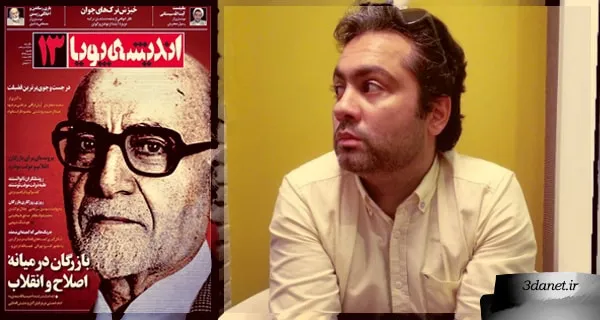
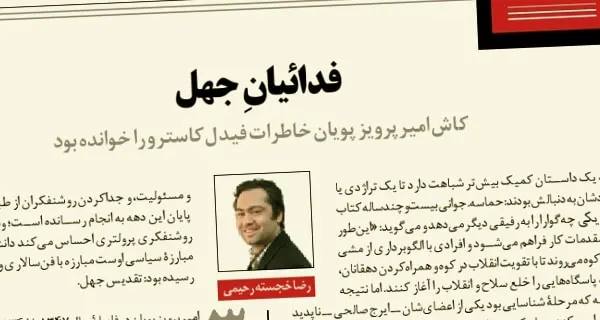
Reza Khojasteh Rahimi: Imagine someone, seeing a similarity in the anti-imperialist theme of the thoughts of the Fadai guerrillas and the Taliban fundamentalists, imagining the Fadaiyan as cultural operatives in the service of the Taliban for the terrorist operation of attacking the Twin Towers or suicide operations to confront imperialism...
.
The Intellectual Does Not Accuse
On Some Reactions and Criticisms Regarding the Critique of the Fadaiyan
1 Imagine someone, upon seeing a similarity in the anti-imperialist theme of the thoughts of the Fadai guerrillas and the Taliban fundamentalists, conceiving of the Fadais as cultural operatives in the service of the Taliban for the terrorist operation of attacking the Twin Towers or for suicide operations to confront imperialism. What opinion can one offer about such an analysis devoid of reasoning? In the same vein, the publication of a critical note about the Fadai guerrillas in Andisheh Pouya unfortunately ignited the fire of anger in some (and we emphasize some) supporters of this group to such an extent that, with a similar analysis, without reasoning and with language far from politeness and fairness, they took up the pen and regaled those involved with Andisheh Pouya with expressions such as “security cultural operatives,” and the like. In such writings, which possess a dogmatic and ahistorical tone – unlike the respectful tone of a piece such as the writing of Mr. Haroun Yashayaei, which is printed in the “Baztab” pages of this issue – one cannot find any sign of a desire or enthusiasm for dialogue and reaching the truth. We mistakenly thought that some Pouyan comrades, who in their youth spent years settling the world’s affairs with such angry language, had been guided onto the path of fairness and forbearance in middle age and the transition to old age. But now one can speak with certainty of “a specific type” that has tried over these years to remain entrenched in its position and not advance beyond the 1960s; its signs are words, sentences, and a tone of this sort, which appeared in rejecting a note in Andisheh Pouya: “The rebuttal writer has discovered that the Fadais of ignorance [...] Pouyan’s back was bent forward due to nutritional poverty. What can be said except that the rebuttal writer, by writing these phrases, has vomited his vulgar mentality into Andisheh Pouya.” (While it is unclear why nutritional poverty and the forward bending of the back, which is a reference to the lifestyle of young militants, is vulgar in the view of the angry critic of Andisheh Pouya’s editorial? Incidentally, it can be added that this image of Pouyan was not “discovered” but rather exactly “quoted” from the writing of Nemat Azarm, a fellow townsman of Amir Parviz Pouyan, about him, and it was not “vomited” in Andisheh Pouya but rather “published.” Nemat Azarm writes: I would visualize Parviz before my eyes with that short stature, a back that was bent forward due to nutritional poverty and, despite his thinness, had made his stomach protrude... )
Another example of this irascibility and uncultured language is where the angry but ill-informed critic calls the reference in the note “Fadais of Ignorance” to Pouyan’s harsh and critical letter to Shariati, since it was explained that the text of this letter is unavailable, “the shoddy sham of an inept trickster.” (For more familiarity with that letter, the ill-informed critic can review Ali Rahnema’s scholarly book, A Muslim in Search of Nowhereland, about the life of Ali Shariati, which has been published for fifteen years, and read about the content of that letter, the detailed account of Nemat Azarm, who was the transmitter of this letter). The entirety of the article, excerpts of which we have cited, is filled with verbal violence, hatred-mongering, and pride in incivility (such that we are even excused from publishing the “title” of this article in a general magazine), and therefore leaves no room for serious discussion and dialogue; and we, too, shall pass over it. In any case, we are pleased that in their writing we became acquainted with an example of a polite and fair piece!
2 As was mentioned, the publication of a note criticizing the Fadai guerrillas – as if it had drawn back a curtain – allowed some enthusiasts of that organization to show us that they have remained entrenched in their violent stance over the years. As the author of a note (an excerpt of which was also published on the BBC website, in the “Observers” section) wrote explicitly in criticism of “Fadais of Ignorance,” while defending the armed struggle: “I myself am among those who do not consider armed struggle useful except under specific conditions that help expand the scope of the people’s mass struggles”; as if one can issue an a priori judgment about the expansion and fruitfulness of mass struggles. (Of course, the BBC website, with a subtle change and probably for political dissimulation, published this sentence, from which the telltale sign of defending armed struggle was protruding, by changing its subject, as follows: Some also see such a struggle as useful only in aiding mass protests.) Thus we see that some comrades have remained entrenched in their position of propagating and promoting violence.
Even if we assume that today, when criticizing their views, we must consider the temporal and global conditions in which Pouyan and his comrades lived, and that every word and deed must be understood in its own time and place (which itself warrants detailed discussion), how can one hide this telltale sign: that half a century after the 1960s and the death of Amir Parviz Pouyan, one of the grandees and survivors of that thought still writes of the necessity of armed struggle, and despite having seen with his own eyes Fidel Castro's promised utopia on that impoverished island, he whistles and applauds Castro's record, and, emphasizing the 3 Some former comrades-in-arms, who have called the article “Fadaiyan of Ignorance” armed with a gauge of insult and contempt, seem to find their gauge malfunctioning when they read Pouyan’s bold and biting letter to Ali Shariati and his devastating, furious piece about Jalal (in which he wrote of “Jalal’s timely death”), or when their own insinuating writings overflow with insult and contempt. While it is commendable to advise one another to reduce verbal, written, and behavioral violence, it is far from fair for one who eats dates—and is unwilling to place his own date-eating and that of his former comrades on the scales of criticism—to forbid others from eating dates. The truth is that the late Amir Parviz Pouyan was a young man of twenty-two, yet he was frank and outspoken in criticizing those he wrote about who were a generation older than him. Whereas the author of “Fadaiyan of Ignorance,” in his thirties, wrote a note about Pouyan and his comrades, who during their lifetimes were at least half a generation behind him. With the little practice in politics I have gained over these years, I thought I had the right to criticize my younger brothers from that generation. To write that taking up arms was far easier than practicing tolerance and reform. To say that seeking and choosing shortcuts in politics through arms and violence is fraught with incidents that do not lead to salvation. To show that I have no fondness for an organization and group that hangs its own political brothers on charges of weakness and laxity, and isolates and eliminates the one it cannot hang, like Mostafa Sho‘aiyan, in the most Stalinist ways possible. I wish that, just as these comrades vied with one another to beat down the critic of Pouyan, they had also vied with one another in settling accounts with those Stalinist mentalities and in explaining and justifying the dark, murky stain of terror that sits at the heart of that political organization’s record. I wish they did not seek to smear anyone who spoke of the ugliness of terror and the killing of comrades by, as they imagined, slinging mud at them through attributions to a book from such-and-such an institute. In that note, I had pointed out that Ahmadzadeh, who was apparently opposed to the intra-group executions (and Hamid Ashraf also noted this point), upon seeing the fruits of some comrades’ laxity in prison, wrote in his interrogation that perhaps it would have been better if we had executed some of the defectors. I do not know how acceptable it is to claim that this direct quotation of that account is unreliable, even when citing the document title and interrogation number, simply because it appears in a book published by a government institute. Why, when we come to a question and answer in the account of Alireza Nabdel’s eighth interrogation session about Pouyan being shot and his illness, must we pass over it and quickly rule that these are lies, while the mythical and far-fetched accounts in the party booklets of the guerrilla comrades can serve as historical sources? (For example, regarding the manner of Alireza Nabdel’s suicide—with all due respect to the bravery and courage that must be accorded to this young man—and this: that he threw himself headfirst out of the room’s window. The guard, who had rushed to him in panic, could only grab the corner of his clothing but could not prevent his fall. The comrade fell, his abdomen split open and his right arm broke, but he was still alive. In such a state, the comrade, with revolutionary self-sacrifice and unparalleled devotion, reached out and pulled his intestines from the gash in his abdomen to tear them and end his own life. But the opportunity for this did not arise, for the enemy’s henchmen arrived and prevented this act.) How can some people, with certainty, assess certain accounts as aiming to destroy the image of the Fadai guerrillas just because they appear in a specific book, when, for instance, the matter of the intra-group killings is not an incident whose documents appear only in that book attributed to a government institution? Before the publication of this book, microfilms that fell into the hands of the German police during a raid on Ashraf Dehghani’s home documented a number of these assassinations and purges for the first time. Hassan Masali has also testified about this with certainty, and Maziar Behrooz, in a historiographical account in his examination of the idealist rebels, has narrated the story of these killings in detail. In any case, those whose neck veins bulge when criticizing the Fadai guerrillas but whose tongues cleave to their mouths when asking about the intra-group purges within this organization will not be the caravan-leaders of truth. I have read that for Marzieh Oskoui’s generation, it was a virtue to write “the life of the people...had polished my grudges,.
.



Discussion0 comments
No comments yet; let yours be the first voice.