Philosophy
The Four Journeys, a History of Shi‘i-Humanistic Letters, Mohammad-Taqi Chavoshi
The question of truth and humanity's encounter with it is always shaped by history. In this light, Mulla Sadra's Four Journeys is not only a work of reason but also a narrative of the intellectual history of the Iranian-Shi'i person—an inquiry into the relationship between humanity and truth across time.
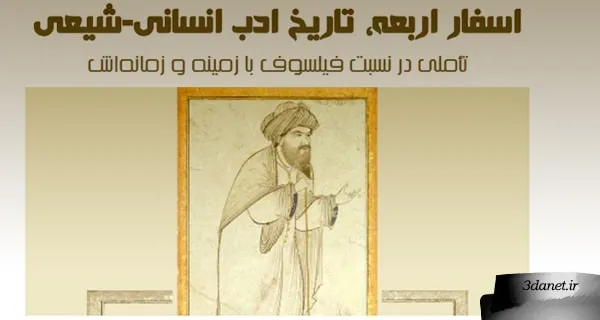
In Islamic philosophy, there has not been much discussion about the nature and essence of "history" or the course and manner of its movement; the reason for this is itself worthy of reflection, but perhaps by re-reading the works of Islamic thinkers, one can speculate about the attention they have implicitly paid to the category of history. The following article aims to show that any discussion of truth is the other side of the coin of the discussion of the relationship between the human being and truth; on the one hand, because the human being is in history, the way of looking at the human being is also influenced by history, and consequently, the discussion of truth and the human being's encounter with truth is always influenced by history; therefore, with these preliminaries, it can be said that Mulla Sadra's Four Journeys is not only a rational and philosophical work but also a narrative of the history of the culture (adab) of the Iranian-Shi‘i human being.
1- In section 82 of Being and Time, Heidegger explicates and then critiques Hegel's discourse on time. He believes that Hegel here remains faithful to the Aristotelian conception of time, depicting time as the homogeneous continuum of the "now" (= present). Hegel, in one of his marginal notes on the Encyclopedia, states: "Positively, time is only the present, and the 'before and after' are missing. Moreover, the present is concrete; the child of the past and pregnant with the future." The spirit of Heidegger's critique is directed at this last part we have quoted from Hegel; Hegel does not consider spirit and reality to be temporal matters and refrains from their realization in time; the "being-within-time" of spirit does not satisfy Hegel.
Heidegger points out that Hegel places time within the philosophy of nature and consequently overlooks the "time of human experience." The problem Heidegger diagnoses here—and in his exposition of Hegel's thought—is that: history (which is fundamentally the history of spirit) unfolds in the medium of time, thus history develops in time. But on the other hand, Hegel does not accept the being-within-time of spirit. Hence, Heidegger, in a relatively exhaustive discussion, explicates Hegel's view and considers it a groundwork for understanding his own view on time. Because from Heidegger's perspective, Hegel did not pay attention to time as a mode of human existence. Contrary to Heidegger, Kojève and Koyré, by appealing to Hegel's statement that time is "the existence of the intelligible form itself," claim that: therefore, the intelligible form is linked with the human subject, and thus they welcome Heidegger's view that time is the time of choice and action, and that the "future" takes precedence over the "past and present."
2- The discussion of the human being and truth is the question of our era. It is the question of our era because truth, due to the ambiguity that has arisen in the nature and identity of the human being, has itself become a question. Truth has become a question; as if it is nothing more than a vanity. Let us not say that doubt about truth is not a new occurrence! From the Hellenistic period to the Renaissance and Montaigne's essays, and more or less thereafter in the works of Hume, truth has been attacked by thinkers. But if Montaigne asked, "What do I know?" he did not intend to unveil the futility of truth, and if the German idealists saw the rationalism of the modern period, with Hume, falling into the abyss of skepticism, it did not mean that for Hume, truth was lost. Neither did Montaigne consider truth fabricated, nor did Hume try to move in such a direction. Let alone that at the foundation of these very views and approaches—especially Hume's thought—the modern period flourished and emerged, claiming that truth is fabricated. These two discussions are separate and require no explanation. The question of truth and its foundation—in our time—harbors the ambition of moving beyond truth. The direction of this question does not arise from the contemporary human being's anxiety and concern for understanding truth. It is as if truth has come to an end. In any case, whether truth is the product of the dominant episteme, the product of tradition, or possesses a noumenal existence, it emerges in connection and relation with the human being.
The philosopher is a child of his time, but his thought cannot be confined to a specific period. The human being cannot be separated from the culture and environment in which he grows and develops, and the philosopher is not free from this condition either. But thought cannot easily be bound to a specific time and place, and at least history and its study show us that what has become historical and whose period has ended is not non-existent.
If in metaphysics they speak of subjectivity and the immanent (immanent) nature of truth, and if they speak of the groundlessness or the groundedness of right and truth; undoubtedly all these findings are human and indicative of the relation between the human being and truth (whether truth is constructed or disclosed). It is precisely on the basis of this relation between the human being and truth that we say: if there is talk of meaninglessness and the groundlessness of truth, as well as of plurality, relativity, and absurdity, then, to the same measure and extent, there has been talk of the specific aspects of human existence and its groundlessness and meaninglessness. Hence, we face a more important question: Is it possible for the human being to sever the relation with truth? Does the passing beyond truth not itself signify the realization of a new truth? Undoubtedly, the presupposition of this question is the primacy of the relation between the human being and truth. In what situation can the human being decree a going-beyond and passing-beyond truth? In a word, one can answer: "meaninglessness." But what relation exists between meaning and truth? If we say that meaning is the same as truth, or truth is the same as meaning, the answer of "meaninglessness" appears extravagant, because it is begging the question. Therefore, there is no escape and we must return once more to the above question. But this time we know that meaning and truth cannot simply be considered identical. Let us state it more precisely: before answering this question, the relation between meaning and truth must be revealed. Here, and in haste, we say that truth is the possibility of the emergence of meaning. Meaning, at every juncture of history, in the form of a relative knowledge and in a not-yet manner, brings one of the possibilities of truth into view and perspective. It goes without saying that until we provide a clear meaning of the human being and truth, we cannot offer a substantial statement about their relation. It is pertinent to ask what is meant here by the human being, truth, and the relation between the two. Nevertheless, and in all these cases, the tangled skein of this kind of discussion is rooted in a disregard for the human being upon which the philosopher's thought is formed. We are not saying that the foundation of the philosopher's thought and thinking is the human being. The philosopher is a child of his time, but his thinking cannot be confined to a specific period. Even in Hegel's thought, we should not mistakenly believe that history merely pertains to the past. If that were so, what would be the use of studying history and scrutinizing the course of reason in history? The human being cannot be separated from the culture and environment in which he grows and develops, and the philosopher is not free from this situation either. But thought cannot easily be bound to a specific time and place, and at the very least, history and its study show us that what has become historical and whose period has ended is not non-existent. Nevertheless, philosophy is a human science, and we have no doubt that it takes shape in a specific context.
3- Whether we deem it permissible or consider it improper and impermissible, history and culture influence our thought and action. Whether we know history, debate about it, find historical thoughts equivalent to relativism, or study and pursue the entire history of a culture in a problem-oriented manner, it makes no difference to the essence and truth of the matter. Historical study is not merely a perspective or a method. Whether philosophers speak of history and its course, or whether the discussion is not raised at all, the human being takes shape and develops in the context of history and time. Let us add here that all this does not mean that thought is merely a historical matter and has a period. There is a difference between thought appearing in history and its manifestations becoming evident in time, and thought being a temporal matter. Thought does not remain confined within the bounds of time; if it did, the manifestation of thought would have to be confined to a single period and epoch, and other eras would remain devoid of it.
Transcendent Philosophy, insofar as it undertakes the study of the history of being—and this history is not separate from the journey of the human being as the locus of manifestation and the manifester of being—has been able, by relying on the rational intuition of being, to delineate the history of its unfolding and realization. The Four Journeys is the history of the disciplining of the Iranian-Shi‘i human being, with all its manifestations.
From what has been said, two points can be inferred regarding the study of history: (1) we can consider history in relation to time and along the course of its unfolding, or we can speak of a truth beyond history, such that the periods of its emergence and manifestation do not reveal an expansion and unfolding, but rather each period remains concealed and hidden, like a fate or dispensation; and (2) we can regard history as the history of adab2 (in its broadest sense). The first part of the first inference has had no place among our philosophers and thinkers; such a view has no precedent or background. The second part of the first inference seemingly has examples in the mystical approach of Islamic mystics, if we can, for instance, consider Ibn Arabi's Fusus al-Hikam as the history of the manifestation of the Divine Names. Of course, the distinction between this view and what was stated in the first part is clear. In Ibn Arabi's thought, the Names have a sudden and sometimes complementary emergence, even if they do not have an evolutionary unfolding in the course of time. In any case, it seems that the mysticism of Khorasan is much more compatible and closer to the second part of the first inference; although no discussion indicating a historical view (the historical emergence of the Names) is observed among these thinkers. But for the second inference, the best example is Mulla Sadra's Transcendent Philosophy.
Transcendent Philosophy, insofar as it undertakes the study of the history of being, and this history is not separate from the journey of the human being—as the locus and manifester of being—has been able, by relying on the intellectual intuition of being, to delineate the history of its unfolding and realization. But this possibility was absent before the emergence of Transcendent Philosophy. The Four Journeys (al-Asfar al-Arba‘a) is the history of the disciplining (ta’dib) of the Iranian-Shi‘i human being, with all its manifestations. The erroneous view that considers Mulla Sadra's philosophy an eclecticism of mysticism, theology (kalam), Peripatetic philosophy, and Illuminationist philosophy not only has no affinity with philosophy and does not know that philosophy is truly incompatible with eclecticism, but also neglects this adab. The Four Journeys is the history of the emergence of the human being and the mode of his specific adab. Mystical, theological, and philosophical adab, upon the ground of Transcendent Philosophy, depicts the stages of human adab that have emerged in the history of Iranian-Islamic culture. It is no wonder that Transcendent Philosophy is the synthesis of the human being of mysticism, theology, and philosophy. The specific mystical, theological, and philosophical adab has been revealed in Transcendent Philosophy and upon a single ground. Hence, Transcendent Philosophy has both encompassed the human being of Ibn Arabi within itself and possesses the adab of the Avicennan human being. But again, we emphasize that all this has been formed upon a single ground, and it is only Transcendent Philosophy that provides the possibility of studying and finding the adab of this culture. By 'single ground' we mean that neither mysticism in its common usage, nor philosophy and theology as they are conventionally understood, are gathered together in Transcendent Philosophy, and yet each has preserved the specific adab of the human being of Iranian-Islamic culture upon that foundation. Transcendent Philosophy shows the possibility of finding adab and its realization in the human being who potentially possesses this adab. For this reason, the Asfar is not merely an encyclopedia of philosophical issues; it is the history of the adab of a human being who has grown and flourished within a specific cultural context. Transcendent Philosophy, throughout the Four Journeys, delineates the actuality and realization of an adab that the human being of Iranian-Islamic culture potentially holds within himself; an adab that has manifested from different perspectives in the philosophy of Ibn Sina, Shaykh al-Ishraq, the mysticism of Ibn Arabi, and Shi‘i theology. Every human being within this culture possesses such a history, and it is Transcendent Philosophy that shows the plan for its realization.
.
.
Endnote
1- PhD in Western Philosophy from the Iranian Institute of Philosophy
2- The discussion of adab is the discussion of all the elements and components that cover the humanity of the human being within a culture. The equivalent of the German (Bildung) and, in some cases, commensurate and synonymous with the Greek (παιδεια).
.
.
The Four Journeys, a History of Shi‘i-Humanistic Letters, Mohammad-Taqi Chavoshi
.
.
The Four Journeys, a History of Shi‘i-Humanistic Letters
Author: Dr. Seyyed Mohammad-Taqi Chavoshi
Source: Journal: Soureh Andisheh » Aban and Azar 1391 - Issues 64 and 65 (3 pages - from 181 to 183)
.
.



Discussion0 comments
No comments yet; let yours be the first voice.