Philosophy
A Conversation between Dr. Seyyed Mohammad Taqi Chavoshi and Dr. Mohammad Ali Moradi
Moradi sees critique as a continuous questioning that depends on transforming the traditional 'I' into a 'transcendental I', while Chavoshi views critique as the disclosure of thought to the destiny of the age and believes the era of critical reason has not yet arrived for us.
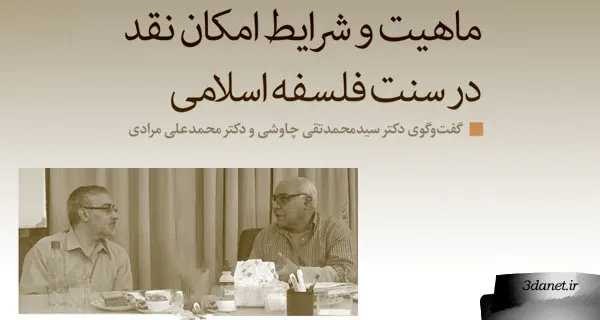
The central question of this session is the nature and conditions of possibility of critique as thought within the tradition of Islamic philosophy. The invited professors hold serious disagreements on these two axes. On the one hand, Dr. Moradi considers critique as thought to be a continuous questioning and even a kind of anarchy, and believes its formation depends on transforming the “I” present in our intellectual tradition into a transcendental “I.” Dr. Chavoshi, however, sees critique as the disclosure of thought according to the destiny of the age, for example in the philosophy of a philosopher like Mulla Sadra, and limits the formation of thoughtful critique to the removal of thought in our culture as an obstacle of “contempt,” believing that the age of critical reason has not yet arrived for us.
Soureh:
Let us begin the discussion with whether there has been anything called critique in Islamic philosophy or in the other modes of thought that have existed in our tradition.
Dr. Moradi:
The concept of critique came into being from the Kantian era onward and is a new concept, constituting a major event in human thought. The world of thought is divided into before Kant and after Kant; that is, the process that took shape in Descartes, and even had its roots in the Middle Ages, advanced until it reached its peak in Kant. Kant said that the subject wants to rebuild the world anew, and that we do not adjust ourselves to nature, but rather nature adjusts itself to us. Without this subject, the concept of modern critique is not possible. That is, when reason reaches the point where it understands it is finite, criticism in the Western tradition takes shape, and the critic in the new sense becomes a very powerful school in the West. The word critic, which is translated as assessment or precisely the term critique, stands in opposition to dogma. Dogma means there is a reality outside, and the mind takes a picture of it and reproduces it exactly. But in our philosophy, a tradition of critique has existed. Because in our intellectual tradition, there exists an “I” that wants to have spontaneity, like Dr. Ha’eri Yazdi, who says our “I” is a performative “I.” But the issue is how critique can organize this “I” and transform it into a transcendental I. This will be the greatest project that, if Islamic philosophy wants to be present in today’s world, it must pursue. Islamic philosophy must focus on the “I,” because without the “I,” the critic is not possible. This “I” must be able to stand here, in the heart of this very civilization, and find itself and its own horizon. For this, we need a “critical turn,” meaning we must reread and reconstruct concepts and lay their foundation in a different way. But this matter faces certain crises. Because many people, especially since the revolution, constantly attack the subject, while the subject fundamentally has a theological and metaphysical aspect. Of course, Heidegger and his followers have also criticized the subject and speak of this. Hence, we must see if we can also give ontological dimensions to the discussion of the subject. This is, of course, a difficult project, but we should not, just because Heidegger said so, attack the subject from now on, as the students of Dr. Fardid have been doing for years and have reached a dead end. Rather, we must go back and see what our question is. We are in a situation where we both want to go through our era of consciousness and know that the subject has limitations, and therefore we need an ontological discussion. Thus, how the question of the subject can be combined with ontology to create the possibility of a highly flourishing current of critique in the tradition of Islamic philosophy and the opening of new horizons is a project that requires great concentration. It can almost be said that no one in Iran is pursuing this issue, because its prerequisite is that the primary texts be read first, and after that, critique will begin.
Dr. Chavoshi:
First, let me make a few points about Islamic philosophy. I do not think like those such as Ian Richard Netton who claim that Islamic philosophy has a different structure—that is, they are structuralists—but I believe that with Islamic philosophy and with the city (medina) that took shape in al-Farabi and its difference from the Greek polis, the culture and history of the Iranian-Islamic human being began. I emphasize that the Iranian-Islamic human being, the human who lives in this culture today, is not Iranian on one side and Islamic on the other, but was formed in a simple, not composite, manner. The beginning of the culture and history of the Iranian-Islamic human being, from the moment it found its philosophical face, goes back to al-Farabi’s city. Al-Farabi’s city is not an ideal or utopian matter, but a formative one, meaning the Prophet is now present in the form of the Imam. This means the city’s coherence depends on a single individual, namely the Prophet, and the rest are subordinate to his existence. Hence, here guardianship (wilaya) will be understood more easily than any other mode of thought, and speaking of democracy and the like is beating the air for the Iranian-Islamic human being, because this human understands guardianship and the Prophet very easily and also sees himself as a citizen of the virtuous city. Islamic philosophy is by no means a commentary on Greek and Neoplatonic philosophy, but a philosophy with its own foundations. Of course, since every metaphysics has a relation to Greece, Islamic philosophy also has a relation to Greece. With a great leap, we turn to Husserl. In the Crisis treatise, Husserl speaks of two cultures, European and non-European. He mentions a very complex synthesis of five characteristics for European culture, one characteristic of which is being critical, meaning its reason is critical reason and constantly critiques itself. Non-European culture lacks this characteristic (though he includes Japan in European culture and holds that Japan also possesses this reason). Being critical means a reason that delineates its own domain and the domain of its appropriation, subjects itself to critique, and for which there is no red line. The next point, which I think is the crux of the discussion, is that when we want to speak about critique and Islamic philosophy, we must speak of the relationship between critique and thought. Critique means the destiny of thought, and the destiny of thought means critique. Critique, in the literal sense, means to become manifest, and its verb is intransitive. Becoming manifest means that reason or thought becomes manifest, and we cannot prescribe for reason or the human being that from now on we shall have a critique of reason. In fact, this is a matter tied to time. Derrida, in his essay critiquing Foucault (Cogito and the History of Madness), says how can one write about madness in the language of critique and order, because until we are in the epoch of something, we do not find its language. We, too, now lack language, and whatever we say has no rule or foundation. This confusion that exists in our language is a sign that our language has not yet found its own time. For us, the time of critical reason (assuming we claim we will reach such a state or dictate that we must reach it!) has not arrived, and pursuing it is akin to pursuing questions that were never questions for us. And by posing them, we have distanced ourselves from what could be our questions and concerns. For example, Heidegger poses the question of truth and raises the inquiry into truth, but in our intellectual system, whether in Islamic philosophy or in Ibn Arabi’s theoretical mysticism, there is absolutely no inquiry into truth. We still try, by presenting this inquiry to Sadra’s philosophy, to find an answer for it. The human being who lives in this culture thinks in advance that he possesses the truth, and one who thinks he possesses the truth has no inquiry into truth. In Husserl’s terms, this critical reason is also present in Descartes, so why do we say critical reason came into being and reached its peak in Kant? In the preface to the Critique of Pure Reason, Kant defines critique as decision, by which he means the decision of reason. The decision of reason to become manifest and to determine its own domain, so that through that domain it may determine the domain of the human being and the world.
Soureh:
Has there been in our tradition something of the nature of delimiting reason, for instance, in order to make room for faith or to determine the relation between religion and philosophy? Since we seemingly see something like a critique of reason in our philosophy. If you do not consider philosophy to be critical, that is, if philosophy cannot inherently be critical, then what is that which exists in Islamic philosophy and apparently resembles critique?
Dr. Chavoshi:
No. It does not exist in our philosophical tradition. Of course, at the beginning of Ibn Fanari's Misbah al-Uns, nine arguments are presented in refutation of reason. But this is not about opening up a space and realm for faith. (Although Kant's meaning of faith was also faith grounded in reason and within the limits of reason.) In mysticism, there was a conception of philosophical reason and they argued against it. Among the philosophers, too, there is no sign of the critique of reason in this sense. The emergence of Western critical reason is in Kant and belongs to the modern period. But as for the second part of your question: since every metaphysics is like this, and philosophy appropriates all thought for its own benefit, believing that outside the philosophical and metaphysical space there is no thought at all, critique is also shaped by this thought. Critique is the destiny of thought itself, that is, the unveiling of thought, and whenever its own era and time begins, critique also begins; meaning critique is not a tool in our hands that we might wish to introduce from somewhere. In Kant himself, too, critique is not a tool, and indeed, if Kant's thought as a whole views cognition in an instrumental way, critique within it is not separate from reason but is rather the critique of reason itself. This is an inherent characteristic of reason, albeit a reason that Husserl calls European reason. In our intellectual space, and in general, critique means the destiny of thought, and the destiny of thought means the being-critiqued of reason and thought, and if its time arrives, thought unveils itself spontaneously; it is not in the hands of you and me, nor a matter of command, will, desire, or wish.
Dr. Moradi:
I also think that Husserl and his like were very Eurocentric, and the critiques of Heidegger and others against them are precisely that the universalism present in Husserl and others has many limitations. For this reason, my view is that we do not know Islamic philosophy and our own civilization at all; rather, Westerners have formulated it for us, and we merely repeat them. That is, even the premises of those who wanted to break out of the Western tradition were Western premises. So first we must be able to draw on phenomenological tools and set aside all the judgments and concepts that Westerners have written about us, so that we can find an
ظاهراً اختلاف اینجاست که شما از تقدیر عقل و تفکر صحبت میکنید و آقای دکتر مرادی از یک پروژهی سوژه محور صحبت میکنند که تبدیل سوژهی پرفورمنس به سوژهی استعلایی است و میتواند یک پروژهی فلسفی باشد. اگر نقد را به عنوان تقدیر و آشکارشدن عقل و تقدیر تفکر در نظر بگیریم، گویا الآن این ظهورات خیلی درخشان نیست و اگر ظهوری هم دارد و آشکارشدنی است، خیلی کم فروغ است. بنابراین کجا باید دنبال ظهورات عقل باشیم؟ در واقع این عقل انسان ایرانی اسلامی که ظاهراً از دورهی فارابی شکل گرفته، الآن چنان بروزی در ساحات مختلف زندگی او ندارد و به یک بیان، انگار خودش دچار بحران است. این بحران و کمفروغی ما را به ساحتی میکشاند که آقای دکتر مرادی میتواند از پروژهای صحبت کند که به تعبیر خیلی بدش، نجات عقل است.
دکتر چاوشی:
ابتدا عرض کنم دترمینیستیک و جبری بودن مدنظر بنده نبود. اتفاقاً تفکر دترمینیسم، تفکر دورهی مدرن است و از دکارت و گالیله به بعد تفکر دترمینیسم در مقابل علیتمحور شکل میگیرد. تفکر علیت محور تفکری است که به عالم کیفی نگاه میکند و دترمینیستیک بودن یک نگاه کمی است که به دنبال قوانین برای طبیعت است و پای قوانین وسط کشیده میشود. چنانکه قبل از دورهی مدرن قانونی به آن معنا نداریم و در دورهی جدید است که بحث قوانین مطرح میشود و آنها را با محاسبات ریاضی حل و فصل میکنند. اوج این قانون- محوری، تفکر هگل است و بحثِ فاهمه و نیرو که در آنجا قانون به صورتِ ذاتِ امور ظاهر میشود. به کار بردن دترمینیستیک در مورد تقدیر به گونهای مبهم میشود، مگر اینکه فقط معنی لغوی آن که موجبیت است را بیان کنیم. اما مراد این است که تقدیر تفکر فقط میتواند موانعی داشته باشد. اگر از چیزی چونان تفکر سخن میگوییم، همواره به یاد داشته باشیم که ما در تفکر هستیم و هرچه تلاش کنیم در جایگاهی بایستیم تا امکان پرسش از تکفر داشته باشیم، نمیتوانیم چون ما درون تفکر هستیم. چطور میتوان از تفکر فاصله گرفت و راجع به آن نقادانه برخورد کرد. تفکر فضایی است که انسان دورهی جدید و اسلاف و اَخلاف آن و همهی عالم در آن تنفس میکنند؛ نمیتوان تفکر را پیش روی نهاد و آن را نقد کرد. البته این سخن را راجع به اقسام تفکر عرض نمیکنم، راجع به فلسفهی اسلامی یا فلسفهی غرب و تفوق فلاسفه اسلامی بر فلاسفهی غرب یا بالعکس میتوان بحث کرد. اما وقتی در فلسفهی صدرا وارد میشویم و میخواهیم از نقد آن صحبت کنیم، نقد یعنی همان معنای عامیانهی نقدشدن، یعنی آشکارشدن. کار نقد آشکارکردن خود امر و خود تفکر است. یعنی برای نمونه اگر از صدرا بخواهید راجع به نقد صحبت کند، میگوید همهی فلسفهی من نقد است. تفکر در فلسفهی صدرا نقد شده و ما هنوز ذیل همان تفکر تنفس میکنیم، یعنی ذیل تفکر دورهی صفویه. البته اگر گفته شود اتفاقات جدیدی رخ داده و یکسری چیزها وارد فرهنگ ما شده و در آن هضم گشته، شاید دلیلی بر آماده شدن جهت رقم خوردن یک دورهی دیگر است. اما بنده که از اهالی علم نیستم که پیشبینی کنم و بگویم آینده چه خواهد شد و از آنِ کیست.
سوره:
این فکری که به بیان شما باید بیاید، نشانهای برای دیدهشدن و فهمیدهشدن ندارد؟ دکتر داوری میگوید: برای دیدن نشانههای آمدن عالم جدید و فکر جدید، شعرها را نگاه میکنم که نشانههای آن را ببینم. به نظر شما آیا نشانههای فکر جدید را میتوان در جایی دید؟
دکتر چاوشی:
بنده نشانههای آن را نمیدانم و با آثار و نظرات دکتر داوری به خوبی آشنا نیستم، اما آنچه میتوانم بیان کنم این است که ما فقط میتوانیم موانع تحقق یک تفکر را برداریم و فکر میکنم عمدهترین مانع در فرهنگ ما «تحقیر» است. آینده دستِ ما نیست و من نمیدانم آینده چطور خواهد شد. البته تحقیر به عنوان یک امر روانشناختی نیست، بلکه تحقیر به معنی تثبیت حال است. انسانِ فرهنگ ما مدام به فکر این است که حال فعلی خودش را تثبیت کند. در واقع کسی که تحقیر میشود، انسانی است که به آینده توجهی ندارد و حضور آینده را در حال خودش دنبال نمیکند، بلکه تلاشش در این است که همواره حال فعلی خود را به دیگران نشان دهد و خود را ثابت کند. در این فضا، امیدی برای انسان نمیماند. انسان فرهنگ ما انسانی است که از تحول واهمه دارد؛ یا شاید بهتر است بگوییم امکانِ تحول ندارد.
سوره:
Given what we know of your (Dr. Moradi’s) previous discussions, it seems that, broadly speaking, you enumerate a set of cultural foundations for the realization of the critical intellect. Please explain the conditions for its realization and the cultural obstacles that prevent the critical intellect from coming into being.
Dr. Moradi:
The discussion of cultural conditions and the topics that scholars such as Dr. Mosleh or Dr. Davari raise about culture does not, in principle, belong to us. Because culture, in terms of terminology, stands in opposition to metaphysics. That is, culture emerged when they no longer wished to discuss things metaphysically. Metaphysics meant proceeding from a single principle and deducing all other matters from it. The Greeks were the only people who stood upon a principle and foundation (Prinzipien), and we, following them, reconstructed metaphysics. But from a certain period, figures like Nietzsche rejected the existence of a principle and posited a space, field, or domain for thought, saying we cannot clearly determine a principle. Then a school called culture emerged, which reads philosophy and metaphysics within the context of culture. But in our philosophical discussion, within the metaphysical tradition, what does it mean that culture does not permit us to critique? Philosophy is not very mysterious. Philosophy had certain foundations, and now we want to replace them with other foundations. Of course, I distinguish between philosophy and thought. For over the past hundred years, we have found a new life in which people want to live relying on their own reason. Therefore, they no longer derive their foundations from theology, and we are compelled to begin philosophical discussion from elsewhere. This is the lesson Heidegger taught us: that we must start philosophy from this very life and philosophize the various affairs of our life. Hence, I do not argue from an identity-based perspective and do not say we must return to tradition; rather, in my own formulations, I use the term “Islamic-Iranian-contemporary” and do not emphasize only the Islamic-Iranian. Now, if we want to make this issue mysterious, nothing will be gained for us in this mystification. We cannot recklessly use new tools and technologies that did not exist in our tradition, but then, when it comes to the discussion of establishing a self-founding reason, say that this is a Western matter.
Soureh:
So the conditions you set forth as conditions for critical thought are logical conditions, not cultural ones, and in this sense, culture is the subject of our thinking, not its condition. In fact, to attain this mode of thinking, we cannot set any cultural conditions.
Dr. Moradi:
As I said, culture wants to say that one can no longer think metaphysically; therefore, I do not use culture in its colloquial sense. Now, if our discussion is within the tradition of the subject, one can no longer discuss culturally, because the subject is metaphysical. Of course, I myself may not discuss metaphysically at all and may discuss within the cultural domain, but my question for Iranian society is a metaphysical question. My concern was how our metaphysics can be reconstructed again. That is, the fundamental question is, considering that we had metaphysics from Farabi to Mulla Sadra, how has this metaphysics been damaged? In fact, one of the currents that attacked this metaphysics is the Fardid circle and his students, who, instead of reconstructing our metaphysics, attacked it.
Dr. Chavoshi:
I think Dr. Moradi has taken culture in an anthropological sense, or in the sense of discussions raised in sociology. Whereas in a book like Gadamer’s Truth and Method, he speaks of “Bildung” as a humanistic term, and I translate “Bildung” as culture. Of course, various meanings are used for culture, but what I mean here is “adab” (cultivation/literary refinement). In the Phenomenology of Spirit, when you enter the discussion of self-consciousness, the discussion of culture is raised in relation to the periods after the Greeks. But when Hegel speaks about the human being, he considers the human being a cultural-historical entity, and Heidegger does the same. This cultural-historical being is the human being’s cultivation in the general sense (the general sense of “adab” is found in the Dehkhoda Dictionary, etc.); in the sense of refinement, bravery, art, courage, and all the concepts that can be called the “adab” of a people.
Dr. Moradi:
But one of Gadamer’s and Heidegger’s quarrels is with the Hegelian concept of Bildung. Bildung means internalizing something from outside. In this sense, Bildung is subject-centered, because the subject is defined by the inner and the outer. This most important aspect of the subject took shape from the time of Augustine, who said: “Do not go outward; return within. Truth dwells inside you,” and this was the beginning of subjectivity. But Heidegger, influenced by Burckhardt and the Basel school, said that culture in Greece did not have Bildung but rather Paideia. In Burckhardt’s view, religion and the state are static, while culture is dynamic; therefore, culture separates itself from Bildung, metaphysics, and theology. In other words, Bildung and subjectivity have greater theoretical harmony with someone who wishes to be religious than with culture. On the other hand, since life today has become subject-centered and Westernized, I believe we must begin with the instances of life and philosophize them.
Dr. Chavoshi:
In the preface to the Phenomenology of Spirit, Hegel speaks of the spirit that undergoes Bildung, that is, forms and cultivates itself, and the entire Phenomenology of Spirit is precisely this. That is, it is the cultivation of modern man and shows what kind of cultivation this man possesses. But I want to say that Bildung and Paideia are different. Paideia is close to the concept of futuwwa among us, while Bildung is a humanist term that you can see from Farabi to Sadr al-Muta’allihin, meaning the atmosphere is entirely metaphysical, and there is absolutely no theological atmosphere defending religion in it; indeed, Sadra’s philosophy is prior to religion, and it is precisely within the realm of Sadra’s philosophy that religion finds its meaning. The second point is that if the discussion is about types of thinking, perhaps one could speak about types of thinking in such a way as to prescribe instructions for them and say what tasks must be done in relation to each. But the discussion is about thinking itself. Of course, when you speak of thinking itself in the realm of metaphysics, every metaphysics claims to speak of the ultimate truth within its own philosophical system. Therefore, when we want to distance ourselves from philosophical systems and speak about them, will we ourselves be situated in a philosophical standpoint or not? If we stand in another philosophical system, for instance, Kantian philosophy, and observe what other philosophers have said, our critique will be based on principles. But if you believe that we happen to stand where no metaphysics exists, this is the very first point of contention: where do you stand that no metaphysics exists! Thus, when we are still thoroughly within Sadrian thought, we cannot have a critique of Kantian thought or anything else, except a critique based on principles. But if you want to change the “I” present in Sadra’s philosophy, that “I” is the manifester of the world. Towards the end of Sadr al-Muta’allihin’s book al-Mabda’ wa’l-Ma‘ad, there is a phrase that we can read both as “the human being is the locus of manifestation (mazhar) of the world” and as “the human being is the manifester (muzhir) of the world.” In his book Mafatih al-Ghayb, there is also a phrase that says whatever the human being sees in the world, he sees it all in the core of his own existence. The human being has the status of the manifester of the world, and does metaphysics ask anything more of you than this? I believe that we still view things in a Sadrian way, and regarding thinking itself, critique in the sense of a critical outlook and method is impossible; because critique is contingent upon the arrival of its time, and until the time of its emergence—which is again brought about by thinking—arrives, such a possibility will not exist. Critique in the sense of the emergence of thinking, and thinking qua thinking does not fall into the hands of you and me. If you return to yourself as well, the very first questions place you in the realm of thinking, meaning we cannot stand outside of thinking; we are always within thinking. But if the discussion is about types of thinking, and metaphysics is one of the types of thinking, then you too stand in one of the types of thinking, and all your critiques will be based on principles; now, what meaning does a critique from one set of principles to another set of principles have? Other than that one person considers Kant to be right and another considers Sadra to be right. However, the project that Dr. Moradi introduces is that we must move from a situated subject here to a transcendental subject. But I truly do not know whether we can provide an instruction to think transcendentally and move toward the transcendental subject or the metaphysical subject, and see the path to salvation in that.
Dr. Moradi:
I am not prescribing anything; rather, this is my intellectual project. None of the philosophers have said that we want to save humanity. Kant said: metaphysics was until yesterday the queen of the sciences and today has fallen into misery, so I will write another metaphysics. Fortune favored him, and he was able to have an influence. The philosopher can free himself from whatever he is attached to. He can say, “I” begin the world. Thus, the beginning of philosophy is with the beginning of the “I.” Now, some in the West consider themselves on Kant’s level and also critique Kant. But in Iran, they say, where are you and who are you to want to critique, for example, Mulla Sadra?
Soureh:
Dr. Chavoshi’s point was that apparently it is not possible for us to transcend this culture, and if this were to happen, each person, based on their own foundation, would find fault with the other person’s foundation. Our understanding of your discussions, Dr. Moradi, is that your base is Neo-Kantian discussions or critical philosophers, and you have adopted such a foundation and, based on it, you put forward your claim regarding the subject and transformation in the philosophical tradition. But in contrast, someone could also stand on the foundation of Mulla Sadra and reject all of your views.
Dr. Moradi:
Look, philosophy is different from the philosopher; philosophy is an institution and it helps society. Allameh Tabatabai correctly understood that the world has changed and we can no longer reconstruct the old world. Now, if we are to have a philosophy, we can create theoretical foundations for it exactly, and theoretical foundations mean being able to discuss conceptually. Therefore, the institution of philosophy in Iran must be shaken up, and we must be able to reread all philosophers, including Western philosophers like Kant and Hegel, within our own tradition. How can Farabi reread Aristotle, but I cannot reread Kant and Hegel in this tradition? So, I did not speak of the institution of the philosopher, but of the institution of philosophy. The institution of philosophy exists everywhere, and within it, they constantly debate with one another, and the very essence of philosophy is this debate. Now, if these discussions do not take place within a conceptual framework, they turn into malice and enmity and destroy civilization. Of course, in philosophical discussion, we do not want to reach a specific conclusion, and we cannot predict the future of the discussions, but we can advance our theoretical foundations through serious debates. This is humanity’s only path, and humanity has no other way to reduce its violence. Westerners resolve all their crises in philosophy and, like the phoenix, rise from their crises. In other words, philosophy is a cure, and problems can be solved through it.
Soureh:
In that case, through what means does critical philosophy or the institution of philosophy take shape?
Dr. Moradi:
First, texts must come into being, so that an institution can subsequently take shape. We must be able, in a specific process, to write several fundamental books and train suitable students for this task, so that an institution can form from them. In the West, too, the institution of philosophy has formed around certain essential books, and civilization essentially forms around the book. This is while in Iran’s university system, they do not teach various methods and approaches to reading texts, so that gradually one could read essential texts differently and critique and reconstruct them. Whereas there is a truth in texts that can be found over time through rereading and critique. This requires that the “I” courageously say, I can critique.
Dr. Chavoshi:
You see, we have a problem with each other regarding the meaning of philosophy and critique; we are far apart on the meaning of metaphysics and thinking. When a philosopher emerges in Islamic philosophy, he is in fact the critique of his own era. This does not mean the cessation of thinking; there is the human being and there is thinking, but we look at this world in a certain way based on the destiny of thinking, and this is one kind of looking at this world. Thus, critique takes shape within the philosopher's philosophy. That is, the philosopher has stood where he must stand, and we are not there, for we are not philosophers. Writing books and philosophical texts is not a matter of decree, nor is it possible. The point is precisely that Farabi stood and resided in a place where he could pose questions, and we are not yet in that position. Our difference from the philosopher lies precisely in this. It is not a matter of dignity, rank, or greatness; it is a matter of the relation between time and thinking. Farabi lived in Farabi's time, just as you and I and Mulla Sadra live in Mulla Sadra's time.
.
.
PDF file of the conversation between Dr. Seyyed Mohammad Taqi Chavoshi and Dr. Mohammad Ali Moradi
.
.
The Nature and Conditions of the Possibility of Critique in the Tradition of Islamic Philosophy
A Conversation between Dr. Seyyed Mohammad Taqi Chavoshi and Dr. Mohammad Ali Moradi
Article Source: Soureh Andisheh Monthly Cultural-Analytical Magazine, Issues 86 & 87, Mehr & Aban 1394
.
.


Discussion0 comments
No comments yet; let yours be the first voice.