Philosophy
The Fusion of Horizons: A Conversation with Mohammad Zaimaran on Gadamer's Hermeneutics
Understanding in Gadamer's hermeneutics is an ontological event that takes shape through a question-and-answer dialogue with the text. The conversation with Zimaran explores Gadamer's intellectual debts to Heidegger, Plato, and the German cultural milieu, and the formation of his phenomenological approach.
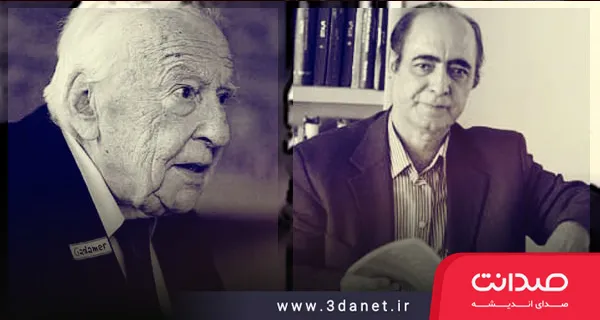
Understanding is an occurrence or event that comes about for the interpreter. Such an ontological approach to understanding belongs to Gadamer. This approach, which is based on a dialectical relationship, is always accompanied by question and answer. This question and answer in Gadamer's hermeneutics is the same as the dialogue in Plato's philosophy. The interpreter poses their questions from the text, before the text, and receives answers from the text commensurate with that question. No end is conceivable for this question and answer. The present conversation, conducted with Dr. Mohammad Zaimaran, is devoted to Gadamer's hermeneutics. Dr. Zaimaran has so far published the books: "Michel Foucault: Knowledge and Power," "Derrida and the Metaphysics of Presence," "Nietzsche after Heidegger, Derrida and Deleuze," and "The Transition from the World of Myth to the World of Philosophy." We read this conversation:
* Sometimes we consider thought insofar as it is thought, and sometimes we consider thought insofar as it is a reflection of social, cultural, and economic factors and backgrounds. Although thought must be examined and criticized independently, its backgrounds are effective in our knowledge of that thought. With this explanation, what event in Gadamer's life do you consider worthy of reflection?
- After the end of the First World War, when Gadamer graduated from the University of Wrocław, he sought to choose which field to pursue for research and study. Since his father was a researcher in the empirical sciences, he believed that the knowledge obtained from textbooks was not very important; rather, what was obtained in the laboratory was worthy of research and investigation. With this family background and under the influence of the environment, Gadamer developed an inclination toward the natural sciences, but he was not very successful in this field. On the other hand, he found the talk put forward by professors in the social sciences and humanities to be hollow; after a while, he studied history and then turned his attention to philosophy. After some time, he developed an interest in art history, but one of the issues that shaped the direction of Gadamer's thought was his family circumstances. Heidegger grew up in a Catholic family where his father was a member of the church, but Gadamer grew up in a Protestant, bureaucratic, and academic family.
* One of the important books of the era in which Gadamer lived was Spengler's "The Decline of the West." Was Gadamer also influenced by such intellectual contexts?
- First of all, he was influenced by Paul Ernst, a critic of the German Idealism school. After him, Oswald Spengler's book "The Decline of the West" was inspiring for him. In his youth, he studied Theodor Lessing's "Europe and Asia," but it was not long before Lessing was the target of an assassination attempt and was killed. His writings on Asian wisdom were highly instructive for Gadamer; the writings of Thomas Mann and Hermann Hesse also deepened his view of life. Richard Hönigswald acquainted him with the critique of psychology. Karl Barth, Nietzsche, and Dilthey were other thinkers who shaped his approach to philosophy and thought in general. During this same period, he read Dostoevsky's novels, including "The Idiot" and "Crime and Punishment," and later the letters of Vincent van Gogh and Kierkegaard. At this time, the writings of Rabindranath Tagore came into his hands, and through reading them, he gained access to the treasury of Eastern wisdom. The theology of the Quakers, a Protestant sect, directed his attention to the principles of human rights and philanthropy. His teacher Nicolai Hartmann introduced him to the philosophy of Plato. Paul Friedländer deepened his information and knowledge regarding Plato's philosophy. At this time, he became acquainted with Husserl's philosophy, but most important of all was the influence of his teacher Heidegger on his thought and approach to philosophy. It was evident that Heidegger taught him a fresh view of Plato, Aristotle, Plotinus, Eckhart, Nicholas of Cusa, Leibniz, Kant, and Hegel, and for the first time acquainted Gadamer with these thinkers through a phenomenological approach. He compiled what he learned from his teacher Heidegger in a book titled "Heidegger's Ways."
* The social and cultural-scientific conditions of that period in Germany, including intellectuals and certain specialists on Nietzsche, Plato, and Kant, played a role in shaping Gadamer's thought. How do you assess this influence?
- The most important of these was Thomas Mann in his famous treatise, Reflections of a Nonpolitical Man. During his time in Marburg, he was introduced to the ideas of Humboldt. Later, he became acquainted with Karl Barth's Commentary on the Epistle to the Romans. He then turned to the thoughts of Wilhelm Dilthey and Ernst Troeltsch. It was during this same period that he became familiar with the poetry of Stefan George. It was at this time that the books of Friedrich Gundolf attracted his attention. In this same period, he studied Ernst Bertram's interpretation of Nietzsche's approach. The new interpretations of Kierkegaard's thought in Germany drew Gadamer's attention to the question of truth from the existentialist perspective, particularly the book Fear and Trembling and the treatise Either/Or, which found widespread resonance in the challenge to Hegelian dialectic among German intellectuals. In general, the Marburg school of philosophy put forward a particular Nietzschean aspect. In Marburg, the shining star of philosophy, Paul Natorp, aroused everyone's attention to the importance of studying Plato in the original Greek. Natorp analyzed Plato with a neo-Kantian approach. One might say that Gadamer's attention to Plato and his writings was itself a result of Natorp's insights. It is interesting to note that at this same time, Max Scheler came to Marburg and turned the phenomenology of love, as his central motif, into a controversial subject among philosophy students. It was in such an atmosphere that Gadamer completed his doctoral dissertation at the age of twenty-two in 1922 under the supervision of Nicolai Hartmann and Paul Natorp. The subject of the dissertation went back to Plato. In 1923, encouraged by Edmund Husserl and Heidegger, he went to Freiburg, but in 1924, following Heidegger, he returned to Marburg.
* Was it during this period that he opposed Natorp's neo-Kantian interpretation?
- As Gadamer drew closer to Heidegger, he criticized his two important teachers, Nicolai Hartmann and Paul Natorp, in an article. He accused the former of naive objectivism and the latter of totalizing system-building. In 1928, while publishing an article in the famous German journal Hermes, he published a critique of Werner Jaeger's theory. This article made Gadamer famous in philosophical and philological circles.
* To what factors should Gadamer's attention to Heidegger be attributed?
- Gadamer's interest in Heidegger has a long story. But in his own words, the reason for the pull towards Heidegger was that he thought Heidegger had provided a philosophical answer to the pressing questions of the contemporary era. Heidegger taught his students how to pose questions related to the problems of the time by engaging with historical thought. Gadamer says Heidegger taught his students how to confront tradition, and it was for this reason that he made the thought of the Greek philosophers the basis of his analyses. Gadamer says Heidegger's Greek interpretations had enchanted his students and followers. In fact, Heidegger was the first to propose the project of deconstructing Greek metaphysics. He also applied this same approach to the reading of Christian theology. It is interesting to note how heated and provocative Heidegger's discussions were. While his philosophical colleagues and peers were discouraging students about the issues of the day with their neo-Kantian and Hegelian perspectives, it was Heidegger who, by employing the philosophy of Aristotle and Plato, caused the transcendental idealism dominating German academic circles to lose its currency. He said that by reflecting and scrutinizing the thought of the pre-Socratic Greek philosophers, one could discuss and debate the pressing problems of this era. The Greeks are capable of teaching philosophical creation to us twentieth-century thinkers. One of the most important Plato scholars of this period, Julius Stenzel, taught us the secret of the Platonic dialogues. He said that by studying Plato, we Germans would be able to prevent the excesses of subjectivity. This position was also compatible with Heidegger's statements.
* What about practical wisdom? Did Gadamer learn this from Heidegger?
Gadamer learned from Heidegger that Book Six of the Nicomachean Ethics is of particular importance, for in this chapter he became acquainted with two concepts: practical wisdom in general and prudence (Phronesis) in its specific sense. Heidegger carefully examined the link between phronesis and techne. He connected prudence and practical wisdom with conscience, and it was on this basis that Heidegger outlined the will directed toward conscience. It was here that we all learned anew from Heidegger the relationship between dynamis, potentiality, and energeia in Aristotle's philosophy. During this same period, Gadamer felt that he should study Greek culture more deeply under the guidance of the renowned philologist and Plato scholar Paul Friedländer. Thus, he also studied the brilliant figure of Pindar under his teacher Friedländer and even wrote a short treatise about him. Gadamer's first book, which was a summary of his doctoral dissertation and his habilitation thesis, was titled Plato's Dialectical Ethics.
In this book, he addressed the philosophy of Plato and especially Aristotle, and analyzed Aristotle's two treatises on pleasure in the Nicomachean Ethics. In fact, in this work, he examined the Aristotelian concept of pleasure in light of the discussions raised in the dialogue Philebus and analyzed the major differences between the thought of Plato and Aristotle regarding art and beauty. By employing Husserl's phenomenological method and Heidegger's existential hermeneutics, he dissected the concept of pleasure in Aristotle and Plato in a new way. Around this time, he met Jacob Klein and learned his mathematical theories; he learned the theory of numbers and especially the doctrine of algebra from Klein. In 1933, he wrote his famous essay
It was at this juncture that Gadamer, alongside figures such as Wolfgang Bartuschat and Rüdiger Bubner, together with Theo Ebert, Heinz Kimmerle, and others, engaged in research and teaching. Meanwhile, students from other countries also came to Germany to study philosophy; from Italy, one can name Gianni Vattimo and Valerio Verra. From Spain, Emilio Lledó also benefited from Gadamer and his classes. What occupied Gadamer in the years following the Second World War was the philosophy of hermeneutics.
* Gadamer officially retired from his university position around 1968 and from that time began his philosophical travels as an itinerant philosopher. How do you assess this period?
- It was at this time that he accepted an invitation from Vanderbilt University in America and began a seminar there on Schleiermacher. From this period, he became deeply interested in Anglo-Saxon thought and literature. To strengthen his English, he studied the works of T. S. Eliot, William Faulkner, Yeats, and Wallace Stevens. At the same time, he sought to build a bridge between continental philosophy and analytical philosophy, and shortly after completing the book Truth and Method in 1960, he studied the later Wittgenstein and found many commonalities between his philosophy and hermeneutics. Gadamer claims that in the early twentieth century, concepts and conceptual language in general gradually underwent an unprecedented transformation, and the project of phenomenology changed the meaning of the Concept, in the sense that the Concept was no longer considered a tool for cognition. Rather, it itself became the subject of philosophy. It is this very orientation toward the concept that transforms Being into essence and then into concept. In the realm of the concept, existence and essence find unity; this current and transformation can be clearly observed in the German word Inbegriff. Heidegger is perhaps the first thinker who, in light of the technique of deconstruction or Destruktion, sought to deconstruct the foundation of the concept and place it in brackets. It was Heidegger who first clarified the conceptual character of philosophy for his students, including Gadamer. He borrowed the term "formal indications" from Kierkegaard and, in light of it, raised the phenomenological problem of the essential emergence of things. It was here that Heidegger extracted language from its instrumental interpretation and gave it an existential character. Here, Gadamer considered the connection between Heidegger's philosophy and Wittgenstein, and realized that when, as Wittgenstein says, we open our mouths to speak, we find ourselves in the realm of words; that is, words do not become objects: language is the arena in which we continue to live. It is for this reason that Heidegger considered the primary task of philosophy to be the deconstruction of words. Heidegger learned the phenomenological analysis of concepts from his teacher Husserl, hence he paid attention to the history and lineage of words. It is here that Heidegger emphasized the linguistic dimension of Being, and Gadamer, in his book Truth and Method, pursued this same motif.
* Gadamer produced his most important work at the age of 60 with the publication of the book Truth and Method. The three main subjects of this book are aesthetics, language, and history. Was the selection of these subjects made with a specific purpose?
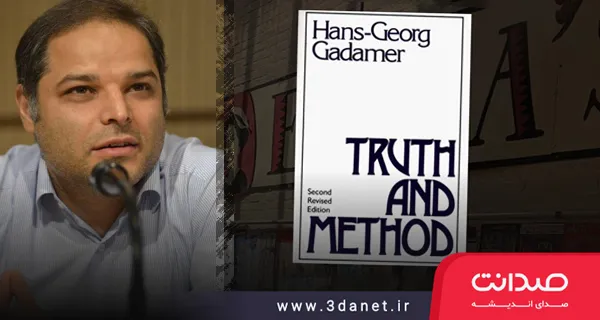
- In general, one can say that Gadamer's book Truth and Method is comparable to the three sides of a triangle. That is, at the apex of the triangle lies the axis of understanding, at one angle the axis of interpretation, and at the opposite angle its application. This triangle is such that philosophical hermeneutics leads to the claim that, unlike Romantic hermeneutics, it is not oriented toward providing a method like the natural sciences; that is, it should not be considered a methodology of the human sciences, in the sense that its goal is not to devise a technique and art of understanding, as traditional theology sought. Rather, it begins by approaching aesthetic experience and historical tradition. He accused Emilio Betti of such an error. In the 1975 foreword to Truth and Method, Gadamer explicitly stated that the hermeneutics he discusses is in no way a methodology of the human sciences but rather attempts to understand the being of the human sciences beyond methodological consciousness, and to become aware of how the totality of our experience of the world relates to hermeneutical understanding. Hence, in the foreword to the second edition of this book, he says that methodological disputes distract us from the essence and substance of the matter. In his view, there is a deep rift between truth and method. Here, truth must be considered beyond method. Two themes are of utmost importance here for understanding his project: first, Gadamer's aim is to search for the essence and core of the social and human sciences. In fact, the first half of this work analyzes the fundamental concepts discussed by Vico, Dilthey, and other representatives of the humanist tradition, and alongside this discussion, an analysis of aesthetic experience, which has a close relationship with the experience of truth, is presented. The second theme in this book, which constitutes the central discussion of this work and is of greater importance, is how understanding comes about. By examining the concept of understanding and the experience arising from it, he scrutinizes the nature of understanding and claims that this phenomenon itself has a linguistic essence. Therefore, to understand Gadamer's hermeneutics, it is essential to seek the necessary condition for understanding in the realm of language.
It is here that he speaks of the linguistic element, and this factor is closely connected to human understanding and rationality. Hence, he emphasizes that the study of hermeneutics is, in the final analysis, the study of being, and the examination of being is ultimately an aspect of linguistic examination. From this, he concludes that all understanding has a linguistic nature, and therefore, understanding in the realm of the human sciences itself entails the application of language.
*What approaches has Gadamer proposed to clarify his conception of art?
- In preparing the ground for the problem, initially, to clarify the meaning and purpose of the human sciences, he discusses several topics. One is aesthetic and artistic experience, and to demonstrate the essence of such an experience, he refers to the concept of play. He then examines the history of the human sciences, and subsequently, ontology; in his view, the discussion of history places us before modes of experience within whose scope our perception of being is linked to the role of play. The third axis, which is considered the most important factor in Gadamer's philosophical hermeneutics, is the hermeneutic circle. Gadamer did not expand or develop the hermeneutic circle at all, because his teacher Heidegger proved that this circle is not vicious but rather a natural matter, as it does not entail a methodological problem. The formulation of this circle in terms of subject and object is what makes it methodologically vicious. However, this circle has an ontological structure and entails the movement of fore-structures. In his discussion of this hermeneutic circle, he lays the foundations for the theory of prejudice. This concept is another interpretation of Heidegger's doctrine of fore-structure. It is evident that, in Gadamer's view, the concept of prejudice does not entail passive and unconditional surrender to impersonal forces; rather, one must distinguish between productive and destructive prejudices, and one of the tasks of philosophical hermeneutics is to discern and differentiate between the two. The important point in this connection—that is, in philosophical hermeneutics—is precisely the dimension he calls the fore-structures of the past, meaning what we acquire from our predecessors within the scope of our language, and in light of which our consciousness takes on a historical form, a central axis upon which Gadamer has insisted.
*How is Heidegger's critique of objectivity justified? And how is historical consciousness explained from his perspective?
- In general, our understanding of being relies upon and is deferred to this metadata. Gadamer discusses this under the heading of our historical consciousness in Truth and Method. He raised this issue in order to critique objectivity. In a sense, our consciousness and awareness are always constituted within the expanse of history. Thus, historical consciousness itself entails an awareness of the prejudices that pertain to our understanding. Consequently, neglecting this element in the act and process of understanding—a characteristic of the scientific method—will lead to a distortion in our knowledge. In truth, the endeavor of proponents of scientific methodology is to purge experience of any historical factor and to objectify such experience. Evidently, this aspect of objectifying our experience will cause a misunderstanding of the true nature and basis of experience. When the interpreter's historical consciousness enters into a relationship with the text, the dialogue with the text ultimately leads to an encounter whose product is an unprecedented experience that Gadamer calls the fusion of horizons, and this fusion is itself the result of dialogue or conversation.
* Unlike Heidegger's Being and Time, where the "and" between Being and Time creates a conjunction, the "and" between Truth and Method signifies a disjunction, meaning there is always a separation between truth and method. In Gadamer's view, the lived experience of human beings always points to the inadequacy of methodology. What is the basis of Gadamer's argument for this claim?
- Gadamer's primary concern in Truth and Method was to challenge the prejudices of the positivist school and their pride in acquiring objective and scientific knowledge of the phenomena of the world. In his own autobiography, Gadamer explicitly states that the picture of the world presented by the natural sciences was one-dimensional and therefore ignored human cognition and perception of specific experiences such as art, beauty, and religion. Hence, Gadamer sought to remedy this deficiency by composing a work. Especially since, in his view, the methods of the natural sciences are incapable of making all human experiences the subject of their investigation. On the other hand, as practitioners of the natural sciences claimed, truth in its philosophical sense is not attainable through engagement with the natural sciences by relying on empirical scientific methods. Therefore, in the title of his book, he placed method alongside truth with the conjunction "and," and by doing so, he sought to ironically challenge such a claim within the realm of empirical sciences. He himself says that when he read Karl Popper's critique of positivism, he realized that his critique of empirical methods was by no means invalid, and even empirical thinkers and philosophers of science had raised the same point in a different way. Particularly when he studied Moritz Schlick's famous work on the foundations of knowledge, he realized that the claims of positivist thinkers had also been criticized by philosophers of science themselves. Gadamer says he has absolutely no claim to raise an issue within the natural and empirical sciences, and his concern is the human and social sciences. He tried to teach us that we do not have that much command in understanding and perceiving matters, and hermeneutic conditions prevail over us; therefore, any reading and interpretation of situations is itself reliant upon and bound to our thrownness into the world. That is, we must always be aware of our existential and temporal finitude and boundedness so that, through neglect of this finitude, we do not fall into the abyss of hubris, as Socrates put it. Hence, the claim of positivist empiricists regarding the possibility of attaining knowledge of objective and true conditions pertains precisely to this hubris.
* Lived experience is a dimension of being-in-the-human-world that is recognizable only through language, for without language, no experience is realized. The language of which Gadamer speaks is not a formal language but an ontological aspect that plays a significant role in giving identity to the human being. Explain the role and place of language in Gadamer's philosophy?
- In the third part of Truth and Method, Gadamer says: “Being that can be understood is language.” Here he has sought to substantiate the claim of Cratylus, who said that language is perhaps the greatest and most important subject in all of being. Levinas, in interpreting Cratylus’s viewpoint, also said that language is the medium through which we make possible our most tangible connection and contact in ethical life. In general, Gadamer considers one of the main axes of his hermeneutics to be articulable within the realm of language. Without language, hermeneutics is simply not possible. In his view, without the mediation of language, many matters cannot be resolved at all. Even thought cannot be realized without language. Following Heidegger, he reminds us that thought requires language. Therefore, the fundamental pillar and main basis of the hermeneutic approach must be sought in language, and this language evolves primarily within the context of society and, generally, within the realm of dialogue. In a letter dated February 26, 1972, that Heidegger wrote to Gadamer about language, he noted that the challenge of language in human life is a serious and unavoidable matter. Any communication, elucidation, and mutual understanding in the realm of hermeneutics, in his view, is realized in language. It is here that Heidegger points to the necessity and need of human beings for language and considers it one of the most important tasks of hermeneutics. This means that in discussing hermeneutics, the agency and centrality of language must first be established. In all instances, when human beings want to realize their needs, they are compelled to clothe them in words, and articulating them without words is impossible. Heidegger asks Gadamer whether one can speak of a “hermeneutics of words,” then points to the finitude arising from language. It is here that Heidegger refers to Hölderlin’s poetry and the issue of naming, adding that naming constitutes the principal realm of poetry, and this realm must be considered sacred.
* How is Heidegger’s view on the matter of translation explicated?
- In discussing the need for language, Heidegger points to the need for the translation of language, then raises the relationship between language and translation and reminds Gadamer that if you tell me what you think about translation, I will tell you who you are. Gadamer followed this approach of Heidegger’s in Truth and Method and, on this basis, notes that when we say being that can be understood is nothing other than language, what is meant is that what exists cannot be fully grasped. The discussion of language is so important that he claims the words we use in our conversations are so close to us that, in a sense, we live within them; that is, language is the medium in whose realm we continue our lives, and it can be said that language is as necessary for us as water is for a fish. The language that connects us with the other is natural, conventional language. It is obvious that the language of philosophy is not natural language but rather an unconventional one. The language of science is likewise not natural.
* It is due to the nature of language that Gadamer believes truth comes into being not through method, but through dialectics. Dialectics is a basis for dialogue. In fact, dialectics replaces method. What is the nature of dialectics that it plays such a role?
- By dialectic is meant the art of engaging in conversation. But this conversation initially begins with oneself, and thus the individual, in this conversation with himself, attains self-awareness and self-knowledge. This awareness entails the art of thinking. In the sense that one must attain the art of questioning what one intends, thinks, or says. It is here that the individual embarks on a journey. In this journey, there is never a fixed destination, because thinking is boundless. This must be considered the essence and nature of dialectic. Thinking is never content with anything concise, but is rather thirsty for a journey beyond itself. Gadamer, unlike his teacher Heidegger, claims that Plato's dialectic and his theory of Forms are not a prelude to the forgetting of Being; rather, the dialectic of Forms is a journey toward a realm beyond simple and commonplace ideas. The early Plato, in his view, is Aristotle. For this reason, he has based the core of his work and his hermeneutics on Aristotle's doctrine in practical philosophy, particularly in the form of the theory of phronesis. Hence, he has founded the structure of understanding more on conversation or dialogue, which is itself closely related to Platonic dialectic, than on method. In his view, our understanding and comprehension are only possible in encountering the other and in dialogue with him. According to Gadamer, genuine and real dialogue is an encounter in which each party, in pursuit of truth, sincerely places their own existence in the possible conditions of the other party, and through this, acknowledges their own ignorance, fallibility, and error, and implicitly accepts that they dwell in a finite realm and therefore have no grasp of absolute knowledge. Hence, they do not seek to subjugate their opponent but strive to become aware of the various directions and aspects of the subject.
*How does the outcome of conversation or dialogue crystallize in Gadamer's view?
- The successful conclusion of a dialogue is manifested in the understanding and comprehension of the subject and, particularly, in the transformation of the initial positions of the parties. In fact, in his view, dialogue and conversation are an educational process and movement that the parties undertake with the intention of learning and enhancing their understanding. Indeed, it is in dialogue that the horizons of knowledge, understanding, and experience of the parties merge. If we wish to express this same matter in Platonic language, according to Gadamer, the roots of Platonic dialogue lie in the "indeterminate dyad." Plato says that in dialogue, duality becomes unity. In a sense, a certain indeterminate two is a concealedness in unconcealedness. It is this very thing that protects philosophy from falling into the abyss of a rigid methodological theory. In fact, Plato raised this issue under the title of duality, and Gadamer interpreted it through his interpretation of the Theaetetus, the elaboration of which is beyond the scope of this conversation. Heidegger considered this same issue in the form of concealedness and unconcealedness and claims that Being or existence is one, two, or in his own terms, existence is aletheia, which entails one and two. Here he refers to the Socratic experience and claims that the philosophical way of life is directed toward "care of the self" through understanding and comprehension, and this care requires three ontological, dialogical, and metaphorical dynamics. The totality of these three dynamics will bring about arete. Here, Gadamer has employed the Socratic way of life for his own thought and crystallizes hermeneutics in the Socratic experience.
* Gadamer believes that the horizon of meaning is shaped by tradition and the current situation. He locates the determination of the nature of tradition in language and gives linguistic tradition precedence over all forms of tradition. Our consciousness is influenced by tradition and history, but what does tradition mean as one of the horizons?
- Gadamer has explicitly stated that the philosophy of the Enlightenment is responsible for the negative connotations of prejudice and, in general, the givens of tradition. Because, in the view of Enlightenment thinkers, prejudice has two main sources: first, that we fall into prejudice by relying on traditional viewpoints and refraining from the independent use of reason. Second, that hastiness and the non-methodical use of reason trap us in deviation and erroneous thinking.
Therefore, in the transition from ignorance to an objective understanding of a subject, we must employ reason and method in the struggle against prejudice and the authority of tradition. In his critique of this Enlightenment approach, Gadamer explicitly declares that prejudice and the pre-given data of tradition must be considered the precondition for understanding and grasping matters and phenomena. In a sense, he rehabilitates prejudice and tradition, and in this process, he points to three fundamental dynamics: The first step involves employing Husserl's view, to the effect that every understanding of an object entails grasping it as something. In other words, every kind of understanding itself involves a projection of meaning that we impute to our perceptions, and such concepts do not exist within perception itself. Thus, on the basis of experience, we always regard one dimension of a three-dimensional phenomenon as three-dimensional. Hence, it can be said that the perception of anything does not rely solely on the givens of that phenomenon, but our perspective is always imposed upon it beforehand. Gadamer follows this same Husserlian approach and says that prejudice is a judgment or verdict reached before providing reasons concerning something. For this reason, he says that the assumption that prejudice is invalid is itself a prejudice and a bias against prejudice.
The second step: It returns to the structure of the historical understanding of phenomena. Here, Gadamer draws on Heidegger's approach and claims that our interpretive projection is always rooted in our historical situation. If, for example, we analyze Mark Twain's famous novel Huckleberry Finn according to racist stereotypes, this in no way inheres objectively in the book itself; rather, this perception goes back to the position that we, as individuals, employ in giving meaning to the text. Perhaps another person would adopt a different position on this same matter. Heidegger raised this discussion under the title of the fore-structure of understanding. This means that before we interpret a text or grasp its meaning, we place ourselves in a specific situation and begin the work of interpretation from a particular perspective. It is here that Gadamer concludes that no understanding can be objective, and in proving this, he relies on Heidegger's hermeneutics of thrownness.
The third step: In truth, it is our situatedness within the expanse of history. This means that the issues we employ in the process of interpreting a text are not our individual concerns but are rooted in the historical tradition to which we belong. Therefore, our understanding of the thoughts of Hafez and Rumi is rooted in our cultural history. This means that we interpret the works of these great figures according to the understanding that our predecessors have bequeathed to us. Therefore, we never interpret any work or text initially and without cultural-historical preconditions. Hence, it must be said that our perceptions are rooted in inheritances that possess a collective nature, have reached us from previous generations, and it is through the passage of these very perceptions that we interpret works and texts.
.
.
The Fusion of Horizons: A Conversation with Mohammad Zaimaran on Gadamer's Hermeneutics
Source: / Newspaper / Hamshahri 2006/01/21
.
.


Discussion0 comments
No comments yet; let yours be the first voice.