Philosophy
Article by Ali Pirhayati: “Hermeneutics as Conversation”
Jean Grondin's Hermeneutics champions tradition and critiques relativism, presenting hermeneutics as a narrative of the philosophical tradition culminating in Gadamer; an analysis of the book, its relevance for Iranian researchers, and a review of its Persian translation.

The book Hermeneutics by Jean Grondin can provide the reader with a concise and suitable understanding of the history of hermeneutic debates, because it presents hermeneutics as a tradition, shows its various facets in contemporary philosophy, and at the same time dispels common misconceptions about hermeneutics. In the present article, we will first address the general content of the book and then enumerate some points regarding the Persian translation.
It seems that the discussion of hermeneutics in Iran did not have a suitable starting point. On the one hand, hermeneutics usually evokes the confrontation between jurists and religious intellectuals, which had little connection to the tradition of philosophical hermeneutics and, due to the specific conditions of our country, became a political issue. On the other hand, hermeneutics implies a relativistic, nihilistic, and postmodernist conception of truth. And of course, neither of these two perceptions resulted from a proper engagement with hermeneutics. In this context, books that address hermeneutics itself with an authentically philosophical perspective have been neglected, and Grondin's book is one such book.
Grondin thinks specifically within the Gadamerian tradition and was, in fact, a student of Gadamer for a time. He explicitly takes Gadamer's side several times in the book (especially against Derrida on pages 101 and 103), and the book is essentially written as if Schleiermacher, Dilthey, and Heidegger are a prelude to Gadamer, and Ricoeur, Derrida, Rorty, and Vattimo are a postscript to him. In other words, the book Hermeneutics is itself a narrative, and Gadamer is its climax. Following Dilthey's biographical tradition, Grondin has also penned Gadamer's intellectual biography (Grondin 2003). Of course, the longest chapter of the book is dedicated to Gadamer, and Grondin sometimes refers to him under the title "the master of hermeneutics."
Following the thought of Heidegger and Gadamer, Grondin emphasizes a "hermeneutics of trust" and the defense of tradition, and confronts the "prejudice against prejudice." He writes on page 60: "... it is immature, as the French say, to reject outright the justified and fruitful prejudices that have come down to us through tradition." Grondin also writes on page 77, in explaining Gadamer's views, "... we can only question a tradition through another tradition...". These emphases show that the thinking of Heidegger and Gadamer, far more than leading us toward relativism, can provide the possibility for a fundamental defense of our own tradition; one through the critique of the history of Western thought, and the other through the emphasis on the necessity of dialogue with tradition. This point is particularly important for philosophy researchers in Iran, because it seems their most important task is to strive for a critique of Western philosophy using the resources of the Islamic-Iranian tradition, and at the same time, a critique of this tradition relying on other philosophies.
On the other hand, understanding hermeneutics in this way can play an important role in the establishment of a tradition of dialogue. Gadamer notes that "the very essence of hermeneutics is the acknowledgment that the other person might be right" (page 108). In Gadamer's view, dialogue does not mean trying to win and defeat the other, or a subjective understanding of the other; rather, in dialogue, both sides place themselves on the path toward reaching an agreement about the subject matter itself (Barthold 2012). Gadamer says, "With hermeneutics, I realize this capacity to listen to the other as if they might be right." (Grondin 2003: 250)
Grondin emphasizes the truth-seeking character of hermeneutics and its turning away from relativism and subjectivism several times in various chapters. Interestingly, Grondin confronts relativism with the simplest critiques, for example, "Of course, if this view were correct, it would inevitably lead to contradiction" (page 118), or "That Paris (and not Marseille) is the capital of France, ..., is a fact and not an interpretation." (page 122), or "[Now that every theory is in its own turn true] why should we accept that the postmodern theory is truer than other theories?" (page 125). These critiques show that by using the hermeneutic tradition itself, one can also confront relativism, and this issue redoubles its importance in our cultural circumstances.
Another point is Gadamer's attempt to present a model for the humanities, which gains importance in light of the discussion on the Islamization and indigenization of the humanities in Iran, because Gadamer tries to explain the foundations of the formation of the humanities by relying on the tradition of humanism and emphasizing the concept of "cultivation and education" (Bildung), as well as critiquing the methodology of Western sciences. If humanities researchers in Iran wish to pursue an independent path in these sciences and also steer clear of a politicized perspective, they can use these discussions as an effective resource.
Of course, it should be noted that the book is by no means an introductory text for familiarizing oneself with hermeneutics and requires prior familiarity with modern and contemporary philosophy. Many parts of the book include cursory references to certain philosophers and their terminology, the understanding of which requires more elaboration or independent familiarity with those philosophers. For example, the reference to Husserl on pages 33, 83, and 85 is among such cases. Also, the concepts of "pre-possession" (Vorhabe), "pre-view" (Vorsicht), and "pre-conception" (Vorgriff) on page 41 are very vague, and by reading this page, almost no understanding of these three concepts is formed in the mind. The most difficult chapter of the book to understand is the chapter on Ricoeur. In this chapter, there is a sudden discussion of giving meaning to the problem of evil and its symbolic aspect, whose connection to the main discussion is unclear. These sections show that the book is fundamentally not an introduction and is, in fact, a complex commentary on the history of hermeneutics.
The translator has been completely engaged with the text and has chosen words carefully, such that it can be said the Persian text does not smell of translation. The translation is very precise, and even editorial issues like spacing and half-spaces have been observed. The number of typographical errors is also very few.[1] Abolghasemi also had a good familiarity with the Arabic language and Islamic philosophy, and the apt use of specific terminology indicates this familiarity. In the following, we will address some points that might perhaps be used in improving the Persian translation of this book:
1) On page 9, it is stated that "[The Bricmont and Sokal article] wanted to prove that quantum physics, despite its claim to neutrality, is nothing more than a social construct." "Neutrality" in this sentence is an equivalent for the word "objectivity," for which perhaps "objectivity" would be more appropriate in this context, meaning the article's aim was to say that quantum physics, although it claims to deal with an objective subject, is a social construct.
2) In many cases, the translator has included certain Roman, Latin, or German phrases in the Latin alphabet within the text, which might perhaps disrupt the reading of the text. Of course, these phrases may not seem so strange in a German or French text, but in a Persian text, it is better to specify these phrases using footnotes. For example, on page 11, the Latin equivalents for sacred, legal, and common hermeneutics, and even the equivalent for the word "obscure," are given in parentheses, while mentioning them in a footnote would suffice. On the same page, the Latin title of Quintilian's book is given, for which the Persian name, meaning "Institutes of Oratory," could be written. The title of Dannhauer's book on page 15 is also among these cases.
3) For the word "universal" and its derivatives in various chapters, the translator has used the words "kolli" (general), "kolliyat" (generality), "omumiyat" (commonality), and "shomul" (inclusiveness). Of course, it seems that even in Gadamer's own works, this word faces a kind of ambiguity and is used in different meanings, but in any case, its Persian translation should probably have been accompanied by some explanations.
4) On page 32, it is stated: "Facticity refers to the concrete, individual existence that is not given to us beforehand, but is an adventure into which we are thrown..." This sentence has not been translated correctly and apparently also has ambiguity, because, in fact, facticity is given to us beforehand. The first part of the sentence in the German text is as follows: "Facticity refers to the concrete, individual existence that is not initially the object of our intuition..."
5) There is a certain inconsistency in the translation of the words “object” and “subject” and their derivatives in the Persian text. In most cases, the translator has rendered these two words as “عین” (ayn) and “ذهن” (zehn) (and “عینیت” (objectivity) and “ذهنیت” (subjectivity), etc.), which, although common equivalents, are controversial (see Davari Ardakani, 1393: 5). At the same time, the translator has also used “سوبژکتیویته” (subjectivity) (page 55) and “سوبژکتیو” (subjective) (page 65), and on the other hand, has translated “objectivité” as “عینیتیافتگی” (objectification), which might even be understood as meaning “realization.” Of course, on page 43, the Persian words “عین و ذهن” are used correctly, which in this case are not translations of “object” and “subject,” but rather equivalents for the German words Sache (thing) and Denken (thinking).
6) On page 39, it would be better to translate verbe pronominal as “فعل انعکاسی” (reflexive verb), not “فعل ضمیری” (pronominal verb) (because “its use refers back to ourselves”). Also, “فلسفه بازاندیشی” (philosophie reflexive) on page 83 would be better replaced with “فلسفه خوداندیشی” or “فلسفه انعکاسی” (just as in other works, it has also been translated as “فلسفه بازتابی,” “فلسفه خودآگاه,” and “فلسفه تأملی”).
7) The literary tone of the Persian translation has, in most cases, made the text more fluent and pleasant, but sometimes these literary expressions seem excessive; for instance, using a poem by Hafez in the translation of Heidegger’s text (page 34) might not be appropriate and could be confusing for someone who has not heard this Hafez poem.
8) On page 72, it states: “Betti condemns Gadamer’s proposed ‘hermeneutic method’ and says his proposal leads to the interpreter casting off method and relying on his own prejudices. Nevertheless, Betti had no doubt that Gadamer’s methodological conception of hermeneutics was similar to his own.”
The meaning of the last sentence is inconsistent with the meaning of the preceding sentences, and it would be better translated as: “Apparently, Betti thought that Gadamer, like himself, had a methodological conception of hermeneutics.”
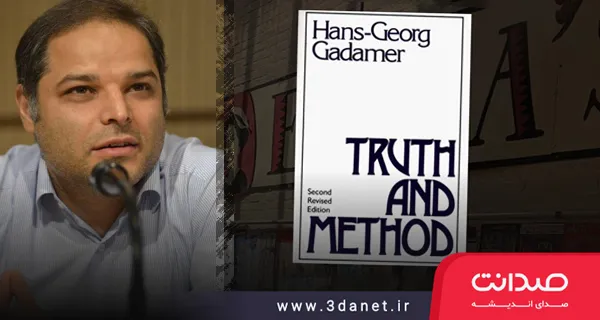
9) On page 76, it states: “... Gadamer had earlier noted in Truth and Method that the authority of a tradition has nothing to do with authoritarianism; rather, this authority rests on knowledge and reason, and tradition is, above all, a recognition of superiority.”
These sentences seem ambiguous, and perhaps Barthold’s (2012) explanations can clarify them: “... genuine authority always requires a kind of active recognition from others. Without this recognition, we do not achieve genuine authority, but rather a kind of passive submission arises, which leads to dictatorship.”[2]
10) On page 99, the word “هستیخداشناسی” (Ontotheology) appears without its status as a technical term being specified and without its German or French equivalent appearing in a footnote (with a space and not as a single unit).
11) On page 105, it states: “Gadamer’s first reaction betrayed his bewilderment. What provoked his reaction was that Derrida, by questioning concepts such as good will, conversation, and understanding, seemed to have even struck at the very root of the possibility of debate. As if Gadamer had tried in vain to show that his views had been repeated thousands of times throughout metaphysics ...”
It seems the last sentence has not been translated correctly, because in fact (according to the German text), Gadamer wants to show that his views have nothing to do with metaphysics.
12) On page 112, it states: “In particular, Gadamer believed that the discipline of epistemology should give way to hermeneutic thinking.” It seems this belief belongs to Rorty, not Gadamer.
13) On page 123, the word eschatologique is translated as “غایتنگری” (teleological view), whereas “فرجامشناسی” (eschatology) is a more appropriate equivalent because “غایتنگری” or “غایتشناسی” is the translation of the word Teleology and its derivatives.
14) The lack of an index, and particularly a subject index, is one of the shortcomings that afflicts many Persian books, including this one.
.
.
References
Davari Ardakani, Reza (2014), “Heidegger and the Opening of the Path of Future Thinking,” in the book Philosophy and the Crisis of the West, Tehran: Hermes
Barthold L.S. (2012), " Hans-Georg Gadamer (1900—2002)", The Internet Encyclopedia of Philosophy, ISSN 2161-0002, http://www.iep.utm.edu/gadamer/
Grondin, J. (2003), Hans-Georg Gadamer: A Biography, trans. Joel Weinsheimer, New Haven: Yale University Press.
[1] These errors are: the Latin title of Quintilian’s book (p. 11, line 24); “ibarat ast” instead of “ibarat ast az” (p. 18, line 8); “chirdeh-dasti” instead of “chireh-dasti” (p. 21, line 13); “bi-jood” instead of “bi-vojud” (p. 67, line 21).
[2] Perhaps the debates that have arisen in recent decades over Shariati’s “Ummah and Imamate” can be better understood in light of these explanations. Shariati emphasizes a kind of non-political authority accompanied by self-awareness, whereas his critics (like Gadamer’s critics) understand this authority as meaning dictatorship.
.
.
PDF file of Ali Pirhayati’s article titled “Hermeneutics as Conversation” from the Naqd va Nazar Quarterly
.
.
Hermeneutics as Conversation
Ali Pirhayati (PhD in Linguistics, University of Tehran)
.
.


Discussion0 comments
No comments yet; let yours be the first voice.